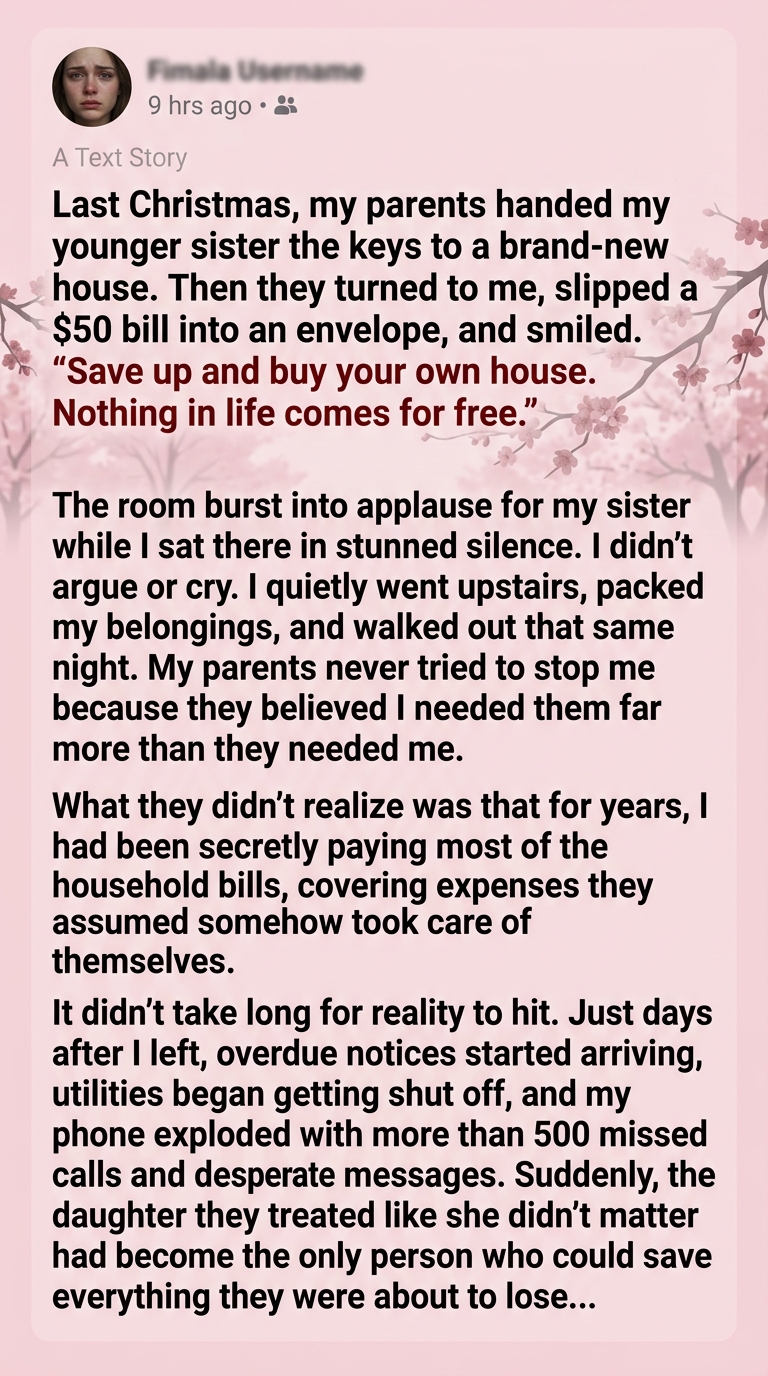
Last Christmas, my parents handed my younger sister the keys to a brand-new house.
Everyone screamed.
My sister, Emily, covered her mouth with both hands and started crying.
My mother hugged her.
My father smiled proudly.
“This is your fresh start,” he said.
Then he turned toward me.
For a second, I thought maybe there was another surprise.
There wasn’t.
He walked over, handed me a small white envelope, and smiled.
Inside was fifty dollars.
“Save up and buy your own house,” he said casually. “Nothing in life comes for free.”
The room went strangely quiet for half a second.
Then my aunt laughed.
Someone started clapping.
Soon, everyone was applauding for Emily again.
I looked at the keys in her hand.
Then I looked at the fifty-dollar bill in mine.
I didn’t argue.
I didn’t cry.
I simply smiled.
“Congratulations, Emily.”
My mother frowned.
“That’s all you have to say?”
I nodded.
“Yeah. I’m happy for her.”
Then I went upstairs.
I packed one suitcase.
A few clothes.
My laptop.
Some important documents.
The framed picture of my grandmother.
And nothing else.
I left my childhood home at 11:47 that night.
Nobody followed me.
Nobody asked where I was going.
My father didn’t even look up from his phone.
He thought I would come back.
They all did.
Because for years, my family had treated me like the responsible daughter who would always be there.
They just never realized how much “being there” actually cost me.
For almost six years, I had quietly paid most of the household bills.
The electricity.
The gas.
The internet.
The property taxes.
The home insurance.
The grocery delivery.
The medical insurance my parents couldn’t afford after my father’s retirement.
Even the car payment on my mother’s SUV.
I never told them how much I was paying.
Not because they asked me to keep it secret.
Because they never asked.
Every month, I transferred money into the family account.
I had convinced myself that was what family did.
When my parents said they were struggling, I helped.
When my sister needed tuition, I helped.
When the roof needed repairs, I helped.
When Dad’s business slowed down, I helped.
I never expected a reward.
I just expected that, someday, they would remember.
That Christmas night taught me something.
They didn’t.
So I stopped.
The next morning, I opened a new bank account.
I changed my address.
I canceled every automatic payment connected to my parents’ household.
And for the first time in years, I used my paycheck for myself.
I rented a small apartment.
It wasn’t fancy.
The kitchen was tiny.
The bedroom barely fit my bed.
But when I closed the door that first night, I felt something I hadn’t felt in years.
Peace.
For three days, nobody called me.
Then, on the fourth morning, my phone started buzzing.
Mom.
Dad.
Mom again.
Then Dad.
Then my sister.
I ignored them.
By lunchtime, I had 47 missed calls.
By dinner, there were 112.
The messages started becoming strange.
“Call me.”
“Something is wrong with the electricity.”
“Did you change something?”
“Why is the internet off?”
“Your father says you need to fix this.”
I stared at the screen.
I hadn’t done anything to them.
I had simply stopped paying.
The next morning, Dad called again.
I finally answered.
“What happened?” I asked.
His voice was angry.
“What did you do?”
“Nothing.”
“The electricity company says our account is overdue.”
“I know.”
“You need to call them.”
“No.”
Silence.
“What do you mean, no?”
“I mean it’s your account, Dad.”
He laughed bitterly.
“You’re being childish.”
I took a breath.
“Dad, I’ve been paying that account for five years.”
Another silence.
“You what?”
“I paid it.”
“You’re exaggerating.”
“I can send you the records.”
He hung up.
That afternoon, my mother called.
Her voice was softer.
“Sweetheart, your father is upset.”
“I understand.”
“You know how he gets.”
“I do.”
“We just need you to help us straighten this out.”
I looked around my tiny apartment.
For the first time, I understood the difference between being needed and being appreciated.
“Mom, I already helped.”
She started crying.
“You’re our daughter.”
“And you’re my parents.”
“Then why are you doing this?”
I swallowed hard.
“Because I finally realized being your daughter doesn’t mean I’m responsible for keeping your entire life running.”
She didn’t answer.
Three days later, their electricity was disconnected.
Then the internet.
Then their water service was scheduled for shutoff.
Their mortgage company sent a late-payment notice.
Their insurance company warned them the policy would lapse if the overdue amount wasn’t paid.
My father called me 38 times in one day.
My sister called 19 times.
My mother sent message after message.
“I don’t understand.”
“Please come home.”
“We need you.”
That last message stayed on my screen for a long time.
We need you.
Not:
We miss you.
Not:
We’re sorry.
Not:
How are you doing?
We need you.
I put my phone down.
That evening, I received a message from my sister.
“You knew this would happen, didn’t you?”
I stared at it.
Then I replied.
“Yes.”
She called immediately.
“How could you?”
I laughed softly.
“How could I what?”
“Let Mom and Dad suffer?”
“I didn’t make them suffer, Emily.”
“They’re going to lose the house!”
I paused.
“The house you were given?”
She went quiet.
“Yes.”
“Then why aren’t you paying for it?”
Silence.
“I don’t have that kind of money.”
“Neither did I.”
“But you always managed.”
“No.”
I looked out my apartment window.
“I always sacrificed.”
That was the first time my sister stopped arguing.
The next day, she came to see me.
She looked different.
No makeup.
No expensive coat.
No Christmas smile.
She sat on my couch and stared at the floor.
“Mom told me you paid the mortgage sometimes.”
“Sometimes?”
She looked embarrassed.
“I didn’t know.”
“You weren’t supposed to.”
“Why?”
“Because nobody ever wanted to know.”
She started crying.
“I thought they had everything under control.”
“They did.”
She looked at me.
“Until you left.”
I nodded.
Then she asked the question I’d been waiting years to hear.
“How much did you actually pay?”
I opened my laptop.
I showed her.
Mortgage payments.
Utilities.
Insurance.
Taxes.
Repairs.
Medical bills.
Groceries.
Over six years, I had paid more than $180,000.
Emily covered her mouth.
“Oh my God.”
I closed the laptop.
“I never wanted credit.”
“Then what did you want?”
I thought about Christmas night.
The envelope.
The fifty dollars.
My father’s smile.
“I wanted them to see me.”
My sister cried harder.
“I should have known.”
“You were a kid when this started.”
“I’m twenty-six.”
“You were still their favorite.”
She didn’t argue.
Instead, she whispered, “I’m sorry.”
I nodded.
“I know.”
“But what are we going to do?”
I looked at her.
“There’s something you don’t know.”
“What?”
“I didn’t just stop paying.”
She frowned.
“What do you mean?”
“I stopped covering everything months ago.”
Her eyes widened.
“Then how did they survive?”
“They didn’t.”
She stared at me.
I opened another folder.
Inside were copies of their bank statements.
Credit reports.
Loan documents.
And a letter from their mortgage company.
My father had been hiding debt for years.
Credit cards.
Personal loans.
A second mortgage.
Unpaid medical expenses.
And a business loan that had gone into default.
The money I’d been sending wasn’t making them wealthy.
It had been keeping them from collapsing.
Emily whispered, “How much do they owe?”
“Almost $240,000.”
She stared at the papers.
Then she looked at me.
“Why didn’t you tell me?”
“Because every time I tried, Mom said you were finally getting your chance.”
She lowered her head.
“I didn’t know.”
“I know.”
That evening, I went back to my parents’ house.
Not because they had demanded it.
Because I wanted to end the cycle.
My father opened the door.
He looked exhausted.
The house was dark.
The refrigerator was nearly empty.
My mother sat at the kitchen table with unpaid bills spread across it.
Neither of them spoke.
I placed a folder on the table.
Dad looked at it.
“What is that?”
“Everything I’ve paid over the last six years.”
He opened it.
Page after page.
Every transfer.
Every bill.
Every payment.
His face slowly changed.
He reached the final page.
The total was highlighted.
$183,742.16.
My mother covered her mouth.
My father sat down.
For several minutes, nobody spoke.
Finally, he whispered, “Why didn’t you tell us?”
I looked at him.
“Because I shouldn’t have had to.”
His eyes filled with tears.
“I thought you were doing fine.”
“I was.”
“Then why?”
“Because I loved you.”
My mother started crying.
“And we treated you like…”
She couldn’t finish.
I nodded.
“Like I didn’t matter.”
Dad lowered his head.
“I was proud of giving Emily that house.”
“I know.”
“I thought you understood.”
“I understood perfectly.”
He looked at me.
“That night, I thought you were jealous.”
“I wasn’t jealous.”
“Then why did you leave?”
I took a breath.
“Because I realized I had spent years helping build a family that didn’t know what I contributed.”
Nobody spoke.
Then Emily walked into the room.
She had been standing outside.
She placed the house keys on the table.
“I can’t keep this.”
Mom looked shocked.
“What?”
“The house.”
My father stood.
“Emily, that’s yours.”
“No.”
She looked at me.
“You gave me a house while she was paying for the one we already had.”
She shook her head.
“That doesn’t feel right.”
I immediately stopped her.
“Don’t give it back.”
Everyone looked at me.
“You don’t have to punish yourself for what they did.”
Emily wiped her eyes.
“Then what do I do?”
“Keep it.”
“Why?”
“Because maybe it’s the first thing our parents gave you without asking you to earn it.”
She stared at me.
“And what about them?”
I looked at my parents.
“They need to sell the house.”
My mother froze.
Dad nodded slowly.
He knew I was right.
They sold the house two months later.
They paid off the worst of their debt and moved into a smaller place they could actually afford.
My father went back to work part-time.
My mother started selling the homemade cakes she had always been good at making.
And I never became their automatic safety net again.
I still helped sometimes.
But now there were boundaries.
Clear ones.
No secret payments.
No hidden sacrifices.
No pretending everything was fine.
Six months later, my parents invited me to dinner.
My mother cooked my favorite meal.
My father put an envelope beside my plate.
I looked at it.
“What’s this?”
He smiled sadly.
“Open it.”
Inside was fifty dollars.
For a second, nobody spoke.
Then Dad laughed.
“I know.”
I smiled.
“You couldn’t resist?”
“No.”
He reached into his pocket and pulled out another envelope.
“This one is different.”
Inside was a handwritten letter.
It said:
You were never worth fifty dollars.
You were worth more than we knew how to say.
We’re sorry it took losing you for us to understand that.
I folded the letter carefully.
Then I looked at them.
“I don’t need you to repay me.”
Dad nodded.
“We know.”
“I don’t need the money.”
“We know.”
“What I need is for you to never forget what happened.”
My mother reached across the table and took my hand.
“We won’t.”
And for the first time in years, I believed her.
I didn’t save my family because they deserved it.
I didn’t leave because I hated them.
I left because I finally understood something that took me years to learn:
You can love your family without financing their lives.
And sometimes, the moment people realize they need you is the exact moment you finally learn that you don’t need their approval anymore.