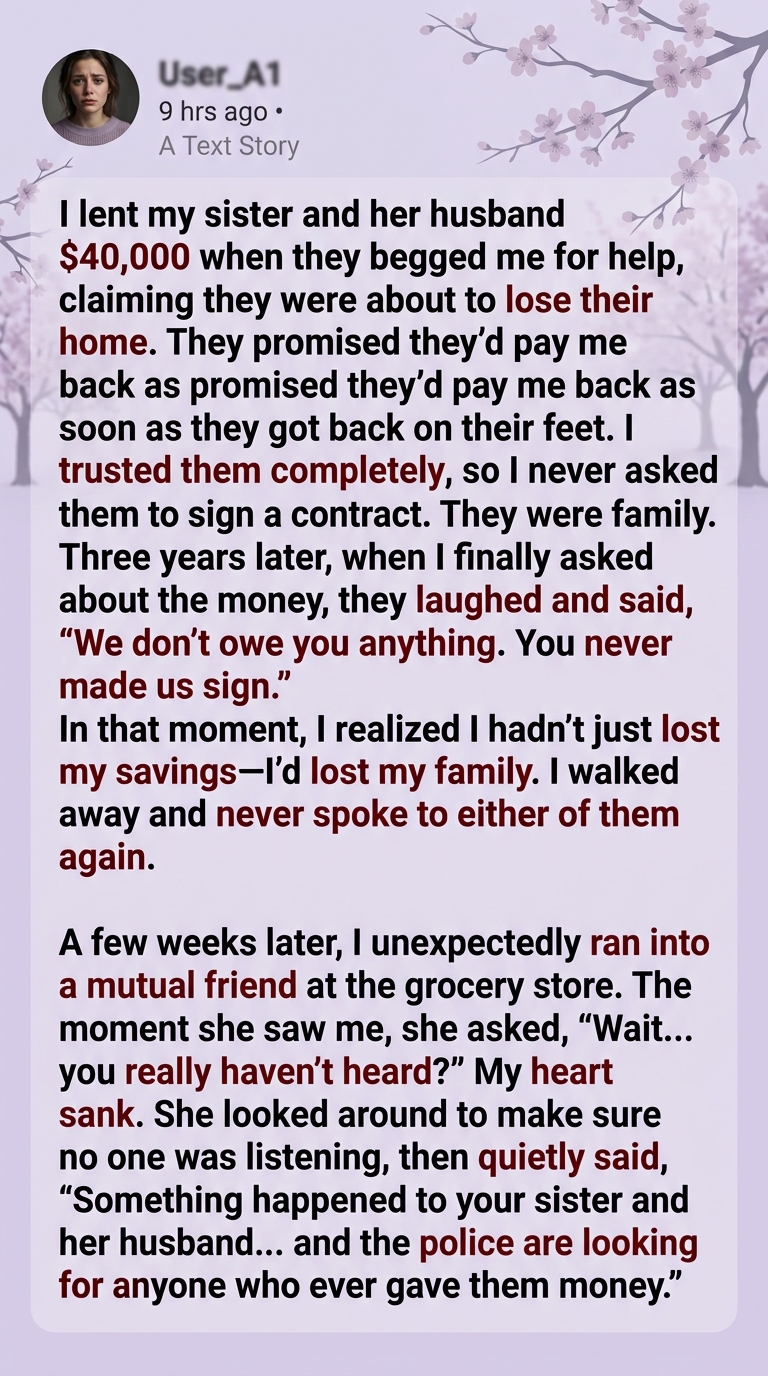
Three years ago, my sister called me crying.
“Please,” she said. “We’re going to lose the house.”
Her husband, Mark, had lost his job.
Their mortgage was behind.
Their car needed repairs.
They had two children.
And according to my sister, the bank had given them only thirty days to catch up.
I didn’t hesitate.
“How much do you need?”
She hesitated.
“Forty thousand.”
I nearly dropped the phone.
“Forty thousand dollars?”
“I know it’s a lot.”
She started crying.
“I wouldn’t ask if we had another option.”
I had savings.
Not enough to casually give away $40,000, but enough to help.
And she was my sister.
So I transferred the money the next morning.
Before I sent it, she promised me something.
“We’ll pay you back.”
“I know.”
“No, seriously. As soon as Mark gets another job, we’ll start making payments.”
I laughed.
“You don’t have to convince me.”
She said something I’ll never forget.
“You’re the only person who still believes in us.”
I believed her.
I didn’t ask for a contract.
I didn’t ask for collateral.
I didn’t even make her sign a piece of paper.
She was my sister.
Family didn’t need paperwork.
At least, that’s what I believed.
For the first few months, everything seemed fine.
Mark found another job.
My sister started working part-time.
Their children stayed in the same school.
They kept their house.
I thought the crisis had passed.
Then a year went by.
No payment.
I didn’t complain.
Another year.
Still nothing.
Whenever I brought it up, my sister had an excuse.
“Things are tighter than we expected.”
“Mark’s hours were cut.”
“The kids needed braces.”
“Can we talk about it later?”
I kept waiting.
Then three years passed.
One Saturday afternoon, I finally decided to ask.
I went to their house.
My sister opened the door.
She smiled.
“Hey.”
“Can we talk?”
“Sure.”
We sat at the kitchen table.
I looked at her.
“I need to ask about the $40,000.”
She looked confused.
“What $40,000?”
I stared at her.
“The money I lent you.”
Mark walked into the kitchen.
My sister looked at him.
Then they both laughed.
Not nervously.
Not awkwardly.
They actually laughed.
I felt something inside me crack.
My sister leaned back.
“You still think we owe you that?”
“Yes.”
Mark shook his head.
“You gave us money.”
“I lent you money.”
“Where’s the contract?”
I stared at him.
“What?”
“You never made us sign anything.”
My sister shrugged.
“You said it was family.”
I looked at her.
“I trusted you.”
“And that’s your problem.”
Those words destroyed something in me.
I stood up.
“I understand.”
My sister rolled her eyes.
“Don’t make this dramatic.”
I walked out.
I didn’t call them again.
I didn’t send another message.
I didn’t ask for the money.
I considered it gone.
Not because I accepted what they did.
Because I accepted that the people I thought were my family weren’t the people I believed them to be.
Three weeks later, I ran into an old family friend at the grocery store.
Her name was Karen.
The moment she saw me, she froze.
“Wait…”
“What?”
“You really haven’t heard?”
My stomach tightened.
“Heard what?”
She looked around.
Then lowered her voice.
“Something happened to your sister and Mark.”
My heart started pounding.
“What happened?”
“The police are looking for anyone who ever gave them money.”
I stared at her.
“Why?”
Karen swallowed.
“I don’t know how much I’m supposed to tell you.”
“Tell me everything.”
She looked around again.
“Your sister and Mark disappeared.”
“What?”
“They haven’t been home in days.”
I felt dizzy.
“Why are the police looking for people who gave them money?”
Karen shook her head.
“Because this isn’t about your $40,000.”
“What do you mean?”
She leaned closer.
“They’ve been running a scam.”
I couldn’t speak.
“What kind of scam?”
Karen told me what she knew.
For the past several years, my sister and Mark had been borrowing money from people using different stories.
Medical emergencies.
Business problems.
Mortgage crises.
Car accidents.
Legal fees.
They always promised to repay.
They rarely did.
I wasn’t the only one.
There were at least nine other people.
The amounts ranged from $5,000 to $75,000.
But that wasn’t the worst part.
The police believed they had been using some of the money to fund another operation.
I immediately thought of my $40,000.
“Did they use my money?”
Karen looked uncomfortable.
“I don’t know.”
The next morning, two detectives came to my apartment.
Detective Harris introduced himself.
His partner was Detective Morales.
They sat at my kitchen table.
Detective Harris opened a notebook.
“We need to ask you some questions about your sister.”
I nodded.
He asked when I gave her the money.
Why I gave it.
How I transferred it.
Whether she ever mentioned other financial problems.
Then he asked,
“Did she ever tell you what the money was for?”
“The house.”
He wrote that down.
“Did she show you any documents?”
“No.”
“Did you know the house wasn’t actually in her name?”
I froze.
“What?”
He looked at me.
“Your sister and her husband haven’t made a mortgage payment on that house in almost two years.”
My stomach dropped.
“But she told me my money saved it.”
“It didn’t.”
“Then where did my money go?”
The detective didn’t answer immediately.
Finally he said,
“We believe your $40,000 was transferred through several accounts.”
“Whose accounts?”
“Your sister’s.”
“Then?”
“Her husband’s.”
“Then?”
“A company registered under another name.”
I stared at him.
“What company?”
He slid a photograph across the table.
It was a building.
A small office.
The name on the sign was Harbor Financial Solutions.
I had never heard of it.
“They used this company to collect money from people,” he explained.
“For what?”
“They claimed to help families facing foreclosure.”
My blood ran cold.
“So they used my story too?”
“Possibly.”
“What do you mean?”
“They told victims they had inside access to mortgage lenders.”
“They said they could negotiate debt reductions.”
“They charged people large upfront fees.”
“And then?”
“They disappeared.”
I covered my face.
My sister had begged me for money because she claimed she was about to lose her home.
She had probably used the same story on strangers.
But the detective wasn’t finished.
“There is something else.”
He opened another file.
“We believe your sister didn’t start this.”
I looked at him.
“Then who did?”
“Her husband.”
I wasn’t surprised.
Mark had always been charming.
Always confident.
Always able to explain away problems.
But I had never imagined this.
“Your sister became involved gradually,” Detective Harris said.
“At first she believed the business was legitimate.”
“When did she know?”
“We’re still investigating.”
“Then why are they missing?”
The detectives exchanged a glance.
“We don’t know.”
That night, I couldn’t sleep.
At 2:17 a.m., my phone rang.
Unknown number.
I answered.
“Hello?”
A whisper came through.
“It’s me.”
My heart stopped.
“Sarah?”
My sister.
“Where are you?”
“I can’t tell you.”
“Are you safe?”
She started crying.
“I think so.”
“What happened?”
“I found something.”
“What?”
“Mark wasn’t just stealing money.”
My blood went cold.
“What do you mean?”
“He was using people’s identities.”
“For what?”
“Loans.”
“Credit cards.”
“Bank accounts.”
I sat up.
“What?”
“He had copies of people’s driver’s licenses, tax forms, bank statements…”
I remembered something.
Three years earlier, when I gave her the $40,000, she had asked me for a copy of my driver’s license.
She said the bank needed it because she was adding me as a guarantor.
I had sent it.
I felt sick.
“Sarah…”
“I’m sorry.”
“Did Mark use my identity?”
She didn’t answer.
That was answer enough.
“What did he do?”
“He opened an account using your information.”
I couldn’t breathe.
“For what?”
“To move money.”
I closed my eyes.
“Is that why the police are looking for me?”
“No.”
She cried.
“They know you were a victim.”
“Then why did you call me?”
“Because I need you to know I didn’t plan this.”
I was silent.
“I know I lied about the $40,000.”
“You didn’t just lie.”
“I know.”
“You stole it.”
“I know.”
“Why?”
She broke down.
“Because by the time I understood what Mark was doing, I was trapped.”
I didn’t say anything.
“He had recordings.”
“What kind?”
“Of me talking to people.”
“Why would that matter?”
“Because he threatened to send them to the police and tell them I was involved.”
“Were you?”
A long silence.
“Yes.”
My heart sank.
“But I didn’t know everything.”
I believed her enough to listen.
“Where are you?”
“I turned myself in.”
“What?”
“I’m at a police station.”
She had surrendered.
She had given detectives access to Mark’s records.
And she had agreed to cooperate.
“Where is Mark?”
“I don’t know.”
Two days later, police arrested him at a motel across the state line.
They found computers, stolen identities, forged documents, account information, and records of dozens of victims.
The investigation grew larger.
There were more victims than anyone initially knew.
And then Detective Harris called me.
“We found the record of your $40,000.”
My heart raced.
“Where did it go?”
He told me.
Part of it paid the mortgage.
Part went to Mark’s company.
And another portion was transferred to an account connected to a victim compensation scheme.
I stared at the phone.
“What does that mean?”
“It means your money was mixed with funds from other victims.”
“Can I get it back?”
“Eventually, some of it may be recovered.”
It wasn’t about the money anymore.
It was about the betrayal.
Months later, Sarah pleaded guilty to several financial crimes and agreed to cooperate with prosecutors.
Mark received a much longer sentence after investigators found evidence that he had organized the entire operation.
The house was eventually sold.
The proceeds were used to compensate victims.
I recovered part of my $40,000.
Not all of it.
But enough to close that chapter.
The strangest part came a year later.
Sarah wrote me a letter.
I almost threw it away.
Instead, I opened it.
She didn’t ask for forgiveness.
She didn’t ask for money.
She simply wrote:
You were the only person who helped us without asking what you’d get in return.
And we repaid you by making you one of the people we hurt.
I’ll carry that for the rest of my life.
I read the letter twice.
Then I put it away.
I still haven’t spoken to her.
Maybe someday I will.
Maybe I won’t.
But I’ve learned something I wish I had understood before.
Trust doesn’t make you foolish.
Trusting someone doesn’t make their betrayal your fault.
But love without boundaries can sometimes become an invitation for people to take more than you ever intended to give.
I thought I lost $40,000.
I thought I lost my sister.
But eventually, I realized something else.
The money wasn’t what I had really lost.
I had lost the version of my sister I thought existed.
And once I accepted that, I could finally stop trying to get her back.
Because sometimes the hardest part of walking away isn’t losing someone.
It’s accepting that the person you loved…
may never have been the person you thought you knew.