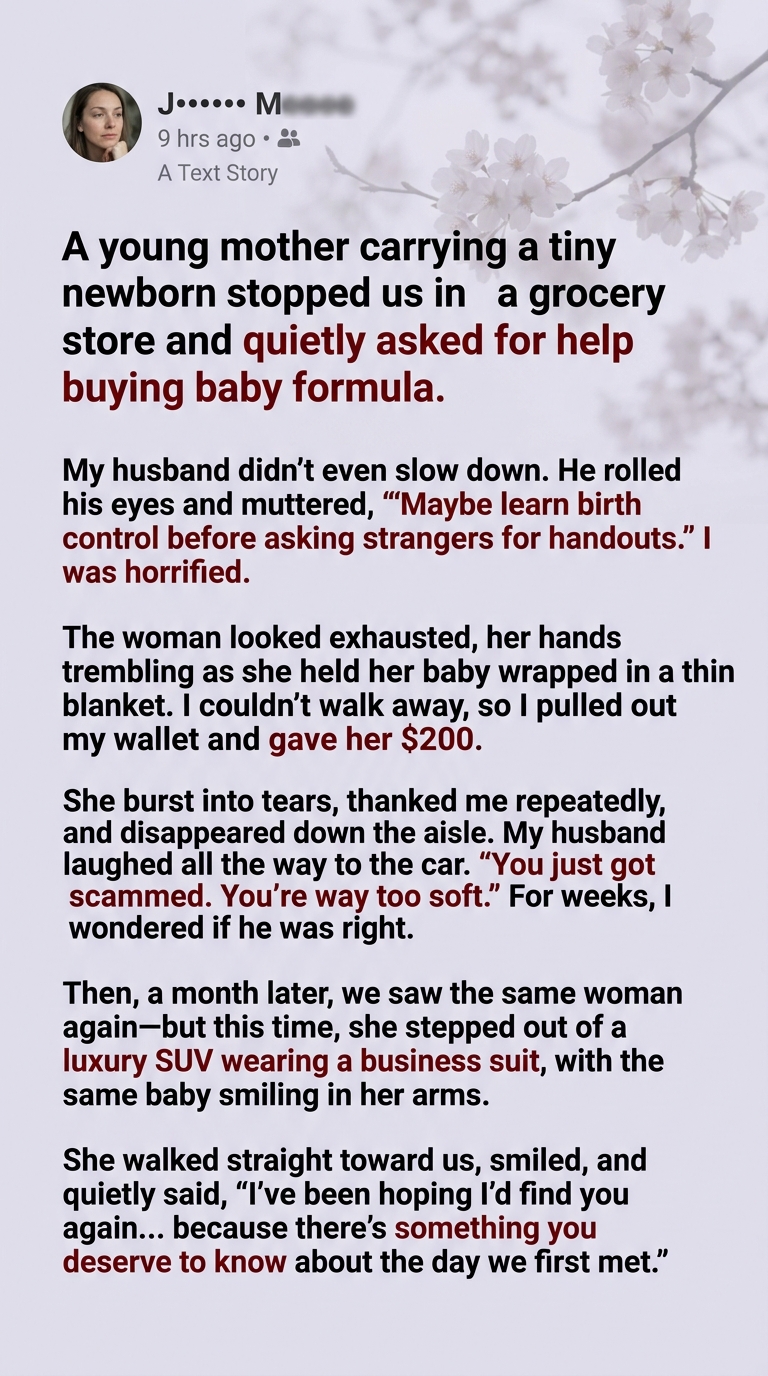
The first time I saw her, she was standing beside the baby formula aisle in a grocery store.
She looked exhausted.
Young.
Maybe twenty-three or twenty-four.
She was holding a tiny newborn wrapped in a thin blue blanket.
The baby’s face was barely visible.
The mother kept looking at the shelves, then at the price tags, then down at the baby.
Finally, she approached us.
“Excuse me,” she whispered.
My husband barely looked at her.
She swallowed.
“I’m sorry to bother you. I just need help buying formula. I’m a little short.”
My husband rolled his eyes.
Then he muttered loud enough for her to hear:
“Maybe learn birth control before asking strangers for handouts.”
The woman froze.
I felt my face burn.
“That’s enough,” I said.
My husband shrugged.
“What? I’m telling the truth.”
The young mother lowered her eyes.
“I’m sorry.”
She turned away.
I watched her walk back toward the shelf.
Her hands were trembling.
The baby made a tiny sound.
She immediately pulled the blanket tighter around him.
Something inside me broke.
I reached into my purse.
“Wait.”
She turned.
I pulled out my wallet and handed her two hundred dollars.
Her eyes widened.
“I can’t take this.”
“You can.”
“But—”
“Please.”
She stared at the money.
Then at me.
Tears filled her eyes.
“Thank you.”
She hugged the baby closer.
“I don’t know how to thank you.”
“You don’t have to.”
She nodded.
“Thank you.”
Then she disappeared down the aisle.
My husband laughed.
All the way to the car.
“You just got scammed.”
I buckled my seat belt.
“She needed formula.”
“Sure.”
“She had a newborn.”
“Exactly. Perfect setup.”
I stared out the window.
“You were cruel to her.”
He laughed again.
“You’re too soft.”
I didn’t answer.
For weeks, I thought about her.
I wondered if she had really needed the money.
I wondered whether my husband had been right.
Maybe I had been naive.
Maybe I had handed two hundred dollars to someone who didn’t need it.
But every time I remembered the baby’s tiny face, I knew I would do it again.
Then, exactly one month later, we were leaving the same grocery store.
My husband was complaining about traffic.
I was carrying the bags.
Then a black luxury SUV pulled into the parking lot.
A woman in a perfectly tailored business suit stepped out.
She was carrying a baby.
I almost walked past her.
Then I stopped.
The baby was older now.
Smiling.
And the woman looked familiar.
Very familiar.
She closed the SUV door.
Then looked directly at me.
Her eyes widened.
She smiled.
And started walking toward us.
My husband whispered:
“Do you know her?”
I couldn’t answer.
The woman stopped in front of us.
She looked at me.
Then at my husband.
Then back at me.
“I’ve been hoping I’d find you again.”
My husband shifted uncomfortably.
I stared at her.
“You’re…”
She nodded.
“The woman from the grocery store.”
My husband went silent.
She smiled.
“Yes.”
I looked at the baby.
“Is he okay?”
“He’s wonderful.”
She kissed his forehead.
Then she looked at me.
“I owe you an explanation.”
My husband crossed his arms.
“About what?”
She ignored him.
“About that day.”
She reached into her purse.
Pulled out a small envelope.
And handed it to me.
I opened it.
Inside was a receipt.
The receipt from that grocery store.
My $200 purchase.
But beneath it was another document.
A medical bill.
I looked at her.
“What is this?”
She took a breath.
“My son was born six weeks early.”
My eyes dropped to the baby.
“He spent nearly three weeks in the NICU.”
She continued.
“I was a single mother. My husband left before the baby was born.”
She swallowed.
“I had just started a new job. I had no family nearby. I was staying in a small apartment with almost nothing.”
I looked at the receipt again.
“The day you met me, I had twenty-three dollars left.”
My husband looked uncomfortable.
“The formula cost thirty-one.”
I remembered.
She had been eight dollars short.
“I had planned to walk away.”
She smiled sadly.
“Then you gave me two hundred.”
I shook my head.
“It was nothing.”
She immediately shook hers.
“No.”
Her voice became firm.
“It wasn’t nothing.”
She opened the envelope wider.
There was another photograph inside.
A photograph of the baby in a hospital bed.
Tiny.
Covered in wires.
My hand went to my mouth.
“He was readmitted two days later,” she said.
“I spent the money you gave me on formula, diapers, and transportation to the hospital.”
I looked at the photograph.
“He made it.”
She smiled.
“He did.”
Then she looked at my husband.
“And that money gave me enough breathing room to keep going.”
He didn’t say anything.
The woman took another envelope from her purse.
“This is why I’ve been trying to find you.”
She handed it to me.
Inside was a business card.
And a letter.
I read it.
Her name was Natalie.
She was the founder of a technology company.
I looked up.
“You own this company?”
She nodded.
“I started it six years ago.”
“Then why were you asking strangers for money?”
She smiled.
“Because being successful doesn’t mean you never run out of money.”
She explained that the company had been struggling with a major legal dispute.
Her personal accounts had been temporarily frozen because of the case.
Her paycheck was delayed.
Her son’s medical expenses had drained everything else.
She had looked successful on paper.
But that day, she couldn’t afford baby formula.
“People assume that if someone looks educated or successful, they couldn’t possibly need help.”
She glanced down at her son.
“Sometimes the person asking for help is simply having the worst week of their life.”
I nodded.
Then she said something that surprised me.
“You didn’t ask me for proof.”
“No.”
“You didn’t ask why I needed it.”
“No.”
“You didn’t make me explain myself.”
I looked at her.
“I just saw a mother who needed help.”
She smiled.
“That is exactly what I remember.”
My husband finally spoke.
“So what is this really about?”
Natalie looked at him.
“I’ll tell you.”
She turned back to me.
“Your wife gave me two hundred dollars.”
She paused.
“I want to give her two hundred thousand.”
My husband laughed.
“That’s ridiculous.”
Natalie didn’t smile.
“I’m not giving her charity.”
She pulled out another document.
“I’m offering her a position.”
I stared at the paper.
It was a formal offer from her company.
A leadership role.
I looked at her.
“Why me?”
“Because I’m building something.”
She glanced at her son.
“And I want people around me who understand that people aren’t numbers.”
I shook my head.
“I don’t know anything about your industry.”
“You don’t need to.”
“Then why?”
“Because I watched you help someone when you thought nobody was watching.”
I didn’t know what to say.
She continued.
“My company is launching a foundation to help struggling parents with emergency expenses.”
She smiled.
“I want you to help run it.”
My husband laughed again.
“She isn’t qualified.”
Natalie’s expression changed.
“She has something more important than a résumé.”
“What?”
“Character.”
The word hung in the air.
My husband looked away.
Natalie handed me another card.
“If you don’t want the job, that’s okay.”
She smiled.
“But I hope you’ll consider it.”
Then she turned to leave.
I stopped her.
“Wait.”
She looked back.
“Why did you really look for me?”
She smiled.
“Because my son is alive.”
She looked down at him.
“And one day, when he’s old enough to understand, I want to tell him that when his mother was scared and ashamed and didn’t know what she was going to do…”
Her eyes filled with tears.
“…one woman looked at her and saw a human being instead of a failure.”
I cried.
She reached over and hugged me.
My husband stood there silently.
Then she whispered:
“I wanted you to know what your kindness became.”
She walked back toward the SUV.
Before she got in, she turned around.
“Oh, and one more thing.”
“What?”
She smiled.
“The $200 never became $200,000.”
I frowned.
“What do you mean?”
She pointed at her son.
“It became him.”
Then she drove away.
I stood there for a long time.
My husband finally broke the silence.
“You really didn’t have to give her that money.”
I looked at him.
“Yes.”
He sighed.
“I still think people take advantage of kindness.”
“Sometimes they do.”
“So why keep doing it?”
I looked at the empty parking space where Natalie’s SUV had been.
“Because I don’t want someone else’s cruelty to decide who I become.”
He didn’t answer.
That night, I placed Natalie’s business card on the kitchen counter.
My husband looked at it.
“You’re really considering it?”
“Yes.”
“What if she expects too much?”
“Then I’ll work hard.”
“What if it doesn’t work out?”
“Then I’ll walk away.”
He stared at me.
“And if it does?”
I smiled.
“Then maybe that two hundred dollars gets to help someone else.”
Six months later, I accepted the position.
The foundation opened its first emergency assistance program.
The first application we received was from a young mother with a premature baby who couldn’t afford formula.
I stared at the application for a long time.
Then I smiled.
I approved it.
We eventually helped thousands of families.
Some needed diapers.
Some needed formula.
Some needed a hotel room because they’d lost their home.
Some needed a bus ticket to get to a hospital.
Some needed only enough money to make it through three terrible days.
And every time someone asked me why I had chosen that work, I told them the same story.
A young mother.
A newborn.
A grocery store.
Two hundred dollars.
And one sentence I never forgot:
“I just saw a mother who needed help.”
Years later, Natalie’s son grew into a happy little boy.
Every Christmas, he would send me a card.
The first one had a drawing of three people holding hands.
Me.
His mother.
And him.
At the bottom, in crooked handwriting, he wrote:
“Thank you for helping my mommy when she was sad.”
I kept that card.
Not because I wanted credit.
But because it reminded me of something my husband had forgotten.
Kindness isn’t a transaction.
You don’t help someone because you’re guaranteed a reward.
You help because, for a few minutes, you have the ability to make someone else’s burden lighter.
Sometimes that’s all.
And sometimes…
you never know how far that small kindness will travel.
My husband once told me I was too soft.
Maybe I was.
But years later, I realized something.
The world doesn’t always need us to be harder.
Sometimes it needs us to remain human.
And that day in the grocery store, I thought I had given a stranger two hundred dollars.
I was wrong.
She gave me something worth far more.
She reminded me that compassion is never wasted.
It simply changes hands.
And sometimes, years later, it comes back carrying a smiling baby in its arms.

