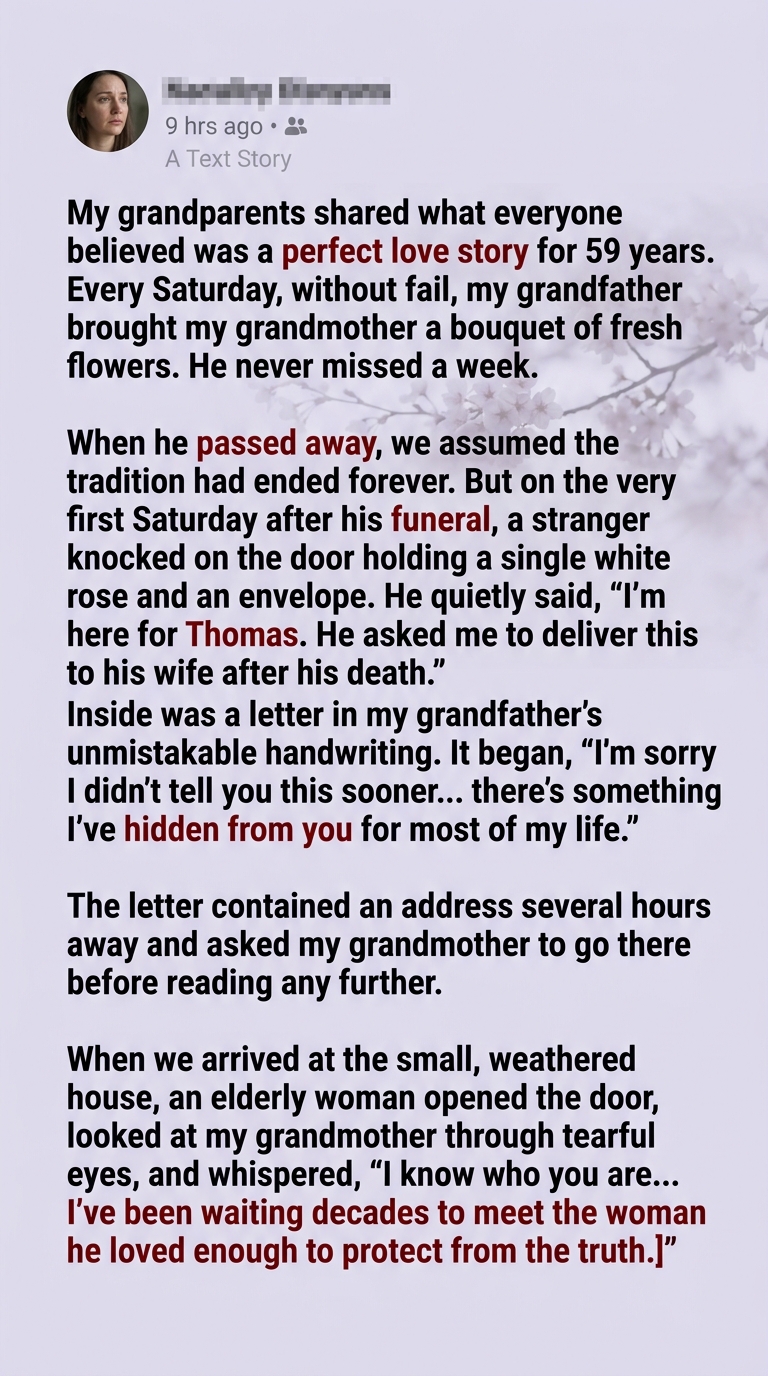
For fifty-nine years, my grandparents had what everyone called a perfect marriage.
My grandfather, Thomas, brought my grandmother, Eleanor, fresh flowers every Saturday.
It didn’t matter if it was raining, snowing, or so cold that the roads were nearly empty. He always came home with a bouquet.
Sometimes roses.
Sometimes tulips.
Sometimes cheap flowers wrapped in brown paper from the grocery store.
My grandmother never cared about the price.
She cared that he remembered.
Every Saturday morning, he would walk through the front door, kiss her cheek, and say, “For the prettiest girl in town.”
She would roll her eyes.
“Thomas, I’m eighty-two years old.”
“And I’m still trying to impress you.”
We all laughed when he said it.
Their love was the kind people wrote anniversary cards about.
They had raised three children, welcomed seven grandchildren, survived financial troubles, buried friends, and weathered illnesses that would have broken other families.
They disagreed, of course.
Grandpa left cupboard doors open.
Grandma insisted that nobody knew how to fold towels correctly.
He snored.
She stole the blankets.
But every Saturday, the flowers arrived.
When I was little, I once asked my grandfather why he never forgot.
He was sitting at the kitchen table, trimming the stems of a bouquet while Grandma made tea.
“Because promises are easy to make when you’re young,” he told me. “Keeping them when life gets difficult is what makes them mean something.”
I thought that was the whole lesson.
I had no idea he was carrying a secret that would change everything we believed about him.
Grandpa died on a Thursday morning.
He was eighty-four.
He passed peacefully in his sleep, with Grandma holding his hand.
At the funeral, she didn’t cry as much as I expected.
She sat very still, holding a photograph of the two of them on their wedding day.
After everyone left, I found her standing in the living room, staring at the empty vase on the windowsill.
“Grandma?”
She touched the rim of the vase.
“Saturday is coming.”
I didn’t understand.
Then she whispered, “For fifty-nine years, Saturday has always meant flowers.”
I put my arms around her.
“I’ll buy you flowers.”
She smiled sadly.
“That isn’t quite the same, sweetheart.”
She was right.
The first Saturday after Grandpa’s funeral arrived with a gray sky and cold wind.
I drove to Grandma’s house early, bringing coffee and breakfast.
She was sitting in her favorite chair when the doorbell rang.
I opened the door.
An elderly man stood on the porch.
He wore a dark overcoat and held a single white rose in one hand and a cream-colored envelope in the other.
“Good morning,” he said.
“Can I help you?”
“I’m looking for Eleanor.”
My grandmother slowly stood behind me.
“I’m Eleanor.”
The stranger looked at her for a long moment.
Then he lowered his head.
“I’m sorry for your loss.”
He held out the rose.
“I’m here for Thomas. He asked me to deliver this to his wife after his death.”
Grandma’s hand flew to her mouth.
“What did you say?”
The man offered her the envelope.
“Your husband left very specific instructions. He asked me to come on the first Saturday after his funeral, bring a white rose, and make sure you received this personally.”
Grandma took the envelope.
Her hands trembled so badly that I had to help her sit down.
The stranger introduced himself as Arthur.
He said he’d known Grandpa for decades, although he didn’t explain how.
Before leaving, he gave Grandma one final message.
“He asked me to tell you that the truth was never meant to diminish your marriage. He hoped it would help you understand something he couldn’t explain while he was alive.”
Then Arthur walked away.
Grandma stared at the envelope.
Her name was written on the front in Grandpa’s familiar handwriting.
Inside was a folded letter.
She began reading aloud.
My dearest Eleanor,
If you are reading this, then I’ve broken my promise to grow old enough to tell you everything myself.
Grandma stopped.
She pressed the letter to her chest.
Then she continued.
For fifty-nine years, you have been my wife, my home, and the greatest blessing of my life.
There is nothing I regret about choosing you.
But there is something I should have told you long ago.
Before you read the rest of this letter, I need you to visit the address enclosed in this envelope.
Please go before you decide what you think of me.
The woman who lives there has waited a very long time.
She deserves to meet you.
And you deserve to know why I kept her existence from you.
I love you, Eleanor.
I always have.
Thomas.
Grandma lowered the letter.
For the first time since Grandpa’s death, she began to cry uncontrollably.
“He kept something from me?”
I sat beside her.
“Maybe there’s an explanation.”
She looked at me.
“Fifty-nine years, sweetheart. Fifty-nine years. What could a man possibly hide for that long?”
I didn’t have an answer.
The address was several hours away, in a small town neither of us had visited.
Grandma insisted we leave that afternoon.
I offered to drive.
She carried the white rose in her lap the entire journey.
We passed fields, small towns, and stretches of empty road.
Every so often, she would unfold Grandpa’s letter and read it again.
Once, she whispered, “I thought I knew every part of him.”
I reached for her hand.
“You knew the part that loved you.”
She stared out the window.
“Perhaps. But I need to know the rest.”
We arrived just before sunset.
The address led to a small, weathered house at the end of a quiet road.
The paint was peeling.
The porch sagged slightly.
A garden filled with winter-dried flowers surrounded the front steps.
I helped Grandma out of the car.
Before we could knock, the front door opened.
An elderly woman stood there.
She had silver hair, a thin face, and eyes that immediately filled with tears.
She looked at Grandma.
Then she whispered,
“I know who you are.”
Grandma gripped my arm.
The woman stepped onto the porch.
“I’ve been waiting decades to meet the woman he loved enough to protect from the truth.”
Grandma’s face went pale.
“Who are you?”
The woman closed her eyes briefly.
“My name is Margaret.”
She looked toward the road, as though she expected someone else to appear.
Then she stepped aside.
“Please. Come in.”
Inside, the house smelled of lavender and old books.
A small fireplace stood against one wall.
On the mantel were photographs.
One showed a young man in a military uniform.
Another showed a woman holding a newborn baby.
And another—
Grandma stopped breathing.
It was Grandpa.
He looked about twenty years old.
He was standing beside Margaret, smiling at the camera.
Grandma stared at the photograph.
“When was this taken?”
Margaret sat down slowly.
“1944.”
Grandma shook her head.
“That isn’t possible. Thomas was born in 1941.”
“I know.”
“Then he was only three years old.”
Margaret looked confused.
“No, dear. The photograph is older than that. Your Thomas wasn’t the man in this picture.”
She reached for another photograph.
“This was his father.”
Grandma stared at the image.
The resemblance was unmistakable.
The same eyes.
The same smile.
The same slightly crooked nose.
Margaret placed the photograph on the table.
“His name was William.”
Grandma sank into a chair.
“William was Thomas’s father?”
Margaret nodded.
“He was my husband.”
The room went silent.
Margaret continued.
“William and I married very young. We had a little boy. Thomas.”
Grandma looked at the photograph again.
“Your husband was my grandfather’s father.”
“Yes.”
“But why did Grandpa tell me to come here?”
Margaret took a shaky breath.
“Because Thomas wasn’t just the boy I lost when I was young. He was also the boy I failed.”
Grandma stared at her.
Margaret explained that she had married William during the final years of the war.
William had been sent overseas, leaving her alone with their infant son.
When he returned, he was ill and struggling to recover from what he’d experienced.
The family was poor.
Margaret was overwhelmed.
And when Thomas was only four, she made a decision she would regret for the rest of her life.
She left.
Not because she didn’t love him.
Because she was young, frightened, and convinced that someone else could give him a better life.
William’s sister agreed to raise him.
Margaret moved to another town, believing she would eventually return.
But William died a few years later.
And his sister refused to let Margaret back into Thomas’s life.
“She told me he’d forgotten me,” Margaret whispered. “She said he was happy. She said I would only hurt him by coming back.”
Grandma’s eyes filled with tears.
“So you never saw him again?”
Margaret shook her head.
“Not until he was a grown man.”
She reached for a small wooden box.
Inside were letters.
Dozens of them.
Some had been opened.
Others were still sealed.
“I wrote to him for years. Most were returned. Eventually, I stopped sending them. I didn’t want to keep hurting him.”
Grandma picked up one of the letters.
It was addressed to Thomas.
The handwriting was careful and old-fashioned.
“Did he know you were alive?”
Margaret nodded.
“Yes. He found me in 1975.”
Grandma looked up sharply.
“1975?”
Margaret nodded.
“He came here one afternoon. He was thirty-four years old. He stood on the porch for nearly ten minutes before knocking.”
Her voice trembled.
“He looked exactly like his father.”
Grandma covered her mouth.
“What happened?”
Margaret smiled sadly.
“He asked me one question.”
“What question?”
“Why?”
The old woman looked down at her hands.
“I told him the truth. I told him I was afraid. I told him I had convinced myself he would be better off without me.”
She wiped her eyes.
“He was angry. He had every right to be. He told me he’d spent his childhood believing his mother didn’t want him.”
Grandma looked at the photographs.
“And did he forgive you?”
“Not that day.”
Margaret smiled faintly.
“But he came back.”
She explained that Thomas had visited her several times over the next few years.
At first, their conversations were awkward.
He asked about his childhood.
She asked about his life.
He told her about his work, his friends, and eventually, the woman he planned to marry.
Margaret had asked to meet Eleanor.
Thomas refused.
Not because he was ashamed of Grandma.
Because he was afraid.
“He told me you had given up your inheritance to marry him,” Margaret said.
Grandma looked down.
“He knew that?”
“Yes. He said you’d sacrificed so much for him already. He didn’t want his past to become another burden you had to carry.”
Margaret took a breath.
“He said you deserved to know him as the man he had become, not as the little boy whose mother had left him.”
Grandma began crying.
“He should have told me.”
“Yes,” Margaret said softly. “He should have.”
The honesty of that answer seemed to surprise Grandma.
Margaret continued.
“But Thomas was afraid that if you knew about me, you would wonder whether there were other parts of his life he had hidden.”
Grandma looked at her.
“Were there?”
Margaret shook her head.
“No. He was a good man. He loved you deeply. He simply carried an old wound that never completely healed.”
She reached into the box and removed a final letter.
“This is the one he asked me to keep for you.”
Grandma opened it.
It was written in Grandpa’s handwriting.
My dearest Eleanor,
I met Margaret again when I was thirty-four.
I was angry with her. I wanted answers. I wanted to understand why my mother had chosen a life without me.
But when I finally sat across from her, I saw a frightened woman who had made a terrible decision and spent the rest of her life regretting it.
I didn’t forgive her all at once.
Forgiveness took years.
And even after I forgave her, I couldn’t bring myself to introduce her to you.
I was ashamed that the woman who gave me life had once walked away from it.
I was afraid you’d look at me differently.
You had already given up so much to marry me. I couldn’t bear the thought of losing the respect you had for me.
I know now that I was wrong to keep this from you.
You deserved the truth.
But please understand this: Margaret was my mother, and I eventually found peace with her. You were my wife, and you were the person I chose to share my life with.
Those were two different kinds of love.
Neither one erased the other.
Grandma stopped reading.
She stared at the paper.
Then she whispered,
“He thought I would love him less.”
Margaret nodded.
“He told me that more than once.”
Grandma pressed the letter to her heart.
“I would never have loved him less.”
“I know,” Margaret said. “I know that now.”
For a long time, no one spoke.
Then Grandma looked at Margaret.
“Did he visit you every Saturday?”
Margaret blinked.
“What?”
“The flowers. He brought me flowers every Saturday for fifty-nine years.”
Margaret’s eyes filled with tears.
“Yes.”
Grandma looked confused.
“How do you know?”
Margaret smiled through her tears.
“Because he brought me flowers too.”
Grandma stared at her.
“Every Saturday?”
“Not every Saturday. He couldn’t always come here. But when he did, he brought a single white rose.”
She looked at the flower Grandma had carried into the house.
“He told me white roses meant forgiveness.”
Grandma closed her eyes.
For fifty-nine years, she had believed the Saturday flowers were a promise between husband and wife.
Now she understood that Grandpa had used the same tradition to heal another relationship he had once thought impossible to repair.
He had loved two women in different ways.
One had raised him.
The other had built a life with him.
And he had spent decades trying to make peace with the first without hurting the second.
Grandma looked at Margaret.
“Did he love you?”
Margaret nodded.
“He did.”
“Did he love me?”
Margaret reached across the table.
“More than anything.”
Grandma took her hand.
Then, after a moment, she said,
“I wish he had trusted me enough to tell me.”
Margaret nodded.
“So do I.”
We stayed until evening.
Before we left, Margaret gave Grandma a small envelope.
Inside was a photograph of Grandpa as a young boy, sitting on his mother’s lap.
On the back, in faded ink, were the words:
My son, my heart, my greatest regret.
Grandma held the photograph against her chest.
“I spent fifty-nine years thinking I knew every secret he had.”
Margaret smiled sadly.
“Perhaps you knew the most important thing.”
“What?”
“That he loved you.”
The drive home was quiet.
Grandma held the white rose in one hand and the photograph in the other.
When we reached her house, she placed the rose in the empty vase on the windowsill.
Then she took out her phone.
She called our family group.
“Everyone needs to come over tomorrow,” she said.
“Why?” I asked.
She smiled.
“Because I have a story to tell you about your grandfather.”
The next day, the entire family gathered around her kitchen table.
Grandma told them everything.
Some cried.
Some were surprised.
My uncle was angry that Grandpa had kept the truth hidden.
My aunt wondered why he had carried so much guilt for so long.
Grandma listened to them all.
Then she said,
“Your grandfather made a mistake. He should have trusted me with the truth.”
She paused.
“But he also spent fifty-nine years showing me that he loved me.”
She looked at the vase.
“I won’t let one secret erase fifty-nine years of kindness.”
From that day forward, our family visited Margaret regularly.
She became part of our lives.
She came to birthdays.
She sat beside Grandma at Christmas.
And every Saturday, she and Grandma placed flowers in separate vases.
One for the man they had both loved.
One for the years they could never get back.
Grandma never pretended the secret hadn’t hurt her.
Sometimes she still cried when she thought about the years Grandpa had spent keeping two parts of his life separate.
But she also began to understand that people could make painful choices out of fear, shame, and love all at once.
And that forgiveness didn’t mean pretending the hurt had never happened.
It meant deciding what to do with the truth once it finally arrived.
Years later, when Grandma was asked about the perfect love story she had shared with Grandpa, she always smiled.
“Perfect?” she’d say. “No. We were two imperfect people who kept choosing each other.”
Then she would look toward the vase on the windowsill.
“And sometimes, love is not about having no secrets.”
She would pause.
“It’s about having the courage to tell the truth before time runs out.”
For fifty-nine years, my grandfather brought my grandmother flowers.
After his death, he left her one final gift: the truth, and the chance to love the whole man—not just the parts she had known.

