The Little Girl Who Apologized for Everything
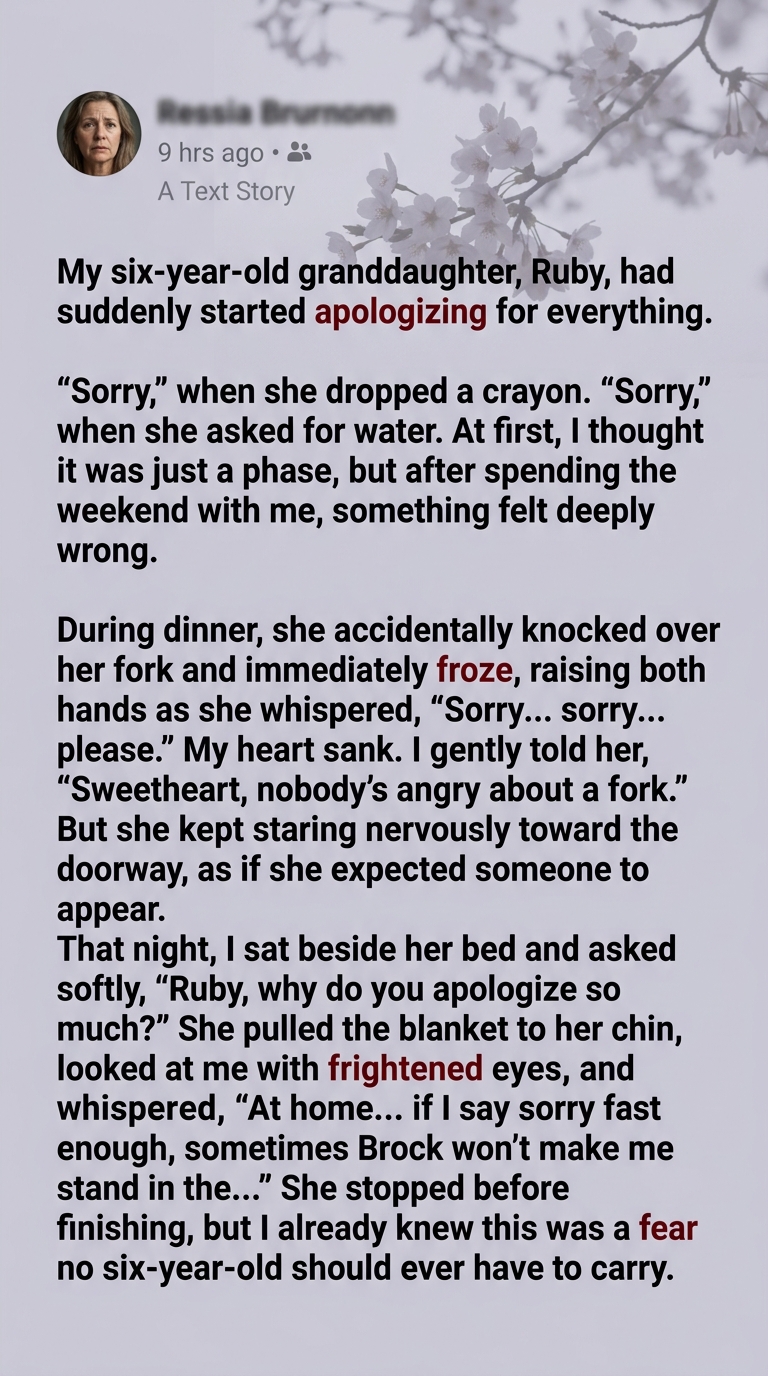
My six-year-old granddaughter, Ruby, had suddenly started apologizing for everything.
“Sorry,” when she dropped a crayon.
“Sorry,” when she asked for water.
“Sorry,” when she laughed too loudly at a cartoon.
At first, I thought it was just a phase. Children sometimes develop strange habits, and Ruby had always been a sensitive little girl.
But after spending the weekend with me, something felt deeply wrong.
During dinner, she accidentally knocked over her fork. It clattered against the floor, barely making a sound.
Ruby immediately froze.
She raised both hands to shoulder height and stared toward the doorway.
“Sorry,” she whispered. “Sorry… please.”
My heart sank.
“Sweetheart,” I said gently, “nobody’s angry about a fork.”
She didn’t move.
I picked up the fork, washed it, and gave her another one. I expected her to smile and continue eating.
Instead, she kept glancing toward the doorway, as though she were waiting for someone to appear.
That night, I tucked her into bed. She had brought her favorite stuffed rabbit, which she’d named Mr. Buttons, and placed it carefully beside her pillow.
I sat on the edge of the mattress and brushed a strand of hair away from her face.
“Ruby, can Grandma ask you something?”
She nodded.
“Why do you say sorry so much, sweetheart?”
Her fingers tightened around the rabbit.
For a moment, I thought she wouldn’t answer.
Then she pulled the blanket up to her chin and whispered, “At home… if I say sorry fast enough, sometimes Brock won’t make me stand in the…”
She stopped.
Her eyes filled with tears.
I kept my voice calm, even though something cold was spreading through my chest.
“Stand where, darling?”
Ruby shook her head.
“I can’t tell you.”
“Are you afraid something bad will happen if you tell me?”
She looked at the bedroom door.
Then she nodded.
I took her small hand in mine.
“You are not in trouble. You haven’t done anything wrong. And you can tell Grandma anything.”
Her lips trembled.
“He says I make Mommy tired. He says I’m naughty even when I’m trying to be good.”
“Who says that, sweetheart?”
“Brock.”
Brock was my daughter’s husband.
He had entered our family three years earlier, after my daughter, Emily, met him through a mutual friend. In public, he was charming, confident, and always ready with a compliment. He remembered birthdays, carried groceries for elderly neighbors, and called me “Mom” with a smile that made everyone believe he adored our family.
I’d never been completely comfortable around him, but I had dismissed my uneasiness as the protectiveness of a mother who struggled to accept that her daughter had grown up.
Now I looked at my six-year-old granddaughter, trembling beneath a blanket, and understood that I had been asking the wrong question.
I’d been wondering whether Brock liked me.
I should have been wondering whether Ruby felt safe in her own home.
I squeezed her hand gently.
“Ruby, you don’t have to tell me everything tonight. But I need you to know something important.”
She watched me carefully.
“You never have to earn love by being perfect. And nobody has the right to frighten you into being quiet.”
A tear rolled down her cheek.
Then she whispered six words that changed everything.
“Grandma, please don’t send me back.”
I leaned forward and kissed her forehead.
“I hear you, sweetheart.”
And I meant it.
I didn’t yet know everything that had happened in that house. But I knew I would not ignore what this child was trying so desperately to tell me.
The Secret Behind the Door
I stayed beside Ruby until she fell asleep.
Even then, she clutched my hand so tightly that I could barely move without waking her.
Every few minutes, she stirred and murmured, “I’m sorry.”
Once, she sat upright in bed, eyes wide with fear.
“I’m being good,” she whispered to someone who wasn’t there.
I held her gently and reassured her that she was safe in my house.
When she finally settled, I went downstairs and sat at the kitchen table.
My daughter, Emily, had called earlier that evening to check on Ruby. She’d sounded distracted, explaining that Brock had been stressed at work and that things at home had been difficult lately.
I picked up my phone and almost called her.
But I stopped.
I was frightened that if I confronted her without understanding the situation, she might immediately tell Brock what Ruby had said. I didn’t know how he would react, and I wasn’t willing to take a chance with my granddaughter’s safety.
Instead, I wrote down Ruby’s exact words while they were still fresh in my mind.
I recorded the date, what had happened at dinner, and what she had told me before bed.
I didn’t question her further or ask her to repeat anything. She had already shown me how afraid she was.
The next morning, Ruby sat at the breakfast table drawing a picture.
She had drawn a yellow house with a red roof. A little girl stood in the garden beside a woman with gray hair.
Above the woman, Ruby had written a large, uneven word:
GRANDMA.
I smiled.
“Is that us?”
She nodded.
“What’s the little girl doing?”
“She’s visiting you.”
“And is she happy?”
Ruby looked at the drawing for a long time.
“She can breathe here.”
My smile faded.
I sat beside her.
“What do you mean, sweetheart?”
Ruby picked up a blue crayon.
“At home, I have to be quiet. Brock says children should be seen and not heard. If I forget, he makes me stand in the pantry with the light off.”
My hands went cold.
“How long do you have to stand there?”
“Until he says I can come out.”
“Does Mommy know?”
Ruby’s face changed.
“Please don’t tell him I told you.”
“I won’t discuss this with him, sweetheart. My job is to help keep you safe.”
She stared at her drawing.
“Sometimes Mommy says he’s just strict. She says I need to listen better.”
I took a slow breath.
“Ruby, you can make mistakes. You can spill things, ask questions, cry, laugh, and be a child. None of those things makes you bad.”
She leaned against me.
For a moment, she let herself be six years old.
Then the doorbell rang.
Ruby dropped her crayon.
Her whole body stiffened.
“Is it him?” she whispered.
I looked through the window.
My daughter stood on the porch.
Alone.
When I opened the door, Emily smiled brightly.
“Morning, Mom! I came to pick up my little girl.”
Behind me, Ruby had gone completely silent.
And when Emily stepped inside, my granddaughter moved behind my legs and whispered:
“Grandma, please don’t let him take me.”
A Mother’s Blind Spot
I asked Emily to sit down while Ruby watched cartoons in the living room.
My daughter looked tired. There were shadows beneath her eyes, and she kept checking her phone.
“Is everything all right?” I asked.
She gave a quick laugh.
“Of course. Why wouldn’t it be?”
I studied her face.
“How has Ruby been sleeping?”
Emily sighed.
“Terribly. She’s become so sensitive lately. She cries over everything. Brock says she needs firmer boundaries.”
“And what do you think?”
Emily hesitated.
“I think he means well. He’s just trying to teach her discipline.”
I folded my hands on the table.
“Emily, did you know Ruby is afraid of making mistakes?”
Her expression shifted.
“She can be dramatic.”
“She is six.”
“I know how old my daughter is, Mom.”
The sharpness in her voice surprised me.
I lowered mine.
“I’m not criticizing you. I’m worried about her.”
Emily looked toward the living room.
“Brock says she’s learned that crying gets her attention. He says I’m making things worse by comforting her every time she gets upset.”
I felt a deep sadness settle over me.
My daughter had always been a loving mother. She read bedtime stories in silly voices, packed little notes into Ruby’s lunchbox, and spent hours helping her build elaborate castles from cardboard boxes.
But after marrying Brock, she had begun second-guessing herself.
She apologized when he interrupted her. She laughed at jokes that embarrassed her. She often asked him whether she was remembering things correctly.
I’d noticed those changes and told myself every marriage had difficult seasons.
Now I wondered how much of Emily’s confidence had been worn away while I stood on the sidelines.
“Has Brock ever locked Ruby in a room as punishment?” I asked.
Emily’s face went pale.
“Why would you ask me that?”
“Because Ruby told me she is sometimes made to stand in a dark pantry.”
Emily stood abruptly.
“She shouldn’t have told you that.”
The words came out before she seemed to realize what she’d said.
I stared at her.
“Emily.”
She pressed her fingers against her forehead.
“It’s not like you’re imagining. Brock doesn’t hit her. He just thinks children need to learn consequences.”
“Being frightened in the dark isn’t a healthy consequence.”
“You don’t understand how difficult things have been. Brock works hard, and Ruby pushes him. She doesn’t listen. She makes messes. She—”
“She is six,” I repeated.
Emily’s eyes filled with tears, but she looked away.
“He says I’m too soft. He says I let her manipulate me.”
I reached across the table.
“Sweetheart, do you believe that?”
She didn’t answer.
I took her hand.
“You don’t have to defend him to me. I want to understand what is happening.”
For a moment, Emily looked like the little girl who used to come to me after a nightmare, asking me to check beneath her bed.
Then her phone buzzed.
She looked at the screen, and the fear in her expression was unmistakable.
“It’s Brock,” she whispered.
She answered.
“Yes, I’m at Mom’s.”
A pause.
“No, I haven’t brought Ruby home yet.”
Another pause.
Emily’s shoulders tightened.
“Because I wanted to see her.”
She listened silently.
Then she said, “I’m sorry.”
She hung up and stared at the table.
“What did he say?” I asked.
“Nothing.”
“Emily.”
“He said I was making him look like a bad father.”
I leaned forward.
“Is he?”
She began to cry.
And for the first time, I realized that Ruby might not be the only person in that house who had learned to apologize out of fear.
The Decision I Couldn’t Delay
I didn’t tell Emily what to do with her marriage that morning.
I didn’t demand that she leave Brock, and I didn’t threaten to expose him.
Instead, I told her what I had observed and what Ruby had said. I made it clear that I would not send Ruby back into a situation where she was frightened, and that I wanted professional help to determine how best to protect her.
Emily initially insisted that I was overreacting.
But when I described Ruby raising her hands after dropping a fork, my daughter covered her mouth.
“I didn’t know it was that bad,” she whispered.
“Have you ever seen her do that before?”
Emily nodded slowly.
“Sometimes she apologizes before Brock even says anything. I thought she was trying to avoid getting into trouble.”
“Does he frighten you when he’s angry?”
She looked at me.
For a long time, she said nothing.
Then she whispered, “Sometimes.”
I felt my heart break for both of them.
Emily explained that Brock had gradually taken control of many decisions in their home. He criticized her parenting, complained about her friends, and insisted that he knew what was best for Ruby. When she disagreed, he accused her of disrespecting him.
He never behaved that way in front of other people.
At family gatherings, he was attentive and charming. He told funny stories, carried Ruby on his shoulders, and praised Emily for being a wonderful mother.
Behind closed doors, the rules changed.
Emily had begun keeping the peace by agreeing with him, even when she felt uncomfortable.
“I kept telling myself he would calm down,” she said. “I thought if I supported him more, he’d stop getting so angry.”
I squeezed her hand.
“You are not responsible for making another adult choose kindness.”
She wiped her face.
“What do we do?”
That was the question I had been waiting for.
I explained that I had not yet spoken to anyone outside the family, but I believed we needed professional guidance immediately. We agreed to contact a child-protection professional and a family support service to discuss Ruby’s disclosure and determine the safest next steps.
I also arranged for Ruby to remain with me while we sought that advice.
We were careful not to confront Brock or alert him to our plans before receiving guidance on safety.
Emily was frightened. I was frightened too.
But we had stopped pretending that everything was normal.
That afternoon, Ruby played in my garden, chasing bubbles across the grass. She laughed when one landed on her nose.
Then she stopped.
“Sorry,” she said automatically.
I knelt beside her.
“What are you sorry for, sweetheart?”
She looked confused.
“I laughed too loud.”
I gently brushed the bubble from her nose.
“You’re allowed to laugh.”
She looked at me, searching my face for a sign that I was joking.
Then she laughed again.
This time, she didn’t apologize.
The Night Brock Came Looking
At seven that evening, someone began pounding on my front door.
Emily was upstairs with Ruby.
I looked through the window and saw Brock standing on the porch.
His face was flushed, and his phone was clenched in one hand.
I did not open the door.
“Where is my daughter?” he shouted.
I kept my voice steady.
“Ruby is safe.”
“She belongs at home. Emily is supposed to bring her back.”
“We’re getting advice about what Ruby has told us. We need to make sure she is safe.”
His expression hardened.
“So a six-year-old tells a little story, and you decide I’m some kind of monster?”
I didn’t argue with him.
“I’m not discussing this on the doorstep.”
He struck the door with the palm of his hand.
“Open it!”
I stepped away and contacted the appropriate authorities for help. I followed their guidance rather than attempting to manage the confrontation myself.
Brock continued shouting for several minutes. He called me interfering, accused Emily of turning against him, and demanded that Ruby come outside.
Then, suddenly, he changed his tone.
“Ruby!” he called through the door. “Daddy’s here. Come on, sweetheart. Let’s go home.”
From upstairs, I heard a small, frightened voice.
“Grandma?”
I turned toward the stairs.
“I’m here, sweetheart.”
Brock heard her too.
“Ruby, tell your grandmother you’re coming home.”
There was silence.
Then Ruby whispered, “I don’t want to.”
The words were quiet, but they seemed to change everything.
Brock stopped shouting.
When he spoke again, his voice was cold.
“Ruby, you know what happens when you don’t listen.”
I felt every muscle in my body tighten.
I didn’t respond to him. I went upstairs and sat beside Ruby while the authorities handled the situation outside.
She was trembling so hard that her stuffed rabbit shook in her arms.
“Am I in trouble?” she whispered.
“No, sweetheart.”
“Because I told?”
I took her hands.
“You did the right thing by telling someone you trust.”
She began to cry.
I held her while she sobbed into my shoulder.
Downstairs, the noise eventually stopped. Brock left before the situation escalated further, and we followed the guidance we were given about keeping the home secure and avoiding further direct contact.
That night, Ruby slept beside me.
She woke twice, but each time I reassured her that she was safe and that the adults were working to help.
At one point, she whispered, “Grandma, will he be angry tomorrow?”
I brushed her hair back.
“I can’t promise how another person will feel. But I can promise that you don’t have to handle his anger alone.”
She considered that for a moment.
Then she curled against me and fell asleep.
I stayed awake long after she did, thinking about how much courage it had taken for a six-year-old to say those words.
And how many adults had failed to notice her fear until she finally found the strength to explain it.
What the Investigation Revealed
Over the following days, Ruby was supported by professionals trained to speak with children about safety and possible mistreatment.
We were careful not to repeatedly question her or suggest answers. The people helping us knew how to listen without making her feel responsible for proving what had happened.
As they gathered information, a troubling pattern emerged.
Ruby had been subjected to frightening punishments, including being shut in the dark pantry for extended periods. She had also been repeatedly told that ordinary childhood mistakes meant she was bad, selfish, or unlovable.
There was no single dramatic incident that explained everything.
It was the accumulation of small, terrifying moments.
A spilled drink.
A forgotten toy.
A question asked at the wrong time.
Each time, Ruby had learned to watch Brock’s face and guess what he wanted before he said it.
Her apologies weren’t simply manners.
They were a survival strategy.
Professionals also spoke with Emily about the atmosphere in the home and the ways Brock had undermined her confidence. They helped her understand that a person could appear loving and reasonable in public while behaving very differently in private.
Emily struggled with guilt.
“I should have seen it,” she told me one afternoon.
I sat beside her on the sofa.
“You saw pieces of it. He made you doubt what you saw.”
“But she’s my child.”
“And now you’re listening to her. That’s what matters next.”
She covered her face.
“I thought keeping the family together was the best thing I could do.”
I held her.
“Keeping a family together isn’t the same as keeping a child safe.”
The authorities took the concerns seriously and worked through the appropriate process. Contact and living arrangements were handled according to professional guidance and the relevant legal decisions.
Brock was not allowed to simply walk into my house and demand Ruby be returned. Any future arrangements would be considered through the proper channels, with Ruby’s safety at the center.
For the first time, Emily began making decisions without asking Brock’s permission.
She contacted people she had stopped seeing. She spoke privately with a counselor. She began learning to recognize the difference between a disagreement and intimidation.
It wasn’t easy.
There were moments when she questioned herself and wondered whether she had misunderstood things.
But whenever doubt returned, she remembered the sound of Ruby whispering, “Please don’t let him take me.”
That was the moment she knew she could no longer pretend.
The Apology Ruby Never Needed to Make
A few weeks later, Ruby came home from school with a paper crown she had made in class.
She rushed into the kitchen and placed it on my head.
“You’re the queen of cookies!” she announced.
I laughed.
“Am I? Then I command you to eat a cookie.”
She giggled, took one from the plate, and bit into it.
A crumb fell onto the floor.
Ruby froze.
Her smile disappeared.
“I’m sorry,” she whispered.
I crouched beside her.
“Did you hurt anyone?”
She shook her head.
“Did you break anything?”
Another shake.
“Then what do you need to do?”
She looked down at the crumb.
“Clean it up?”
“Exactly.”
We fetched a little brush and swept it away together.
When we finished, I held out my hand.
“Now what?”
Ruby thought for a moment.
“Can I have another cookie?”
I smiled.
“Absolutely.”
She took one, then climbed into my lap.
“Grandma?”
“Yes, sweetheart?”
“If I make a mistake, do you still love me?”
The question struck me so deeply that I had to pause before answering.
I turned her toward me so she could see my face.
“Ruby, listen carefully. You never have to be perfect for me to love you. You don’t have to be quiet all the time. You don’t have to guess what everyone wants. You can be upset, you can ask for help, and you can make mistakes.”
She watched my lips as I spoke, as though memorizing every word.
“Even if I spill my milk?”
“Even then.”
“Even if I break a cup?”
“Even then.”
“Even if I’m angry?”
“Even then.”
Her eyes filled with tears.
“Even if I say no?”
I hugged her close.
“Especially then. Your feelings matter, and you are allowed to tell a trusted adult when something feels wrong.”
She rested her head against my chest.
“I think I want to be a normal kid again.”
I kissed her forehead.
“You already are, sweetheart. You were never the problem.”
Learning to Feel Safe
Healing didn’t happen overnight.
Ruby still apologized sometimes. She startled at sudden noises and occasionally asked whether she was allowed to play with a toy that was already hers.
Her counselor explained that these habits could take time to fade. Ruby needed patience, consistency, and the freedom to express herself without fear.
We built small routines.
She chose what to wear in the morning.
She helped decide what we’d eat for dinner.
If she spilled something, we cleaned it up together.
If she became upset, I listened before offering advice.
And every night, I asked the same question.
“What was something you liked about today?”
At first, Ruby gave tiny answers.
“My sandwich.”
“The blue crayon.”
“The dog we saw.”
Gradually, her answers grew.
“That I made a big tower.”
“That I asked a question in class.”
“That I told my friend I didn’t want to play that game.”
One evening, she said, “I liked that I laughed really loud, and nobody told me to stop.”
I smiled.
“That sounds like a wonderful day.”
Emily also began rebuilding her life. She worked with her counselor and the professionals supporting the family to establish boundaries and make decisions that prioritized Ruby’s well-being.
She didn’t become confident in a single afternoon. Sometimes she cried because she missed the future she’d imagined with Brock. Sometimes she blamed herself for not understanding sooner.
But she began to recognize that loving someone didn’t mean accepting everything they did.
One Saturday, she joined Ruby and me in the garden.
Ruby was painting small stones, making each one a different color.
She handed her mother a bright yellow stone.
“This one is for you, Mommy.”
Emily held it carefully.
“Why yellow?”
“Because yellow is happy.”
Emily’s eyes filled with tears.
“Thank you, baby.”
Ruby looked at her.
“You’re not mad?”
Emily knelt and shook her head.
“No, sweetheart. I’m happy you made it for me.”
Ruby smiled and returned to her painting.
Emily watched her for a long time.
Then she whispered to me, “I thought I was protecting my family by keeping everything calm.”
I put my arm around her.
“Sometimes the bravest thing a mother can do is admit that something isn’t safe and ask for help.”
She nodded.
For the first time in months, she looked as though she believed it.
The Picture on the Refrigerator
Six months later, Ruby drew another picture.
This time, it showed a yellow house with a red roof. Three figures stood in the garden: Ruby, Emily, and me.
Above them, she had written:
WE ARE SAFE.
She brought it to me after breakfast.
“Can we put it on the refrigerator?”
“Of course.”
I found a magnet and fixed it beside the grocery list.
Ruby stood back and admired her work.
Then she looked at me.
“Grandma?”
“Yes?”
“I don’t think I need to say sorry all the time anymore.”
I smiled gently.
“You can still say sorry when you mean it. Everyone makes mistakes sometimes. But you don’t have to apologize just for being here.”
She nodded thoughtfully.
Then she ran outside to play.
I stood in the kitchen, looking at the picture.
There were still difficult days ahead. The adults would continue working through the necessary arrangements, and Ruby would need ongoing support as she grew.
But something important had changed.
She was no longer alone with her fear.
She had learned that telling the truth didn’t make her bad. She had learned that adults could be trusted to listen. And she was beginning to understand that love did not have to be earned through silence.
As for me, I learned a lesson I wished I’d understood sooner.
Sometimes the warning signs aren’t loud.
Sometimes they’re hidden inside a child’s repeated apologies, a sudden flinch, or the way she looks at a doorway before she answers a question.
Sometimes the bravest thing a child can do is whisper the truth.
And the most important thing an adult can do is believe that the whisper deserves to be heard.
One evening, as I tucked Ruby into bed, she wrapped her arms around my neck.
“Goodnight, Grandma.”
“Goodnight, sweetheart.”
She paused.
“I love you.”
“I love you too.”
She settled beneath the blanket, hugged Mr. Buttons, and closed her eyes.
For the first time in a long while, she didn’t look toward the doorway.
She didn’t ask whether she’d been good enough.
She simply fell asleep.
And I sat beside her for a few minutes, listening to the quiet breathing of a child who was finally beginning to feel safe.
A child should never have to apologize for being a child. Sometimes, the smallest voice in the room is the one asking us to be brave enough to protect it.

