The Secret My Husband Kept for Our Daughter
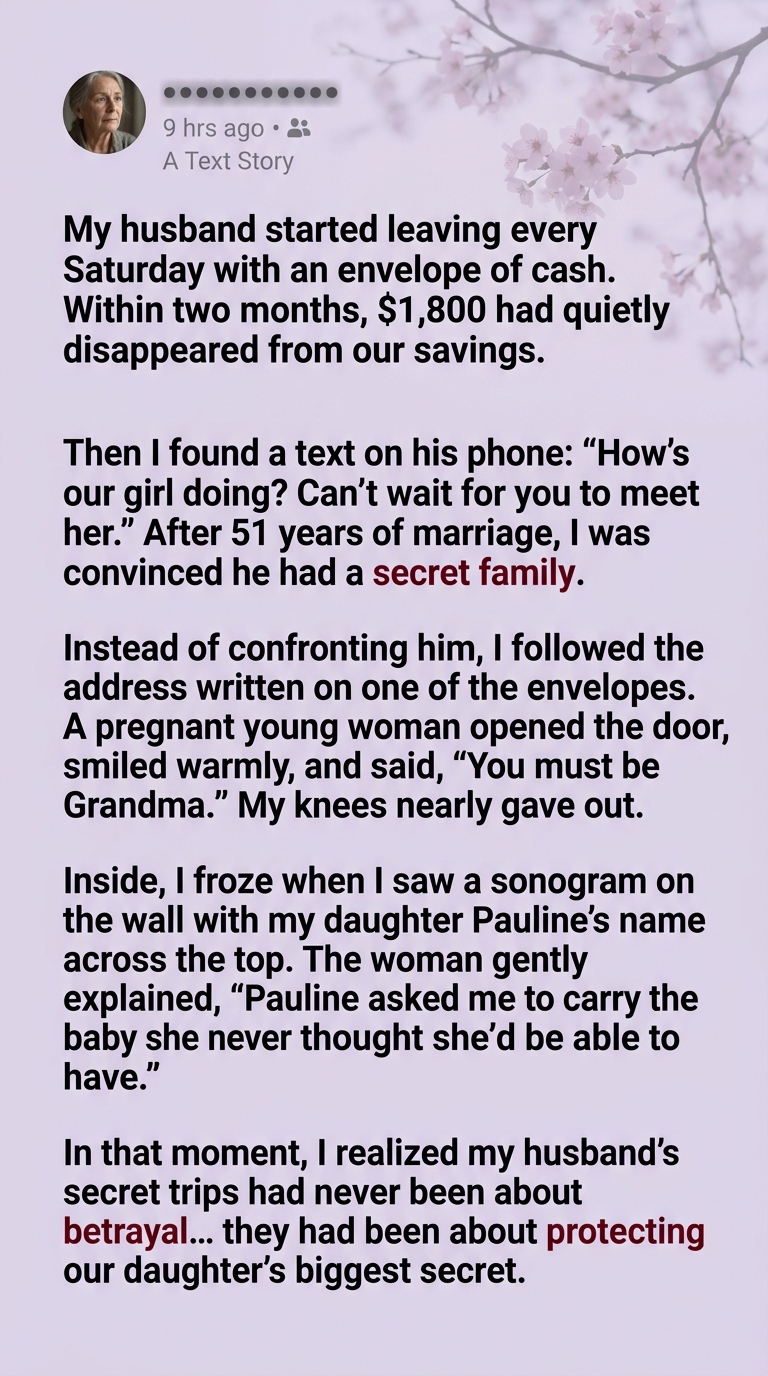
My husband started leaving every Saturday with an envelope of cash.
At first, I barely noticed. After fifty-one years of marriage, Harold and I had developed our own routines. He went to the hardware store on Saturday mornings, bought his favorite newspaper, and occasionally visited an old friend.
But these trips were different.
He dressed carefully, checked his phone several times, and tucked a thick envelope into his coat pocket before leaving. When he returned, he seemed distracted, as though his mind were somewhere else.
Within two months, $1,800 had quietly disappeared from our savings.
Then I found a text on his phone.
“How’s our girl doing? Can’t wait for you to meet her.”
After fifty-one years of marriage, I was convinced my husband had a secret family.
I sat at the kitchen table, staring at those words until they blurred. Our daughter, Pauline, was forty-six. She lived two hours away with her husband, Michael, and had always been the center of our world.
Who was this other girl?
And why was Harold spending our savings on someone he had never mentioned?
I wanted to wake him and demand an explanation. Instead, I remembered the address written on one of the envelopes I’d found in his coat pocket.
The next Saturday, I followed him.
I watched him drive to a quiet neighborhood on the other side of town. He parked in front of a small white house with flower boxes beneath the windows and a yellow rocking chair on the porch.
He walked to the door carrying his envelope.
A few moments later, a young woman opened it.
She was heavily pregnant.
I waited in my car, my heart pounding, until Harold disappeared inside.
Then I crossed the lawn and knocked.
The woman opened the door again.
She looked at me for a moment, then smiled warmly.
“You must be Grandma.”
My knees nearly gave out.
“Grandma?” I repeated.
She stepped aside.
“Please, come in. I’ve heard so much about you.”
I walked into the living room and froze.
A sonogram was pinned to the wall above a small table. Across the top, in bold letters, was our daughter Pauline’s name.
The young woman gently touched my arm.
“Pauline asked me to carry the baby she never thought she’d be able to have.”
In that moment, I realized my husband’s secret trips had never been about betrayal.
They had been about protecting our daughter’s biggest secret.
But as I stared at the sonogram, another question rose in my mind.
If this baby belonged to Pauline, why had my husband kept the truth from me?
And what else had my daughter been carrying alone?
The Woman Named Grace
The young woman introduced herself as Grace Miller.
She offered me a glass of water and helped me sit down, clearly concerned by how pale I’d become.
“I’m sorry,” she said. “I probably should have called before you came.”
I could barely hear her over the pounding in my ears.
“How long have you known my husband?”
“About eight months.”
“Eight months?”
She nodded.
“He’s been helping me with the appointments and expenses. Pauline wanted everything to remain private until we knew the pregnancy was going well.”
I looked toward the sonogram again.
“Why would my daughter need a surrogate?”
Grace’s smile softened.
“Pauline can explain that better than I can. But I can tell you that she and Michael have wanted a child for a very long time.”
I knew that much.
For years, Pauline had smiled through family gatherings while other relatives announced pregnancies. She had attended baby showers, bought gifts, and held other people’s newborns with a tenderness that sometimes made me ache for her.
Whenever I asked whether she and Michael planned to have children, she would say, “We’re still figuring things out, Mom.”
I had accepted the answer because I didn’t want to pressure her.
But I had never understood how much pain might have been hidden behind it.
Grace led me toward the kitchen.
There were baby clothes folded in a basket, a stack of medical appointment cards, and a notebook filled with dates and instructions.
On the refrigerator was a photograph of Pauline and Michael standing beside Grace in a clinic waiting room.
All three were smiling.
Harold stood at the edge of the picture, one hand resting on Pauline’s shoulder.
He looked happier than I’d seen him in months.
“Your husband has been wonderful,” Grace said. “He never makes me feel like I’m just carrying a baby for someone else. He asks how I’m feeling, whether I’m sleeping, and whether I need anything.”
I swallowed hard.
“Why didn’t he tell me?”
Grace looked uncomfortable.
“Pauline asked him not to.”
The answer stung more than I expected.
My husband had shared this enormous secret with another woman, and our daughter had trusted him to keep it from me.
After fifty-one years of marriage, I had imagined that there was nothing important we couldn’t tell each other.
Apparently, I had been wrong.
I stood and looked at the sonogram one more time.
“When is the baby due?”
“Six weeks from Monday.”
I placed a hand over my mouth.
Six weeks.
In six weeks, our family would welcome a baby, and I had nearly discovered the truth by accident after convincing myself my husband was having an affair.
Grace walked me to the door.
“Please don’t be angry with Pauline,” she said softly. “She wasn’t trying to hurt you.”
I wanted to tell her I wasn’t angry.
But the truth was that I was angry, frightened, confused, and heartbroken all at once.
“I need to speak to my husband,” I said.
Grace nodded.
“I understand.”
I returned to my car and sat behind the steering wheel for several minutes.
Then I drove home.
For the first time in fifty-one years, I had no idea what to say to Harold.
The Conversation at Our Kitchen Table
Harold arrived home at four thirty that afternoon.
He walked into the kitchen, set down his keys, and stopped when he saw me sitting at the table.
A cup of untouched tea sat in front of me.
He looked at my face.
“You followed me.”
It wasn’t a question.
“Yes.”
He slowly pulled out the chair opposite me.
“Did you meet Grace?”
“I did.”
He closed his eyes.
For several seconds, neither of us spoke.
Then I asked the question that had been burning inside me since I read the text.
“Why didn’t you tell me?”
Harold looked down at his hands.
“Because Pauline asked me not to.”
“And you agreed?”
“Yes.”
“You’ve spent eight months helping another woman carry our grandchild while I sat at home wondering where you were going every Saturday.”
His face tightened.
“I know.”
“You let me think you were hiding an affair.”
“I never imagined you’d think that.”
“Then what did you imagine? That I wouldn’t notice eighteen hundred dollars missing from our savings?”
He rubbed his forehead.
“I was going to explain.”
“When?”
He didn’t answer.
I felt tears rising.
“Harold, we’ve been married for fifty-one years. We’ve survived unemployment, your father’s funeral, my surgery, and the years when Pauline struggled in school. We have never been perfect, but we’ve always told each other the truth.”
“I know.”
“Then why did you make me feel like a stranger in my own marriage?”
He looked at me, and for the first time, I saw tears in his eyes.
“Because I promised our daughter.”
I sat back.
He took a deep breath.
“Pauline and Michael tried for years to have a baby. They went through treatments, tests, and more disappointment than either of them should have had to endure. Eventually, the doctors explained that carrying a pregnancy herself would be dangerous for Pauline.”
I felt the anger inside me soften, replaced by a deep, aching sadness.
Harold continued.
“She was devastated. She told me she felt as though her body had betrayed her. She worried that Michael would eventually resent her, even though he kept telling her that he loved her and wanted a life with her, whether they had children or not.”
I looked away.
I remembered Pauline’s quietness after certain family dinners. I remembered how she would excuse herself when someone announced a pregnancy.
I had mistaken her silence for contentment.
“What happened next?” I whispered.
“Pauline and Michael began exploring surrogacy. It took time to find someone they trusted. Then they met Grace.”
“And she agreed to carry their baby?”
“Yes. Grace had already been through the process of learning about surrogacy and wanted to help a family. Everyone involved had medical and legal support.”
He paused.
“Pauline told me before she told anyone else. She was frightened. She asked me to help her through the appointments and keep things private until the pregnancy was further along.”
I stared at him.
“Why you? Why not both of us?”
Harold’s expression crumpled.
“Because she was afraid you’d blame yourself.”
“Blame myself for what?”
“For asking questions. For wanting grandchildren. For every time you mentioned how lovely it would be to have a little one running around the house.”
My heart ached.
I had said those things innocently. I had never intended to make Pauline feel inadequate.
But I could suddenly imagine how my words might have sounded to someone who wanted a child more than anything and feared she might never have one.
Harold reached across the table.
“She needed time, Margaret. I thought I was helping her by giving her that time.”
I looked at his hand but didn’t take it.
“You could have told me that something important was happening without telling me every detail.”
“I know.”
“You could have said our daughter was struggling and needed privacy.”
“I know.”
“You didn’t have to make me suspect you were being unfaithful.”
His eyes filled.
“No. I didn’t.”
For a long time, we sat in silence.
Then I asked, “What else don’t I know?”
Harold looked at me.
“Nothing that concerns our marriage. I promise you that.”
I wanted to believe him immediately.
But trust, once shaken, doesn’t always return just because someone finally tells the truth.
I stood and took my tea to the sink.
“I need some time.”
He nodded.
“I understand.”
That night, we slept in the same bed, but I lay facing the window.
Harold didn’t try to touch me.
And for the first time in fifty-one years, I wasn’t sure whether the silence between us was protecting someone we loved or keeping us apart.
The Secret Pauline Had Carried
The next morning, Pauline called.
“Mom?”
Her voice was cautious.
“Dad said you know.”
I closed my eyes.
“Yes, sweetheart. I know about Grace.”
There was a long pause.
“Are you angry with me?”
The question broke my heart.
“I’m confused,” I said honestly. “And I wish you had told me. But I’m not angry that you’re having a baby.”
Pauline began to cry.
“I wanted to tell you. I really did.”
“Then why didn’t you?”
She took a shaky breath.
“Because every time I tried, I imagined having to explain all the years when it didn’t happen. I imagined you looking at me differently.”
“Differently how?”
“Like I was broken.”
I gripped the phone.
“Oh, Pauline.”
“I know you love me, Mom. But I didn’t want to see pity in your eyes. I didn’t want to be the daughter who couldn’t give you a grandchild.”
I sat down slowly.
“You have never owed me a grandchild.”
“I know that now. But I didn’t always know it.”
Her voice cracked.
“Every time someone asked when we were having children, I felt like I had failed at something everyone else could do. I smiled because I didn’t want anyone to know how much it hurt.”
I remembered the family gatherings. The baby showers. The Christmas cards featuring smiling grandchildren.
I remembered Pauline bringing gifts and helping other mothers with their babies.
I had thought she was being generous.
I hadn’t understood that she might have been grieving.
“Why did you tell Dad before me?” I asked.
“Because he found me crying one night. I told him about the appointments and how scared I was. He didn’t try to fix everything. He just sat with me.”
I pressed my hand against my chest.
“I wish I had been there.”
“I know.”
“I’m your mother. You can tell me when you’re hurting.”
“I was afraid you would try to make me feel better before I was ready to talk.”
That answer hurt because I recognized myself in it.
I had spent much of my life trying to solve problems for the people I loved. Sometimes I offered reassurance when what they needed was simply a person willing to sit beside them in their sadness.
“I can’t promise I’ll always say the perfect thing,” I told her. “But I can promise I’ll listen.”
Pauline cried quietly.
Then she asked, “Can you forgive Dad for keeping the secret?”
I glanced toward the kitchen, where Harold was sitting alone with his newspaper.
“I’m trying to understand why he did it. I also need him to understand how much it hurt me.”
“That’s fair.”
“Pauline, I want to ask you something.”
“Anything.”
“Do you want me to be part of this baby’s life?”
There was no hesitation.
“More than anything.”
I covered my mouth as tears spilled down my cheeks.
“Then I want to be there too.”
Pauline let out a trembling breath.
“Really?”
“Yes, sweetheart. Really.”
We spoke for another twenty minutes. She told me about the nursery, the appointments, and the little yellow blanket she had already bought for the baby.
For the first time, I allowed myself to imagine holding my grandchild.
But when we hung up, I knew there was one more conversation I needed to have.
Not with Pauline.
With my husband.
The Envelope in His Drawer
Two days later, I found Harold sitting in his study with a small stack of envelopes.
He looked up when I entered.
“Can we talk?” I asked.
He put the envelopes aside.
“Of course.”
I sat opposite him.
“I’ve been thinking about what Pauline said.”
He nodded.
“She was frightened. I understand that.”
“So do I. But I also understand that you were frightened on her behalf, and you decided to handle everything yourself.”
He looked down.
“I thought it was the right thing to do.”
“I believe you thought you were protecting her. But you forgot that I was part of the family you were protecting.”
He swallowed.
“You’re right.”
I hadn’t expected him to agree so quickly.
He continued.
“I kept telling myself that once the pregnancy was further along, once the doctors were confident, once Pauline felt ready, I’d tell you. Every week, there was another reason to wait.”
“And every week, I was left wondering what you were hiding.”
He nodded.
“I should have told you that Pauline needed privacy. I didn’t need to tell you about Grace or the medical details. But I should never have let you believe there was something wrong with our marriage.”
I felt some of the tension leave my shoulders.
“Why did you use our savings without asking?”
He reached for one of the envelopes.
“I wasn’t trying to hide the amount from you. I was taking cash because Grace had some expenses that needed to be paid directly, and Pauline wanted to contribute without making the arrangements obvious to anyone who might ask questions.”
“Then why not tell me what the money was for?”
He looked ashamed.
“I thought explaining would mean breaking my promise.”
I shook my head.
“You could have said, ‘I’m helping Pauline with something private. I can’t explain everything yet, but I need to spend some money, and I want you to know it isn’t a threat to our marriage.’”
He stared at me.
“I never thought of it that way.”
“That is the problem, Harold. You were so focused on keeping one promise that you stopped considering the promises you had made to me.”
He rubbed his eyes.
“I am sorry.”
I studied him.
After fifty-one years, I knew the difference between an apology offered to end an argument and one spoken by someone who finally understood the hurt he had caused.
This time, Harold wasn’t defending himself.
He was listening.
“I need you to promise me something,” I said.
“Anything.”
“Next time Pauline—or anyone we love—asks you to keep a secret that affects our family, you tell them you love them, but you won’t create lies to protect them. Privacy is one thing. Deception is another.”
He nodded slowly.
“I promise.”
I took his hand.
“I don’t want to spend the years we have left wondering whether you’re hiding something from me.”
“You won’t have to.”
I wanted to believe him, and this time I was willing to begin.
Not because fifty-one years erased what had happened, but because fifty-one years had taught me that love sometimes required two people to admit they’d been wrong.
We sat together until the light outside the window began to fade.
Then Harold smiled faintly.
“Would you like to see the nursery?”
I laughed through my tears.
“I thought you’d never ask.”
The Room Painted Yellow
Pauline and Michael invited us to their home the following Saturday.
For the first time in months, Harold and I drove together without a cloud of suspicion hanging between us.
He held my hand over the center console.
I didn’t pretend that everything was suddenly perfect. There were still things we needed to discuss, and I knew rebuilding trust would take more than one conversation.
But I was ready to move forward.
When we arrived, Pauline opened the door before we could knock.
She hugged me tightly.
“I’m so glad you’re here.”
“Me too, sweetheart.”
Michael came out of the kitchen carrying a tray of tea. He looked nervous, as though he wasn’t sure whether he should apologize for keeping the secret too.
I hugged him too.
“You don’t have to explain everything today,” I told them. “I just want to be part of this with you.”
Pauline’s eyes filled with tears.
She led us upstairs to the nursery.
The room was painted a soft yellow. A white crib stood beside the window, and tiny clothes hung neatly in the wardrobe.
On the wall was a framed sonogram.
I walked toward it slowly.
There was our grandchild, no bigger than a small curled hand in the first picture, and then a later image showing a clearer profile.
I touched the edge of the frame.
“Have you chosen a name?”
Pauline and Michael exchanged a smile.
“We’re thinking about Eleanor,” Pauline said.
I turned toward her.
“Eleanor?”
She nodded.
“After Grandma Eleanor. She was Dad’s mother, and she was the person who taught us both what family means.”
I smiled.
“It’s a beautiful name.”
Pauline sat on the edge of the bed.
“There’s something else I want you to know.”
I sat beside her.
“Go on.”
“I know the secret hurt you. I understand why. But I need you to know that Dad wasn’t the only person helping me. Michael was there for every appointment he could attend. My doctors explained the risks and options, and Grace has been wonderful. I wasn’t alone.”
I took her hand.
“I’m glad.”
“And I want you to know that when the baby comes, I don’t want you to feel like you have to make up for lost time. I just want you to be Grandma.”
I laughed softly.
“I can manage that.”
She leaned her head against my shoulder.
For a moment, we sat quietly in the yellow room, surrounded by tiny blankets and the promise of a future none of us had known how to talk about before.
Then Pauline whispered, “I was afraid you’d be disappointed in me.”
I turned toward her.
“Sweetheart, I have never been disappointed that you are my daughter. I am sorry that I ever made you wonder whether you had to give me something to deserve my love.”
She began to cry.
I held her until she was ready to let go.
That afternoon, we drank tea, looked through baby clothes, and argued about whether the nursery needed another lamp.
For the first time, the secret wasn’t a wall between us.
It was simply a chapter in a story we were finally telling together.
The Saturday That Changed Everything
Six weeks later, Grace went into labor.
Harold received the call just after midnight. He woke me gently and handed me my glasses.
“It’s time,” he whispered.
I sat upright.
“Is Pauline all right?”
“She says she’s fine. They’re on their way to the hospital.”
We dressed in a hurry and drove through the quiet streets. At the hospital, Michael met us near the waiting room. His face was pale with exhaustion and excitement.
“She’s doing well,” he told us. “Grace is being cared for by the medical team, and Pauline is here with us. Everyone is safe so far.”
I squeezed his shoulder.
“Thank you for telling us.”
Hours passed.
We drank terrible coffee, paced the hallway, and checked our phones far too often. Harold held my hand through every anxious moment.
At one point, he leaned toward me.
“Do you remember when Pauline was born?”
I laughed.
“You nearly fainted before the doctor even came out.”
“I did not.”
“You sat down on the floor.”
“Because the chair was uncomfortable.”
I laughed again, and he smiled.
It was the first time in months that we had shared a joke without the weight of our secret sitting between us.
Then the door opened.
A nurse stepped into the waiting area.
“Pauline and Michael would like you to come in.”
I stood so quickly that Harold had to help me with my coat.
We entered the room together.
Pauline lay in bed, exhausted but radiant. Michael sat beside her, holding a tiny bundle wrapped in a pale yellow blanket.
He looked up at us with tears in his eyes.
“Meet your granddaughter.”
I approached slowly.
The baby was so small, with a little pink face and a head of soft dark hair. Her eyes were closed, and her mouth moved gently as she slept.
Pauline reached for my hand.
“Mom, this is Eleanor.”
I began to cry.
Harold put his arm around me.
“She’s beautiful,” I whispered.
Pauline smiled.
“Would you like to hold her?”
I looked at Grace, who was resting nearby under the care of her medical team. She smiled at me and nodded.
I sat down, and Pauline carefully placed the baby in my arms.
The moment I felt her warmth against my chest, something inside me softened.
For months, I’d been afraid that our family was breaking apart because of a secret.
Now I understood that the secret had been born from fear, love, and a desperate desire to protect a dream that had once seemed impossible.
It hadn’t been handled perfectly. It had hurt people who loved one another.
But the baby in my arms wasn’t a symbol of that hurt.
She was a new beginning.
Harold sat beside me and looked down at our granddaughter.
“Hello, Eleanor,” he whispered. “I’ve been waiting to meet you.”
I glanced at him.
“And you thought you could keep this from me forever?”
He gave a small, embarrassed laugh.
“No. I think I was hoping you’d forgive me before she arrived.”
I smiled through my tears.
“I’m working on it.”
He nodded.
“I know.”
And in that moment, I knew we would be all right.
Not because we had never hurt one another.
Because we were finally telling the truth.
What the Money Was Really For
A few weeks after Eleanor came home, Harold and I sat at our kitchen table and reviewed our savings together.
We listed every expense from the past two months. Some had gone toward travel and practical support for Grace. Others had covered baby supplies and costs associated with appointments.
We agreed on a budget for future gifts and family expenses so neither of us would be surprised by another unexplained withdrawal.
Harold also told me something he hadn’t mentioned before.
On several Saturdays, he had been taking Grace to appointments when she didn’t have reliable transportation. He had worried that Pauline would feel overwhelmed if she had to coordinate every detail herself.
He’d also helped assemble the crib, carried boxes into the nursery, and driven Michael to collect a car seat.
“You did all that?” I asked.
He smiled.
“I didn’t want Pauline to feel she had to manage everything alone.”
I shook my head.
“You could have asked me to help.”
“I know.”
“You could have let me be part of the excitement.”
“I know.”
He reached across the table.
“I’m sorry, Margaret. I thought I was protecting our daughter. I didn’t realize how much I was hurting my wife.”
I took his hand.
“Next time, we protect each other too.”
He nodded.
“Next time.”
Over the months that followed, we learned how to talk about the experience without treating it as a forbidden subject.
Pauline grew more comfortable sharing the details she wanted us to know. Grace remained part of the family, and we were grateful for the extraordinary commitment she had made to help Pauline and Michael become parents.
We also learned that love could be complicated without being dishonest.
Pauline didn’t owe us every medical detail. Grace deserved privacy and respect. Harold could support his daughter without making me feel excluded.
And I could be a loving mother and grandmother without demanding that everyone tell me everything before they were ready.
The difference was that we had finally learned to say what we needed.
Instead of inventing excuses, we could say, “This is private, but it isn’t a betrayal.”
Instead of assuming the worst, we could ask questions.
Instead of hiding our fears, we could share them.
It wasn’t a perfect system.
But it was a more honest family.
The Envelope I Kept
On Eleanor’s first Christmas, our house was full again.
Pauline and Michael arrived with the baby, carrying bags of gifts and a casserole that was still warm. Grace joined us for dessert. Harold put on his favorite holiday music, and I placed a tiny pair of knitted socks beneath the tree.
The baby slept through most of dinner.
At one point, I caught Harold watching her from across the room.
He smiled when he noticed me looking.
“What?” I asked.
“Nothing.”
“Harold.”
He laughed.
“I was just thinking how close we came to making this harder than it needed to be.”
I sat beside him.
“Yes,” I said. “We did.”
He took my hand.
“I’m glad you followed me.”
I raised an eyebrow.
“You are?”
He nodded.
“If you hadn’t, I might have kept telling myself I was protecting everyone. I needed to understand that keeping a promise to Pauline didn’t give me permission to deceive you.”
I leaned against his shoulder.
“And I needed to understand that my daughter could be hurting in ways I hadn’t seen.”
We watched Pauline hold her baby near the Christmas tree.
For fifty-one years, I had believed that a strong marriage meant sharing everything.
Now I understood something more subtle.
A strong marriage doesn’t require every private thought or every painful detail to be revealed immediately. It requires honesty about the things that affect the life two people share. It requires the courage to say, “I can’t tell you everything yet, but I won’t lie to you.” And it requires the humility to admit when an attempt to protect someone has caused harm.
Later that evening, I found the envelope Harold had used to carry money to Grace.
I had kept it in a drawer as a reminder of the day I had followed my husband and feared the worst.
I turned it over in my hands.
Then I wrote a note on the front.
For our granddaughter, Eleanor.
Inside, I placed a photograph of Harold and me holding the baby for the first time.
I tucked the envelope into a memory box with her first hat, a hospital bracelet, and the little yellow blanket Pauline had chosen.
Years from now, when Eleanor was old enough to ask about the story of her birth, we would tell her the truth with love and care.
We would tell her about Pauline’s dream, Michael’s devotion, Grace’s generosity, and the grandfather who drove across town every Saturday with an envelope of cash.
We would also tell her that the adults had made mistakes.
That secrecy had caused pain.
And that families become stronger not by pretending they never hurt each other, but by learning to repair what they can.
That night, after everyone had gone home, Harold and I stood beside the Christmas tree.
He wrapped his arms around me.
“Fifty-one years,” he whispered.
“Fifty-one years,” I repeated.
“Still choosing each other?”
I looked toward the memory box on the shelf.
“Still choosing each other. But next time, let’s choose honesty too.”
He kissed my forehead.
Outside, snow began falling softly against the window.
And for the first time since those Saturday envelopes had appeared, I felt no need to wonder where my husband had been.
I knew where he was.
He was beside me.
Our daughter was home with her baby.
And our family, though imperfect, was finally learning how to carry its secrets without letting them become walls.
After fifty-one years of marriage, I learned that love isn’t proven by keeping every secret. Sometimes it’s proven by finding the courage to tell the truth—and trusting the people you love enough to face it together.

