The Letter That Waited Sixty Years
Opal Whitmore had not thought about the time capsule in sixty years.
Not once.
Not when she married a kind, hardworking man named Arthur. Not when she raised two children, buried her parents, or watched her hair turn silver in the bathroom mirror. Not even when she lost Arthur three winters ago and discovered how unbearably quiet a house could become when the person you loved was no longer there to fill it.
But on a bright Saturday morning in May, a letter written in 1965 found its way back to her.
And with it came a question she had spent most of her life believing she would never have to answer.
What if the love you never knew about had been waiting for you all along?
The town of Bellweather was celebrating the hundredth anniversary of its high school. The streets were decorated with blue-and-gold banners, children ran around the football field with paper flags, and former students had traveled from distant cities to revisit the place where their lives had begun.
Opal almost stayed home.
At seventy-eight, she had little interest in crowds. Her knees ached when she walked too far, and she disliked the way people at gatherings looked at her with sympathy whenever they learned she was widowed.
Poor Opal. All alone now.
She had heard those words enough times to last another lifetime.
But that morning, she had poured coffee for one, stared at the empty chair across from her, and realized she had absolutely no reason to stay inside.
So she put on her pale blue dress, pinned a small silver brooch to her collar, and drove to the school.
She told herself she was going for the memories.
The truth was that she was afraid of making any more.
The school looked smaller than she remembered. The brick walls had been cleaned, the windows replaced, and the old oak tree beside the entrance had grown so wide that three people could barely reach around its trunk.
Yet when Opal stepped onto the lawn, the smell of freshly cut grass and warm pavement brought her straight back to the girl she had once been.
Sixteen years old.
Dark curls. Ink-stained fingers. A stack of library books against her chest.
And a habit of sitting beside the window in third-period English.
She remembered the sunlight falling across her desk. She remembered the teacher’s chalk tapping against the board. She remembered how she used to watch the rain slide down the glass and imagine what her life would look like after graduation.
She had imagined cities, travel, a little house with a garden, and someone who would love her without making her wonder whether she deserved it.
She had never imagined standing on that same school lawn sixty years later, wondering whether any part of her younger self still existed.
A voice crackled through the loudspeaker.
“Everyone, if you’ll gather around, we’re about to open the time capsule buried by the graduating class of 1965.”
A small crowd moved toward the center of the lawn.
Opal followed slowly, resting one hand on her cane.
The capsule had been buried behind the old gymnasium, beneath a concrete marker engraved with the school’s name and the year. The original students had filled it with photographs, newspaper clippings, childhood treasures, and letters to the future.
Some had written to their forty-year-old selves.
Others had written to their future spouses, their unborn children, or the world they hoped would become kinder than the one they knew.
For sixty years, the steel box had remained underground.
Now, after months of planning for the centennial, the town had finally dug it up.
The mayor stood beside a folding table while volunteers carefully lifted the rusted lid. Inside lay a collection of yellowed papers wrapped in protective cloth, several small keepsakes, and dozens of envelopes.
The crowd applauded.
The mayor began reading the names printed on the envelopes.
“To my future self, from Harold Jenkins.”
Laughter followed when Harold, now a retired dentist with a round belly and a shock of white hair, admitted he had hoped to become a famous baseball player.
Another letter belonged to a girl who had dreamed of becoming a pilot. She had eventually become a teacher, but her granddaughter cheered as though she had just won an Olympic medal.
One by one, the names brought the past into the present.
Opal smiled politely, enjoying the stories without expecting anything for herself.
Then the mayor picked up a narrow cream-colored envelope.
He turned it over, examining the faded handwriting.
His smile disappeared.
He leaned toward the microphone.
“I have one here that’s a little different.”
The lawn grew quiet.
The mayor adjusted his glasses and read the words written across the front.
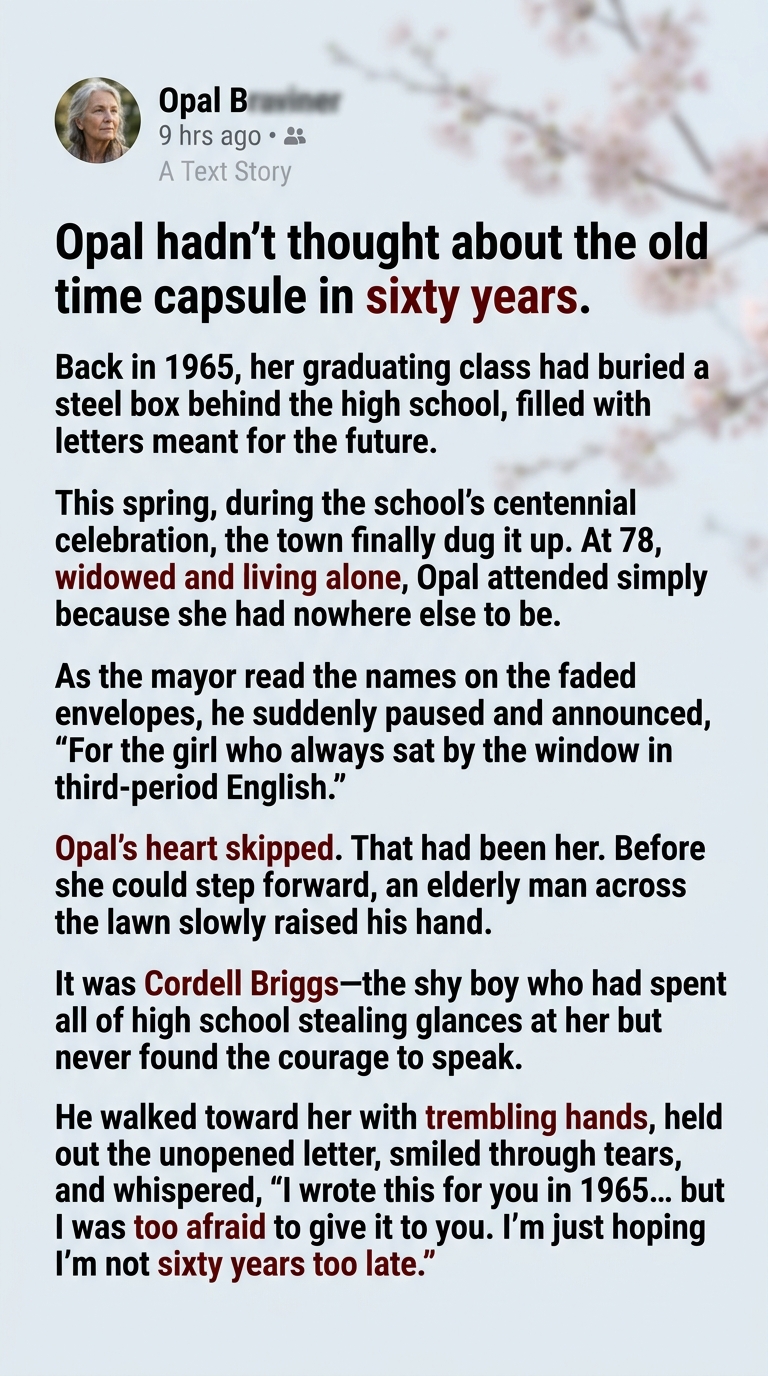
“For the girl who always sat by the window in third-period English.”
Opal stopped breathing.
For one impossible moment, the entire schoolyard seemed to vanish.
She was sixteen again, sitting beside the window with her notebook open and her heart full of questions she had never dared to ask.
The mayor looked around.
“Does anyone remember who that might have been?”
Opal’s fingers tightened around her cane.
She had sat by that window because she liked the light. She had stayed there because the seat was far enough from the classroom door that no one bumped her books. She had never considered that someone might have noticed.
Then, across the lawn, an elderly man slowly raised his hand.
He stood near the old oak tree, dressed in a charcoal suit that looked slightly too large for his narrow shoulders. His white hair was neatly combed, and he held his hat against his chest with both hands.
Opal recognized him before he took a single step.
Cordell Briggs.
The shy boy who had sat two rows behind her.
The boy who had always carried a pencil tucked behind his ear.
The boy who sometimes looked at her when he thought she wasn’t paying attention, then immediately stared at his desk whenever she turned around.
Cordell had been the quietest boy in their class. He rarely volunteered answers, avoided school dances, and seemed to become completely speechless whenever Opal spoke directly to him.
Once, during a history assignment, she had asked to borrow his notes.
He had handed them over without looking up.
“Thank you, Cordell.”
“You’re welcome,” he had whispered.
She remembered smiling at him.
She remembered him dropping his pencil afterward.
But she had never known why his ears turned red whenever she was near.
The mayor looked toward him.
“Mr. Briggs? Is this yours?”
Cordell nodded.
His lips moved, but no sound came out at first.
Then he took a breath.
“It is.”
The mayor offered him the envelope.
Cordell accepted it with trembling hands.
He stared at the faded writing for a long moment before turning toward Opal.
Their eyes met across the grass.
He began walking.
Each step was slow and careful. His left hand trembled against his side, and his right hand clutched the envelope as though it were the most valuable thing he had ever owned.
People moved aside to let him pass.
Opal stood perfectly still.
When he finally reached her, he stopped close enough for her to see the tears gathering in his pale blue eyes.
“Hello, Opal,” he said.
His voice was older, rougher, but she recognized something familiar beneath it.
“Hello, Cordell.”
He smiled.
“I used to practice saying that in the mirror.”
Opal blinked.
“What?”
“Your name. I practiced saying it without sounding like I was about to faint.”
A few people nearby laughed softly, but Cordell didn’t seem to notice.
He held out the envelope.
“I wrote this for you in 1965,” he whispered. “But I was too afraid to give it to you.”
His voice cracked.
“I’m just hoping I’m not sixty years too late.”
Opal looked at the envelope.
Her name wasn’t written on it. Only the description of the girl by the window.
“Why didn’t you give it to me then?” she asked.
Cordell lowered his eyes.
“Because I was sixteen, and I thought you were the most extraordinary person I’d ever seen. I was certain that if I spoke to you for more than ten seconds, you’d discover how ordinary I was.”
“Ordinary?”
“I wasn’t handsome like the football players. I couldn’t dance. I didn’t know how to tell jokes. Whenever you laughed, I spent the next hour trying to remember what had been funny.”
Opal felt a strange ache in her chest.
“I didn’t know you noticed me.”
Cordell gave a small, sad laugh.
“That was the problem. I noticed everything.”
He told her that he knew she liked the seat beside the window. He knew she used blue ink when she was happy and black ink when she was upset. He knew she tucked her hair behind her right ear when she was concentrating.
He knew that when it rained, she watched the clouds instead of taking notes.
“And I knew,” he said, looking down at the envelope, “that I was never going to be brave enough to tell you any of it.”
Opal swallowed.
“Did you ever try?”
“Once.”
She searched his face.
“When?”
“The last week of school. You were standing near your locker, holding a stack of books. I had the letter in my pocket. I walked over to you, and you smiled.”
He shook his head at the memory.
“Then you asked if I was all right because I looked pale. I told you I had a stomachache.”
Opal covered her mouth.
Cordell chuckled softly.
“It was the best excuse I could think of. I went home, put the letter in a drawer, and told myself I’d give it to you at graduation.”
“But you didn’t.”
“No.”
“Why?”
“Because at graduation, you were surrounded by friends. You looked happy. I didn’t want to embarrass you.”
He paused.
“And then you left town.”
Opal remembered that summer.
She had gone to Chicago for a secretarial job, determined to prove she could build a life far from Bellweather. Cordell had stayed home to help his father at the hardware store.
She had never known he had wanted to follow her.
“I thought about writing,” he continued. “I even bought a stamp. But every time I sat down, I imagined you opening the letter, laughing, and showing it to your friends.”
“I would never have done that.”
“I know that now.”
He looked at her with an expression so tender that Opal felt the years between them become strangely thin.
“But I didn’t know it then.”
For a while, neither spoke.
The centennial celebration continued around them, but the noise seemed distant.
Finally, Opal reached for the envelope.
“May I read it?”
Cordell hesitated.
Then he nodded.
“That’s why I brought it.”
She eased the envelope open. The paper inside was fragile and yellowed, folded into thirds. The handwriting was neat at the beginning and increasingly uneven toward the bottom.
She began to read.
Dear Opal,
I don’t know if you will ever read this. I am writing it because I am tired of pretending that I don’t look for you every morning when I enter English class.
You always sit by the window. Sometimes the sun shines on your hair, and I forget what the teacher is saying.
You once lent me a pencil when mine broke. You probably don’t remember. I kept it in my desk for the rest of the year because I couldn’t bear to use it and wear it down.
Opal pressed the letter against her chest.
Cordell looked mortified.
“I was sixteen,” he said quickly. “I realize how ridiculous that sounds now.”
“No,” she whispered. “It doesn’t.”
She continued.
I don’t know what you want to do with your life. I hope you get to do all of it. I hope you see the ocean and visit places where the streets are full of lights. I hope you find someone who makes you feel beautiful even when you are old and tired.
I hope he knows how lucky he is.
Her vision blurred.
At the bottom of the page, Cordell had written one final paragraph.
If I ever meet you again, I hope I will be brave enough to tell you that you were the first person who made an ordinary day feel like something worth remembering.
Yours, even if you never know it,
Cordell.
Opal couldn’t speak.
She had spent sixty years believing she had passed through high school without leaving much of an impression on anyone. She had been a quiet girl with good grades and modest dreams, neither especially popular nor especially interesting.
Yet someone had carried the memory of her through an entire lifetime.
Someone had remembered the light on her hair.
Someone had kept a broken pencil alive in his memory.
Someone had written her a letter and waited sixty years to see whether she might finally read it.
“Did you ever love anyone?” she asked softly.
Cordell took a long breath.
“Yes.”
Opal’s heart sank before she could stop it.
He noticed.
“Her name was Margaret,” he said. “We met at a church picnic when I was twenty-six. She was funny, stubborn, and the only person who could convince me to sing in public.”
He smiled at the memory.
“We were married for fifty-one years. She passed away four years ago.”
“I’m sorry.”
“Thank you. She was a wonderful woman.”
He looked toward the school building.
“I never told her about the letter. Not because I was hiding some great romance, but because it belonged to a part of my life I had never learned how to explain.”
He turned back to Opal.
“I loved Margaret. I loved our children. I loved the life we built. But sometimes, when I passed this school, I wondered what might have happened if I’d been brave enough to speak to you.”
Opal looked down at the letter.
She understood more than he realized.
She had loved Arthur deeply. He had been gentle and patient, the sort of man who remembered how she liked her tea and always warmed her side of the bed before winter nights.
She had never wished to trade her marriage for another life.
But she had wondered about the younger version of herself. The girl who had sat by the window and dreamed about all the things she could not yet imagine.
“Arthur was a good man,” she said.
Cordell nodded.
“I hoped he was.”
“He made me laugh every day. Even when I was angry with him.”
“That sounds like a good marriage.”
“It was.”
Opal smoothed the letter with her fingertips.
“And Margaret sounds like she was a wonderful woman, too.”
“She was.”
They stood together beneath the spring sunshine, two widowed people with sixty years of life behind them and a single sheet of paper between them.
For the first time, Opal realized the letter wasn’t asking her to undo the past.
It was simply giving the past a voice.
She folded it carefully.
“Would you like to have lunch with me?” she asked.
Cordell stared at her.
“Today?”
“Unless you have something more important planned.”
“I was going to go home and complain about my knees.”
“Well, you can complain about them over lunch.”
He laughed, and the sound surprised them both.
“I would like that very much.”
They left the celebration together, walking slowly toward the small café on the corner. Cordell offered his arm when they reached the pavement, and Opal accepted it.
Neither of them called it a date.
Neither of them mentioned love.
They talked about the school, their families, their late spouses, and the strange things that happened when a person grew old enough to understand how little they had understood when they were young.
Cordell told her about his daughter, who lived three states away and called him every Sunday. Opal told him about her son, who wanted her to move closer to him but couldn’t understand why she wasn’t ready to leave the house where she and Arthur had lived.
They discovered they both liked old movies, disliked overly sweet coffee, and had each kept a box of high-school photographs in a closet.
When they finished lunch, Cordell walked her to her car.
“Would you mind if I called you sometime?” he asked.
Opal pretended to consider the question.
“That depends.”
“On what?”
“Whether you intend to practice saying my name in the mirror first.”
Cordell laughed so hard that he had to steady himself against the car.
“I think I can manage without the mirror now.”
“Good.”
She slipped the letter into her handbag.
“Then you may call.”
That evening, Opal placed the envelope on her kitchen table beside Arthur’s framed photograph.
For a long time, she sat quietly, looking at both.
She had worried that allowing a new person into her life would somehow diminish the love she had shared with her husband. But the longer she sat there, the more she understood that love was not a room with only one chair.
Arthur had given her a lifetime of warmth, laughter, and belonging.
Cordell had given her something different.
He had returned a piece of her youth she hadn’t known was missing.
She touched Arthur’s photograph.
“I think you’d have liked him,” she whispered.
The next morning, Cordell called.
He asked whether she might enjoy a walk around the school grounds the following week.
She said yes.
The week after that, they went to a matinee.
By June, they were having lunch together twice a week. By July, Cordell had learned that Opal hated carnations, loved strawberry pie, and became stubborn whenever someone suggested she needed help carrying groceries.
Opal learned that Cordell talked to his houseplants, forgot where he put his glasses, and had a habit of humming whenever he was nervous.
One afternoon, he brought her a small wooden box.
“I found this while cleaning out my attic,” he said.
Inside lay an old yellow pencil, worn down almost to the eraser.
Opal stared at it.
“Is this…?”
“The pencil you lent me in English class.”
“You kept it?”
“Apparently, I was a sentimental fool.”
She laughed until tears came to her eyes.
“No,” she said. “You were a boy who wanted to remember something good.”
Cordell looked at her for a long moment.
“May I tell you something else?”
“Of course.”
“I don’t expect anything from you, Opal. I don’t want you to feel that because I wrote that letter, you owe me a chance at something.”
She waited.
“I am glad I finally gave it to you. Even if all we ever become is two old friends who share pie and complain about our knees, that will be enough.”
Opal reached across the table and took his hand.
“Then let us start there.”
And they did.
They became friends first. Not the hurried kind of friendship that tries to fill an empty space, but the gentle kind that grows because two people enjoy being in the same room.
They learned to sit together in silence without feeling the need to explain it.
They visited the library, attended school concerts, and took short drives into the countryside when the weather was warm.
Sometimes Opal brought Arthur’s favorite cookies to share. Sometimes Cordell spoke about Margaret, telling stories that made Opal laugh and occasionally cry.
Neither asked the other to forget the person who had come before.
Instead, they made room for those memories at the table.
One crisp autumn afternoon, almost six months after the centennial celebration, Cordell invited Opal to the school grounds again.
The oak tree had begun to turn gold. The lawn was quiet, and the windows of the old English classroom reflected the late afternoon sun.
Cordell carried a small paper bag.
“I brought something,” he said.
Opal eyed it suspiciously.
“If that’s another pencil, I’m going to start worrying about you.”
He smiled and took out a folded sheet of paper.
“I wrote this last night.”
Her heart fluttered.
“Another letter?”
“Not quite.”
He unfolded the paper and handed it to her.
It contained only a few lines.
Dear Opal,
I spent sixty years wishing I had been brave enough to speak to you.
I cannot ask for those years back. Neither of us would trade the lives we lived.
But if you are willing, I would like to spend whatever time remains learning the person you became.
No promises about forever. Just coffee on Tuesdays, walks when the weather allows, and the privilege of knowing you now.
Yours,
Cordell.
Opal read the words twice.
Then she looked up.
“Coffee on Tuesdays?”
“And pie on Thursdays, if negotiations go well.”
She laughed, wiping a tear from her cheek.
“You drive a hard bargain, Mr. Briggs.”
“I’ve had sixty years to prepare.”
She folded the paper and tucked it into her handbag beside the original letter.
Then she reached for his hand.
“I would like that, Cordell.”
His eyes shone.
“Really?”
“Really.”
He looked as though he might say something else, but the words caught in his throat.
Opal squeezed his hand.
“You know,” she said, “I used to think the most important moments in life were the ones that changed everything at once. A wedding. A birth. A goodbye.”
She looked toward the classroom window.
“But perhaps some moments simply open a door.”
Cordell followed her gaze.
“And you don’t have to walk through it all at once.”
“No,” Opal said. “You only have to be brave enough to take the first step.”
He lifted her hand and kissed it gently.
They stood beneath the old oak tree while the autumn sunlight stretched across the grass, two people who had lived full lives, loved deeply, lost much, and somehow found one another again.
They were not sixteen.
They could not recover the dances they never shared, the conversations they never had, or the years that had slipped quietly through their fingers.
But they could share tomorrow.
And the day after that.
And perhaps, if they were fortunate, many Tuesdays and Thursdays still to come.
Years later, when people asked Opal how she and Cordell had met, she always told them the same story.
She told them about a steel box buried in 1965.
She told them about a letter that had waited six decades.
And she told them about the shy boy who had been afraid to speak to her when they were young.
Then she would smile and add, “The funny thing is, I thought he was sixty years too late.”
“Was he?” someone would ask.
Opal would look at Cordell, who was usually sitting beside her with his hand resting over hers.
“No,” she would say. “He was right on time for the life we had left.”
Because time does not always give us back what we lost.
Sometimes, it gives us something we never knew we were still allowed to have.
And sometimes, the bravest words are not the ones we say when we are young.
They are the ones we finally find the courage to say before it is too late.