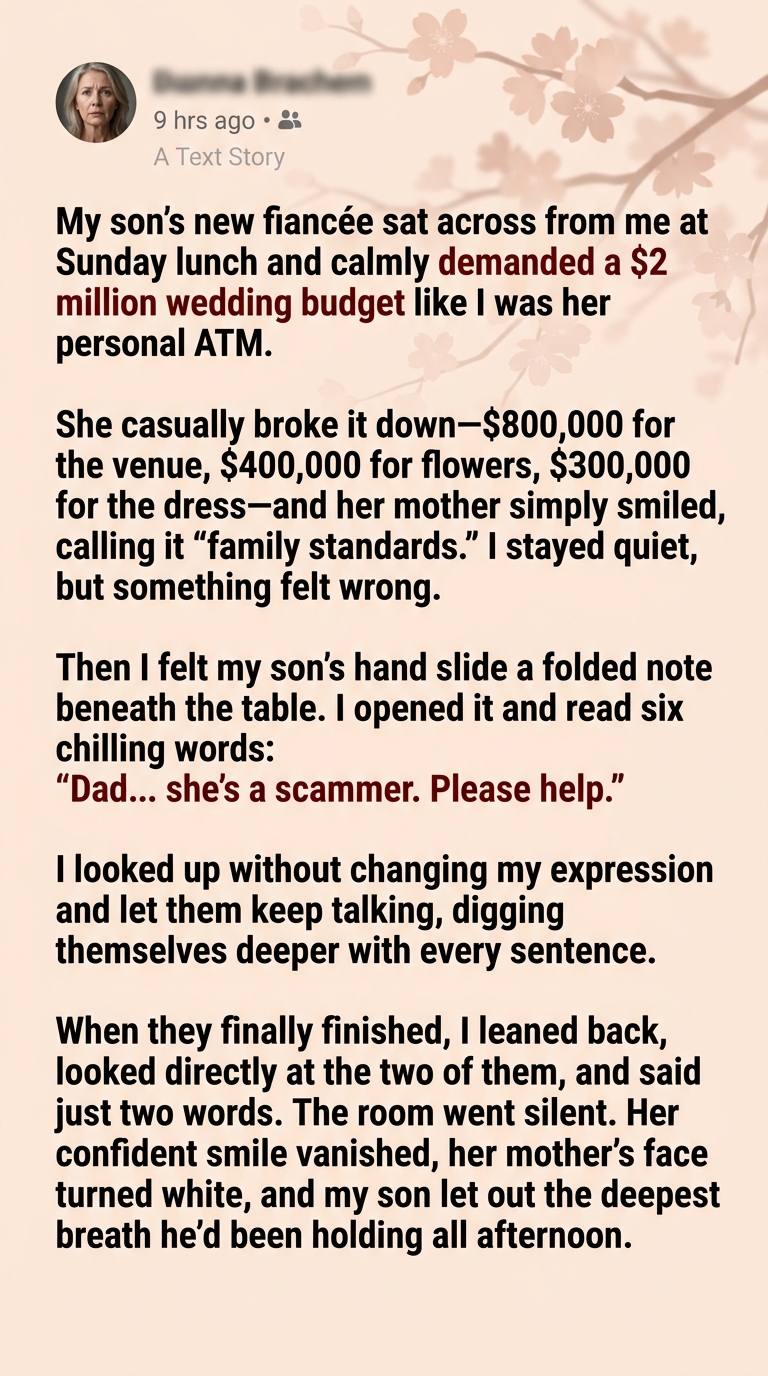
“Dad… She’s a Scammer. Please Help.”
My name is Richard, and at sixty-one, I thought I had learned to recognize trouble before it walked through my front door.
I had spent thirty-five years building my construction business from a small operation with two employees into a company that employed hundreds of people. I had negotiated million-dollar contracts, survived recessions, and learned that the most dangerous deals were often the ones that sounded too good to question.
But nothing prepared me for what happened at Sunday lunch when my son introduced me to the woman he planned to marry.
Her name was Vanessa.
She was thirty, beautifully dressed, perfectly spoken, and carried herself with the kind of confidence that made people assume she belonged in any room she entered. My son, Andrew, had been dating her for eight months. He had seemed happy, so I welcomed her into our home and tried to get to know her.
Her mother, Patricia, joined us that Sunday. From the moment she arrived, she spoke as though our families had already agreed to become one.
Then, halfway through lunch, Vanessa set down her glass and smiled at me.
“Richard, we need to talk about the wedding budget.”
I smiled back. “Of course. Have you two decided on a date?”
“We have several venues in mind,” she replied. “But before we confirm anything, we need to make sure we’re all on the same page financially.”
Patricia nodded. “A wedding establishes the standard for the marriage. We believe in doing things properly.”
I folded my napkin and waited.
Vanessa opened a folder and began listing figures as casually as someone ordering lunch.
“Eight hundred thousand for the venue. Four hundred thousand for flowers and decorations. Three hundred thousand for my dress and accessories. Two hundred thousand for catering, and the remaining three hundred thousand for entertainment, photography, travel, and miscellaneous expenses.”
She looked up.
“So, approximately two million dollars.”
For a moment, I thought she was joking.
“Two million?” I repeated.
“Yes,” she said. “We don’t want to cut corners on something this important.”
Patricia gave a little laugh. “It’s about family standards, Richard. You understand that.”
I looked at Andrew.
He was staring at his plate.
I had raised that boy after his mother died when he was twenty-two. I had watched him work his way through university, build a career, and become a thoughtful young man who treated people with kindness.
He wasn’t extravagant. He had never asked me to buy him a luxury car or fund an elaborate lifestyle.
So why was he sitting there while his fiancée demanded two million dollars from his father?
Before I could ask, I felt something brush against my hand beneath the table.
Andrew had slipped me a folded note.
I opened it without moving my expression.
Six words were written inside.
“Dad… she’s a scammer. Please help.”
My stomach tightened.
I looked at my son. His jaw was clenched, and there was a fear in his eyes I had never seen before.
I wanted to ask him what he meant. I wanted to stand up and demand an explanation from Vanessa.
Instead, I folded the note and placed it beside my plate.
I had learned long ago that when someone was trying to manipulate you, reacting too quickly often gave them the advantage.
So I let Vanessa continue.
She described the venue as an exclusive European estate, the flowers as rare imported arrangements, and the dress as a custom creation from a designer whose name I recognized only vaguely.
She even had a printed document that appeared to be a preliminary budget from a luxury wedding planner.
Patricia leaned forward.
“Andrew has told Vanessa how successful your business has been. We assume you understand that this isn’t an unreasonable request for a family in your position.”
I kept my voice calm.
“That’s an interesting way to look at it.”
Vanessa smiled, apparently interpreting my response as agreement.
“We’re not asking you to give us money for nothing,” she said. “This wedding will reflect well on everyone. Your business associates will be there, and people will see the kind of family Andrew comes from.”
That was when I became certain this wasn’t simply about an extravagant wedding.
She wasn’t talking about love, a future together, or the life she wanted to build with my son.
She was talking about appearances.
Still, I needed facts.
I rested my hands on the table.
“Before we discuss payment, I’d like to see the contracts.”
Vanessa blinked.
“What contracts?”
“The venue agreement, the florist’s proposal, the dress order, and the planner’s credentials. If we’re discussing a two-million-dollar event, I want to understand exactly what we’re purchasing.”
Her smile tightened.
“Most of those details aren’t finalized.”
“Then there shouldn’t be any problem verifying them before we commit.”
Patricia intervened.
“Richard, I don’t think it’s appropriate to treat a family wedding like a corporate acquisition.”
I gave her a polite smile.
“Two million dollars is a substantial commitment. I treat every substantial commitment carefully.”
Vanessa closed the folder.
“We thought you’d be more supportive.”
“Supportive doesn’t mean careless.”
For the first time, her confidence slipped.
But then she recovered and leaned toward me.
“Andrew and I are getting married regardless. If you refuse to support us, we’ll simply have to reconsider how involved you’ll be in our future.”
I glanced at my son.
He looked as though he wanted the floor to swallow him.
I understood then that he hadn’t slipped me the note because he was unsure about the wedding budget. He was asking for help getting out of something much more serious.
I turned back to Vanessa.
“Tell me something. Have you already collected money from anyone for this wedding?”
Her eyes narrowed.
“Why would you ask that?”
“Because you seem unusually certain that I’ll provide the entire budget without seeing a single signed agreement.”
Patricia straightened in her chair.
“This conversation is becoming insulting.”
“Then let’s make it simple,” I said. “Show me the documentation.”
Vanessa stood abruptly.
“I don’t have to prove myself to you!”
The room fell silent.
I looked at her, then at Patricia.
They had spent the last twenty minutes explaining what I supposedly owed them. Yet when I asked for ordinary financial documentation, they reacted as if I had committed an offense.
I slowly leaned back in my chair.
Then I looked directly at both women.
“Show me proof.”
Two words that changed the atmosphere completely.
Vanessa’s confident smile disappeared. Patricia’s face turned pale. And across the table, Andrew released a breath so deep it sounded as though he had been holding it for months.
I waited.
Vanessa finally gathered her folder and muttered that she needed to make a phone call. Patricia followed her into the hallway.
As soon as they were out of earshot, Andrew leaned toward me.
“Dad, I’m sorry.”
“Start from the beginning,” I said.
He rubbed his face.
“I met Vanessa at a charity networking event. She was charming, intelligent, and seemed genuinely interested in me. She knew things about my work and asked thoughtful questions. I thought I’d finally met someone who liked me for who I was.”
“What changed?”
“About three months ago, she started talking about money. At first, it was small things. A temporary cash-flow problem. A deposit she needed help covering. An investment opportunity her mother said was guaranteed.”
“How much money?”
Andrew looked down.
“About thirty-five thousand dollars.”
My chest tightened.
“Did you transfer it?”
“Yes. She promised to repay me within a few weeks. Then she said the money was tied up in a business transaction. Every time I asked for it, there was a new explanation.”
“Why didn’t you tell me?”
“Because I was embarrassed. I thought I’d made a mistake, and I didn’t want you to think I was foolish.”
I softened my voice.
“Being deceived doesn’t make you foolish. But keeping it secret can make it easier for someone to deceive you again.”
He nodded.
“Then I found messages on her laptop when she asked me to help print some wedding documents. They were between her and her mother.”
“What did they say?”
Andrew swallowed.
“They were discussing how much money they could get from you before the wedding. Vanessa wrote that once we were married, she could persuade me to invest in a business her mother was setting up. They called it our ‘family opportunity.’ Her mother said the wedding would make it harder for you to refuse because you’d already be publicly committed.”
I sat very still.
“Did you save the messages?”
“Yes. I took screenshots. I know I shouldn’t have looked at her private messages, but she had left the conversation open on a shared computer. After that, I started checking the claims she’d made about her business.”
“And?”
“Some of them don’t add up. The company she said she owned isn’t registered under the name she gave me. The luxury apartment she claimed to own appears in public records under someone else’s name. I also found complaints from people who said they’d paid deposits for services that never materialized.”
“Did you verify those complaints?”
“Not all of them. That’s why I wanted to talk to you before making accusations.”
I nodded. That was important. Suspicion wasn’t proof, and I wasn’t going to destroy someone’s reputation based on screenshots and internet posts alone.
“Did she ask you for more money recently?”
Andrew pulled out his phone.
“She said her mother had arranged a special rate with the wedding planner, but they needed another deposit immediately. When I asked to see the agreement, she became angry. That’s when I started to suspect the whole wedding budget might be a setup.”
I looked at the folder Vanessa had left behind.
“Let me handle the financial side. You handle your safety and your decisions about the relationship. Don’t send another payment, and don’t sign anything while we’re sorting this out.”
He nodded.
“But, Dad, I don’t know how to end it. Every time I’ve tried to question her, she says I’m betraying her.”
“Someone who genuinely loves you should be able to answer reasonable questions without threatening you.”
At that moment, Vanessa and Patricia returned.
Vanessa had recovered enough to put on a strained smile.
“I think we’ve all had a misunderstanding,” she announced. “We can provide the documentation later. For now, perhaps Richard could transfer a small initial payment so we can secure the venue.”
“How much?” I asked.
“Two hundred thousand dollars.”
Patricia added quickly, “It’s refundable if plans change.”
I looked at them.
“Then the contract will explain the refund terms, the venue’s legal name, and the account receiving the payment.”
Vanessa’s expression hardened.
“You’re making this impossible.”
“No,” I replied. “I’m making it verifiable.”
She turned to Andrew.
“Are you going to sit there while your father humiliates me?”
Andrew finally raised his head.
“I’m asking the same questions he is.”
Vanessa stared at him as though she couldn’t believe he had spoken.
“You don’t trust me?”
“I trusted you enough to lend you money,” he said. “You promised to repay me. You haven’t. Now you’re asking my father for two million dollars without showing us a single contract.”
Patricia slammed her hand on the table.
“This is outrageous. Vanessa has standards. If your family can’t meet them, perhaps this marriage was a mistake.”
Andrew looked at her for several seconds.
Then he turned to Vanessa.
“I think you’re right about one thing. The marriage would be a mistake.”
Her face went blank.
“Andrew, don’t be ridiculous.”
“I’m not getting married until I know the truth about the money and the things you’ve told me.”
“You’re throwing away eight months because of a misunderstanding?”
“No,” he replied quietly. “I’m stopping because I don’t know which parts of those eight months were real.”
For the first time that afternoon, Vanessa had no immediate answer.
I stood and walked toward the kitchen, giving my son space to speak for himself. I could hear their voices rising in the dining room, but I didn’t intervene unless things became threatening.
Eventually, Patricia announced that they were leaving.
Vanessa picked up her handbag and turned toward Andrew.
“You’ll regret this.”
He looked at her sadly.
“Maybe I’ll regret how I handled it. But I won’t regret asking for the truth.”
They walked out without another word.
As the front door closed, Andrew sat down and covered his face with both hands.
I sat beside him.
“You did the right thing by asking for help,” I told him.
He shook his head.
“I feel like an idiot.”
“You’re not an idiot. You wanted to believe someone you loved. That’s human. What matters now is what you do with what you’ve learned.”
Over the following weeks, we handled the situation carefully.
Andrew saved copies of the messages and payment records he already had. We spoke with a lawyer about recovering his money and avoiding any further financial exposure. He contacted his bank to discuss the transfers and whether any protective steps were available.
The lawyer also warned us not to confront Vanessa with unsupported public accusations. If money had been obtained through deception, the proper next step was to document the facts and report them through the appropriate channels.
We did exactly that.
A review of Andrew’s records revealed that the thirty-five thousand dollars had gone into an account associated with a company that did not match the business Vanessa had described. We also discovered that the supposed wedding planner’s contact details led to a different business than the one named in the documents.
The venue itself was real. The booking confirmation Vanessa had shown us, however, could not be verified with the venue, and the listed payment account did not belong to it.
That was the turning point.
Andrew filed a formal complaint and provided the relevant records. Investigators began examining the transactions and contacting other people who had reported similar experiences.
We learned that Vanessa had used different explanations to obtain money from several people. Some of the claims against her were still being investigated, and we waited for the evidence rather than assuming every allegation was true.
The most painful discovery came from a message Andrew had saved before the confrontation.
Vanessa had written to her mother:
Once he feels embarrassed enough, he’ll pay just to make this go away.
Andrew read that sentence several times.
Then he put his phone down.
“I kept thinking I wasn’t good enough,” he said. “I thought if I questioned her, she’d leave because I was being difficult.”
I placed a hand on his shoulder.
“Someone who uses your fear of losing them to control your decisions isn’t offering you a healthy relationship.”
It took time for him to recover. He returned to his work, spent more time with friends, and eventually sought counseling to understand why he’d ignored his discomfort for so long.
The money wasn’t recovered immediately. Some transfers were difficult to reverse, and the legal process moved slowly. But Andrew stopped the losses, preserved the evidence, and no longer faced the possibility of a much larger financial commitment.
Several months later, the investigation resulted in formal charges related to financial deception. Vanessa denied some of the allegations, and the case proceeded through the legal system. I refused to turn it into a public spectacle. My priority was making sure my son was safe and that the evidence was handled properly.
Patricia sent me a long email accusing me of ruining her daughter’s future. I didn’t respond to the emotional accusations. I forwarded it to our lawyer and let the process continue.
Andrew eventually received a partial repayment through a negotiated settlement connected to the financial dispute. It wasn’t everything he had lost, but it was a start. More importantly, he had escaped before the proposed wedding budget became a much larger loss.
One evening, nearly a year after that Sunday lunch, Andrew joined me for dinner.
He looked more relaxed than he had in months.
“I used to think finding the right person meant never doubting them,” he said. “Now I think it means being able to ask difficult questions without being punished for asking.”
I smiled.
“That sounds like something worth remembering.”
He paused, then laughed softly.
“I still can’t believe you sat there while they demanded two million dollars.”
“I was tempted to throw them out after the first number.”
“Why didn’t you?”
“Because you passed me a note asking for help. I wanted to understand what you were facing before I made it worse.”
He nodded.
“Those six words were the hardest thing I’ve ever written.”
I looked at him across the table.
“And they were exactly the right words to write.”
My son had believed he was trapped between the woman he loved and the fear of admitting he’d been deceived. He thought asking for help would make him look weak.
Instead, it gave him a way out.
The two-million-dollar wedding never happened. There was no extravagant venue, no imported flowers, and no grand celebration built on money that had never been earned honestly.
There was only a quiet dinner between a father and son, and a lesson neither of us would forget.
The right person will never require you to abandon your judgment to prove your love.
And sometimes, the most important thing a father can give his son isn’t money.
It’s a calm voice, an open door, and the reassurance that when something feels wrong, he never has to face it alone.

