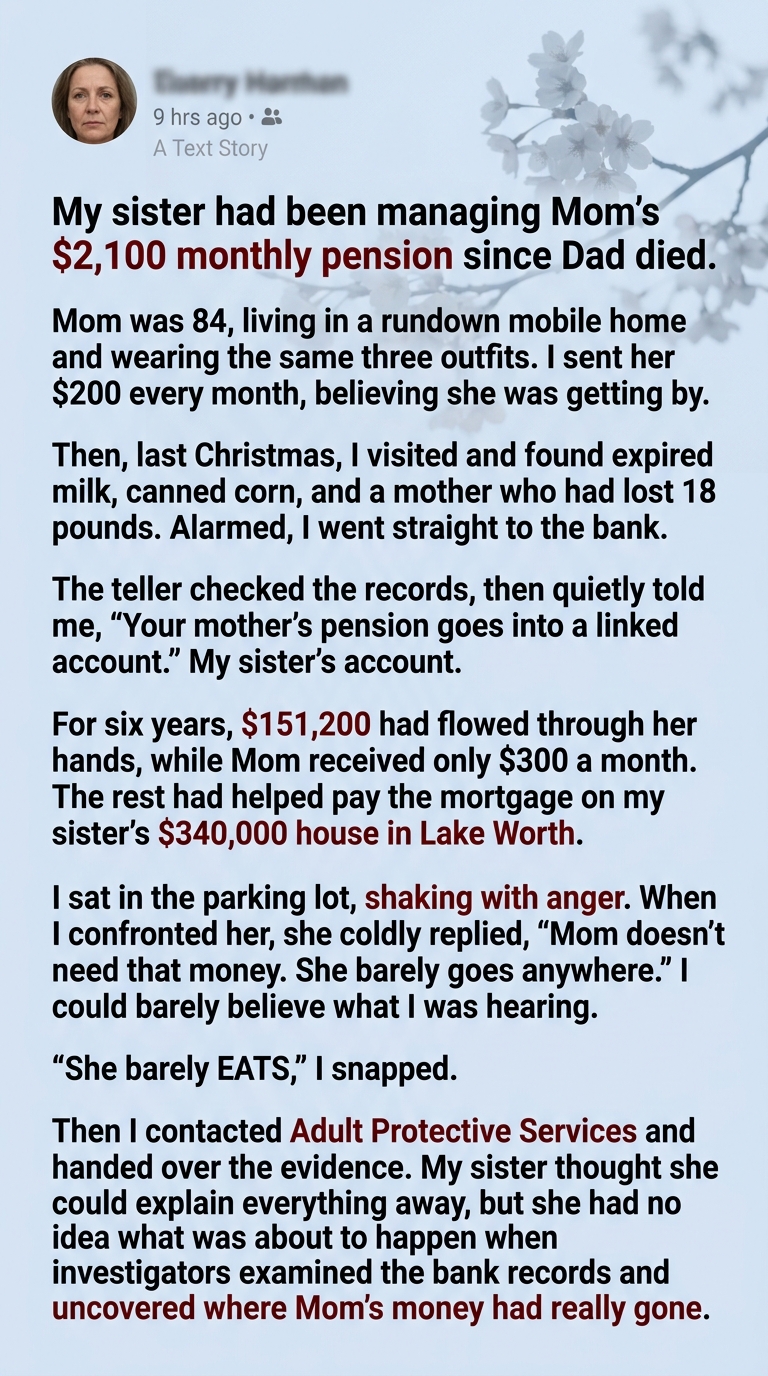
My sister had been managing Mom’s $2,100 monthly pension since Dad died.
For years, I trusted her.
She lived closest to Mom, handled the bills, and always insisted she knew what was best for our 84-year-old mother. Whenever I asked whether Mom needed anything, my sister brushed me off.
“She’s fine,” she would say. “You know how stubborn she is. She refuses to spend money on herself.”
I lived far enough away that I couldn’t visit every week. So I did what I thought was right: I sent Mom $200 every month to help with groceries, medication, and anything else she might need.
I believed my sister was using Mom’s pension to cover the rest.
I was wrong.
The truth hit me last Christmas.
I arrived at Mom’s rundown mobile home with a bag of groceries and a present I had wrapped myself. I expected to find her watching her favorite television program, waiting for me to complain about how much I had overpacked.
Instead, I found her sitting in a faded recliner, wearing the same blue cardigan I had seen during my previous visit.
The refrigerator contained expired milk, a few eggs, and almost nothing else. The cupboards held canned corn, crackers, and a nearly empty box of oatmeal.
Mom had lost 18 pounds.
Her cheeks looked hollow. Her hands trembled as she reached for the glass of water I poured her.
“Mom, when was the last time you had a proper meal?” I asked.
She gave me a small, embarrassed smile.
“Oh, honey, don’t fuss. I manage.”
“Where’s your pension money?”
She looked down at her lap.
“Your sister handles all that.”
“Does she give you enough?”
Mom hesitated.
“She gives me $300 a month for everything. I don’t like asking her for more. She’s busy with her own family.”
I stared at her.
Three hundred dollars.
My mother was receiving just $300 a month while her pension paid $2,100.
I tried to keep my voice calm.
“Mom, what happens to the other $1,800?”
She rubbed her hands together.
“Your sister says she takes care of the bills.”
That answer followed me all night.
The next morning, while Mom rested, I drove straight to the bank where her pension was deposited.
I brought my identification and the documents Mom had authorized me to obtain. I explained that I was concerned about her finances and asked what I could legally review.
The teller listened carefully.
After verifying the appropriate permissions, she examined the account records. Her expression changed.
“Could you wait here for a moment?” she asked.
She returned with a supervisor.
They showed me the transaction history I was authorized to see. Mom’s pension had been deposited into an account linked to another account held by my sister.
Every month, $2,100 came in.
Only $300 was transferred to Mom for her personal expenses.
The remaining money was moved elsewhere.
I sat down.
Six years.
Seventy-two monthly payments.
A total of $151,200 in pension deposits had passed through my sister’s control during that period.
I asked for copies of the records available to me and took them outside.
I sat in the parking lot with the papers spread across the passenger seat, my hands shaking.
I had spent years sending Mom money because I believed she was getting by.
Meanwhile, my sister had been using her pension to help pay the mortgage on her $340,000 house in Lake Worth.
I couldn’t understand how someone could look at our mother, see her struggling to eat, and still justify keeping her money.
But I was about to hear her justification for myself.
That afternoon, I drove to my sister’s house.
Her driveway was clean, her lawn was trimmed, and a wreath hung perfectly on the front door. Through the window, I could see a decorated Christmas tree and a dining table set for a family meal.
I knocked.
My sister opened the door wearing a silk blouse and holding a mug of coffee.
“What are you doing here?”
I held up the bank records.
“We need to talk about Mom’s pension.”
Her expression barely changed.
“What about it?”
“You’ve been transferring most of her money away from her account. Mom is living on $300 a month. She’s lost 18 pounds, and there’s barely food in her refrigerator.”
My sister sighed as if I had interrupted something important.
“Mom doesn’t need that money. She barely goes anywhere.”
For a moment, I couldn’t speak.
Then the words came out louder than I intended.
“She barely EATS!”
My sister rolled her eyes.
“She has a roof over her head. She has electricity. She has food. I pay attention to the things you don’t have time to handle.”
“Then why is the milk in her refrigerator expired?”
“She forgets what she buys.”
“Why has she lost 18 pounds?”
“She’s 84! People lose weight when they get old.”
I felt sick.
“You took money that belonged to her and used it to help pay your mortgage.”
My sister folded her arms.
“I manage her finances. That money was going toward family expenses. If I hadn’t helped her all these years, she would have ended up in a worse situation.”
“Did Mom agree to you using her pension for your house?”
She looked away.
That silence told me more than her excuses had.
I gave her one final chance.
“Give me a full accounting of every dollar. If you can show that Mom’s money was spent on her care, I’ll look at the records. But if you used it for yourself, you need to make that right.”
She stepped back and pointed toward the driveway.
“Get out of my house.”
I left.
But I didn’t leave the matter there.
That evening, I contacted Adult Protective Services and explained what I had found. I provided the bank records, photographs of Mom’s living conditions, receipts for the groceries I had purchased, and a written account of what Mom had told me.
I also asked how to arrange an independent assessment of her health and financial needs.
The caseworker listened without making promises about the outcome.
“Financial exploitation of an older adult is serious,” she told me. “We’ll need to investigate and determine what happened.”
For the first time since Christmas, I felt I had done something useful.
I wasn’t going to threaten my sister, empty accounts, or take matters into my own hands. I was going to let the evidence speak.
And the evidence was only the beginning.
Within days, an investigator contacted me for additional information. Mom was interviewed privately, without my sister present. She was also offered help assessing her nutrition, medical needs, and living situation.
The investigator asked whether Mom had knowingly authorized the use of her pension.
Mom’s answer was heartbreaking.
“I told my daughter she could pay my bills,” she explained. “I never told her she could keep the rest. I thought the money was being saved for when I needed more help.”
That statement changed the direction of the investigation.
The question was no longer simply where the money had gone. Investigators needed to determine what authority my sister had been given, what she had disclosed to Mom, and whether the transfers had been properly authorized.
They obtained additional financial records through the appropriate process.
And that was when they uncovered something neither my sister nor I had known about.
The pension transfers weren’t the only payments connected to my sister’s mortgage.
Over several years, money had moved from the linked account into a personal account controlled by my sister. From there, some payments went directly toward her mortgage, while others covered household expenses and credit-card bills.
Investigators also found transfers labeled with vague descriptions such as “family,” “bills,” and “reimbursement.”
My sister claimed those payments represented money she was owed for caring for Mom.
But when investigators requested supporting records, she couldn’t provide receipts or a reliable accounting for much of the money.
Some expenses could potentially have been legitimate. Others appeared to have no clear connection to Mom’s care.
The investigators did not simply accept either side’s explanation. They compared the bank statements with the available bills, medical expenses, and records of money actually spent on Mom.
The results were devastating.
The records showed that Mom had received only $300 a month for personal expenses, while substantial amounts had been directed toward my sister’s financial obligations.
There was no reliable documentation showing that the money used for the mortgage had been spent on Mom.
When my sister was asked to explain the discrepancies, she insisted that she had been helping herself only because she was helping the family.
But the documents told a different story.
A few weeks later, an investigator called me.
“We have substantial evidence of potential financial exploitation,” she said. “The case is being referred to the appropriate authorities for further review.”
I sat silently, absorbing her words.
I had wanted someone to stop my sister from taking advantage of Mom. Now I was realizing how much bigger the consequences could be.
The investigation continued.
My sister was required to respond to the financial findings, and authorities examined whether her actions violated the law. Any criminal charges or financial recovery would have to follow the proper legal process.
Meanwhile, we focused on Mom.
I helped arrange an appointment with her doctor, who assessed her weight loss and reviewed whether any medical issues were contributing to her condition. We made sure she had groceries, nutritious meals, and the medication she needed.
With Mom’s informed consent, we also worked with a qualified professional to review her benefits and arrange a safer way to manage her finances.
Her pension began going into an account she controlled, with appropriate support for paying her bills. My sister no longer had unrestricted access to the money.
For the first time in years, Mom could see exactly what came in and what went out.
The change was immediate in one important way: she no longer had to ask my sister for permission to buy groceries.
But the emotional damage took longer.
One afternoon, I found Mom sitting at her kitchen table, sorting the receipts from the groceries I had brought.
“I’m sorry,” she whispered.
I looked at her in disbelief.
“Mom, what are you apologizing for?”
“I should have asked more questions. I didn’t want to cause trouble between you girls.”
I pulled out the chair beside her and sat down.
“You didn’t cause this. You trusted your daughter to help you. You deserved to be treated honestly.”
She wiped her eyes.
“I kept thinking maybe I was being selfish. I thought if I needed more money, I was taking something away from her children.”
I took her hand.
“You were entitled to your own money, Mom. Buying food isn’t selfish.”
She cried then—not loudly, but with the exhausted relief of someone who had spent too long trying not to be a burden.
I stayed until dinner, and we made a proper meal together.
For the first time in months, she asked for seconds.
That small moment meant more to me than any argument I could have won with my sister.
Several months later, the financial investigation reached a formal stage. Authorities pursued the available legal remedies based on the evidence, while Mom received independent assistance with her accounts.
My sister’s explanations did not erase the records. She had to answer for the transfers, and the question of repayment became part of the legal process.
The outcome was not instant or simple. Recovering money that had already been spent or tied up in a mortgage required further review and negotiation.
But my mother was no longer financially dependent on the person whose actions were under investigation.
As for my sister, she called me repeatedly.
At first, she was furious.
“You’ve destroyed this family over money,” she said during one call.
I took a breath before answering.
“No. The money didn’t destroy this family. What happened to Mom is what brought us here.”
“She was never going to spend it all!”
“That was her decision to make.”
“She doesn’t even understand finances!”
“Then you should have protected her, not used that as a reason to control her money.”
She hung up.
We didn’t speak for months.
I missed the family gatherings we used to have. I worried about what would happen to our relationship in the future. But I refused to pretend nothing had happened simply to make holidays more comfortable.
Mom needed security more than we needed a peaceful-looking family photograph.
A year later, she was still living in her mobile home, but it looked different. The refrigerator was stocked. Her clothes were clean and comfortable. She had regular medical appointments and people checking in on her.
I still sent her money occasionally, but I no longer assumed my contribution was enough or that someone else was handling everything properly.
I asked her what she needed.
And I listened to the answer.
One evening, while we sat on her porch watching the sun sink below the trees, Mom squeezed my hand.
“Your father would be proud of you,” she said.
I looked at her.
“I just wish I’d come sooner.”
She shook her head.
“You came when you knew something was wrong. That’s what matters now.”
I thought about the $151,200 that had passed through my sister’s hands. I thought about the expired milk, the nearly empty cupboards, and the mother who had been afraid to ask for more than $300 of her own money.
And I thought about how easily I had accepted the phrase, She’s fine.
I learned a lesson I will never forget.
Love is not measured by how confidently someone claims to care for an elderly parent. It’s measured by whether that parent is safe, fed, respected, and allowed to keep control of their own life.
My sister had believed that managing Mom’s money made her the person in charge.
But she had forgotten one essential truth.
The pension was never hers.
The house was never hers to finance with Mom’s money.
And my mother was never someone else’s burden to manage without accountability.
She was a person who had spent her life caring for her family.
At 84, she deserved the chance to live the rest of it with dignity.
And this time, I made sure she didn’t have to ask permission.
Family loyalty should never mean looking away when an elderly parent is being neglected or financially exploited.