The NICU Nurse Who Knew My Son’s Secret
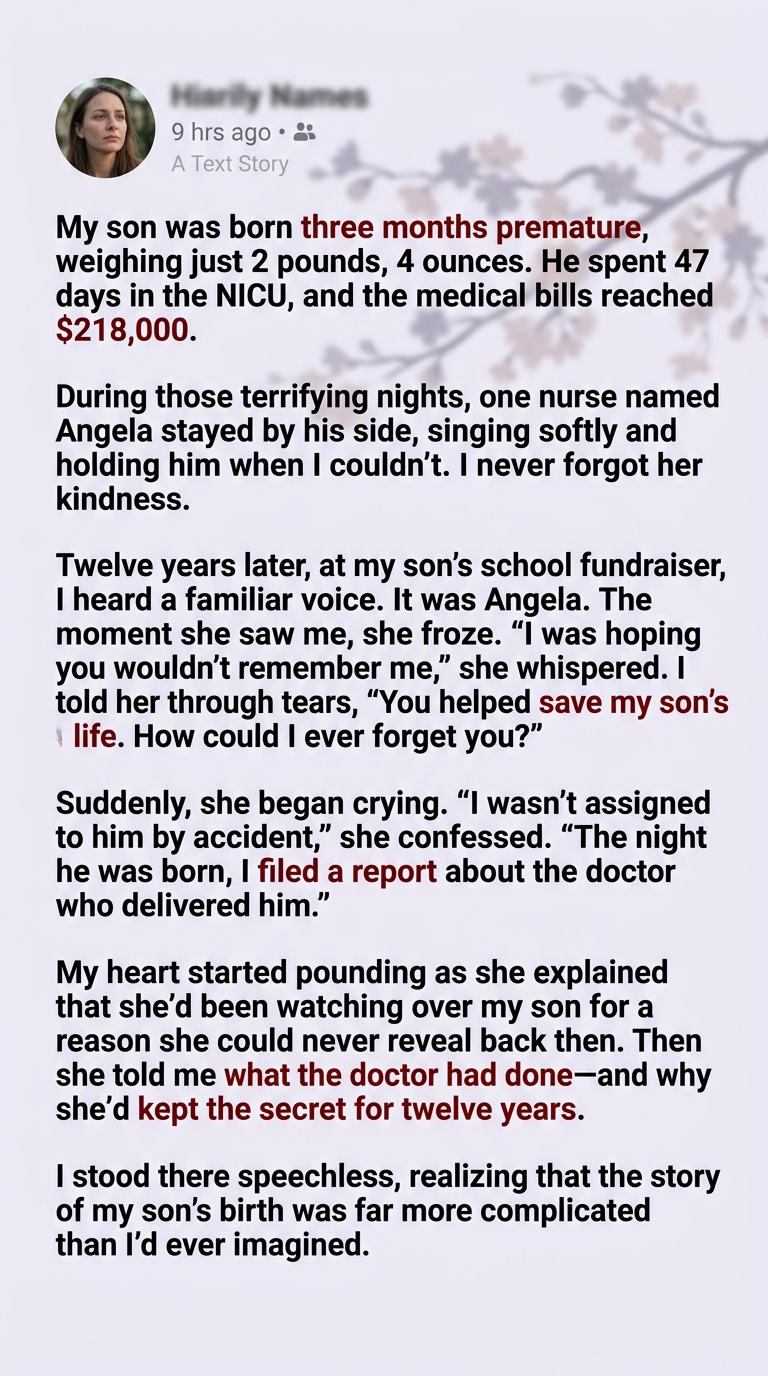
My son was born three months premature, weighing just 2 pounds, 4 ounces.
When the doctor first placed him in my arms, I barely had time to touch his tiny fingers before a team of nurses rushed him away to the neonatal intensive care unit.
He was so small that his diaper looked enormous against his body. Wires surrounded him. A breathing tube helped him survive. Every beep from the machines made my heart jump.
The doctors told us the next several weeks would be critical.
I remember sitting beside his incubator at three in the morning, whispering promises to a baby who was too young and too weak to understand them.
“Please stay with us,” I begged. “You don’t have to be strong forever. Just stay with us tonight.”
My wife, Sarah, tried to be brave, but I often found her crying in the hospital bathroom. We had prepared a nursery, painted the walls, and folded tiny clothes into drawers. We had imagined bringing our baby home after a few days.
Instead, we learned to measure progress in grams, oxygen levels, and minutes without complications.
The medical bills eventually reached $218,000. Insurance covered part of the cost, and we spent months working through payment plans and financial assistance. But at the time, money was the last thing on our minds.
We only wanted our son to live.
During those 47 days in the NICU, one nurse became a constant source of comfort.
Her name was Angela.
She had gentle hands and a quiet voice. Whenever she was assigned to our son’s care, she spoke to him as if he were the strongest little boy in the world.
“Come on, sweetheart,” she’d whisper. “You’ve got a whole life waiting for you.”
Sometimes, when the monitors were steady and the doctors allowed it, she would help me hold him against my chest.
Other nights, when I couldn’t stay because the hospital had limited visiting hours or I was too exhausted to keep my eyes open, Angela would sit near his incubator and sing softly.
I once asked her why she sang to him.
She smiled without looking up from the tiny blanket she was adjusting.
“Babies deserve to hear a kind voice, especially when everything around them is frightening.”
I never forgot those words.
I also noticed that Angela seemed unusually protective of our son. She checked his chart carefully, asked detailed questions about his delivery, and sometimes became very still when a particular physician entered the room.
I assumed it was ordinary professional caution.
I had no idea there was something else behind it.
After 47 days, our son was finally strong enough to leave the hospital.
I cried when we carried him through the doors. Sarah cried, too. Angela stood near the nurses’ station, smiling through tears of her own.
Before we left, I hugged her.
“You helped save our boy,” I told her.
She squeezed my shoulder.
“Just keep loving him. That’s your job now.”
We exchanged a few words, and then we went home.
Life slowly became normal.
Our son grew stronger. His first birthday was celebrated with a cake he mostly smeared across his face. He learned to walk, ride a bicycle, and read. He was small for his age at first, but his determination made up for it.
At school, he became the child who volunteered to help other students. He loved science, asked endless questions, and wanted to know how everything worked.
Every year, on his birthday, Sarah and I remembered the 47 days that had changed our lives.
And every year, I thought of Angela.
I sometimes wondered whether she remembered us.
Twelve years passed.
Then, one Saturday afternoon, I attended my son’s school fundraiser. The gymnasium was crowded with parents, teachers, volunteers, and children running between tables covered in baked goods and donated prizes.
I was helping carry a box of raffle tickets when I heard a familiar voice behind me.
“Excuse me, could you tell me where the donation table is?”
I turned.
For a moment, I couldn’t speak.
It was Angela.
Her hair had become streaked with gray, and she looked older, but her eyes were unmistakable.
“Angela?”
She turned toward me.
The moment she recognized my face, she froze.
The smile disappeared from her lips.
“I was hoping you wouldn’t remember me,” she whispered.
My throat tightened.
“How could I forget you? You helped save my son’s life.”
Her eyes filled with tears.
She glanced around the gym as if she were searching for somewhere to escape. Then she looked back at me.
“Can we talk somewhere private?”
I followed her into an empty classroom near the gym.
She closed the door but didn’t sit down.
For several seconds, she stared at the floor.
Then she said something that made the room feel suddenly smaller.
“I wasn’t assigned to your son by accident.”
I frowned.
“What does that mean?”
Angela took a shaky breath.
“The night he was born, I filed a formal report about the doctor who delivered him.”
My heart began pounding.
“What doctor? Why?”
She looked directly at me.
“Because I believed something had gone terribly wrong during your son’s delivery. And I was afraid someone was going to hide it.”
I gripped the back of a chair.
“What are you saying? Was my son hurt?”
“He survived,” she said quickly. “And I need you to understand that I cannot tell you anything I haven’t been authorized to share. But there are records you should know exist.”
She explained that, on the night my son was born, she had been working in the maternity unit when the delivery became an emergency.
My wife had gone into labor far too early. The medical team had acted quickly, and our son had been transferred to the NICU.
At first, Angela had assumed the outcome was simply a tragic complication of extreme prematurity.
But later that night, while reviewing the documentation as part of her nursing duties, she noticed inconsistencies between the delivery timeline and entries in the medical record.
Some entries appeared to have been added after the events they described. A medication entry also did not match what Angela remembered from the emergency.
She didn’t know whether the discrepancies reflected mistakes, delayed documentation, or something more serious.
But she was concerned enough to report them through the hospital’s established patient-safety process.
“What happened after that?” I asked.
“The hospital opened an internal review. I was told not to discuss it with the family while it was ongoing. Later, I was advised that the matter had been referred for further review.”
“Did the doctor do something to my son?”
Angela’s face crumpled.
“I don’t know the full answer. I was a nurse on the unit, not the person conducting the investigation. I reported what I saw because I believed it could matter.”
I felt a mixture of anger and confusion.
“You watched over him for 47 days. You sang to him. You stayed by his side. Was that because you felt guilty?”
“No,” she said immediately. “Never think that.”
She sat down at last and pressed her hands together.
“I cared about him because he was a tiny baby who needed someone to care. But after I filed the report, I was afraid that if anything happened to his case, the family would never know there had been concerns. I wanted to make sure his records were accurate and that he received every bit of care he needed.”
“Why didn’t you tell us?”
“Because I wasn’t allowed to share confidential information from an active review. I could have put the investigation at risk, and I could have lost my license. I was told the hospital would contact the family if the review established a reason to do so.”
“Did they?”
Angela shook her head.
“Not that I know of.”
I stared at her.
“Twelve years have passed.”
“I know.”
She wiped her cheeks.
“I’ve wondered about him every year. I wondered whether he grew up healthy. Whether he remembered the hospital. Whether I should have done more. When I saw you today, I knew I couldn’t keep pretending that conversation would never happen.”
I wanted to ask a hundred questions, but one rose above the others.
“What did the doctor do?”
Angela looked at me for a long moment.
Then she answered.
“I can’t honestly tell you that the doctor deliberately harmed your son. I never proved that. What I can tell you is that I saw documentation that concerned me, and I made a report. I believe the family deserves to know what records exist and whether the hospital properly reviewed those concerns.”
It wasn’t the dramatic confession I had expected.
It was worse in a different way.
It left me with uncertainty.
For twelve years, I had believed the frightening part of my son’s birth was behind us. Now I was wondering whether an important part of the story had never been explained.
I thanked Angela for telling me what she could.
Then I went home and told Sarah everything.
She listened without interrupting. When I finished, she sat perfectly still.
“Are you saying the doctor might have made a mistake?”
“I don’t know.”
“Are you saying someone covered it up?”
“I don’t know that either.”
Sarah covered her mouth.
“We spent months thanking everyone at that hospital. We trusted them with our son’s life.”
“I know.”
She began to cry.
Not because we knew that someone had harmed our baby, but because we suddenly understood how much we still didn’t know about the most frightening period of our lives.
The next morning, we contacted the hospital’s patient-relations department and requested our son’s complete medical records, including delivery documentation, medication records, and any review findings we were entitled to receive.
We also consulted an attorney experienced in medical-record and patient-safety matters.
We were careful not to accuse anyone publicly. We wanted facts, not rumors.
The hospital initially sent us a large file of records. Some of the entries were difficult to interpret, and a few documents referred to an internal review without providing its conclusions.
Our attorney helped us submit a more specific request for the records and explanations that could legally be disclosed.
Weeks later, we received a formal response.
The hospital confirmed that a patient-safety report had been filed concerning documentation and medication-record discrepancies associated with the night of our son’s delivery.
The report had prompted an internal review.
However, the hospital said its available records did not establish that the doctor had intentionally harmed our son. The review had identified documentation issues that required correction and additional staff training, but the records we received did not conclusively establish whether those discrepancies had affected his treatment.
There it was.
Not proof of a conspiracy.
Not proof of deliberate harm.
But confirmation that Angela had not imagined the concerns she had reported.
We asked for clarification about the medication entry and the delivery timeline. Our attorney arranged for an independent medical professional to review the available records.
The specialist explained that extreme prematurity carries serious risks even when medical teams follow appropriate procedures. It would be impossible to determine from the records alone that any particular discrepancy had caused our son’s premature birth or his subsequent complications.
There was no evidence in the materials we received that our son had suffered a specific injury because of deliberate misconduct.
I felt relief, but not complete relief.
I still wished the hospital had explained the review to us years earlier. I wished we had known that questions had been raised about the records. And I wished Angela hadn’t spent twelve years wondering whether speaking up had been enough.
Eventually, we received a meeting with the hospital’s patient-safety leadership.
They explained the steps taken to improve documentation practices and medication-record verification. They also acknowledged that the communication with our family could have been clearer.
It wasn’t the sweeping confession I had feared—or secretly expected.
It was an imperfect, complicated answer.
But it was an answer grounded in what the evidence could support.
A few weeks later, I met Angela for coffee.
I told her what we had learned.
She listened quietly, then lowered her eyes.
“I’m sorry you had to discover this twelve years later,” she said.
“I’m sorry you carried it alone for so long.”
She shook her head.
“I did what I thought was right. I reported the concern. I cared for your son. I followed the rules that applied to me. I just wish I could have given you more certainty.”
I reached across the table.
“You gave him kindness when we couldn’t be there. You helped us survive the worst days of our lives. That part is certain.”
She began crying again.
This time, I cried with her.
When I returned home, my son was at the kitchen table working on a science project. He looked up and asked how my day had gone.
I looked at him—twelve years old, healthy, curious, and impatient to get back to his homework.
For a moment, I saw the tiny baby inside the incubator, his fingers curled around mine.
I thought about the 47 days that had nearly broken us.
I thought about the nurse who had sung to him, the report she had filed, and the questions we had finally asked.
Then I sat beside him.
“There’s something about the night you were born that Mom and I learned recently,” I said. “Some of your medical records raised concerns, and we’re still learning what they mean.”
He looked worried.
“Was something wrong with me?”
“You were born very early, and you had a difficult start. The doctors and nurses worked to care for you. One nurse noticed some things in the records that concerned her, so she reported them. We don’t have evidence that anyone deliberately hurt you.”
He considered that.
“Was she the nurse who sang to me?”
I smiled.
“Yes. Her name was Angela.”
He thought for a moment, then said, “Can we thank her?”
I swallowed hard.
“That’s exactly what I was thinking.”
A week later, Angela visited our home for dinner.
My son showed her his science project and asked if she remembered him.
She smiled.
“I remember a very small boy who gave everyone a reason to hope.”
He laughed.
“I don’t remember any of that.”
“You don’t have to,” she said gently. “Your parents remember it for you.”
After dinner, my son brought out a handmade card. On the front, he had drawn a tiny baby wrapped in a blanket.
Inside, he had written:
Thank you for staying with me before I could remember you.
Angela held the card against her chest and cried.
I watched them from the doorway, feeling something settle inside me.
We had not uncovered a simple story about a villain and a hero. We had uncovered a troubling set of questions, a nurse who had chosen to report what concerned her, a hospital process that deserved scrutiny, and a family that finally had the opportunity to ask for answers.
We might never know every detail of that night.
But we knew Angela had cared for our son when he was too small to speak for himself.
We knew she had raised concerns through the proper channels.
And we knew our son had grown into a boy whose future was not defined by the frightening circumstances of his birth.
As I tucked him into bed that night, he looked up at me.
“Dad?”
“Yeah, buddy?”
“I’m glad you found her.”
I kissed his forehead.
“Me too.”
Twelve years earlier, I had stood beside an incubator, terrified that I might lose the child I had barely met.
Today, I could stand beside his bed and watch him fall asleep, knowing that the past still held unanswered questions—but those questions no longer had to remain buried.
And Angela’s kindness had never needed a secret to make it extraordinary.
She had helped care for my son when he needed her most. That was the truth we could hold on to, even when the rest of the story remained complicated.

