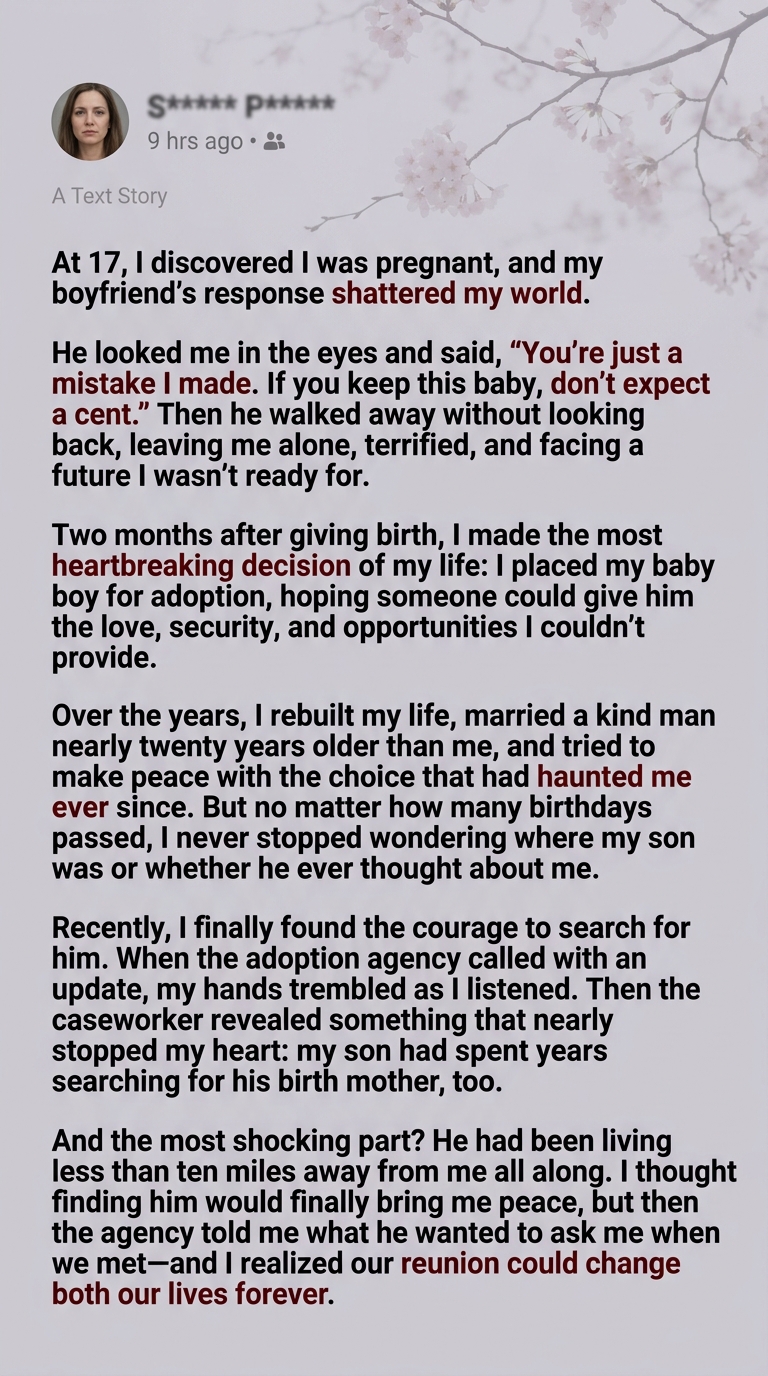
I Gave My Baby Up at 17… Twenty-Six Years Later, He Was Searching for Me, Too
At seventeen, I thought my life was over.
The pregnancy test sat on the bathroom counter, two pink lines staring back at me like a sentence I couldn’t escape. My hands shook as I waited for my boyfriend, Jason, to come over. I had imagined telling him a hundred different ways, hoping that once he heard the news, he would hold me, tell me we would figure things out, and promise that I wouldn’t face it alone.
Instead, he stared at me as if I had ruined his life.
“You’re just a mistake I made,” he said coldly. “If you keep this baby, don’t expect a cent from me.”
“Jason, please,” I whispered. “I’m scared.”
He grabbed his jacket.
“So am I. But I’m not throwing my future away.”
Then he walked out.
He never called again.
My parents were disappointed and frightened, but they eventually helped me through the pregnancy. I finished school as best I could, worked part-time whenever I was able, and spent countless nights lying awake, wondering how a girl who still needed permission to stay out late was supposed to raise a child.
When my son was born, I named him Noah.
The first time I held him, he opened his tiny hand and wrapped his fingers around mine. His face was red from crying, his hair was soft against my cheek, and he smelled like warmth and new beginnings.
I fell in love with him instantly.
That was what made the decision so unbearable.
I had no stable income, no place of my own, and no partner willing to help. My parents loved me, but they could not raise another child indefinitely. I spent weeks exploring every option I could find, asking questions I was ashamed to ask and crying whenever someone spoke about Noah’s future as if it were something I had already lost.
Eventually, I met with an adoption counselor.
She explained that there were families who had spent years hoping for a child. Families who could offer stability, time, and opportunities I could not yet provide.
I wanted to believe that love meant keeping him close.
But I was beginning to understand that love sometimes meant making a choice that broke your own heart.
When Noah was two months old, I placed him for adoption.
The morning I said goodbye, I dressed him in a pale blue outfit and held him longer than I should have. I memorized the curve of his nose, the little crease above his eyebrows, and the way he settled when I hummed softly.
“I’m sorry,” I whispered against his forehead. “I hope you have a beautiful life. I hope you never have to wonder whether you were wanted.”
Then I handed him to the woman who would become his adoptive mother.
I watched her cradle him carefully, as though he were the most precious thing in the world.
And I knew I had made the right decision.
I also knew that knowing something was right did not make it hurt any less.
For years, I carried Noah in silence.
I finished school, found steady work, and slowly built a life of my own. I met Michael when I was twenty-five. He was nearly twenty years older than me, patient in ways I had never experienced, and kind without making a performance of it.
He never treated my past as a stain.
When I finally told him about Noah, I expected him to look at me differently.
Instead, he took my hand.
“You were seventeen,” he said. “You made the best decision you could with what you had. You don’t have to punish yourself for the rest of your life.”
I married him two years later.
We built a comfortable home, took small trips, celebrated ordinary milestones, and learned how to be happy together. Michael never tried to replace the child I had lost. He simply made room for the part of my heart that had never stopped loving him.
Still, every year on Noah’s birthday, I bought a small cake.
Sometimes I lit a candle. Sometimes I just sat at the kitchen table and wondered whether he had inherited my laugh, whether he liked the same books I did, and whether someone had taught him to ride a bicycle while running beside him.
I wondered if he ever thought about me.
Most of all, I wondered whether he believed I had abandoned him.
I had no way to answer that question.
The adoption had been arranged through an agency, and the records remained confidential. I respected Noah’s privacy, even when the silence became almost unbearable.
Then, shortly after my forty-fourth birthday, something changed.
I was washing dishes when Michael came into the kitchen and found me staring out the window.
“You’re thinking about him again,” he said gently.
I nodded.
“What if he’s looking for me?” I asked. “What if he isn’t? What if finding me only hurts him?”
Michael dried his hands and stood beside me.
“You don’t have to force a reunion,” he said. “But you can find out whether the door is open. Let him decide what he wants to do with the truth.”
That night, I barely slept.
The following morning, I contacted the adoption agency.
I expected paperwork, waiting lists, and perhaps a polite explanation that nothing could be done.
Instead, the counselor asked me to verify several details from Noah’s adoption file. She explained that, depending on the records and applicable privacy rules, the agency might be able to facilitate contact if both of us consented.
Weeks passed.
Every time my phone rang, my heart leaped.
Then, one rainy Tuesday afternoon, the agency called.
“Is this Claire Bennett?” the caseworker asked.
“Yes.”
“My name is Ms. Harris. I’m calling about your request concerning your son.”
I gripped the edge of the kitchen counter.
“Have you found him?”
There was a brief pause.
“Yes. We’ve located information that appears to match his records, and we’ve confirmed that he has also registered a search for his birth mother.”
I stopped breathing for a moment.
“He’s looking for me?”
“Yes,” she said softly. “He has been looking for several years.”
Tears filled my eyes so quickly that the kitchen blurred.
For twenty-six years, I had imagined Noah living his life somewhere beyond my reach. I had pictured him growing up in another city, perhaps another state, never knowing how often I thought about him.
And all that time, he had been searching, too.
Then Ms. Harris told me where he lived.
Less than ten miles away.
He had grown up, studied, worked, and built a life almost within reach of mine. We might have passed each other in a grocery store, waited at the same traffic light, or stood in line at the same coffee shop without knowing who we were to each other.
The distance between us had been so small.
The years between us had been enormous.
“Does he want to meet me?” I asked.
“He has agreed to a possible first meeting, provided you both consent. But before we arrange it, there’s something he wants you to know.”
My fingers tightened around the phone.
“What is it?”
“He has a question he has carried with him for a long time,” she explained. “He doesn’t want to accuse you of anything. He simply needs to understand something about his adoption before he can decide what kind of relationship he wants with you.”
My stomach twisted.
“What does he want to ask?”
Ms. Harris took a breath.
“He wants to know whether you ever tried to find him before now.”
The words landed harder than any accusation could have.
For twenty-six years, I had wondered whether Noah thought I had forgotten him. Now I learned that he had wondered whether I had forgotten him.
“No,” I whispered, then corrected myself. “I mean, I never contacted him directly. I didn’t know how. I was afraid of disrupting his life. I thought searching for him might make him feel that I was trying to take something away from the family who raised him.”
“Would you be comfortable explaining that to him?” she asked.
“Yes.”
I wiped my face.
“Please tell him I never forgot his birthday. Tell him I never stopped wondering if he was happy. And tell him I never stopped loving him.”
“I can pass that along,” she said. “But it’s important to let him hear your own words when you’re ready.”
After the call, I sat at the kitchen table and cried.
Michael found me there.
When I told him what Noah wanted to ask, he pulled out the chair beside me.
“Then tell him the truth,” he said. “Not the version that makes you look better. The truth.”
For the next several days, I wrote letters I couldn’t finish.
In one, I explained how frightened I had been at seventeen.
In another, I described the morning I said goodbye.
In a third, I apologized for every birthday he had spent wondering why I wasn’t there.
Eventually, I realized I couldn’t prepare an answer that would erase twenty-six years. I could only offer him honesty and let him decide what it meant.
The agency arranged our first meeting at a quiet café on a Saturday afternoon.
I arrived forty minutes early.
I chose a table near the window, ordered a cup of tea I never touched, and watched every person who entered.
At 2:07 p.m., a man in a dark blue jacket walked through the door.
He looked around the café, then stopped when he saw me.
He had my eyes.
Not exactly, perhaps, but close enough that I felt the room tilt beneath me.
He approached slowly.
“Claire?”
I stood so quickly that my chair scraped the floor.
“Yes.”
He swallowed.
“I’m Noah.”
For a moment, neither of us moved.
I had imagined this moment for so long that I thought I would immediately know what to do. I would hug him, tell him I loved him, and somehow bridge the distance between the frightened girl I had been and the man standing in front of me.
Instead, I asked the only question I could manage.
“Would you like to sit down?”
He smiled nervously.
“Yeah. I think I’d better.”
We sat across from each other.
He told me about the parents who had raised him. His adoptive mother was a teacher, and his father repaired musical instruments. They had taken him camping, helped him through college, and supported him when he changed careers. He spoke about them with affection.
I was relieved.
I had always hoped he had been loved.
“They’re my parents,” he said. “I want you to know that. Finding you doesn’t change that.”
“I wouldn’t want it to,” I replied. “They gave you the life I hoped you would have.”
He looked down at his hands.
“They also told me I was adopted when I was little. They never made me feel unwanted. But when I got older, I started wondering about you.”
“I wondered about you every day,” I said.
He looked up.
“Then why didn’t you look for me?”
There it was.
The question that had kept us apart, even when we lived only miles from each other.
I took a slow breath.
“Because I was afraid,” I admitted. “I was afraid you might think I wanted to take you away from your parents. I was afraid you might hate me. And I was afraid that if I found out you were happy, I would have to face the fact that you were happy without me.”
His expression changed, but he didn’t look away.
“I know that doesn’t sound fair,” I continued. “It wasn’t fair to you. I convinced myself that staying away was the best thing I could do for you, but I should have understood that you might have questions of your own.”
He was quiet for a long time.
Then he reached into his jacket and took out a small, folded piece of paper.
“I’ve carried this for years,” he said.
He unfolded it carefully.
It was a photocopy of the brief note I had written when I surrendered him for adoption. The agency had preserved it with his records, and he had received a copy through the appropriate process.
My handwriting was uneven, the ink faded.
I hope you grow up knowing you were wanted. I am giving you a chance I cannot give you yet. Please don’t ever think this was because I didn’t love you.
Noah stared at the note.
“I used to read this whenever I wondered if you regretted having me,” he said. “I didn’t know if you meant it.”
I reached across the table but stopped before touching his hand.
“I meant every word.”
He looked at me, and tears gathered in his eyes.
“There’s something else I need to ask.”
“Anything.”
“When you gave me up, did you ever regret it?”
My heart ached.
“Yes,” I said honestly. “I regretted the circumstances. I regretted being so young and so frightened. I regretted every birthday I missed and every time I wondered whether you needed me. But I never regretted wanting you to have a safe, loving life.”
He lowered his head.
“I think I needed to hear that.”
Then he reached across the table and took my hand.
It was the first time I had touched my son since he was two months old.
I wanted to hold him, but I didn’t pull him toward me. I didn’t ask him to call me Mom. I didn’t tell him that twenty-six years of longing entitled me to anything.
I simply held his hand and let him decide how long to stay.
We talked for nearly three hours.
He asked about his birth, my parents, and the family medical history he had been trying to learn. I answered what I knew and promised to check anything I couldn’t remember. He asked whether I had kept anything from his babyhood.
I told him I had a photograph of him wrapped in a pale blue blanket.
“I’d like to see it someday,” he said.
“Whenever you’re ready.”
Before we left, he hesitated beside the café door.
“Can we do this again?” he asked.
I felt tears return.
“Yes,” I said. “As often as you’re comfortable.”
He smiled.
“Good. Because I have a lot more questions.”
Our first reunion did not magically repair twenty-six years. There were awkward silences, difficult emotions, and days when I wondered whether I had said too much or too little. Noah sometimes needed space, and I learned not to mistake that space for rejection. He continued building his relationship with his adoptive parents, and I never asked him to choose between the family that raised him and the woman who gave birth to him.
Michael welcomed Noah when he was ready to visit our home. He listened more than he spoke, made him coffee, and treated him with the quiet kindness that had helped me trust love again.
A few months later, Noah brought his adoptive parents to dinner.
I was nervous enough to nearly burn the meal, but his mother hugged me when we met.
“Thank you for loving him enough to want him to have a good life,” she said.
I cried into her shoulder.
“I’ve wondered for years whether you hated me.”
She held me a little tighter.
“I never knew you,” she replied. “But I knew he was loved before we ever met him. I hope we can all make room for the truth now.”
That evening, as we sat around the table, Noah showed me a picture of himself as a little boy holding a toy airplane. His father had taken him to an airfield for his fifth birthday because he had been fascinated by planes.
I laughed through my tears.
“I would have bought you every toy airplane in the world if I could have.”
He smiled.
“You don’t have to make up for everything, Claire.”
Then he paused and added, “Just keep showing up.”
That became our promise.
Not a promise to erase the past. Not a promise that we would instantly become mother and son in the way I had imagined when I was seventeen.
A promise to keep showing up.
On Noah’s twenty-seventh birthday, we celebrated together for the first time. I made a small cake, just as I had done privately for years. When I placed it on the table, he noticed the single candle beside it.
“You did this every year?” he asked.
I nodded.
He looked at the candle for a long moment.
Then he hugged me.
“I’m glad you kept remembering,” he whispered.
And for the first time in twenty-seven years, I didn’t have to imagine what my son might say to me on his birthday.
He was standing right there.
I had once believed that giving Noah up meant losing him forever. I had spent years punishing myself for a decision made by a frightened seventeen-year-old who wanted her baby to have a chance at a better life.
Now I understood something I wish I had known sooner.
Love had never disappeared between us. It had simply lived in two separate lives, waiting for the day we were both ready to meet.
I couldn’t give my son back the years we had lost.
But I could give him the truth.
I could listen to his questions.
And I could keep showing up.
Sometimes, a second chance doesn’t arrive with a dramatic apology or a perfect ending.
Sometimes, it begins with two people sitting across from each other in a quiet café, learning how to become family—one honest conversation at a time.