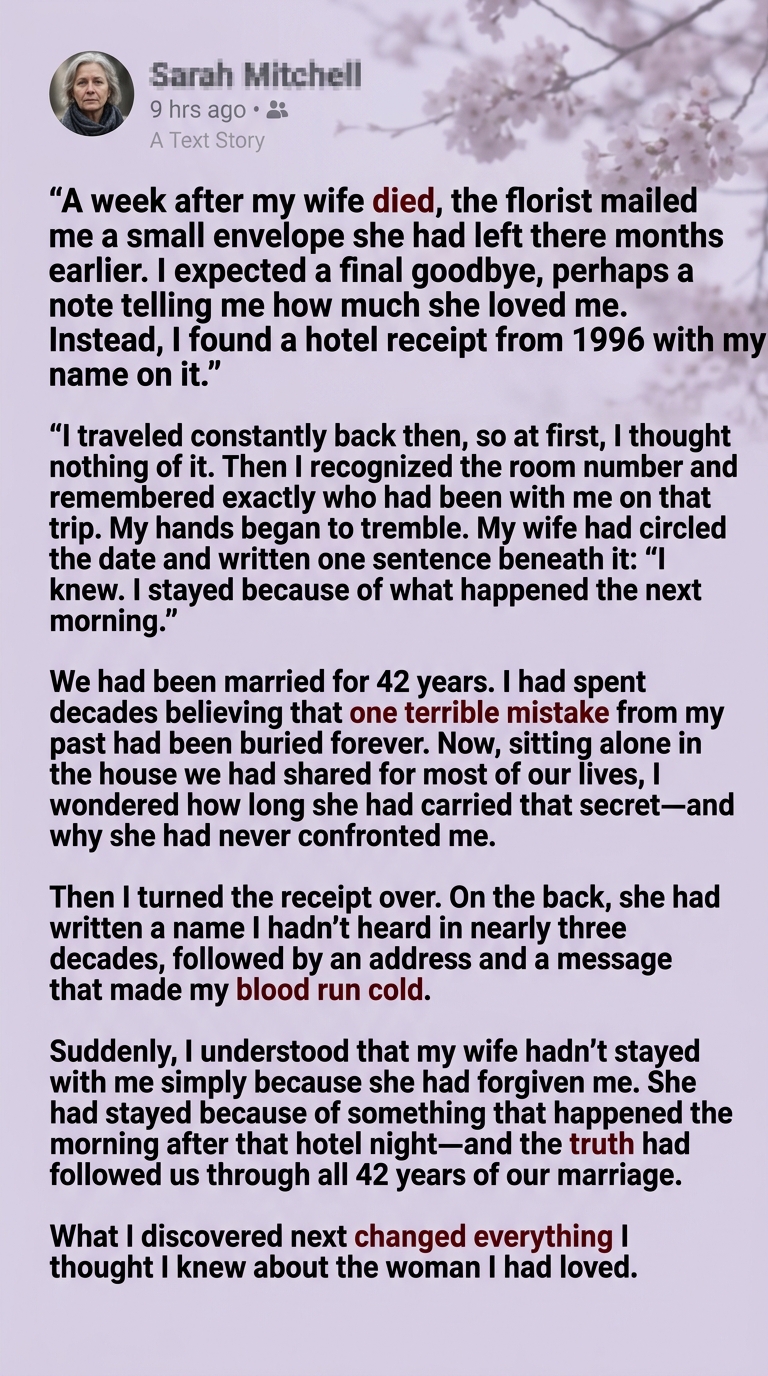
A week after my wife died, the florist mailed me a small envelope she had left there months earlier.
I almost threw it away.
I was seventy years old, living alone in the house where my wife, Margaret, and I had raised our children, celebrated our anniversaries, and grown old together. Every room reminded me of her. Her reading glasses still rested beside her favorite chair. Her blue cardigan hung behind the bedroom door. A half-finished crossword puzzle lay on the kitchen table, waiting for a woman who would never return to complete it.
I had barely slept since the funeral.
When I opened the envelope, I expected a final goodbye. Perhaps a letter telling me how much she loved me, or instructions about something she had wanted me to do after she was gone.
Instead, I found an old hotel receipt.
The paper had turned yellow at the edges. The ink was fading, but the date was still readable.
October 17, 1996.
I stared at it for several seconds.
I had traveled constantly during those years. I worked in commercial sales, sometimes spending three or four nights a week away from home. I stayed in dozens of hotels across the country.
At first, the receipt meant nothing.
Then I saw the room number.
Room 614.
My stomach tightened.
I remembered that room.
And I remembered the woman who had been with me that night.
Her name was Laura Bennett.
She had been a colleague at the time, a woman I had worked with on a major business account. We had traveled together for several meetings, and during one terrible evening, after too much drinking and a long argument about our personal lives, I had crossed a line I could never uncross.
I had been unfaithful to Margaret.
It had happened once. That was what I had told myself for nearly three decades.
Laura and I had agreed never to speak about it again. Within a few months, she left the company, moved away, and disappeared from my life.
I returned home to Margaret, buried the memory beneath work and family responsibilities, and convinced myself that if I never mentioned it, the damage would never reach the people I loved.
Margaret and I had been married for forty-two years.
We raised two children, survived my father’s death, paid off our mortgage, celebrated grandchildren, and held each other through the ordinary disappointments of life. I had believed our marriage was imperfect but honest, built on a foundation that had grown stronger with every passing year.
Then I noticed the sentence Margaret had written beneath the circled date.
“I knew. I stayed because of what happened the next morning.”
My hands began to tremble.
I read the words again.
And again.
I had never told Margaret about Laura.
At least, I had never believed I had.
I sat down at the kitchen table and turned the receipt over.
On the back, in Margaret’s familiar handwriting, was a name I hadn’t heard in nearly thirty years.
Daniel Bennett.
Below it was an address in a small town several hours away.
And beneath that, one final message:
“He deserves to know who you are. Before you decide you have nothing left to lose, go and hear his story.”
I felt the blood drain from my face.
Daniel.
I knew that name.
For years, I had believed Laura had moved away alone. I had never asked whether she had married, had children, or rebuilt her life. I had simply closed that chapter and pretended it had never existed.
But Margaret had known.
She had known about Laura, about the hotel, and about something that happened the next morning.
I couldn’t understand how.
I couldn’t understand why she had stayed.
And I couldn’t understand why she had waited until death to leave me the truth.
That night, I didn’t sleep.
I sat in my study, searching through old photographs and boxes of forgotten papers. I found a picture from a company conference in 1996. Laura stood beside me in the background, smiling at someone outside the frame.
I remembered the morning after the hotel night.
I had woken before dawn, sick with regret. Laura was already dressed, sitting by the window.
She had told me she needed to speak with me.
I had panicked.
I told her that what happened had been a mistake, that I loved my wife, and that nothing could ever come of it. I offered to pay for her taxi to the airport and promised to arrange separate travel for the next business trip.
She stared at me for a long time.
Then she said, “You really think you can walk away from this and pretend it never happened?”
I answered with the worst possible words.
“I have a family. I can’t destroy my life over one night.”
She looked away.
I left the hotel shortly afterward.
For twenty-nine years, I had remembered that conversation as the end of the affair.
Now I wondered whether it had been the beginning of something I had never understood.
The next morning, I drove to the address Margaret had written.
The journey took almost four hours. Rain fell against the windshield, and every mile made me more uncertain about what I was doing.
The address led to a modest brick house with a small garden and a wooden porch.
A man answered the door.
He appeared to be in his late twenties or early thirties, with dark hair beginning to gray at the temples. His eyes were familiar in a way that unsettled me.
“Can I help you?” he asked.
I struggled to speak.
“Are you Daniel Bennett?”
“Yes.”
“My name is Robert Hayes. I was a friend of your mother’s.”
His expression changed immediately.
“My mother died when I was sixteen,” he said. “How did you know her?”
I took the receipt from my pocket.
“I think your mother and I need to have a conversation that should have happened a long time ago.”
Daniel stared at the paper.
Then he looked at my face.
“Come inside,” he said quietly.
We sat in a small living room filled with books and framed photographs. On the mantelpiece stood a picture of Laura holding a baby wrapped in a yellow blanket.
Daniel followed my gaze.
“That was me,” he said. “She used to tell me that the day I was born changed her life.”
I swallowed.
“How old are you?”
“Twenty-nine.”
The room seemed to grow smaller.
I did the arithmetic.
October 1996. A child born the following year.
I looked at him again, unable to escape the possibility forming in my mind.
“Daniel,” I said carefully, “did your mother ever tell you who your father was?”
He nodded slowly.
“She told me his name was Robert. She said he was married, and that when she told him she was pregnant, he refused to be part of our lives.”
I couldn’t breathe properly.
“That isn’t how I remember it,” I whispered.
Daniel’s expression hardened.
“Then perhaps you should tell me what you remember.”
For the first time in twenty-nine years, I had no excuse ready.
I told him about the hotel, the affair, and the conversation the next morning. I admitted that I had panicked and left, convinced that silence was the easiest way to protect my marriage.
I also told him I had never known Laura was pregnant.
Daniel listened without interrupting.
When I finished, he stood and walked toward the window.
“My mother never asked you for money,” he said. “She worked two jobs to raise me. She never wanted me to hate you, but she never wanted me to believe that you had chosen us and then been taken away.”
I lowered my head.
“I am sorry.”
He turned around.
“Are you sorry you hurt my mother, or are you sorry you might be my father?”
The question struck harder than any accusation could have.
I wanted to tell him that I was sorry for everything. But I understood that words would mean very little to a man who had spent his entire life growing up without answers.
“I don’t know how to make this right,” I admitted. “But I want to find out the truth. If you’re willing, we can arrange a DNA test.”
Daniel considered it for a long moment.
Then he nodded.
“Fine. But I don’t want promises. I want honesty.”
We arranged the test through a legitimate laboratory and waited for the results.
Those two weeks were the longest of my life.
I returned home and spent hours looking through the photographs Margaret and I had collected over four decades. I remembered her laughing in our first apartment, holding our newborn daughter, dancing with me at our silver anniversary, and sitting beside my hospital bed after my heart surgery.
Had she known about Daniel all those years?
Had every happy memory been accompanied by a secret she could never discuss?
I began to understand that the question was no longer simply whether I had a son.
It was what Margaret had carried alone—and why.
When the test results arrived, I opened the envelope with shaking hands.
The conclusion was clear.
Daniel was my biological son.
I sat down and wept.
I had missed his first steps, his first day of school, his birthdays, his childhood illnesses, his graduation, and every moment that had shaped him into the man I had met on that rainy afternoon.
I had not known those moments existed.
But ignorance did not erase the consequences of my choices.
I called Daniel and told him the result.
He was quiet for a long time.
Then he said, “I need some time.”
I told him I understood.
After we hung up, I returned to Margaret’s envelope and read her final message again.
“He deserves to know who you are.”
Now I needed to know what Margaret had meant by the morning after the hotel night.
I searched our old files, hoping to find a letter, a diary, or some record of how she had discovered the affair.
Eventually, I found a small notebook tucked into a box of photographs from the late 1990s.
It belonged to Margaret.
Most of the pages contained grocery lists, notes about our children’s school schedules, and reminders about family birthdays. But near the back, I found an entry dated October 19, 1996—two days after the hotel receipt.
I read it standing beside the desk.
Robert came home today looking like a man who had seen his own future collapse. He thinks I don’t notice when he lies. I noticed the hotel charge. I noticed the name on the receipt he left in his coat. I noticed the way he could barely look at me.
My throat tightened.
The entry continued.
I wanted to scream. I wanted to pack the children’s things and leave. But before I could decide what to do, a woman called the house.
I stopped reading.
Margaret had received a call from Laura.
According to the notebook, Laura had told her about the affair and said she might be pregnant. She hadn’t called to demand money or threaten our marriage. She had called because she was frightened and wanted Margaret to know the truth before she made any decisions about her future.
Margaret had asked her one question.
“Does my husband know?”
Laura had answered, “He knows what happened. He doesn’t know about the baby.”
Margaret wrote that she had been furious—not only because I had betrayed her, but because I had made a decision that could affect another woman’s life and then walked away without considering the consequences.
She considered leaving me.
She even packed a suitcase.
But the next morning, something else happened.
Our daughter, Emily, was eight years old at the time. She woke with a high fever and severe abdominal pain. Margaret rushed her to the hospital while I was still away on business.
The doctors discovered that Emily had acute appendicitis. She needed emergency surgery.
Margaret spent hours beside our daughter’s bed, terrified that something might go wrong. When I finally arrived at the hospital, she told me what had happened to Emily and watched me hold our sleeping child.
That was the morning she had referred to on the receipt.
Not because Emily’s illness erased my betrayal.
Not because Margaret suddenly stopped hurting.
But because, while watching our daughter recover, Margaret realized that she could not make a life-changing decision in the middle of a crisis and anger.
She decided to stay for the time being, to protect the stability of our young children, and to give herself time to understand what she wanted.
But the notebook revealed something else.
Margaret had never intended to let the truth disappear forever.
She wrote that she had contacted Laura again and offered to help her find a lawyer and access any support she needed. Laura refused financial assistance, but she accepted help locating a local support group for single mothers.
Margaret also wrote that she had considered telling me about Laura’s pregnancy when I returned home. But before she could speak, I had come into the kitchen, kissed her cheek, and started talking about the next business trip as though nothing had happened.
She realized then that I was determined to bury the night rather than face it.
And she made a choice of her own.
She would not pretend that I had done nothing wrong. She would not forget. But she would decide what to do about our marriage in her own time.
The notebook contained one final entry, written several years later.
I stayed because I still loved him, but love was not the only reason. I stayed because our children needed stability, because I wanted to see whether the man I married could become someone more honest, and because I refused to let one terrible decision determine every remaining day of my life.
But staying does not mean the wound disappears. If I never tell him, he will continue believing that silence has no cost.
I closed the notebook and covered my face with my hands.
For years, I had congratulated myself for keeping my family together.
I had treated our long marriage as evidence that my secret had caused no lasting damage.
I had been wrong.
Margaret had not stayed because the affair meant nothing.
She had stayed while carrying a truth that changed how she understood me, herself, and the life we shared.
And she had found a way to keep living without allowing that truth to consume every part of her.
I began to understand why she had sent me to Daniel.
She had not wanted me to spend my remaining years drowning in guilt. She wanted me to face the person whose existence had been shaped by my decision to walk away.
A few days later, Daniel agreed to meet me again.
We sat together at a quiet restaurant halfway between our homes. He brought a photograph of Laura, taken a few years before she died.
“She kept this picture in her bedroom,” he said, placing it on the table. “She never told me everything about you. I think she wanted to protect me from feeling like a mistake.”
I studied the photograph.
Laura was smiling at the camera, her eyes bright and her hair tucked behind one ear.
“I wish I had known,” I said.
Daniel looked at me.
“You could have known if you’d asked. You made a choice not to.”
He was right.
I had no right to blame time, distance, or circumstance for a decision I had made myself.
“I can’t give you back the years I missed,” I said. “I can’t ask you to call me Dad, and I won’t demand a place in your life. But if you want to know me, I would be grateful for the chance.”
Daniel looked down at his hands.
“My mother loved me,” he said. “She never made me feel unwanted. But I spent years wondering why my father wasn’t there.”
His voice broke slightly.
“I don’t know what I feel about you yet.”
“You don’t have to decide today.”
For the first time, he seemed relieved.
We finished our meal and talked about ordinary things. His work. His home. The books he liked. The kind of music his mother used to play while cooking.
Before we parted, he handed me a small envelope.
Inside was a letter Laura had written shortly before she died.
Daniel had kept it because he thought I might need to understand her side of the story.
The letter did not accuse me of destroying her life. It did not ask me for money or forgiveness.
It said she had once believed I would return and choose to be part of her child’s life. Eventually, she accepted that I would not.
She built a life she was proud of, raised Daniel with love, and stopped waiting for me.
Near the end, she wrote:
I hope one day you will understand that the worst thing you did was not loving me for one night. It was believing that walking away meant you no longer had a responsibility to the people your choices affected.
I read that sentence several times.
It was the truth I had spent twenty-nine years avoiding.
Over the months that followed, Daniel and I began speaking occasionally. We did not become father and son overnight. We were two adults trying to understand a connection that had existed long before either of us knew how to name it.
I answered his questions honestly. When I didn’t remember something, I said so. When I had behaved selfishly, I admitted it without trying to soften the truth.
He told me stories about Laura that made me smile and ache at the same time.
She had loved gardening. She had taught him to cook. She had saved every birthday card he had ever made her.
He also told me about the difficult years, the times she worked late, the nights she cried after receiving another medical bill, and the way she always made him feel that he was worth every sacrifice.
I listened.
For the first time, I understood that my secret was not merely an episode from my past. It had been part of another family’s history.
I could not rewrite that history.
But I could stop pretending it had never existed.
A year after Margaret’s death, I returned to the cemetery with flowers for my wife.
I stood beside her grave and told her about Daniel, about the DNA test, and about the conversations that had begun between us.
I thanked her for leaving the receipt.
I also apologized.
“I thought staying meant you had forgiven me,” I whispered. “I thought because we grew old together, the truth had stopped hurting you. I understand now that I was wrong.”
The wind moved gently through the trees.
“I wish I had told you the truth myself. I wish I had faced what I did instead of letting you carry it alone.”
I stood there for a long time.
Then I realized that Margaret’s final gift had not been a confession designed to punish me.
It had been an opportunity to become honest before it was too late.
I could not ask Margaret to forgive me again. I could not hear her voice or hold her hand. But I could honor the courage she had shown by finally facing the consequences of my actions.
And I could choose not to repeat the same mistake with Daniel.
Before I left the cemetery, I placed the old hotel receipt inside my coat pocket.
For twenty-nine years, I had treated that night as a closed chapter.
Now I understood that some chapters do not end simply because we stop reading them.
Sometimes, they remain open in another person’s life, waiting for us to find the courage to face the truth.
THE END
A FINAL MESSAGE
A long marriage does not prove that no one was hurt. Silence is not always forgiveness, and staying is not the same as forgetting.
We cannot change the choices we made decades ago, but we can take responsibility for them today. We can tell the truth, acknowledge the people affected by our decisions, and offer honesty without demanding forgiveness in return.
Sometimes, the most important legacy we leave behind is not the life we believed we had built, but the courage to face the truth about it.

