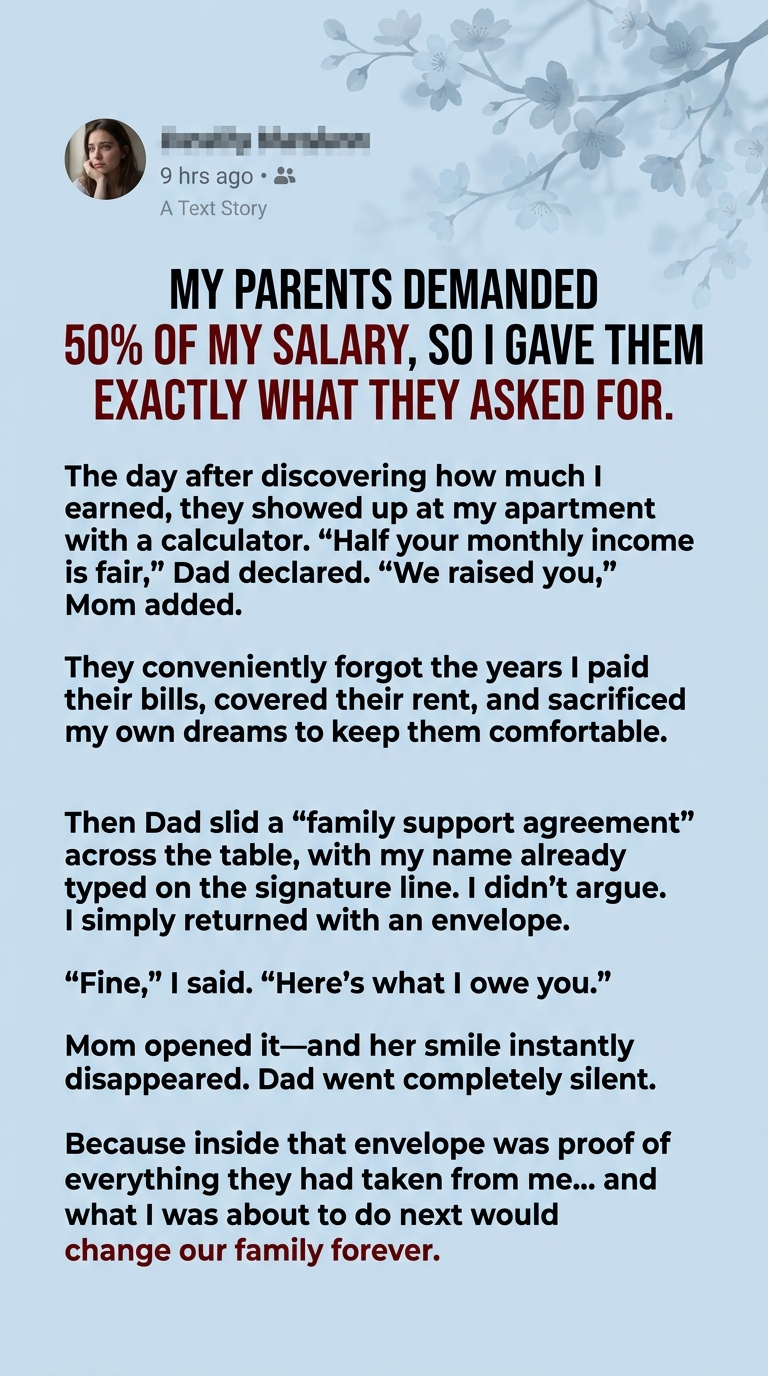
The day my parents discovered how much I earned, they arrived at my apartment with a calculator.
Not a birthday cake. Not a home-cooked meal. Not even a phone call asking whether I was free.
A calculator.
My father, Richard, walked in first, carrying the confidence of a man who believed that being a parent gave him permanent authority over his adult child’s life. My mother, Linda, followed with a folder tucked under her arm.
I was still wearing my work clothes when Dad sat at my kitchen table and placed the calculator in front of him.
“We need to discuss your financial responsibilities,” he announced.
I looked at the calculator, then at my mother.
“Good evening to you, too.”
“Don’t be sarcastic, Emily,” Mom replied. “Your father and I have been talking, and we think it’s time you started contributing properly to the family.”
I was twenty-nine years old, worked as a financial analyst, and had spent the previous seven years helping my parents stay afloat.
I had paid their electricity bills when Dad’s business struggled. I had covered three months of rent when they fell behind. I had paid for Mom’s dental treatment, repaired their leaking roof, and quietly settled debts they were too embarrassed to discuss with relatives.
There had been months when I had skipped vacations, postponed buying a car, and eaten cheap meals at home because my parents needed help.
I never kept score.
They were my parents. I loved them.
Or at least, I believed love meant helping without asking for anything in return.
Dad tapped the calculator.
“We know what you earn now.”
My stomach tightened.
A week earlier, I had received a promotion and a significant salary increase. During a family dinner, I had mentioned it because I was happy. For once, I wanted to share something good without worrying about someone else’s problems.
I had earned that promotion after years of late nights, difficult exams, and turning down opportunities that would have taken me too far from home.
I thought my parents would be proud.
Instead, Dad entered a number into his calculator.
“Half your monthly income is fair,” he declared.
I stared at him.
“Half?”
“Fifty percent,” he repeated. “You make good money. Your mother and I raised you, fed you, clothed you, and paid for your education. You wouldn’t be where you are without us.”
Mom nodded.
“We never asked you to repay us when you were young. Now that you’re successful, it’s your turn to help us.”
I took a slow breath.
“I’ve been helping you for years.”
“And we appreciate it,” Mom said quickly. “But that’s different. Those were occasional payments. We’re talking about a proper arrangement now.”
Dad pushed the folder toward me.
Inside was a document titled Family Support Agreement.
My full name had already been typed onto the signature line.
The agreement required me to transfer fifty percent of my net monthly salary to my parents, beginning the following month. It also included a clause stating that the amount could be reviewed annually based on their financial needs.
There was no end date.
I read it twice.
“You expect me to sign this?”
“We expect you to honor your responsibilities,” Dad replied.
“What happens if I lose my job? What happens if I want to buy a home? What happens if I have a family of my own?”
Dad shrugged.
“Those are things you can work out later. Your mother and I need stability now.”
I looked at Mom, hoping she might recognize how unreasonable this was.
Instead, she said, “Don’t make us feel guilty for raising you.”
Something inside me grew very still.
For years, I had tried to be the good daughter. I had convinced myself that every sacrifice was temporary, every emergency would eventually pass, and one day my parents would stand on their own feet.
But every time I helped, the next request became larger.
The money I gave them had stopped being a gift. It had become an expectation.
And now they were asking me to sign away half my future as if I were an employee they had hired.
I closed the folder.
“All right,” I said.
Dad blinked.
“All right?”
“You want fifty percent of my salary. I understand.”
Mom exchanged a satisfied look with him.
“Good,” she said. “We knew you’d see reason.”
I didn’t argue. I didn’t cry. I didn’t remind them about the rent, the bills, or the roof.
I simply stood up, walked to my desk, and opened a drawer.
Inside was a thick envelope I had been preparing for several weeks.
I returned to the table and placed it in front of Dad.
“Fine,” I said. “Here’s what I owe you.”
Mom smiled as she reached for it.
Then she opened the envelope.
Her smile disappeared.
Dad leaned forward to see what she was holding.
For several seconds, neither of them spoke.
Inside were bank statements, copies of payment receipts, a spreadsheet listing seven years of financial support, and a letter from a lawyer.
At the top of the spreadsheet was a single figure.
The total amount I had given them.
Dad stared at the number.
Mom’s hands began to tremble.
“Emily,” she whispered, “what is this?”
I pulled out a chair and sat across from them.
“It’s the record you forgot to ask for.”
Mom pulled out the first bank statement.
“This can’t be right.”
“Every payment is documented,” I replied. “Rent. Electricity. Medical bills. The roof repair. The credit card balances. The money I transferred when Dad’s business nearly collapsed.”
Dad flipped through the pages, growing more uncomfortable with each one.
“You kept records of everything you gave us?”
“I kept records because I work in finance. I never planned to use them against you.”
“Then why bring them now?” Mom demanded.
“Because you just told me I owe you half my salary.”
I pointed to the spreadsheet.
“Over seven years, I’ve transferred $148,600 to you. That doesn’t include the groceries I’ve bought, the holidays I’ve paid for, or the times I’ve taken unpaid leave to help you when something went wrong.”
Mom looked down at the total.
“That seems impossible.”
“It averages more than $1,700 a month. Some months were much higher.”
Dad cleared his throat.
“We never forced you to give us that money.”
“No. You didn’t. You asked, and I gave it because I loved you. But you cannot tell me that I owe you half my income because you raised me while pretending the last seven years never happened.”
Mom pushed the papers away.
“We didn’t come here to argue about the past.”
“Neither did I. You brought an agreement demanding half my future.”
Dad’s jaw tightened.
“We’re your parents, Emily. This isn’t some business transaction.”
“Then why did you bring a contract?”
The room fell silent.
I took the second document from the envelope. It was a letter from my lawyer explaining that I would not be signing the agreement and that I was ending the recurring transfers I had arranged for them. Any further support would be voluntary, discussed in advance, and limited to what I could genuinely afford.
Dad read the letter twice.
“You hired a lawyer against your own parents?”
“No. I hired a lawyer to help me understand my rights and make sure my finances were protected. There’s a difference.”
Mom’s eyes filled with tears.
“After everything we’ve done for you, this is how you repay us?”
That question hurt more than I expected.
I had heard versions of it for years. Whenever I said I couldn’t afford something, whenever I asked for time to save, whenever I mentioned a dream that required money, the conversation somehow ended with me feeling guilty.
But this time, I didn’t apologize for having limits.
“Mom, I am not refusing to love you. I am refusing to sign a document that gives you half of everything I earn, indefinitely.”
Dad stood up.
“So all those years of helping us meant nothing?”
“No,” I said. “They meant so much to me that I kept giving even when it hurt. That’s why this is so difficult.”
I looked at the envelope between us.
“I used to believe that if I helped enough, eventually you wouldn’t need me to rescue you anymore. I thought we were working toward a future where you were secure and I could build a life of my own.”
My voice shook, but I continued.
“Instead, every time I helped, the next request became bigger. I stopped saving for a house. I postponed traveling. I stayed in a job I was ready to leave because I was afraid you would need me. And when I finally earned more money, you didn’t ask what I wanted to do with it. You arrived with a calculator.”
Mom began to cry.
Dad remained standing, holding the agreement he had brought for me to sign.
Then he said something I hadn’t expected.
“You don’t understand what we’ve been dealing with.”
“Then tell me.”
He looked at Mom.
She stared at the floor.
For the first time that evening, they seemed less angry than frightened.
Dad sat back down and admitted that his business had never fully recovered from its earlier losses. They had borrowed against their savings and accumulated debt. Rather than tell me how serious the situation had become, they had repeatedly asked for money to cover one problem at a time.
The more I earned, the more they convinced themselves that I could solve it.
“We thought you could afford it,” Mom whispered.
“I could afford to help,” I said. “That doesn’t mean I could afford to give away half my life.”
Dad rubbed his forehead.
“We didn’t know how else to manage.”
I wanted to feel only anger, but I also felt sadness. My parents were not strangers trying to steal from me. They were people I loved who had made poor financial decisions and then allowed fear and entitlement to turn my generosity into an obligation.
That explained their behavior.
It did not make the agreement fair.
I asked for a complete picture of their finances: their income, debts, expenses, and any assets they could use to support themselves. I told them I would help them work with a financial counselor if they were willing to be honest about their situation.
“But I will not sign this agreement,” I said. “And I will not continue sending money without knowing what it’s for.”
Dad looked at the signature line with my name printed beneath it.
“What if we really need help?”
“Then we can talk about a specific need. I will consider what I can reasonably do. But you cannot decide that half my salary belongs to you.”
Mom wiped her eyes.
“So you’re just going to leave us to struggle?”
“No. I’m asking you to let me help without making me responsible for your entire future.”
They left that evening without the signed agreement.
For the first time in seven years, I did not send them money at the end of the month.
And the silence that followed was harder than I expected.
For several weeks, my mother called almost every day.
Sometimes she cried. Sometimes she reminded me of the sacrifices they had made when I was a child. Once, she said that my father hadn’t slept properly since our conversation.
I listened, but I stopped trying to make every difficult feeling disappear by sending money.
My father didn’t call at all.
I knew he was angry. I also knew that if I rushed to fix his anger, we would return to the same arrangement with a different excuse.
So I waited.
During that time, I finally looked honestly at my own finances. I calculated how much I needed for an emergency fund, how much I could invest, and how long it would take me to save for a home if I stopped treating every parental request as an emergency.
The numbers were painful.
I had earned a good salary for years, yet my savings were far smaller than I had expected. I had spent so much energy keeping my parents comfortable that I had neglected the person I was supposed to be building a future for.
I created a plan.
I set up automatic savings. I established a separate emergency fund. I stopped feeling guilty about buying myself decent clothes or taking a weekend away. I even enrolled in a professional course I had postponed twice because I was worried about the cost.
For the first time, my paycheck belonged to a future I was allowed to imagine.
Two months later, Dad called.
“Can we meet?” he asked.
We met at a small café near their house. He looked older than I remembered, though perhaps I was seeing him differently now.
He didn’t bring a calculator.
He brought a notebook.
“We spoke to a financial counselor,” he said. “Your mother and I. We listed everything. The debts, the bills, the money coming in.”
He slid the notebook across the table.
“We should have done this years ago.”
I read the pages. Their situation was difficult, but it was not hopeless. They had expenses they could reduce, a debt they could restructure, and a few financial decisions they needed to make honestly rather than postpone.
Dad took a breath.
“I thought that because we raised you, you would always put us first. I never stopped to consider that you had a life you were trying to build.”
It wasn’t a perfect apology. He still spoke as though he had only recently discovered that I was an adult.
But it was the first time he had acknowledged my future without treating it as something that came after his needs.
“I’m willing to help you make a plan,” I told him. “I can also contribute a fixed amount toward a specific expense if it fits my budget. But we need to agree on it together. There will be no fifty-percent rule.”
He nodded.
“And the money you’ve already given us?” he asked.
“I’m not asking you to repay every dollar. I gave that money voluntarily. But I need you to understand that those payments were help, not proof that you own my future.”
Dad looked down at his notebook.
“I understand.”
I couldn’t tell whether he fully did.
But this time, I didn’t need to convince him.
Mom took longer to accept the new arrangement. She still occasionally compared me with relatives who supported their parents more generously. She sometimes described my boundaries as distance.
I learned not to turn every comment into a debate.
I could love her without agreeing with her.
I could help when I chose to without making promises I couldn’t keep.
And I could say no without explaining myself for an hour.
A year later, I bought a small apartment of my own.
It wasn’t luxurious, and the monthly payments required careful planning. But the keys were in my name, the savings were mine, and the decision had been made without asking whether I would have enough left to rescue someone else.
On the day I moved in, my parents came to visit.
Mom walked through the rooms, touching the kitchen counter and looking out the windows.
“You’ve made a lovely home,” she said.
“Thank you.”
She stood quietly for a moment.
“I’m sorry we made you feel as though you had to earn our love by helping us.”
I looked at her, surprised by the words.
She continued, “We were frightened about money. We saw how successful you were becoming, and we convinced ourselves that asking for more was reasonable. We stopped seeing what it was costing you.”
I hugged her.
I didn’t tell her that everything was forgotten. It wasn’t. Trust takes time to rebuild, even within a family.
But I was grateful that she had finally said what I needed to hear.
Dad helped carry a box into the bedroom. Before leaving, he placed a small envelope on my kitchen table.
Inside was a handwritten note.
You were our daughter before you earned a salary. We should never have made you feel that your worth to this family depended on what you could give us.
I read it twice.
For years, I had believed that being a good daughter meant giving until there was nothing left to give. I had confused sacrifice with love and guilt with responsibility.
Now I understood something I wished I had learned sooner.
Parents deserve care and respect. Adult children deserve the same.
Helping family can be an act of love, but love cannot be measured by a percentage of someone’s paycheck. It cannot be demanded through a contract, and it should never require a person to abandon every dream of their own.
My parents had asked me for fifty percent of my salary.
I gave them something else instead: a record of the help I had already provided, a clear boundary, and the chance to build a healthier relationship with me.
The envelope did not destroy our family.
It ended the arrangement that had been quietly hurting it.
And the most important thing I gained was not the money I stopped sending.
It was the freedom to be their daughter without having to become their entire financial plan.

