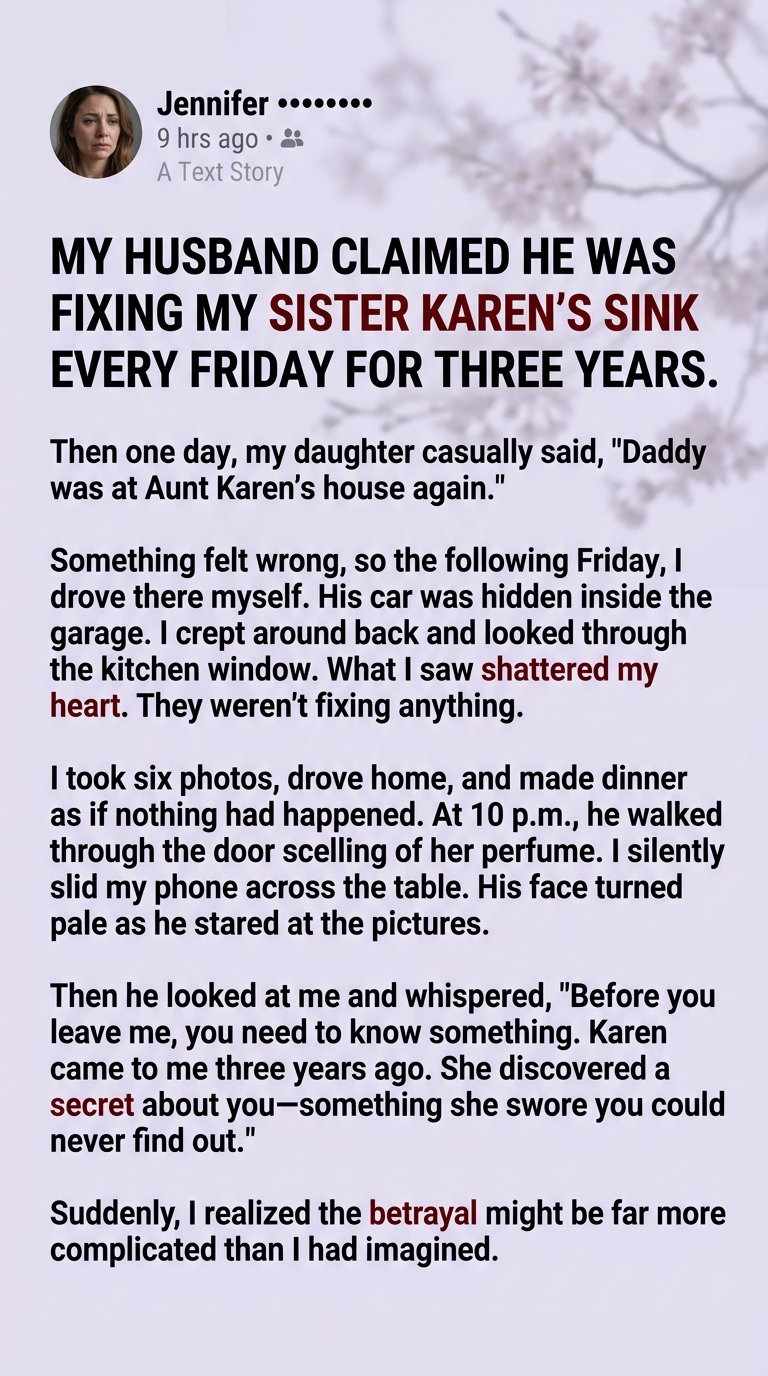
My Husband Visited My Sister Every Friday—Until I Discovered Their Secret
For three years, my husband, David, had one unbreakable Friday tradition.
He went to my younger sister Karen’s house to fix her kitchen sink.
Every Friday evening, shortly after dinner, he would grab his toolbox, kiss me on the cheek, and say, “Karen’s plumbing is acting up again. I’ll be back in a couple of hours.”
At first, I thought nothing of it.
David had always been good with his hands. He could repair a leaking faucet, replace a broken cabinet hinge, and make an old appliance work long after everyone else had given up on it. Karen lived alone, and after her divorce, she often needed help around the house.
I was glad my husband was willing to help my sister.
“Tell her to call a plumber eventually,” I would joke.
David would laugh. “Why pay someone for a ten-minute job?”
But the ten-minute jobs somehow lasted three years.
Sometimes he came home late. Sometimes he said he had needed to visit the hardware store. Occasionally, he returned smelling of unfamiliar perfume, which he blamed on Karen’s scented candles.
I noticed these things, but I pushed my suspicions away.
I had a full-time job, a teenage daughter named Sophie, and a household to manage. I didn’t want to become the kind of wife who questioned every hour her husband spent away from home.
Then one Tuesday afternoon, Sophie said something that changed everything.
We were making sandwiches in the kitchen when she casually mentioned that she’d seen her father at Aunt Karen’s house.
“Again?” I asked.
She nodded. “Yeah. I saw his car when I went over to drop off the birthday card. He was there with Aunt Karen.”
I put down the knife.
“When was this?”
“Last Friday. Why?”
“Your dad told me he was fixing her sink.”
Sophie shrugged.
“I don’t know about the sink, Mom. They were in the kitchen together.”
She said it without suspicion, then went back to making her sandwich.
But I couldn’t stop thinking about her words.
They were in the kitchen together.
There was nothing unusual about that by itself. Karen was my sister. David was my husband. They had known each other for more than a decade.
Still, something about the way Sophie had described it made my stomach tighten.
That Friday, David followed his usual routine.
He finished dinner, rinsed his plate, and reached for his toolbox.
“Karen’s sink again?” I asked.
He didn’t look up.
“Unfortunately.”
“Maybe you should install a new one.”
He smiled. “Maybe I should.”
Then he kissed my cheek and left.
I waited ten minutes before taking my car keys.
I told myself I was going to find out whether there really was a plumbing problem. That was all. If everything was innocent, I would come home embarrassed by my own imagination.
Karen lived twelve minutes away.
When I arrived, I noticed David’s car was nowhere near the front door. For a moment, I felt relieved.
Then I saw a faint reflection from the side of the house.
His car was parked inside the garage.
The garage door was almost completely closed.
I sat in my car for several minutes, staring at it.
My husband had told me he was going to repair a sink. Why was his car hidden inside the garage?
I got out and walked around the side of the house.
The back garden was quiet. Through the kitchen window, I could see the lights above the counter and the table where Karen and I used to sit as children, sharing secrets and whispering about our dreams.
I moved closer.
And then I saw them.
David was standing behind Karen, his arms wrapped around her waist. She leaned back against him, tilted her face toward his, and kissed him.
Not a friendly kiss.
Not a moment that could be misunderstood.
It was the kind of kiss shared by two people who knew exactly what they were doing.
David brushed a strand of hair away from her face. Karen smiled and touched his cheek.
Then he kissed her again.
My husband.
My sister.
The two people I had trusted most in the world.
For several seconds, I couldn’t breathe. My fingers went numb around my phone.
I raised it and took a photograph.
Then another.
I took six pictures in total, making sure I captured enough to remove any doubt about what I had witnessed.
I wanted to throw open the door. I wanted to scream at them and demand to know how long they had been laughing at me behind my back.
Instead, I stepped away from the window.
I returned to my car, drove home, and made dinner.
I even set the table for three.
When Sophie asked where Dad was, I told her he was helping Aunt Karen.
I hated myself for saying it, but I wasn’t ready to explain what I had seen. My daughter deserved the truth, but she didn’t deserve to become the messenger between two adults who had betrayed our family.
At 10 p.m., David finally came home.
He entered the kitchen, loosened his collar, and leaned down to kiss my cheek.
I smelled Karen’s perfume.
He walked toward the refrigerator.
“How was Karen’s sink?” I asked.
“Fine. Finally got the leak under control.”
I looked at him.
“That’s wonderful.”
He smiled, unaware that the world he had built around his lies was already falling apart.
I picked up my phone and slid it across the table.
“What’s this?” he asked.
“Something you should look at.”
He opened the first photograph.
His smile disappeared.
He swiped to the second, then the third. By the time he reached the sixth, his face had turned pale.
He slowly placed the phone on the table.
For a long moment, neither of us spoke.
Then he looked at me and whispered, “Before you leave me, you need to know something.”
I folded my hands in my lap.
“I’m listening.”
David swallowed hard.
“Karen came to me three years ago. She discovered a secret about you. Something she swore you could never find out.”
My heart began to pound.
“What secret?”
He looked toward the hallway, as though checking whether Sophie could hear us.
Then he said five words that made me forget, for a moment, that I was looking at the man who had just betrayed me.
“It’s about your daughter, Sophie.”
I stared at him across the kitchen table.
“What does Sophie have to do with this?”
David dragged a hand over his face.
“Three years ago, Karen found something in your mother’s old belongings. Letters. Photographs. Documents you thought had been destroyed.”
“What documents?”
He hesitated.
“Letters from your biological father.”
For a moment, I genuinely thought I had misheard him.
“My biological father is dead.”
“Your mother told you he was your father. But Karen found letters proving that wasn’t true.”
My mother had died five years earlier. She had been the person who raised me, comforted me, and taught me that family meant standing beside one another even when the truth was difficult.
I had never questioned who my father was.
“What are you talking about, David?”
He looked down at his hands.
“Karen told me your mother had an affair before you were born. She found letters from another man. According to those letters, he believed you were his daughter.”
I felt as though the floor had shifted beneath me.
“That doesn’t mean anything,” I whispered. “Letters aren’t proof.”
“I know.”
“Then why are you telling me this now?”
“Because Karen said she had more documents. She said your mother had lied about the circumstances of your birth, and she was afraid the truth would destroy you.”
I stared at him, struggling to understand why my sister would have kept something like this from me—and why my husband would have allowed it to become part of a secret between them.
“Did you believe her?”
“At first, no. But she showed me the letters.”
“And instead of telling me, you started sleeping with my sister?”
David flinched.
“No. That’s not how I want you to understand it.”
“Then help me understand it.”
He told me that Karen had approached him after finding the letters. She had been frightened about what the revelation might do to our family. She said she needed someone to help her work out what to do with the information.
David listened. He accompanied her to look for more documents. He became the person she called when she was overwhelmed.
And somewhere along the way, their emotional closeness became an affair.
He claimed he had tried to end it more than once, but every time he pulled away, Karen reminded him that he was the only person who knew the secret besides her.
“She said she was afraid you would hate her for hiding it,” he explained. “She said she needed me.”
“And you decided that the best way to help her was to betray me every Friday?”
“No.”
“Then stop making excuses.”
He fell silent.
I pushed the phone farther away from me.
“You had three years to tell me about those letters. You could have brought them home. You could have asked me whether I wanted to know. You could have spoken to a counselor with me. Instead, you made my sister your secret partner and left me to discover it through a kitchen window.”
David began to cry.
I had seen him cry only twice in our marriage: once when his father died, and once when Sophie was born.
I felt no satisfaction watching him now.
“Do you still have the letters?” I asked.
“Yes. Karen has them.”
“Then I want to see them.”
He nodded.
“And tomorrow, you’re going to tell Karen that whatever happened between you two is over. If it isn’t, you can leave this house.”
He looked at me.
“I don’t want to lose you.”
“You should have thought about that before you spent three years making choices for me.”
That night, David slept in the guest room.
I stayed awake until dawn, thinking about the mother who had raised me, the sister who had betrayed me, and the husband who had somehow convinced himself that hiding the truth was a form of protection.
By morning, I knew two things.
I needed to discover the truth about my past.
And I would not let that truth excuse what they had done to me.
The Meeting That Changed Everything
The next afternoon, I drove to Karen’s house.
For the first time in three years, I wasn’t going to check on her or bring her groceries. I wasn’t going to ask whether she needed help with a bill or whether David had managed to fix her sink.
I was going to demand the truth.
Karen opened the door wearing a gray sweater. When she saw me, her expression changed immediately.
“Emily. I wasn’t expecting you.”
“I’m sure you weren’t.”
She glanced toward the street, as if checking whether David had followed me.
I stepped inside.
“Where are the letters?”
Her face went pale.
“So he told you.”
“He told me enough. I want to see everything you found.”
Karen walked to a cabinet in the living room and took out a brown envelope. She held it against her chest for a moment before handing it to me.
Inside were six letters, several old photographs, and a folded document written in my mother’s handwriting.
The letters were dated before I was born. They were from a man named Thomas Reed, addressed to my mother. In them, he spoke about their relationship, his regret at leaving town, and his hope that they could speak again.
One letter, written several months after my birth, contained a sentence that made my hands shake.
If the little girl is mine, I want the chance to know her. I won’t force myself into your life, but please don’t let her grow up believing I never wanted her.
I read it again.
My mother had never told me about Thomas.
The photographs showed a young man standing beside her near a lake. In one, he was holding a baby wrapped in a yellow blanket.
I recognized the blanket.
It had been in a box of my childhood belongings for years.
“Did Mom ever answer him?” I asked.
Karen shook her head.
“Not in the letters I found.”
“Why didn’t you tell me?”
“Because I didn’t know how. I was afraid you would think our whole childhood had been a lie.”
“Our childhood isn’t the question. My identity is.”
She looked down.
“I know.”
I asked her when she had discovered the documents.
“Three years ago. I was helping sort some things from Mom’s storage unit. I found the letters inside an old suitcase.”
“And you went straight to my husband?”
“I panicked. I thought he might know how to handle it.”
“Why not me?”
Karen’s eyes filled with tears.
“Because I was jealous.”
I stared at her.
She continued before I could speak.
“You were always the one everyone admired. Mom trusted you with everything. David was devoted to you. Even when things went wrong, people always assumed you would be the one to fix them. I know that sounds awful, but I’d been carrying those feelings for years.”
“So you found a secret about my birth and decided it was yours to control?”
“I didn’t think it would become this.”
“Then what did you think would happen?”
She covered her face.
“I don’t know.”
I sat down because my legs had begun to tremble.
Karen admitted that she had initially called David because she wanted advice. But she had also enjoyed having something he knew that I didn’t. The secret created a private world between them, and she allowed herself to become attached to the attention he gave her.
When their relationship turned physical, she knew she was crossing a line.
She did it anyway.
“Did you ever intend to tell me?” I asked.
Karen was quiet for so long that I thought she wouldn’t answer.
“Not while it was still happening.”
That was the moment I understood the depth of the betrayal.
She hadn’t simply made one terrible decision. She had maintained a secret for three years while allowing me to trust her with my marriage, my daughter, and my life.
“Did you threaten David with these letters?”
She looked up sharply.
“I never threatened him.”
“Then why did he say he couldn’t leave because you knew the secret?”
“Because he was afraid you would blame him for knowing. He said he couldn’t bear to watch your life fall apart.”
I shook my head.
“He was more afraid of telling me the truth than he was of destroying my marriage.”
Karen didn’t defend him.
I gathered the letters and photographs, leaving the documents in their original order.
“I’m taking copies of these,” I said. “I will decide what to do with them after I’ve spoken to a professional who can help establish the facts.”
“Emily, please. I know you hate me.”
I stopped at the door.
“I don’t know what I feel yet. But you don’t get to decide what I know about my own life anymore.”
I left her standing in the hallway.
For the first time, the secret was no longer hers to control.
The Truth About My Father
I spent the next several weeks trying to make sense of the letters.
I didn’t want to accuse my mother of lying based on a handful of old documents. I also didn’t want to ignore evidence simply because the truth might be painful.
I contacted a family counselor, who helped me work through the shock, and a lawyer, who explained how to approach questions about identity and any available family records. I also spoke with a specialist about whether DNA testing could help establish a biological relationship.
Before I made any decisions, I asked Karen for permission to examine the photographs and letters together with a professional. She agreed.
The evidence showed that Thomas had been in a relationship with my mother around the time I was conceived. It also showed that he had tried to contact her after my birth.
But the letters could not establish paternity on their own.
My mother was gone. I couldn’t ask her why she had never told me about him, whether she had known he might be my biological father, or why she had kept his letters.
That absence became its own kind of grief.
I arranged a DNA test with a relative of Thomas’s family who was willing to participate. The results supported a close biological relationship between me and his family, consistent with Thomas being my biological father.
The news changed how I understood my past, but it didn’t erase the childhood I remembered.
The man who raised me had loved me. He had taught me to ride a bicycle, attended my school performances, and sat beside me through childhood illnesses. Whatever he had known about my parentage, he had been my father in every way that mattered to the life we shared.
And my mother had been the woman who raised me, too. Her secret had complicated my understanding of her, but it could not erase the years she had cared for me.
I decided not to reduce my family history to a single question of biology.
Instead, I began learning about Thomas and the relatives I had never known. They welcomed me cautiously and kindly. They didn’t pretend that DNA alone made us a family, and neither did I. We started with conversations, photographs, and stories about a man whose life had intersected with mine long before I knew his name.
One relative showed me a letter Thomas had written near the end of his life.
It wasn’t addressed to me. He hadn’t known whether I would ever learn the truth. But he had written that he hoped the child he once believed might be his had grown up surrounded by love.
I cried when I read those words.
For years, I had assumed the most painful truth about my family would be discovering that someone had lied to me.
Instead, I found that the truth could contain love and loss at the same time.
I could be grateful for the father who raised me and curious about the man whose biological connection to me had only recently been established. I could love the mother who had cared for me while acknowledging that her silence had left questions I might never fully answer.
None of that changed what David and Karen had done.
Their affair was not an act of protection. It was not an unavoidable consequence of a family secret. It was a series of choices made by two adults who had decided that hiding the truth was easier than facing the consequences.
And I refused to let my newly discovered history become an excuse for their betrayal.
The Decision I Made About My Marriage
David moved into a short-term rental while we decided what came next.
He attended counseling and admitted that he had used the secret as a reason to avoid an honest conversation. He said he had convinced himself that waiting for the right time was kinder than telling me something that might hurt me.
But there had been no right time, because he had never truly intended to risk the consequences.
“I kept telling myself I was protecting you,” he said during one of our conversations. “The truth is, I was protecting myself.”
I believed that he finally understood some of the damage he had caused.
But understanding was not the same as repairing it.
I asked myself whether I could ever trust him again. I thought about the hundreds of Fridays when he had left our house with his toolbox. I remembered the dinners I had kept warm, the explanations I had accepted, and the way he had kissed me when he returned home smelling of my sister’s perfume.
I thought about Sophie, who had trusted both of us to make our home a safe place.
I also thought about the life I wanted beyond the betrayal.
I didn’t want to spend the next decade checking phone records, questioning every late meeting, or wondering whether the person beside me was telling the truth.
So I filed for divorce.
David didn’t fight me on the decision. We worked through the practical arrangements with professional help and focused on protecting Sophie from being drawn into the conflict. We agreed not to use her as a messenger or ask her to take sides.
Karen and I stopped speaking for several months.
She sent letters apologizing, but I wasn’t ready to respond. I needed distance to understand who I was without the role I’d always played in our family: the dependable older sister, the forgiving wife, the person who kept everyone else comfortable.
Eventually, I wrote back.
I told her that I wasn’t ready to restore our relationship, and that any future relationship would require honesty, patience, and respect for my boundaries.
I did not promise forgiveness on a schedule.
She replied that she understood.
It was the first time she had accepted a boundary without trying to negotiate it.
A year later, Sophie and I moved into a smaller house across town. It had a little garden and a kitchen with windows that let in the morning sun.
One Saturday, she helped me unpack a box of photographs.
She found an old picture of me and Karen as children, standing beside our mother at the beach.
“Do you think you’ll ever talk to Aunt Karen again?” she asked.
I sat beside her.
“I don’t know, sweetheart. Maybe one day. But people have to take responsibility for what they do before relationships can heal.”
She nodded slowly.
“Are you okay?”
I looked around our new kitchen.
For the first time in a long time, the silence in the house didn’t feel like a secret.
“Yes,” I said. “I’m getting there.”
And I meant it.
I still had difficult days. I still missed the marriage I thought I had, and I still wished my mother had left me an honest explanation of my beginnings.
But I was no longer living inside a story written by other people.
David had told himself he was protecting me. Karen had told herself she was protecting a secret. Both had taken away my chance to make informed decisions about my own life.
Now those decisions belonged to me.
I had lost a husband and the easy closeness I once shared with my sister. I had also discovered a missing part of my history, learned to set boundaries, and begun rebuilding a life that did not depend on pretending everything was fine.
I never did find out exactly what had happened in every conversation between David and Karen during those three years. I no longer needed every detail to understand the essential truth.
They had betrayed my trust.
Their reasons could explain their behavior, but they could not excuse it.
And my identity was not something they had the right to use as leverage against me.
I used to believe that family was something you protected at any cost.
Now I understand that a family worth protecting must also protect the people within it.
The truth about my birth changed how I understood my past.
The truth about my husband and sister changed how I chose my future.
And for the first time, that future was mine to decide.

