The DNA Test That Exposed My Parents’ Biggest Secret
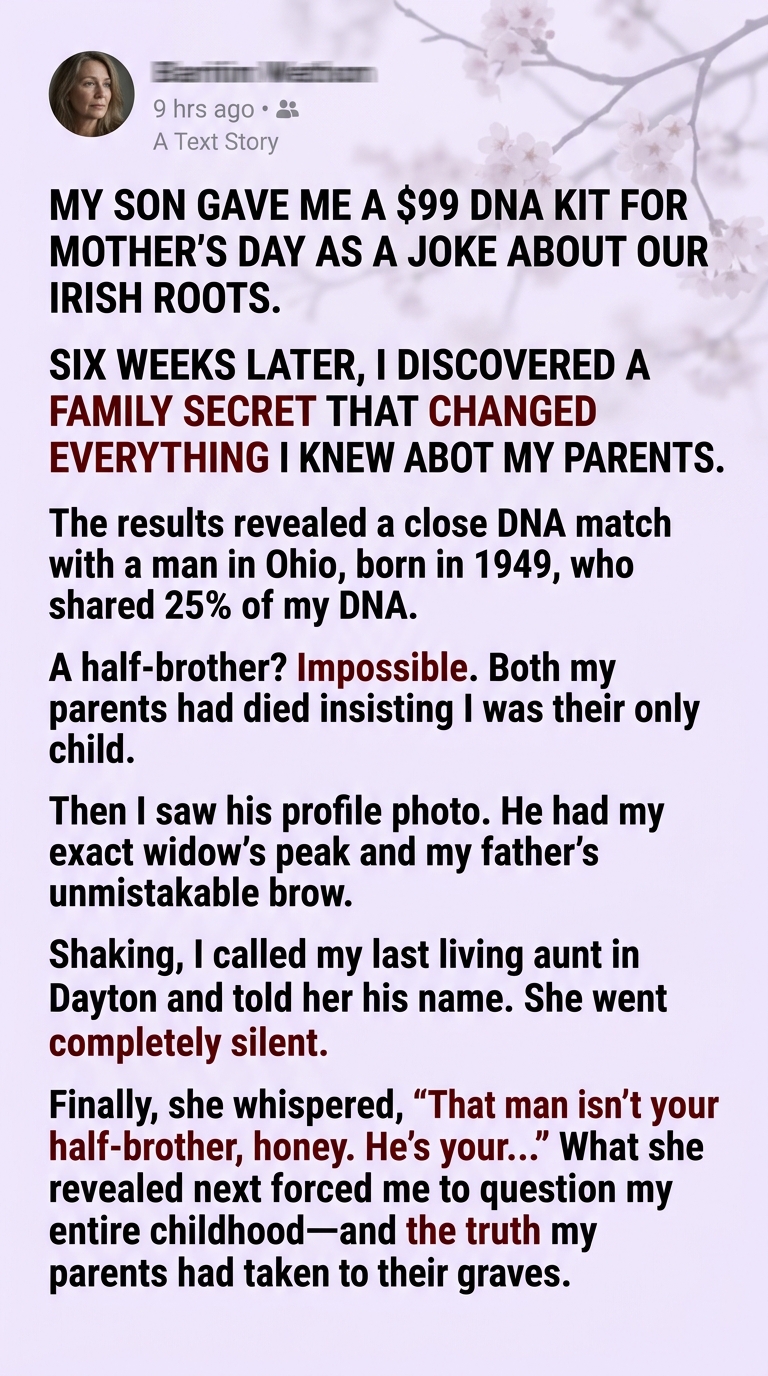
My son gave me a $99 DNA kit for Mother’s Day because he thought it would be funny to find out how Irish we really were.
“Maybe we’ll discover we’re secretly descended from a king,” Michael joked as he handed me the little white box. “Or maybe you’ll find out Grandma was actually Italian and spent her whole life making soda bread for nothing.”
I laughed.
My parents had always been proud of our Irish heritage. My father, Patrick, loved telling stories about his ancestors, and my mother, Margaret, insisted that our family had been in the same small Irish-American community for generations.
I was their only child. They had told me that so often it had become as unquestionable as my own name.
So I sent in the saliva sample, forgot about it, and returned to my ordinary life.
Six weeks later, an email arrived announcing that my results were ready.
I opened the website at my kitchen table, expecting percentages of Irish, Scottish, and perhaps a little English ancestry.
Instead, I found a close DNA match.
A man in Ohio, born in 1949, shared approximately 25% of my DNA.
The website estimated that he could be a half-brother, an uncle, or another close relative.
I was sixty-eight years old. Both my parents had been dead for years. My mother had passed away at eighty-six, and my father had died five years before her. Neither had ever mentioned another child.
I read the match’s profile again.
His name was Thomas Walsh.
His birth year was 1949.
I was born in 1958.
A half-brother? My father would have been twenty-seven when Thomas was born. My mother would have been twenty-four. It was possible, I supposed, that one of them had fathered a child before I was born. But they had always spoken about their early marriage as though their life together had begun without any complications.
Then I clicked on his photograph.
My breath caught.
Thomas had a pronounced widow’s peak, just like mine. His eyebrows formed the same strong line my father used to have in old family photographs. Even the shape of his chin looked familiar.
I enlarged the picture until the pixels blurred.
Then I called my last living aunt, Dorothy, who lived outside Dayton, Ohio.
She was my mother’s younger sister and the only person left who had known my parents before I was born.
When she answered, I could hear a television playing in the background.
“Dorothy, I need to ask you something strange.”
“What is it, sweetheart?”
“I took one of those DNA tests. I have a close match with a man named Thomas Walsh. He was born in 1949.”
The television continued playing for another second.
Then it went silent.
“Dorothy?”
I heard her draw a shaky breath.
Finally, she whispered, “That man isn’t your half-brother, honey.”
My hand tightened around the phone.
“Then who is he?”
Her answer came so quietly I almost didn’t hear it.
“He’s your…”
She stopped.
I could hear her crying.
And when she finally finished the sentence, the story my parents had told me about my childhood began to fall apart.
Chapter 1: The Name My Aunt Feared
“He’s your mother’s brother,” Aunt Dorothy finally said. “Your half-brother’s not what he is, sweetheart. Thomas is your uncle.”
I stared at the wall.
“My mother didn’t have a brother.”
“Yes, she did.”
“No. She told me she was an only child. Dad told me the same thing. They showed me family photographs. There was no brother.”
“Because they didn’t want you to know.”
My mouth went dry.
“Why?”
Dorothy began to cry harder.
“Because your grandparents gave him away.”
For a long moment, I couldn’t speak.
My mother’s parents had died before I was old enough to remember them clearly. I knew them from a few photographs, from stories about their farm outside Dayton, and from the occasional family anecdote my mother told during holidays.
My grandfather had been strict. My grandmother had been quiet. They had lived through the Depression, raised a family during difficult years, and believed that certain things were never discussed outside the home.
But a son?
A son who had disappeared so completely that my mother had denied his existence?
“Tell me everything,” I said.
Dorothy hesitated.
“I should have told you years ago.”
“Yes,” I replied. “You should have.”
She explained that Thomas had been born in 1949, when my mother, Margaret, was still a teenager. He was the son of my grandmother and a man who was not my grandfather. The circumstances surrounding his birth had brought shame and gossip to their small community, and my grandparents had decided to place the baby with another family.
My mother had been only a child herself when it happened, but she had never forgotten her brother.
“He was raised by a couple in Ohio,” Dorothy said. “They gave him their name and loved him as their own. Your mother was told never to contact him. Your grandparents said it would destroy the family.”
“And my father?”
“Your father learned the truth before he married your mother. He promised he would never bring it up.”
I closed my eyes.
My father, Patrick, had been a man of few words. He believed in loyalty, privacy, and keeping one’s promises. I had always admired those qualities.
Now I wondered how many of his silences had been built on someone else’s pain.
“Did my mother ever see Thomas again?”
Dorothy took a long breath.
“Once.”
“When?”
“In 1971. He was already a grown man. He had started looking for his birth family, and somehow he found your mother.”
I gripped the edge of the table.
“What happened?”
“She met him in a diner outside Dayton. She came home crying. Your father was furious—not at Thomas, I think, but because the past had found them again. After that, your mother promised she would never see him again.”
“Did she tell him she had a daughter?”
“No.”
That answer hurt more than I expected.
Thomas had spent his life searching for his birth family. I had spent mine believing my family was complete.
Somewhere between those two lives, my parents had built a wall of silence so high that neither of us knew the other existed.
“Why didn’t you tell me?” I asked.
“Your mother made me promise.”
“And you kept that promise for decades?”
“I thought I was protecting you.”
I looked again at Thomas’s photograph on my computer screen.
His eyebrows were my father’s. His widow’s peak was mine. But now I knew those features came from a family story that had started long before my birth.
“Dorothy,” I said, “does Thomas know about me?”
“I don’t know.”
“Then I’m going to find out.”
For the first time in my life, I understood that family secrets didn’t disappear when the people who created them died.
Sometimes, they simply waited for someone to ask the right question.
Chapter 2: The Box in the Attic
The next morning, I drove to my aunt’s house.
Dorothy lived in a modest brick home surrounded by mature trees and flowerbeds she still tended herself. She greeted me at the door with red eyes and a trembling smile.
“I knew this day might come,” she said.
“You knew about Thomas all these years.”
She lowered her head.
“Yes.”
We sat at her kitchen table. After a few minutes, she rose and went to a small storage room. When she returned, she carried a shoebox tied with faded blue ribbon.
“This belonged to your mother,” she said. “She gave it to me before she died. She told me to keep it somewhere safe.”
Inside were old photographs, folded letters, and a small envelope bearing the name Thomas.
My hands began to shake.
The first photograph showed a young woman standing beside a baby carriage. I recognized my mother immediately, though she looked scarcely older than a teenager. Her expression was solemn, and her hand rested protectively on the carriage handle.
On the back, someone had written:
Margaret and Thomas, summer 1949.
I stared at it until the words blurred.
Beneath the photograph lay several letters. Most were written by my mother to her younger brother, beginning in the early 1970s. They were never mailed.
In one, she wrote:
I saw you today, and I wanted to tell you that I have thought about you every day of my life. I have a daughter now. Her name is Eleanor. She has your eyes, and sometimes I wonder whether you would have loved her the way I do.
I pressed the letter against my chest.
My mother had known exactly who Thomas was. She had thought about him. She had written to him. And she had never told me.
Another letter was dated several years later.
Patrick says we must leave the past alone. He believes we can protect Eleanor by giving her a peaceful childhood. Perhaps he is right. But every time I look at her, I wonder what she would think if she knew how much of our family history has been hidden from her.
I looked at Dorothy.
“Was my childhood a lie?”
“No,” she said quickly. “Your mother loved you. Your father loved you. They were good parents in many ways.”
“But they decided I couldn’t handle the truth.”
Dorothy looked down at the letters.
“They were afraid.”
“Of what? That I would love my uncle?”
“Of everything changing.”
I understood fear. I understood the instinct to protect the people we loved from painful information.
But I also understood what it meant to grow old believing a story that wasn’t true.
At the bottom of the box was one final envelope. Unlike the others, it had been addressed and stamped.
It had never been mailed.
Inside was a letter written shortly before my mother’s death.
Thomas, I don’t know whether you will ever read this. I have spent my life regretting the day we were separated. I allowed shame and fear to silence me, and then I allowed that silence to become a family tradition. I have a daughter who deserves to know where she comes from. If I cannot find the courage to tell her myself, perhaps one day someone else will.
I put the letter down.
My mother had left me a message without ever delivering it.
I was angry with her. I was heartbroken for her. And, in a way I couldn’t yet explain, I missed her more than I had in years.
“Do you think Thomas would want to meet me?” I asked.
Dorothy reached across the table and took my hand.
“I think he’s spent his whole life wanting to know where he came from.”
I folded the letter carefully.
“Then he deserves to know he has a family.”
Chapter 3: The Man from Ohio
I sent Thomas a message through the DNA website.
I wrote that my name was Eleanor, that I had recently discovered our close DNA match, and that my aunt had explained we were related through my mother’s side of the family.
I did not tell him everything at once.
I wanted to give him room to process the news without overwhelming him with a lifetime of secrets.
He replied the following afternoon.
I’ve been looking for my birth family for more than forty years. I never expected to find someone this close. Can we talk?
We arranged a video call.
When his face appeared on my screen, I felt the same strange recognition I had experienced when I first saw his photograph. His hair was gray now, and deep lines crossed his forehead, but the resemblance was unmistakable.
For a few seconds, neither of us spoke.
Then he smiled uncertainly.
“You look like someone I might have known my whole life.”
I laughed, though my eyes filled with tears.
“You look like the man who taught me to ride a bicycle.”
Thomas blinked.
“Your father?”
“Yes. Patrick. He had the same eyebrows.”
Thomas leaned back in his chair.
“I was told my birth mother was young and that there were circumstances that made keeping me impossible. My adoptive parents never hid the adoption from me, but they didn’t have much information. I always wondered whether I had brothers or sisters.”
“You have a niece,” I said. “And a sister who thought about you for her entire life.”
He lowered his head.
“Your mother?”
I nodded.
“Margaret was my mother.”
He covered his mouth with his hand.
For a long moment, he said nothing. Then he asked whether she had been happy.
It was the first question he asked, and it broke my heart.
I told him about her garden, her terrible singing, the way she baked bread every Christmas, and how she used to sit beside my bed when I was sick. I told him she had been stubborn, loving, and sometimes afraid of things she could not control.
I also told him the truth: she had known about him, and she had never found the courage to tell me.
Thomas listened quietly.
“I’m not angry with her,” he finally said. “I used to be angry at the people who gave me away. But my adoptive parents loved me. They gave me a good life. I don’t want to spend the rest of it hating people I never had the chance to know.”
I felt my shoulders relax.
“Would you like to meet?”
He smiled.
“I was hoping you’d ask.”
We chose a Saturday two weeks later. He lived a few hours away, so we agreed to meet halfway at a quiet restaurant.
After the call, I sat at my kitchen table and looked at the DNA results again.
A few months earlier, I had thought the test might tell me whether I was Irish enough to tease my son about his gift.
Instead, it had given me a name, a photograph, and a family member who had been missing from our history for seventy-seven years.
I called Michael.
“You were right,” I told him.
“About what?”
“This was the most interesting Mother’s Day gift I’ve ever received.”
He laughed.
“Wait. Does that mean we’re royalty?”
“No,” I said, smiling through tears. “It means your grandmother had a brother no one told us about.”
The laughter stopped.
“What?”
And so I began the story again.
Chapter 4: The First Meeting
I arrived at the restaurant twenty minutes early.
I changed my blouse twice, checked my hair in the car mirror, and rehearsed what I would say. It seemed ridiculous that a sixty-eight-year-old woman could be nervous about meeting someone for lunch, but I was terrified of getting it wrong.
What if we had nothing in common?
What if he resented my family?
What if meeting him made me feel even angrier at my parents?
At twelve fifteen, a silver sedan pulled into the parking lot.
Thomas stepped out.
He was taller than I had expected, with broad shoulders and a slight stoop. He wore a blue button-down shirt and carried a small paper bag.
When he saw me, he stopped walking.
For a moment, we simply looked at each other.
Then he approached and held out his hand.
“Eleanor?”
“Yes.”
“I’m Thomas.”
“I know.”
We both laughed, and the awkwardness eased.
He opened the paper bag and removed a small photograph in a frame. It showed him as a toddler sitting on the lap of the couple who had adopted him.
“These are my parents,” he said. “They raised me. They loved me. I want you to know that before we talk about anything else.”
I studied the photograph.
“I’m glad they loved you.”
“They did. I wouldn’t trade them for anything.”
We sat down.
For the first half hour, we talked about ordinary things. His job, my family, our children, the places we had lived. He had two grown daughters and three grandchildren. I showed him photographs of Michael and his children.
Then he asked about Margaret.
I told him about her life, her marriage, and the years she had spent trying to bury a painful chapter of her past.
“Did she ever talk about me?” he asked.
I took a breath.
“I found letters she wrote to you. She never sent them, but she wrote about you often.”
Thomas looked down at his coffee.
“Did she love me?”
I reached into my bag and took out a copy of the letter I had found in Dorothy’s shoebox.
I had asked my aunt’s permission to share it. The original remained safely stored with the family papers.
Thomas read it slowly.
When he reached the line about my mother wondering whether he would have loved me, he began to cry.
I sat quietly while he finished.
“She wanted me to know about her daughter,” he whispered.
“Yes.”
“And she wanted you to know about me.”
“Yes.”
He wiped his eyes.
“I wish she’d been brave enough to tell us both.”
“So do I.”
We sat in silence for a while.
Then he looked at me.
“Eleanor, I don’t want you to feel that you owe me a relationship because we’re related. I spent a long time searching for my birth family, but I understand that finding someone doesn’t automatically make us close.”
I smiled.
“Good. Because I was hoping we could start with lunch.”
He laughed.
And for the first time, I felt that something good could grow from the truth without requiring us to pretend the past had been painless.
Chapter 5: The Question My Son Asked
When I returned home, Michael was waiting for me.
He had driven over with his wife, Laura, and brought dinner. They knew I had met Thomas and wanted to hear everything.
We sat in the living room while I described the meeting.
Michael listened carefully.
Then he asked the question I had been avoiding.
“Mom, if Grandma hid an entire brother, what else might she have hidden?”
I looked at him.
“I don’t know.”
“Doesn’t that bother you?”
“Of course it does.”
“Then how can you sound so calm?”
I thought about my answer.
“Because being angry won’t give me back the years I lost. And because I don’t want to turn the rest of my life into an investigation of every conversation my parents ever had.”
Michael nodded, but he still looked troubled.
“Do you feel like you didn’t really know them?”
“Yes,” I admitted. “A little.”
I looked at the family photographs on the mantel.
My parents had loved me. I had never doubted that. They had worked hard, cared for me when I was ill, attended my school performances, and supported me when I became a mother myself.
Those memories were real.
But so was the secret.
I was learning that two things could be true at the same time: my parents could have loved me deeply, and they could have made a decision that deprived me of a part of my family.
“They thought they were protecting me,” I said. “Maybe they believed that if they kept the secret long enough, it would stop hurting everyone.”
“Did it?”
I shook my head.
“No. It just made the truth harder to find.”
Laura reached for my hand.
“What will you do now?”
I smiled.
“Get to know my uncle.”
Chapter 6: The Truth Behind the Family Story
A month later, Thomas and I visited Aunt Dorothy together.
She had been anxious about seeing him, but when he arrived, she opened her arms and began crying before he could even say hello.
“Oh, Thomas,” she whispered. “You look so much like your mother.”
He embraced her.
“I’m glad I finally get to meet you.”
They sat in the living room for hours, sharing memories and filling in the gaps in each other’s stories.
Dorothy explained that my grandparents had feared scandal. My grandmother had been unmarried when Thomas was born, and the circumstances of his conception were complicated. My grandfather had eventually married her and raised my mother, but the family had agreed never to discuss the child who had been placed for adoption.
My mother grew up knowing she had a brother but was repeatedly told that acknowledging him would bring shame to the family.
When she became an adult, she tried once to reconnect with him. But my father, who was afraid of the scandal resurfacing, persuaded her to stop.
None of this excused the years of silence.
But it helped me understand how the secret had survived. One person had made a frightened decision, another had promised to keep it, and every generation had been asked to protect the lie.
Until the DNA test.
Before we left, Thomas asked Dorothy whether she had any photographs of his birth mother.
She brought out a small album.
On one page was a photograph of my grandmother holding Thomas as a baby. She looked young and frightened, but her face was turned toward him with unmistakable tenderness.
Thomas studied the picture for a long time.
“I used to imagine that she never wanted me,” he said.
Dorothy shook her head.
“She wanted you. She was just afraid.”
He nodded slowly.
“I think I can understand that now.”
I looked at the photograph, and for the first time, I felt compassion for the young woman my grandmother had been.
She had made a choice that changed several lives. My mother had carried the burden. My father had helped preserve the silence. Dorothy had been trapped by a promise. Thomas had grown up wondering where he came from.
And I had spent sixty-eight years believing my family story was complete.
No one had escaped the consequences.
Chapter 7: The Family We Chose to Become
Over the next year, Thomas became part of our lives.
He attended a family barbecue at Michael’s house. His daughters met me, and his grandchildren began calling me their great-aunt. We discovered that we both loved old movies, terrible puns, and arguing about the best way to make Irish soda bread.
He also told me about his adoptive parents, who had given him a safe and loving childhood. We made a point of honoring them rather than treating them as a footnote in his story.
Sometimes, we talked about what might have happened if our families had known each other all along.
Would our children have grown up together?
Would my mother have visited him?
Would my father have accepted him?
We couldn’t answer those questions.
Eventually, I stopped asking them.
One afternoon, Thomas and I sat on my porch drinking tea. He was looking through an old album of my parents.
He paused at a photograph of my mother holding me as a newborn.
“She looks happy,” he said.
“She was.”
“I’m glad.”
I studied him.
“Do you wish she had found you sooner?”
“Of course,” he said. “But I don’t want the rest of my life to be defined by the years we lost.”
I smiled.
“That’s what I’ve been trying to learn.”
He closed the album.
“Then maybe we can help each other.”
That evening, I called Michael and told him I wanted to organize a family gathering for the next summer. I wanted everyone to meet Thomas’s daughters, to share photographs, and to give our children a chance to know one another.
Not to rewrite the past.
To make room for the truth in our future.
On Mother’s Day the following year, Michael brought me flowers and another small gift.
“Don’t worry,” he said. “No more DNA kits.”
I laughed.
“That’s probably wise.”
He hugged me.
“I’m glad I gave you the first one.”
“So am I.”
After he left, I sat at the kitchen table and opened the folder where I kept the copies of my mother’s letters. I no longer read them looking for proof that she had loved me. I knew she had.
Instead, I read them as a reminder that love and fear can live in the same heart, and that good intentions do not erase the harm caused by silence.
My parents had taken the truth to their graves.
But the truth had found its way back to me anyway.
It arrived in a $99 box, through a percentage on a computer screen, and in the face of a man who looked strangely familiar.
I had thought the test would tell me where my ancestors came from.
Instead, it showed me who had been missing all along.
And in the end, the greatest discovery wasn’t that my mother had a secret brother.
It was that I still had time to know him.

