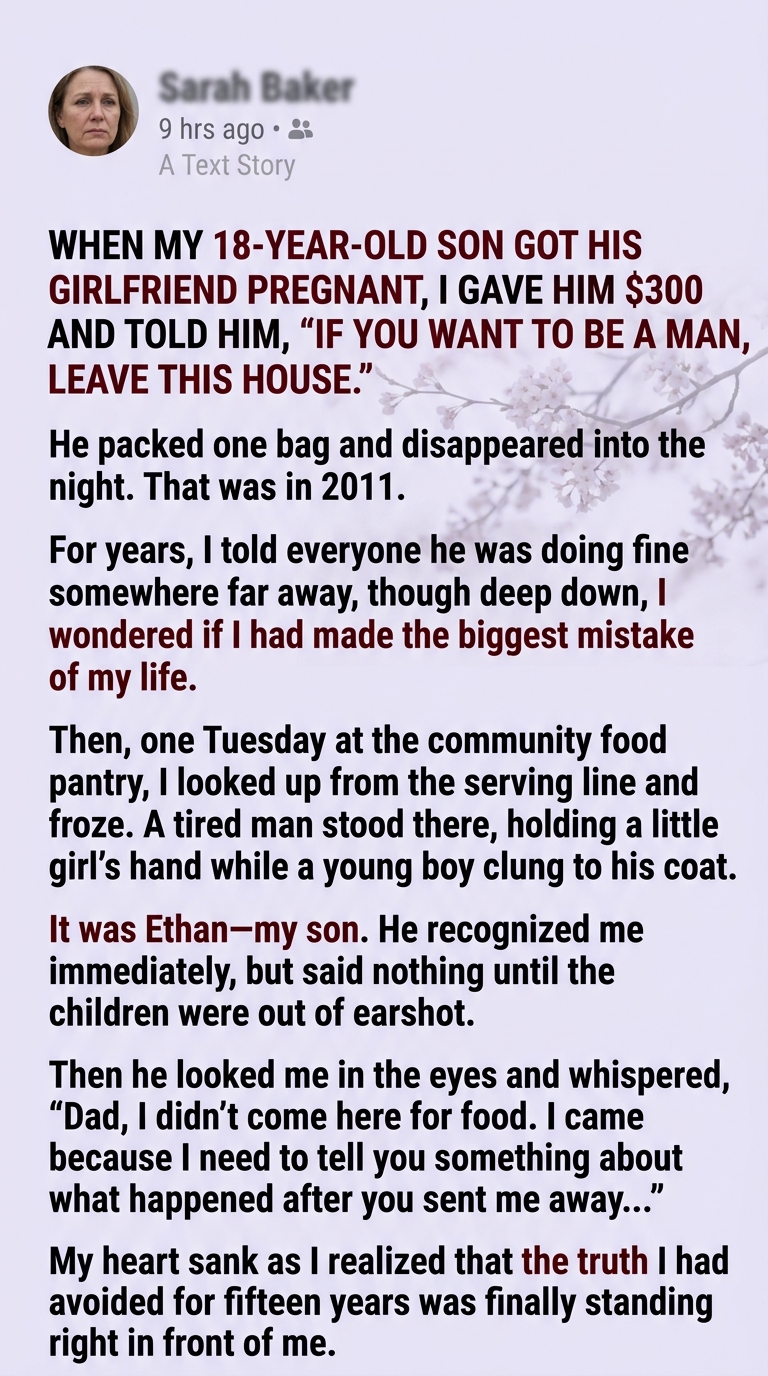
The Son I Sent Away Came Back With a Secret
In 2011, I gave my eighteen-year-old son, Ethan, three hundred dollars and told him to leave my house.
His girlfriend was pregnant. He had barely finished high school, had no steady job, and seemed to me like a boy who had made an adult mistake without understanding what it would cost.
I was fifty years old then, and I believed I understood what it meant to be a man. You worked hard. You took responsibility. You didn’t ask anyone to rescue you from the consequences of your decisions.
So I stood in our kitchen, placed three hundred dollars on the table, and said the words that would haunt me for the rest of my life.
“If you want to be a man, leave this house.”
Ethan stared at me.
“Dad, she’s pregnant. I know I messed up, but I need help.”
“You should have thought about that before.”
“I am thinking about it. That’s why I’m asking you.”
I mistook his fear for weakness. I mistook his request for help as an attempt to avoid responsibility.
His mother, Linda, stood by the sink with tears in her eyes.
“Please,” she whispered to me. “He’s still our boy.”
But I had already made up my mind.
Ethan packed one bag, put the money in his wallet, and walked out into the cold night. He didn’t slam the door. He didn’t curse me. He simply looked back once, as if he were waiting for me to change my mind.
I didn’t.
That was the last time I saw my son for fifteen years.
I told our relatives that he had found work and was building a life of his own. Whenever someone asked whether I had heard from him, I said he was doing fine.
The truth was that I didn’t know where he was sleeping, whether he had enough to eat, or whether his child had been born healthy.
At first, pride kept me from looking for him.
Later, shame did.
Then, one Tuesday morning, I volunteered at a community food pantry. I was arranging cans on a shelf when I looked toward the serving line and froze.
A tired man stood there holding a little girl’s hand. A young boy clung to his coat. The man’s jacket was worn at the elbows, his shoes were scuffed, and dark circles shadowed his eyes.
But I recognized him immediately.
Ethan.
He was thirty-three now, fifteen years older than the boy I had sent away. There were faint lines around his eyes, and his shoulders carried the weight of someone who had learned to survive without expecting help.
He recognized me, too.
For several seconds, neither of us moved.
Then he quietly collected the food for his children and guided them toward the waiting area.
He waited until they were out of earshot before approaching me.
“Dad,” he whispered, looking directly into my eyes, “I didn’t come here for food. I came because I need to tell you something about what happened after you sent me away.”
My heart sank.
For fifteen years, I had imagined a hundred possible explanations for my son’s silence. I had told myself he was angry, that he wanted nothing to do with me, that perhaps he had built a better life without the father who had refused to help him.
I had never imagined that the truth might be something far worse.
I opened my mouth, but no words came out.
Ethan glanced toward his children.
Then he said, “Before you tell yourself I abandoned you, Dad, you need to know what really happened that night.”
And as he began to speak, I realized that the story I had told myself for fifteen years had been wrong from the very beginning.
Chapter 1: The Night I Closed the Door
“I remember every word you said,” Ethan began.
His voice was calm, but there was something painful beneath it.
“I remember the money on the table. I remember Mom crying. And I remember standing outside with my bag, thinking you’d come after me.”
I looked down.
“I thought you needed to learn responsibility.”
“I know what you thought.”
He didn’t raise his voice. Somehow, that made it worse.
Ethan told me that after leaving our house, he walked nearly four miles before finding a bus station. He had no car, no job, and only a vague idea of where his girlfriend, Megan, might be staying.
He called her from a pay phone.
She answered on the fourth attempt.
“Ethan, where are you?”
“I’m outside the bus station. My dad kicked me out.”
There was a long silence.
Then she started crying.
Megan’s parents had refused to let her stay with them after learning about the pregnancy. They believed the two teenagers had ruined their futures, and they didn’t want the responsibility of helping them.
She was staying temporarily with a friend from school, sleeping on a couch and trying to finish her final semester.
“I told her I’d figure something out,” Ethan said. “I had three hundred dollars and no idea what I was doing.”
He spent that first night at a cheap motel. The following morning, he started looking for work.
He found a job washing dishes at a restaurant. The pay was low, but the owner allowed him to take home leftover food at closing time. He rented a room in a house shared by three other workers and began saving whatever he could.
Within two weeks, Megan moved into the room with him.
They had a mattress on the floor, a borrowed microwave, and a secondhand heater that worked only when someone kicked the side.
But Ethan said those first weeks had one thing he hadn’t felt at home in a long time.
He felt needed.
“I wasn’t good at being a father yet,” he admitted. “I was barely an adult myself. But I wanted that baby to know I wouldn’t leave.”
I swallowed hard.
“You could have called me.”
He looked at me for a long moment.
“I did.”
My stomach tightened.
“What?”
“I called home three days after I left. Mom answered. I asked if you were there.”
“What did she say?”
“She said you were angry and didn’t want to talk to me.”
I shook my head.
“I never told her that.”
Ethan’s expression changed.
“She said you had made your decision. She said I needed to give you time.”
I felt a chill move through me.
“Why didn’t you call again?”
“Because I believed her. And because I was ashamed. I thought if I could get a steady job and find a proper place to live, I’d come back and show you I could do it.”
He rubbed his hands together.
“But then everything happened so fast.”
“What happened?”
He glanced toward the children.
“Megan went into labor six weeks early.”
His daughter had been born before either of them had finished preparing for her arrival. The baby needed extra care, and the hospital bills frightened them. Ethan worked double shifts whenever he could, while Megan recovered and tried to learn how to care for a newborn.
He had been exhausted, frightened, and desperate to keep his promise.
But the worst part, he said, came when he tried to contact us again.
He called home from the hospital.
He asked to speak to me.
And, according to Ethan, I had refused.
“I didn’t refuse,” I said immediately.
He looked at me.
“Dad, I heard Mom tell someone you wouldn’t speak to me. I heard her say you wanted me to handle my own life.”
I felt the room shift around me.
“Who did you hear her talking to?”
“My grandmother. Your mother-in-law.”
I stared at him.
Linda had died nine years earlier. She had been a kind woman who hated conflict and spent her life trying to keep everyone happy.
But I couldn’t understand why she would have told Ethan that I didn’t want to speak to him.
Unless she believed it herself.
Unless someone had told her.
Ethan continued.
“After that, I stopped calling. I thought you had made it clear that I wasn’t welcome. I told myself I would never come back asking for anything.”
He paused.
“Then Megan got sick.”
Chapter 2: The Years Nobody Knew About
Ethan’s voice grew quieter as he described the years that followed.
Megan had suffered serious complications after their daughter’s birth. The doctors treated her, but her recovery was difficult, and she struggled with recurring health problems that made it hard to work consistently.
Ethan took whatever jobs he could find. He washed dishes, unloaded trucks, cleaned offices, and eventually found work at a warehouse.
He and Megan married in a small courthouse ceremony when their daughter, Sophie, was two.
There were no parents beside them, no family photographs, and no celebration afterward. They bought two sandwiches from a convenience store and ate them on a park bench while Sophie slept in her stroller.
“I promised Megan we’d give Sophie a better life than we had,” Ethan said. “I thought if I worked hard enough, we could do it.”
For a while, they managed.
They rented a small apartment. Sophie started preschool. Ethan earned a forklift certification and began making a little more money.
Then Megan became pregnant again.
Their son, Noah, was born several years later. Ethan was delighted, but the added expenses strained their finances. When the warehouse cut its hours, he took a second job delivering groceries.
He rarely slept more than five hours a night.
Still, he didn’t call home.
He had convinced himself that asking me for help would mean admitting I had been right to send him away.
Then, when Noah was four, Megan’s health deteriorated.
She spent weeks going in and out of hospital. Eventually, she died after a sudden medical emergency.
Ethan stopped speaking for a moment.
I wanted to reach for him, but I was afraid he would pull away.
“When she died,” he said, “I didn’t know how to be both parents. Sophie was old enough to understand that her mother wasn’t coming home. Noah kept asking when Mommy would wake up.”
He swallowed.
“I went back to work because rent was due. My neighbor watched the kids when she could, and a social worker helped me find childcare. I did everything I could to keep them together.”
He didn’t describe himself as a hero. He told me about mistakes, exhaustion, missed payments, and days when he sat in his car after work because he couldn’t bear the thought of going inside and pretending to be strong.
Eventually, he found steadier work with a maintenance company. It wasn’t glamorous, but it offered reliable hours and benefits.
For a few years, life became manageable again.
Then the company lost a major contract, and Ethan’s position was eliminated.
He used his savings to pay rent and buy food. He applied for dozens of jobs. Some employers never responded. Others rejected him because he lacked certain qualifications.
His savings dwindled.
He fell behind on rent, negotiated with his landlord, and tried to keep the children from noticing how frightened he was.
But the landlord eventually had to reclaim the apartment.
Ethan moved the children into a temporary family shelter while he searched for work and more permanent housing. A caseworker helped him apply for assistance and connected him with the community food pantry where I volunteered.
That was why he had come that morning.
Not because he wanted to embarrass me.
Not because he wanted revenge.
He had brought his children to collect food because the money he had left needed to cover transportation and the costs of finding somewhere to live.
“I never wanted Sophie and Noah to go hungry,” he said. “I thought I could get us through it before anyone knew how bad things had become.”
I looked toward the waiting area.
Sophie was drawing something on the back of a paper bag. Noah was leaning against her shoulder, watching her pencil move.
They were beautiful children.
And I had missed their entire lives.
Chapter 3: The Lie That Kept Us Apart
I sat down on a chair beside the serving table.
“Ethan, listen to me. I never told your mother to say I wouldn’t speak to you.”
He looked tired.
“Maybe you didn’t say those exact words.”
“I didn’t say anything like them.”
“Then why didn’t you call me?”
The question struck harder than anything else he had said.
I had spent fifteen years telling myself that my son was the one who had walked away.
I had never seriously considered that he might have been waiting for me to open the door.
“I thought you didn’t want to hear from me,” I admitted.
Ethan gave a small, humorless laugh.
“I was eighteen. I had a pregnant girlfriend, no money, and a father who told me to leave. Why would you think I didn’t want you?”
I had no answer.
He told me that after the first few attempts, he had stopped calling because each failed attempt felt like another rejection. He was embarrassed by his circumstances, but he had also wanted me to show him that my love was not conditional on his success.
“I wanted you to call once,” he said. “Just once. To ask whether we were alive. Whether your granddaughter had been born. Whether we needed anything.”
His eyes filled with tears.
“I kept thinking that if I mattered to you, you’d find a way to reach me.”
I felt the full weight of my decision.
I had believed that a father showed love by demanding strength from his son. I had thought that sending Ethan away would force him to grow up.
Instead, I had made a frightened young man believe he had lost his family at the exact moment he needed one most.
“I was wrong,” I whispered.
Ethan looked away.
“I know.”
“No. I mean it. I was wrong to send you away. I was wrong to think that asking for help meant you weren’t willing to take responsibility. And I was wrong to let pride keep me from looking for you.”
He didn’t respond.
I continued.
“I don’t expect you to forgive me because I’m saying this now. You have every right to be angry.”
For the first time, his expression softened slightly.
“I’m not here to make you feel guilty, Dad.”
“Then why did you come?”
He looked toward the children.
“Because Sophie asked me about her grandfather.”
I couldn’t breathe for a moment.
“She did?”
“She’s been asking about my family. She wanted to know whether I had parents, whether they were still alive, and why she had never met them. I told her I had a father who lived somewhere nearby, but we hadn’t spoken in a long time.”
He rubbed his eyes.
“Last week, she asked whether you’d be proud of her. She said she wanted to show you the pictures she draws.”
I looked at the little girl in the waiting area.
She was concentrating fiercely on her drawing, her tongue caught between her teeth.
“What did you tell her?”
“I told her I didn’t know.”
The words hurt more than I could explain.
I had spent fifteen years wondering whether Ethan had become a man I could be proud of.
All the while, he had been wondering whether I would ever be proud of him.
Chapter 4: The Grandchildren I Never Met
I asked Ethan whether I could meet the children properly.
He hesitated.
“I don’t want them caught in the middle of anything.”
“Neither do I.”
“And I don’t want you promising them things just because you feel guilty.”
I nodded.
“You’re right.”
He studied me for a moment, perhaps searching for the father who would turn the conversation into an argument.
Then he called Sophie and Noah over.
“Sophie, Noah, this is my dad,” he said.
Sophie looked at me with serious brown eyes.
“Your dad?”
“Yes.”
“Then he’s our grandpa?”
Ethan took a breath.
“If he’s willing to be.”
I knelt so I was closer to their height.
“I’m very willing,” I said. “If you’ll let me get to know you.”
Sophie studied my face.
“Do you like drawing?”
“I do, although I’m not very good at it.”
She immediately held up her picture.
It showed a small house, two children, and a tall figure holding an umbrella. Above them, she had drawn a bright yellow sun.
“This is the house I want us to have,” she explained. “And that’s Daddy keeping us dry.”
I swallowed the lump in my throat.
“It’s a beautiful picture.”
“Would you put it on your refrigerator?”
I looked at Ethan.
He gave a small nod.
“Of course,” I told her. “I’d be honored.”
Noah, who had been quiet, tugged at Ethan’s coat.
“Dad, can Grandpa help us find a house?”
Ethan closed his eyes briefly.
“Buddy, we’re working on that.”
I looked at my son.
“I have a spare room at my house,” I said carefully. “It’s been empty for years. If you’re comfortable with it, all of you could stay there temporarily while you work with your caseworker to find a stable place.”
Ethan stiffened.
“I can’t take your money.”
“I’m not offering you money.”
“You know what I mean.”
“Yes,” I said. “I know you don’t want to feel like a failure. But accepting a safe place to sleep isn’t a failure. It’s a chance to get back on your feet.”
He looked at his children.
I could see the argument happening inside him. His pride was fighting with his exhaustion, and his exhaustion was fighting with the part of him that wanted to believe me.
Finally, he said, “I need to think about it.”
“Take all the time you need.”
I didn’t reach for him. I didn’t demand a hug. I didn’t tell him that we should forget the past.
I had already demanded too much of him once.
This time, I would let him choose.
Chapter 5: The Letter in the Drawer
That evening, I went home and opened the drawer where I kept old family photographs.
I found Ethan’s school pictures, his eighth-grade graduation certificate, and a photograph of him at twelve, grinning beside the fishing rod I had bought him for his birthday.
I sat at the kitchen table until midnight.
Then I found the letter.
It was folded inside a birthday card Linda had kept after Ethan left. The envelope had never been sealed. His name was written across the front in Linda’s handwriting.
I opened it carefully.
Ethan, sweetheart,
I wish I had been braver the night your father sent you away. I wanted to stand between you, but I was afraid that if I challenged him, I would make everything worse.
Your father believes he is teaching you responsibility. I know he loves you, but I don’t think he understands how frightened you are.
I want you to know that you will always have a home with me. If you need to come back, I will open the door. If you need help, I will help you. You are my son, and nothing you do will change that.
I hope your father finds the courage to tell you the same thing.
Love, Mom.
I read the letter twice.
Then I noticed the date.
It had been written three days after Ethan left.
Linda had known he was struggling. She had tried to reach him in her own way, but she had never sent the letter. Perhaps she had been afraid of angering me. Perhaps she had hoped I would change my mind first.
I would never know.
I placed the letter beside Ethan’s school photographs and cried for the family we had been before pride became more important than love.
The following morning, I called Ethan.
He answered cautiously.
“Dad?”
“I found something I think you should have.”
“What is it?”
“A letter your mother wrote you after you left.”
He was silent.
“She never sent it,” I continued. “I’m sorry. I should have told you about it sooner, but I only found it last night.”
He breathed shakily.
“Can I read it?”
“Of course.”
We arranged to meet that afternoon.
When I handed him the letter, he recognized his mother’s handwriting immediately. He sat in my living room and read it without speaking.
By the time he finished, tears were running down his face.
“She wanted me to come home,” he whispered.
“Yes.”
“Why didn’t she tell me?”
“I don’t know, son.”
He folded the letter carefully.
“I thought she had chosen you.”
I shook my head.
“She loved you. She was frightened, too. We both made mistakes.”
He looked at me.
“Do you think she would be disappointed in us?”
I thought about Linda, who had spent her life trying to hold our family together.
“I think she would want us to stop wasting the time we still have.”
For a long moment, Ethan stared at the letter.
Then he asked whether he could stay in the spare room with the children for a little while.
I felt relief, but I tried not to let it overwhelm my answer.
“Yes,” I said. “You can.”
I gave him the key.
Not as a reward.
Not as proof that I had won an argument.
As an invitation.
Chapter 6: Learning to Be a Father Again
Ethan and the children moved into the spare room that weekend.
I made sure they had clean bedding, towels, and space for their belongings. Sophie taped her drawing to the refrigerator. Noah chose the room’s smallest shelf for his toy cars.
The first few days were awkward.
Ethan and I had fifteen years of silence between us. We didn’t know how to talk about ordinary things without stumbling into painful memories.
I wanted to ask about every year I had missed. I wanted to know when Sophie had learned to walk, what Noah’s first words had been, and whether Ethan had been alone when Megan died.
But I realized that asking him to recount fifteen years of hardship would be another way of making his pain serve my need for answers.
So I started small.
I made breakfast.
I drove the children to school when Ethan had job interviews. I helped him update his résumé and contacted a friend who managed a maintenance company. With Ethan’s permission, I passed along his qualifications and work history.
He secured an interview, then a temporary position that could become permanent.
He also continued working with his caseworker to arrange stable housing and access the support his family needed. I offered to help with practical expenses, but we agreed on clear boundaries so he wouldn’t feel that accepting help meant surrendering his independence.
One night, I found him sitting alone on the back porch.
“Can’t sleep?” I asked.
“Not really.”
I sat beside him.
After a while, he said, “I used to imagine coming back here one day and showing you that I had made it.”
“You don’t have to prove anything to me.”
He gave me a tired smile.
“That’s easy to say now.”
He was right.
Trust could not be restored because I had finally found the right words. I had to show him that I could be different from the father who had sent him into the night.
“I can’t change what I did,” I told him. “But I can stop asking you to pretend it didn’t hurt.”
He looked out into the darkness.
“I was angry with you for years.”
“I understand.”
“Sometimes, I still am.”
“You have that right.”
He rubbed his hands together.
“But I don’t want my kids growing up thinking family is something you lose forever when you make a mistake.”
I turned toward him.
“Neither do I.”
We sat together without speaking.
It wasn’t forgiveness. Not yet.
But it was the first honest conversation we’d had since he was eighteen.
Chapter 7: The Day Sophie Asked Me a Question
Three months later, Ethan found a permanent job with a local facilities company.
The pay wasn’t extraordinary, but the hours were reliable, and he could afford to begin planning for a place of his own. With his caseworker’s help and careful budgeting, he found a modest two-bedroom apartment near the children’s school.
He and the children would be moving in the following week.
I was proud of him.
Not because he had finally become the man I once demanded he be, but because he had kept going through years of grief and hardship without giving up on his children.
The night before the move, Sophie came into my kitchen while I was washing dishes.
“Grandpa?”
“Yes, sweetheart?”
“Are you going to stop seeing us when we move?”
I dried my hands.
“No. Why would you think that?”
She shrugged.
“Sometimes people say they’ll do things, but then they don’t.”
I knelt beside her.
“You’re right. Sometimes people make promises they don’t keep. I can’t ask you to believe me just because I say something. You’ll have to see what I do.”
She considered this.
“Will you come to our new house?”
“If your dad invites me, I’d love to.”
She smiled.
“I’m going to ask him.”
Then she hugged me.
It was a small, ordinary moment. But it felt bigger than any apology I could have received.
The next morning, I helped carry boxes to Ethan’s car. Noah insisted on carrying his toy cars himself, and Sophie made sure her drawing was placed safely between two books.
Before they left, Ethan stood beside me in the driveway.
“I don’t know what to say,” he admitted.
“You don’t have to say anything.”
He nodded.
Then he stepped forward and hugged me.
It was brief and a little awkward, as if neither of us quite knew how to do it anymore.
But he didn’t pull away immediately.
“Thank you for helping us,” he said.
I held him a little tighter.
“Thank you for giving me the chance.”
After they drove away, I went inside and looked at the empty spare room.
For fifteen years, I had thought that sending Ethan away would teach him to stand on his own.
Instead, it had taught both of us how much a family can lose when pride becomes a wall.
I couldn’t recover the years we had missed. I couldn’t attend the birth of my grandchildren, comfort my son when his wife died, or take away the nights he had spent worrying about rent and food.
But I could be present for the years that remained.
And this time, I wouldn’t make him earn my love by suffering in silence.
Chapter 8: The Father Who Finally Learned
A year after I saw Ethan at the food pantry, he invited me to dinner at his new apartment.
It was small, but it was clean and warm. The children’s drawings covered the refrigerator, and a row of books sat beside the television. Ethan had bought a secondhand dining table and repaired one of the chairs himself.
Sophie proudly showed me the bedroom she shared with her brother.
Noah asked me to help build a model airplane.
After dinner, Ethan and I sat on the balcony while the children watched a movie inside.
He handed me a cup of coffee.
“I’ve been thinking about something,” he said.
“What’s that?”
“When you sent me away, I thought being a man meant never needing anybody.”
I listened.
“I spent years refusing help because I thought accepting it would mean you were right about me. I wouldn’t call relatives. I wouldn’t tell people how bad things were. I thought if I could survive everything alone, I’d prove I didn’t need you.”
He shook his head.
“But I did need you, Dad. I needed you when Megan was in the hospital. I needed you when she died. I needed you when the kids were little and I was terrified I was getting everything wrong.”
My eyes filled with tears.
“I should have been there.”
“Yes,” he said quietly. “You should have.”
I didn’t defend myself.
He looked at me.
“But I don’t want to spend the rest of my life punishing you. I want my kids to know their grandfather. And I want us to have something better than what we had.”
I reached across the small table.
“I want that, too.”
He took my hand.
We didn’t declare that everything was forgiven. We didn’t pretend the past had disappeared.
We simply agreed to keep showing up.
Over the next year, I attended school events, helped with homework, and learned which foods Noah refused to eat. Sophie began bringing me her drawings, and I framed the first one she had made at the food pantry.
I also learned to listen when Ethan spoke about his past. I stopped trying to explain why I had made my decision and started acknowledging what that decision had cost him.
Our relationship grew slowly, built from ordinary moments rather than grand gestures.
One afternoon, Sophie asked why her father had spent so many years without seeing me.
I looked at Ethan, allowing him to decide how much to share.
He sat beside her.
“Grandpa and I made mistakes,” he explained. “I was young, and Grandpa was too proud to understand that people sometimes need help. We stayed apart for a long time because we didn’t know how to fix things.”
Sophie looked at me.
“Are you still mad at each other?”
I smiled.
“Sometimes, people have feelings they need time to work through. But we’re learning how to talk to each other now.”
She seemed satisfied with that answer and returned to her drawing.
That evening, as I drove home, I thought about the man I had been in 2011.
I had believed that love meant preparing your children for a hard world by making them face it alone.
I had confused discipline with rejection and pride with strength.
It had taken fifteen years, a community food pantry, and two grandchildren I had never met to understand what I should have known all along.
A father doesn’t make his son a man by closing the door. He helps him become one by showing him that even when he fails, he doesn’t have to face the world alone.
I had given Ethan three hundred dollars and sent him into the night, believing I was teaching him a lesson.
Fifteen years later, my son gave me something worth far more.
He gave me another chance to be his father.
And this time, I intended to deserve it.

