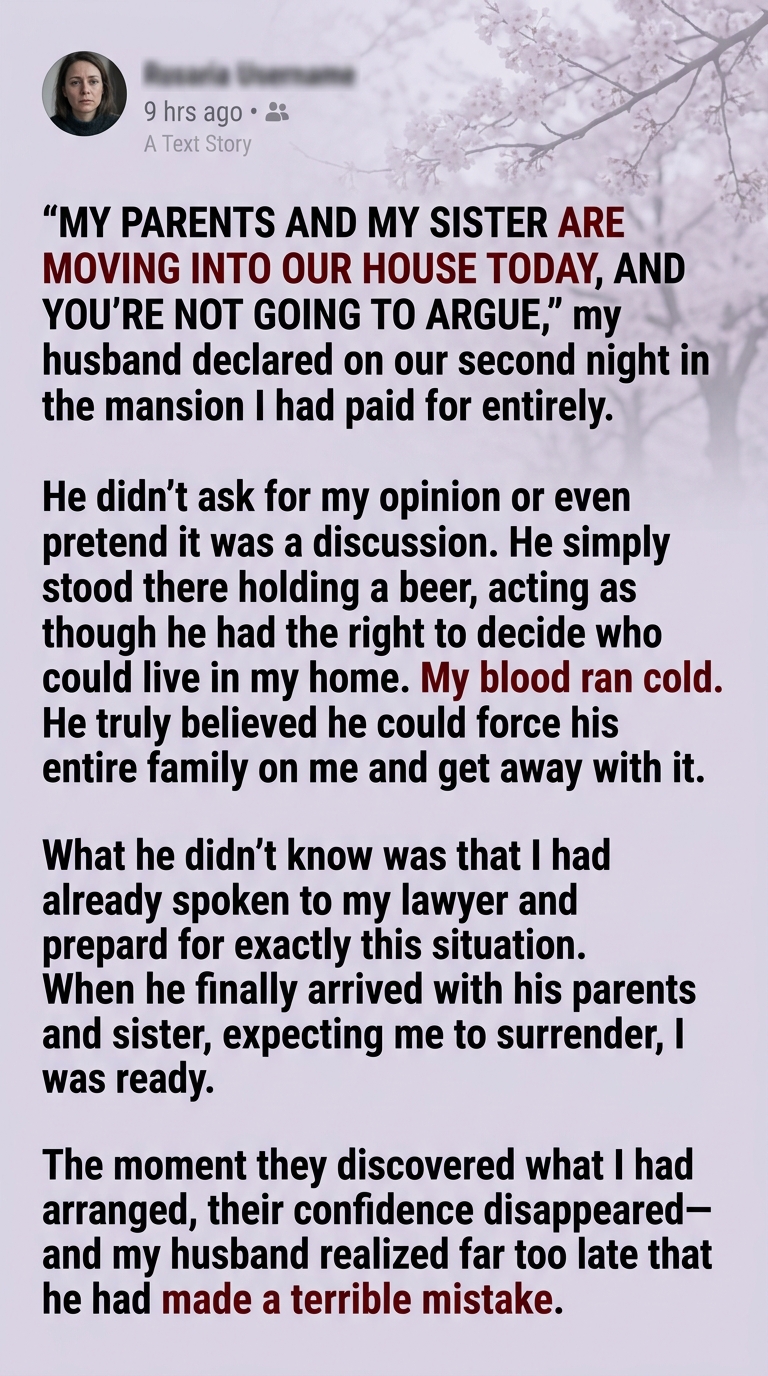
He Tried to Move His Entire Family Into My Mansion—But I Had Already Prepared for Him
Chapter 1: The House That Was Supposed to Be Our Dream
The mansion had twelve rooms, a sweeping staircase, floor-to-ceiling windows, and a backyard so large that the previous owners had installed a stone pathway leading to a small garden pavilion.
But the thing I loved most about the house wasn’t its size.
It was what it represented.
For eleven years, I had built my own interior design business from nothing. I started with a secondhand laptop, a tiny rented office, and clients who sometimes paid me weeks late. I worked weekends, skipped vacations, and learned to negotiate contracts before I could afford to hire someone to do it for me.
Eventually, the business grew.
My projects appeared in magazines. Luxury developers began calling me. I hired a team, bought a commercial property, and built a savings account that gave me something I had never experienced growing up.
Security.
When I decided to buy the mansion, I paid for it entirely with my own money. The purchase was made through my attorney, and the title was placed in my name alone.
I had no mortgage.
No outstanding debt on the property.
No financial assistance from anyone.
My husband, Ryan, was proud of me—or at least, I believed he was.
We had been married for four years. He worked in sales for a technology company, and although his income was respectable, it was nowhere near what I earned from my business.
That had never bothered me.
I never expected him to match my income. I wanted a partner, not a competitor.
When I showed him the photographs of the mansion before we bought it, he wrapped his arms around me.
“Can you imagine us living here?” he asked.
I smiled. “I can.”
He kissed my forehead.
“You’re incredible, Claire. One day, I’ll make you as proud of me as I am of you.”
I believed those words.
The first day we moved in, we ordered takeout, opened a bottle of champagne, and sat on the living-room floor because our furniture hadn’t arrived yet.
Ryan raised his glass.
“To our new beginning.”
“To our home,” I replied.
He smiled, but his eyes were already wandering around the enormous room.
“Just think,” he said. “There’s enough space here for everyone.”
I assumed he meant guests.
I had no idea he meant his entire family.
Chapter 2: The Announcement
Our first night in the mansion was peaceful.
Our second night changed everything.
I had just finished answering emails in my home office when Ryan walked in holding a beer. He leaned against the doorway as casually as if he were about to tell me what we should order for dinner.
“My parents and my sister are moving into our house today, and you’re not going to argue.”
I looked up from my laptop.
For a moment, I thought he was joking.
“What did you just say?”
He took a sip of his beer.
“My parents sold their apartment. They need somewhere to stay, and Megan’s lease is ending. There’s plenty of room here, so they’re coming over.”
“Today?”
“Yes.”
“You made this decision without talking to me?”
Ryan sighed as if I were being unreasonable.
“Claire, don’t start. My parents are getting older. My sister needs help. We have twelve rooms. What’s the point of having all this space if we can’t use it for family?”
I slowly closed my laptop.
“Having space doesn’t mean I agreed to share my home with three additional adults.”
His expression hardened.
“Your home? We’re married. It’s our house.”
“I paid for it entirely. We haven’t even finished unpacking, and you’ve already decided who gets to live here?”
“Here we go again,” he muttered. “Everything always comes back to money with you.”
I stared at him.
That sentence would have been funny if it hadn’t been so revealing.
I had never used my money to humiliate him. I paid for vacations we took together, helped him when he struggled with unexpected expenses, and covered the cost of our wedding reception when his family said they couldn’t afford their share.
I had done those things because I loved him.
But Ryan had begun treating my generosity as if it were an obligation.
“Your parents are welcome to visit,” I said. “Your sister is welcome to visit. But nobody is moving into this house without my agreement.”
He set his beer on my desk.
“You don’t get to dictate everything just because you have more money.”
“And you don’t get to dictate who lives in a house you didn’t buy.”
His jaw tightened.
For several seconds, we stared at each other.
Then he leaned forward and said the words that made my blood run cold.
“They’re coming. I’ve already promised them. If you embarrass me by refusing, you’ll regret it.”
He walked out before I could answer.
I remained in my chair, listening to his footsteps fade down the hallway.
It wasn’t the demand that frightened me most.
It was the certainty in his voice.
Ryan didn’t think he needed my permission.
He thought I would eventually surrender because challenging him would be too uncomfortable.
He believed that once his family arrived with their luggage, I would feel pressured to let them stay.
He believed that if he made the decision confidently enough, I would accept it as a fact.
He had made one serious mistake.
He had confused my kindness with helplessness.
And I was done allowing that confusion to continue.
Chapter 3: The Conversation He Never Knew I Had
Ryan went to bed that night convinced the argument was over.
He assumed my silence meant I had accepted his decision.
I waited until I heard him begin snoring before I walked downstairs, poured myself a glass of water, and called my attorney, Rebecca Collins.
Rebecca had helped me purchase the mansion. She knew exactly how I had paid for it, how the title had been registered, and what documents protected my ownership.
She answered on the third ring.
“Claire? It’s almost midnight. Is everything all right?”
“No,” I said. “Ryan has announced that his parents and sister are moving into my house tomorrow. He says I have no choice.”
There was a pause.
“Did you agree to this?”
“No.”
“Did you sign anything giving them an interest in the property or permission to occupy it?”
“Absolutely not.”
“Good. Don’t sign anything under pressure. Don’t get into another confrontation tonight. I’ll review the documents and explain your options in the morning.”
I told her about Ryan’s threat, his insistence that his family was coming, and the way he had spoken as though my consent were irrelevant.
Rebecca listened carefully.
Then she asked a question I hadn’t expected.
“Claire, has Ryan ever told you what his family knows about your finances?”
I frowned.
“What do you mean?”
“Does his family understand that the house was purchased with your separate funds and titled in your name? Or have they been told something different?”
I thought about Ryan’s mother, Patricia, who had once referred to the mansion as “the house Ryan bought for his wife.”
I remembered his sister Megan asking whether we planned to put the property in a family trust.
And I remembered Ryan telling me, only a few weeks earlier, that his parents were “counting on him” to help them financially.
“I don’t know what he’s told them,” I admitted.
“Then tomorrow may reveal quite a lot,” Rebecca said. “Send me a copy of any messages you have about the proposed move. I’ll prepare a written notice making your position clear and review the appropriate next steps. Since Ryan lives there with you, we also need to handle any dispute about his own occupancy properly. Don’t assume that ownership alone means you can remove a spouse immediately.”
That last sentence mattered.
I wasn’t looking for revenge. I wanted to protect my property and my right to decide who could live in it.
By morning, Rebecca had reviewed my purchase documents, confirmed the title was solely in my name, and prepared a letter stating that I had not consented to Ryan’s relatives taking up residence.
She also advised me to preserve messages, secure my personal financial records, and avoid signing anything without independent legal advice.
I followed every instruction.
Then I did something Ryan never expected.
I made one more call.
It was to a luxury extended-stay residence a short drive from our neighborhood. I reserved a furnished apartment for Ryan’s parents and sister for a few nights, with the reservation paid directly by me.
It wasn’t an invitation for them to live in my mansion.
It was a temporary alternative that would prevent the situation from becoming a public spectacle while everyone figured out their next steps.
I printed the reservation confirmation and placed it beside Rebecca’s letter.
Then I waited.
Chapter 4: Three Cars in the Driveway
At 10:17 the following morning, I heard the sound of car doors slamming outside.
I stood by the front window.
Ryan’s black SUV pulled into the driveway first. Behind it came his father’s sedan and his mother’s small crossover.
The vehicles were packed with suitcases, plastic storage containers, garment bags, and boxes.
They hadn’t come for a visit.
They had come prepared to stay.
Ryan stepped out wearing sunglasses and a satisfied smile. He opened the rear door of his parents’ car and helped Patricia out.
His father, George, pointed toward the mansion.
“Well, this is certainly better than our old apartment.”
Megan climbed out of the third car, carrying a large suitcase and a handbag.
“I call the room with the balcony,” she announced.
Ryan laughed.
“Take whichever room you want. There’s plenty of space.”
I watched them walk toward the front door.
Then I opened it before Ryan could use his key.
His smile widened when he saw me.
“Good morning, sweetheart.”
He kissed my cheek as though the previous night’s conversation had never happened.
“Everyone’s here. Let’s get them settled.”
Patricia stepped forward and looked past me into the entrance hall.
“Oh, this is beautiful. I can’t wait to see the upstairs rooms.”
Megan wheeled her suitcase across the threshold.
I placed my hand gently against the doorframe.
“Before anyone brings their belongings inside, we need to talk.”
Ryan’s smile disappeared.
“Claire. Don’t do this.”
“I’m not doing anything. I’m asking everyone to stop for five minutes.”
George frowned.
“What’s the problem? Ryan said everything was arranged.”
I looked at my husband.
“Did you tell them I agreed to this?”
Ryan’s eyes flashed.
“We discussed it.”
“No. You announced it. I said no.”
Patricia’s face tightened.
“Surely you aren’t going to turn us away. We’re family.”
“I haven’t turned anyone away as family,” I replied. “I’ve simply said that nobody can move into my home without my agreement.”
Megan let out a sharp laugh.
“Your home? Ryan lives here too.”
“Yes, he does. And any decisions about our marriage or his own occupancy will be handled properly. But that doesn’t mean he can invite three people to establish a permanent residence without my consent.”
Ryan stepped closer, lowering his voice.
“You are embarrassing me in front of my family.”
I looked at him steadily.
“You threatened me in private. Now you don’t like hearing my answer in public.”
His father shifted uncomfortably.
“Ryan, you told us you had worked everything out.”
Ryan ignored him.
“Claire, take a breath. Let them in. We’ll talk about this later.”
“No.”
One word.
Quiet.
Final.
For the first time since I had known him, Ryan looked genuinely uncertain.
Then the doorbell rang.
I stepped aside just enough to reveal Rebecca standing on the porch with a leather folder in her hand.
Ryan’s expression changed.
“Who’s that?”
“My attorney.”
His mother looked from me to Rebecca.
“Your attorney? Why would you need a lawyer for a family arrangement?”
Rebecca greeted everyone politely, introduced herself, and asked that we speak before any belongings were moved inside.
Ryan gave a nervous laugh.
“This is ridiculous. Claire is overreacting.”
Rebecca opened her folder.
“Mr. Ryan, I understand that you have invited your parents and sister to move into this property. Ms. Claire has not consented to that arrangement. The purchase documents establish her sole legal title to the house. She has instructed me to make her position clear and to advise her on protecting her rights.”
George stared at his son.
“You said this house belonged to both of you.”
Ryan opened his mouth, then closed it.
Rebecca continued calmly.
“No one here needs to argue on the doorstep. But no one should assume that a marriage gives them unrestricted authority to invite permanent occupants into a property without the owner’s agreement. Any separate questions concerning the marital home or Mr. Ryan’s own rights will be addressed through the proper legal process.”
Patricia slowly lowered her handbag.
Megan stopped smiling.
And Ryan, who had arrived believing the decision was already made, suddenly had nothing to say.
Chapter 5: The Papers on the Hallway Table
Rebecca placed two documents on the small table beside the entrance.
The first was a copy of the property’s title and purchase records.
The second was her letter explaining that I had not agreed to let Ryan’s family move in and that any attempt to establish an ongoing residence would be handled through the appropriate legal channels.
George picked up the title document.
He read it once.
Then he read it again.
“Ryan,” he said slowly, “you told us your name was on this house.”
Ryan’s face flushed.
“I live here. We’re married. It belongs to both of us in every way that matters.”
“That’s not what the document says,” George replied.
Patricia looked at me with wounded disbelief.
“Claire, surely this is just a technicality.”
“No,” I said. “It’s a fact. I paid for this property with my own money. I never promised anyone a room, and I never agreed to give anyone a right to live here.”
Megan crossed her arms.
“So you’re going to let your husband’s parents struggle while you sit in a mansion with twelve rooms?”
The accusation was designed to make me feel ashamed.
For years, that tactic would have worked. I would have tried to prove that I wasn’t selfish. I would have offered money, made compromises, and swallowed my discomfort to keep everyone happy.
Not that morning.
“I offered Ryan’s parents and sister a furnished apartment nearby for a few nights while they arrange their next steps,” I said, pointing to the reservation confirmation. “I’ve paid for it. They can go there today. I haven’t agreed to a permanent arrangement, and I won’t be pressured into one.”
Patricia blinked.
“You’ve already arranged somewhere for us to stay?”
“Yes.”
For a moment, her anger softened into surprise.
Then she looked at Ryan.
“Why didn’t you tell us she had done that?”
He didn’t answer.
George turned toward his son.
“Did you actually ask Claire if we could move in?”
Ryan’s silence answered the question.
His father shook his head.
“You told us she had agreed.”
“I knew she’d come around,” Ryan snapped.
Rebecca closed her folder.
“That is precisely the problem. You cannot treat another person’s consent as something you are entitled to override.”
Ryan turned to me.
“You planned this. You knew I’d bring them.”
“I knew you said they were coming. I prepared to protect my rights.”
“You made me look like a fool!”
“No, Ryan. You made a decision for me and expected me to obey.”
Megan grabbed the handle of her suitcase.
“This is unbelievable. We drove all the way here.”
I looked at her.
“And you can drive to the apartment. The reservation is in your mother’s name. The address is on the confirmation.”
Patricia stared at the paper.
George slowly placed the title document back on the table.
For the first time, the three of them seemed to understand that the mansion was not a prize Ryan had won, a family inheritance, or a resource he could distribute.
It was a property I had purchased.
And I had a say in what happened inside it.
Ryan looked around at his family, searching for someone to rescue him from the consequences of his own promise.
No one did.
Chapter 6: The Secret Behind the Move
I thought the confrontation was over when George began loading the suitcases back into his car.
Then he stopped.
“Claire,” he said, “there’s something you should know.”
Ryan’s head snapped toward him.
“Dad, don’t.”
George ignored him.
“Your husband told us you were planning to help us financially. He said you had agreed to let us move in for a year while we sold our belongings and found somewhere cheaper to live.”
I stared at him.
“What?”
Patricia nodded reluctantly.
“He said we’d be able to save our pension money. Ryan told us you thought it was the sensible thing to do.”
Megan added, “He also said the house was going to be placed into a family trust eventually, so everyone could benefit from it.”
I felt as though I were hearing about a stranger.
Ryan had not simply invited his family into my home.
He had made promises on my behalf, using my money and property as though they were his to distribute.
“Did he tell you I had agreed to pay your expenses?” I asked.
George looked embarrassed.
“He said you would cover groceries and utilities until we got settled.”
“And did he tell you why you needed to move out of your apartment?”
Patricia hesitated.
“We were behind on some payments. Ryan said moving in here would help us get back on our feet.”
I turned toward my husband.
“How long have you been telling them this?”
Ryan’s face had become pale.
“It was just a plan.”
“A plan that involved my house, my money, and my consent—which you never obtained.”
He looked at his parents.
“I was trying to help you!”
George’s expression hardened.
“By lying to us?”
Ryan threw up his hands.
“I knew Claire would say no if I asked her. She always has to control everything.”
There it was again.
He had decided that my answer didn’t matter because he didn’t like what he expected it to be.
Rebecca intervened before the argument escalated.
“This conversation should end here. Any financial commitments or property arrangements need to be discussed openly and documented appropriately. Claire has made her position clear.”
George apologized to me.
“I’m sorry. We thought this was something you had both agreed to.”
“I understand why you came,” I said. “But I need you to understand that I never made those promises.”
Patricia looked down at her hands.
“We should have asked you.”
“Yes,” I said. “You should have.”
Megan said nothing.
Ryan stood in the doorway, watching his family pack their belongings back into the cars. His expression was a mixture of anger, humiliation, and disbelief.
He had expected them to stand beside him.
Instead, they were beginning to understand that they had been brought into a conflict without being told the truth.
And the person who had caused it was standing right in front of them.
Chapter 7: When the House Became a Battlefield
After Ryan’s family left for the temporary apartment, the mansion felt strangely quiet.
Rebecca stayed long enough to explain the next steps.
She reminded me to keep copies of all relevant messages, review our shared financial arrangements, and avoid making rushed decisions about the marriage. She also explained that because Ryan lived in the property as my spouse, any decision about separation or occupancy would require careful attention to the applicable law.
I thanked her and walked her to the door.
When I returned to the living room, Ryan was standing beside the staircase.
“You’ve humiliated me,” he said.
I was exhausted.
“I didn’t tell your parents you had made promises you couldn’t keep. You did that yourself.”
“You could have let them stay for a few weeks.”
“And what would have happened after a few weeks? Would you have told them they had to leave? Or would you have accused me of being heartless when I insisted on it?”
He looked away.
“You’re making everything about ownership.”
“No, Ryan. I’m making it about consent.”
He laughed bitterly.
“You think because you paid for this house, you can do whatever you want.”
“I think paying for this house means I have a responsibility to protect it. And I think being married means we should make important decisions together.”
He stepped closer.
“You owe my family some support.”
“I’ve supported them when I chose to. That doesn’t give you the right to volunteer my home or my income.”
He shook his head.
“I don’t even recognize you anymore.”
I felt the familiar pull to defend myself, to remind him of every generous thing I had done, every time I had paid a bill or helped his family.
Then I realized something.
I shouldn’t have to build a case for why I deserved a say in my own life.
“Maybe you don’t recognize me,” I said quietly, “because you’ve mistaken my kindness for permission.”
Ryan stared at me.
Then he walked upstairs and slammed the bedroom door.
That night, I slept in the guest room.
Over the following days, the arguments continued. Ryan alternated between apologizing and accusing me of destroying his relationship with his family. He said I had made him look weak. He complained that his parents were uncomfortable in the apartment. He insisted I should let them move in while we worked everything out.
I refused to change my answer under pressure.
I also began meeting privately with Rebecca to discuss my options regarding the marriage and the property. I reviewed my financial accounts, made sure my business records were secure, and separated decisions about my personal finances from Ryan’s promises.
I wasn’t trying to punish him.
I was trying to make sure that whatever happened next, I would not be forced into it by fear or guilt.
Eventually, Ryan agreed to attend a counseling session with me.
I hoped it might help us understand how we had reached this point.
Instead, it revealed how far apart we had become.
When the counselor asked Ryan why he had announced that his family would move in without consulting me, he answered, “Because I knew she’d refuse.”
The counselor waited.
“And you believed that justified making the decision without her?”
Ryan shifted in his chair.
“I thought she’d understand once they arrived.”
I looked at him.
“You didn’t trust me enough to accept my answer, so you tried to make refusal impossible.”
He stared at the floor.
For the first time, he seemed to understand that this was not really about twelve bedrooms.
It was about whether he believed my choices mattered when they conflicted with his own.
Chapter 8: The Choice I Made
The final conversation happened three weeks after the confrontation.
Ryan came home late one evening and found me sitting at the dining table with a notebook and a cup of tea.
He pulled out a chair.
“My parents are asking when they can move in.”
“They can’t.”
He exhaled sharply.
“So that’s it? You’re never going to reconsider?”
“Not under pressure. And not when you still believe you were entitled to make that decision for me.”
He stared at the table for a long time.
Then he said, “I thought if they came here, you’d have to accept it. I didn’t think you’d actually stand your ground.”
His honesty hurt more than another argument would have.
“You knew I hadn’t agreed?”
“Yes.”
“And you did it anyway?”
He nodded.
I waited for an apology.
Instead, he said, “I thought you’d choose me over the argument.”
I shook my head.
“You keep describing this as an argument. It wasn’t. You made a decision about my home and expected me to surrender because saying no would make me look cruel.”
“I wanted to help my family.”
“Then you should have discussed what you could afford to give them. You could have helped them find an apartment, contributed money from your own income, or asked me whether I wanted to help. There were a hundred honest ways to approach this.”
I paused.
“But you chose the one way that guaranteed I had no say.”
Ryan covered his face with his hands.
“I didn’t think it would go this far.”
“That’s because you thought I would give in.”
He didn’t deny it.
I took a breath.
“I’ve spent years trying to be a good wife. I’ve supported you, supported your family, and tried to make sure you never felt smaller because I earned more money. But I can’t keep proving my love by giving up my boundaries.”
“So what are you saying?”
“I’m saying I don’t want to continue this marriage as it is.”
His face went white.
“You’re leaving me over this?”
“I’m leaving because of what this revealed. You believe my resources are yours to promise, my home is yours to distribute, and my consent is something you can ignore if you think I’ll eventually surrender.”
He began to cry.
He said he was sorry. He promised that his family would never move in. He offered to ask his parents to apologize. He even suggested that we could put the incident behind us and start over.
I listened.
I believed he was frightened by the consequences.
But I wasn’t sure he understood the harm.
“I don’t want another promise made because you’re afraid of losing something,” I told him. “I want a relationship in which neither of us has to threaten the other to be heard.”
We began a formal separation, with legal advice guiding the decisions about our shared finances, our living arrangements, and the property. Because Ryan had been living in the house as my spouse, we followed the proper process rather than pretending I could resolve every issue simply by showing him the title.
He eventually arranged somewhere else to live while we worked through the separation.
His parents and sister found their own housing. I helped them locate practical options when asked, but I did not take responsibility for expenses I had never agreed to cover.
George apologized again before he left.
“We believed Ryan had spoken to you,” he said. “We should have checked.”
Patricia admitted that she had assumed my success meant I could absorb any family expense without it affecting me.
Megan never offered an apology, but she stopped insisting that the mansion should be shared.
I accepted what each person was willing to acknowledge.
I no longer tried to make everyone understand my position before allowing myself to act on it.
Months later, the separation became a divorce.
It was painful. There were moments when I missed the man I had married, the man who had once celebrated my success and promised to build a future with me. I sometimes wondered whether I had been too firm.
Then I remembered him standing in my office with a beer in his hand, telling me I wasn’t going to argue.
And I remembered how certain he had been that my answer did not matter.
That memory always brought me back to the truth.
I had not ended my marriage because his family needed help.
I had ended it because my husband believed helping them gave him the right to decide for me.
Chapter 9: The Mansion Became a Home Again
A year after that terrible morning, I hosted a small dinner party in the mansion.
The house looked different now.
I had turned one of the unused rooms into a reading room with floor-to-ceiling bookshelves. I filled the garden with lavender and white roses. I replaced the heavy curtains in the living room with lighter ones that let the afternoon sun spill across the floor.
I invited a few close friends, my sister, and two colleagues who had supported me during the separation.
No one arrived with a truck full of boxes.
No one assumed they had a right to stay.
When my sister asked whether she could spend the weekend, she waited for my answer. When a friend offered to bring groceries, we discussed what we needed. Every small interaction reminded me how peaceful life could be when people respected one another’s choices.
After dinner, I walked alone through the house.
I passed the staircase where Ryan had once announced his plans as though they were orders. I stood in the living room where his family had waited for me to surrender. Then I stepped outside into the garden, where the evening air smelled of roses and damp earth.
The mansion had never been the problem.
Nor had the money, the number of rooms, or the fact that I had paid for it myself.
The problem was the belief that my generosity meant I had no boundaries.
I had once thought love required me to accommodate everyone I cared about, even when doing so made me uncomfortable. I had believed that refusing a request made me selfish.
Now I understood that generosity was only meaningful when it was freely given.
A gift demanded under threat was not a gift.
A family arrangement imposed without consent was not togetherness.
And a marriage in which one person expected obedience was not partnership.
I looked up at the warm lights glowing through the mansion’s windows.
For the first time since moving in, the house felt completely mine—not because nobody else was allowed through the door, but because the decisions made inside it belonged to the people who lived there.
I had not won a battle against my husband’s family.
I had reclaimed the right to make choices about my own life.
And that was worth more than every room in the mansion.
The greatest mistake Ryan made wasn’t believing he could move his family into my house. It was believing that because I loved him, I would never have the courage to tell him no.

