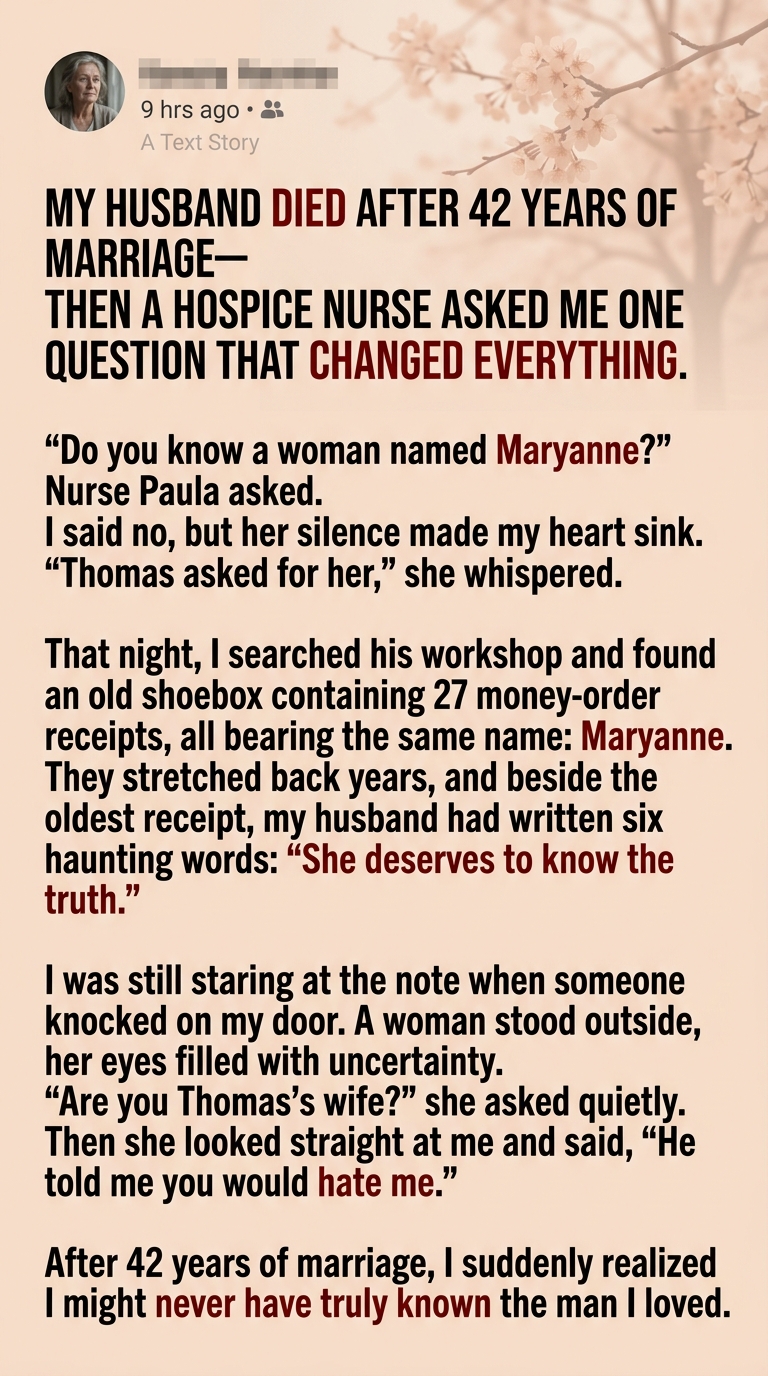
“Do you know a woman named Maryanne?”
Hospice nurse Paula asked me that question three days after my husband died.
I was sitting in the living room, surrounded by sympathy cards, half-empty cups of tea, and flowers that were already beginning to wilt. Thomas and I had been married for forty-two years. I still couldn’t bring myself to move his slippers from beside the bed.
I looked up at her.
“No. Why?”
Paula hesitated.
“Thomas asked for her during his final night.”
I felt something tighten in my chest.
“Perhaps she was an old friend?”
Paula shook her head slowly.
“He seemed frightened. He kept saying, ‘Please find Maryanne. She deserves to know the truth.’”
I stared at her.
“What truth?”
“I don’t know,” she replied. “But he said it several times. He was very specific about her name.”
After Paula left, I sat alone until the afternoon light disappeared behind the curtains.
My husband had been a quiet man. He wasn’t the sort who collected secrets, or at least that was what I had believed. He worked as a carpenter for most of his life, loved gardening, and spent his Sunday mornings reading the newspaper at the kitchen table.
We had raised two children, celebrated seven grandchildren, survived financial difficulties, and buried our parents together.
I knew how he took his coffee.
I knew the songs he hummed when he worked.
I knew he always checked the front door twice before going to bed.
How could I have lived beside a man for forty-two years and never heard him mention a woman named Maryanne?
That evening, I walked into his workshop.
I hadn’t entered it since his funeral. The smell of cedarwood and machine oil still lingered in the air. His tools were arranged neatly on the wall, and his old workbench stood beneath the window where he used to spend hours repairing furniture for neighbors.
I opened the drawers one by one.
At first, I found nothing unusual. Old receipts, instruction manuals, photographs of our children, and a small collection of screws he had apparently decided were too useful to throw away.
Then I noticed a dusty shoebox tucked beneath the workbench.
Inside were twenty-seven money-order receipts.
Every receipt carried the same name.
Maryanne.
The earliest was dated thirty-one years earlier. The latest had been issued just months before Thomas died.
The amounts varied. Some were small, others surprisingly substantial. But the payments were remarkably consistent, arriving several times a year.
My hands trembled as I arranged them by date.
Thirty-one years.
Thirty-one years of payments to a woman I had never heard of.
At the bottom of the box lay a folded piece of paper.
It was written in Thomas’s familiar handwriting.
Six words had been underlined twice.
She deserves to know the truth.
I sat down on his workbench, clutching the note.
Had Thomas been supporting another woman for three decades?
Had he fathered a child before we met?
Had there been an entire second family hidden somewhere beyond the life we had built together?
I was still staring at the receipts when someone knocked on the front door.
I walked slowly down the hallway and opened it.
A woman stood on the porch, perhaps in her late fifties, wearing a dark blue coat. Her hands were clasped tightly in front of her.
She looked exhausted, as though she had spent the entire journey rehearsing what she intended to say.
“Are you Thomas’s wife?” she asked.
“Yes.”
She swallowed.
“My name is Maryanne.”
I felt the blood drain from my face.
She glanced past me into the house.
“Thomas told me you would hate me.”
I wanted to slam the door.
I wanted to demand that she leave.
Instead, I heard myself ask the question that had been tearing through my mind all evening.
“Who were you to my husband?”
Maryanne closed her eyes.
Then she whispered five words that changed everything.
“I’m the daughter he abandoned.”
I gripped the doorframe.
“No. Thomas never had another daughter.”
She looked at me with tears filling her eyes.
“He did.”
For a moment, neither of us moved.
Then Maryanne reached into her handbag and pulled out an old photograph.
It showed a younger Thomas standing beside a woman I had never seen before. In his arms was a little girl wearing a yellow dress.
On the back, in Thomas’s handwriting, were the words:
Maryanne’s fourth birthday. I promise I’ll never forget you.
I stared at the photograph until the faces blurred.
My husband had not merely kept a secret.
He had kept a daughter.
And after forty-two years of marriage, I was about to discover why.
Chapter Two: The Daughter He Never Mentioned
I let Maryanne inside.
She sat on the edge of our living-room sofa, refusing the tea I offered her. She kept looking at Thomas’s photograph on the mantelpiece, and every time she did, her expression seemed to collapse a little further.
“How old were you when you last saw him?” I asked.
“Twenty-three.”
“And you’re fifty-four now?”
She nodded.
“He came to see me once when I was a little girl, then again when I was a teenager. After that, he disappeared from my life.”
I stared at her.
“Why?”
“My mother, Eleanor, never told me the whole story. She said Thomas was a married man who couldn’t face the consequences of his choices.”
I sat down opposite her.
“Thomas and I didn’t meet until 1982.”
Maryanne looked surprised.
“My mother met him in 1970. They were young. She was working at a little café outside town, and he was doing carpentry work nearby.”
She paused, struggling to continue.
“They fell in love. But when my mother told him she was pregnant, he panicked. He had just received an opportunity to work in another city. He left, promising to return.”
“Did he?”
“Not when she needed him.”
Her voice broke.
“My mother raised me alone. She worked two jobs, and there were times we barely had enough money for groceries. She wrote him letters, but most went unanswered.”
I looked down at my hands.
Thomas had always told me that before we met, he’d spent several years working far from home. He’d never mentioned a woman named Eleanor.
“Why did he start sending money?”
Maryanne wiped her eyes.
“When I was twenty-three, my mother became seriously ill. I found an old address among her belongings and wrote to him. I told him who I was and asked why he’d abandoned us.”
She took a breath.
“He came to the hospital. It was the first time I’d seen him in years. He cried when he saw my mother. He apologized, but she wouldn’t forgive him.”
“What happened after that?”
“He started helping me financially. He paid for some of my nursing training and sent money when my children were young. But he never wanted to be publicly acknowledged as my father.”
I felt anger rise inside me.
“He could send money, but he couldn’t tell you he loved you?”
Maryanne looked down.
“I think he loved me. I also think he was ashamed of what he’d done.”
I thought of Thomas sitting at our dinner table, asking about our children, helping with homework, and carrying our grandchildren on his shoulders.
Had he looked at them and thought about the daughter he had left behind?
Had he spent every family holiday knowing another woman was waiting for him to become the father he had promised to be?
“Did he ever tell you about me?” I asked.
“Yes. He said you were a good woman. He said you had given him a beautiful family.”
She paused.
“He also said he was afraid you would never look at him the same way if you knew about me.”
I laughed bitterly.
“He was right.”
Maryanne flinched.
I immediately regretted my tone.
She wasn’t the person who had made those choices. She was a child who had grown up without her father, and a woman who had carried the consequences of his silence for decades.
“I’m sorry,” I said. “I’m angry with him, not you.”
She nodded, and for the first time, her shoulders relaxed.
Then she reached into her handbag again.
“There’s something else you should see.”
She placed a sealed envelope on the coffee table.
My name was written on the front.
Thomas’s handwriting.
My hands began to shake.
“He gave this to me six months ago,” Maryanne explained. “He said I should bring it to you after he died. He made me promise not to open it.”
I stared at the envelope.
For forty-two years, I had believed there was nothing about my husband I didn’t know.
Now I was afraid to discover what else he had hidden.
Chapter Three: The Letter That Changed My Memories
I opened the envelope carefully.
Inside was a six-page letter.
My dearest Margaret,
If you’re reading this, I’ve finally run out of time to find the courage to tell you the truth.
I stopped reading.
I could almost hear Thomas’s voice in the words.
I had heard him say my name thousands of times. In the morning when he brought me coffee. Across crowded rooms when he wanted my attention. At night when he reached for my hand.
Now his handwriting seemed to belong to a stranger.
I continued.
Before I met you, I made a mistake that changed another person’s life forever. I was young, frightened, and selfish. I left a woman named Eleanor when she needed me most.
She gave birth to a daughter, Maryanne.
For years, I told myself that leaving was the only choice I had. I told myself I would return when I was more successful, when I had more money, when I was ready to face the consequences.
But every year I waited made it harder to return.
Then I met you.
You gave me a home, a family, and a reason to become the man I should have been all along.
I pressed the letter against my chest.
I loved you with everything I had. But I was a coward about the part of my life that existed before you.
When Maryanne contacted me years later, I realized that no amount of money could repay the childhood I had taken from her. I tried to help her quietly. I thought I was protecting you from pain, but I was really protecting myself from shame.
You deserved to know.
Maryanne deserved a father who would stand beside her without hiding.
I failed both of you.
I stopped again.
Tears were running down my cheeks.
The letter continued.
There is one more thing I need you to understand. I did not keep Maryanne a secret because I loved you less. I kept her a secret because I was afraid that the truth would expose the worst part of me.
But love without honesty is not the love you deserved.
I cannot ask you to forgive me. I can only ask you not to punish Maryanne for my choices.
She has spent enough of her life paying for my mistakes.
If you can find it in your heart to do one thing after I’m gone, please meet her again. Hear her story. Let her know she was never the mistake. My leaving was.
I love you, Margaret. I am sorry I waited until death made honesty unavoidable.
Thomas.
I folded the letter and placed it on my lap.
For several minutes, I couldn’t speak.
I had spent forty-two years believing our marriage was built on complete trust. Now I understood that my husband had carried a room inside himself that I had never been allowed to enter.
And yet, the letter did not erase our life together.
I remembered the night our first child was born, when Thomas held my hand so tightly that his fingers went numb.
I remembered the winter he worked extra shifts because our daughter needed surgery.
I remembered how he sat beside me after my mother’s funeral and held me until I could finally sleep.
Those moments had been real.
But so was the daughter he had abandoned.
I looked at Maryanne.
“Did he ever tell you why he didn’t come back when you were little?”
She nodded slowly.
“He said he thought he had ruined my mother’s life. He believed that staying away was better than coming back and making things worse.”
“Did you believe him?”
“No.”
She looked toward the window.
“I think he was afraid that if he came back, he would have to face what he’d done. And I think he spent the rest of his life trying to make up for it without admitting it to the world.”
I understood then that Thomas’s secret had not been one single lie.
It had been thousands of small decisions to delay the truth until telling it became almost impossible.
And now the truth belonged to the people left behind.
Chapter Four: The Twenty-Seven Receipts
The next morning, Maryanne and I returned to Thomas’s workshop.
I wanted to understand the money-order receipts. I needed to know whether there had been more to his secret than the letter revealed.
We spread all twenty-seven receipts across the workbench.
At first, they looked like a simple record of financial support. But when we arranged them by date, we noticed something strange.
The payments had begun again in a regular pattern after Thomas’s retirement.
Every three months, almost without fail, he had sent Maryanne money.
Some payments were modest. Others were large enough to cover a semester of tuition or an emergency expense.
But the final three receipts were different.
They were accompanied by handwritten notes.
The first read:
For the house repairs. Please don’t refuse this.
The second said:
I wish I had been there when you needed me.
The third contained only a few words:
Ask Margaret about the blue box.
I looked at Maryanne.
“What blue box?”
She shook her head.
“I don’t know.”
We searched the workshop, opening drawers and moving old toolboxes. At the back of a cupboard, behind a stack of woodworking magazines, I found a small blue metal box.
Inside were photographs, letters, and a child’s drawing of a house with three people standing in front of it.
On the back, a little girl had written:
Daddy, this is the house I want us to live in someday.
The handwriting was uneven and childish.
Maryanne began to cry.
“I drew that when I was seven.”
Beneath the drawing was a photograph of Thomas holding her outside a school building. He looked younger, thinner, and happier than the man I had known in his later years.
There was also a letter from Eleanor, dated many years earlier.
I asked Maryanne if she wanted to read it first.
She shook her head.
“Please. I think I need you to read it with me.”
We sat side by side as I unfolded the paper.
Eleanor’s letter explained that she had learned Thomas was married shortly after their daughter was born. She had been devastated, but she refused to let him return simply because he felt guilty.
She wanted him to acknowledge Maryanne openly, not send money in secret.
My daughter deserves to know where she comes from, Eleanor had written. She deserves a father who will not disappear whenever life becomes difficult.
At the bottom was a sentence that made me pause.
If you cannot be that man, then at least be honest enough to let her stop waiting for you.
I looked at Maryanne.
“Did your mother ever tell you about this letter?”
“No. She kept most of the details from me. She wanted me to have a childhood without hating him.”
I thought about that for a long time.
Eleanor had protected her daughter from the full weight of Thomas’s failure, just as Thomas had tried to protect me from the truth.
But the difference was that Eleanor had not pretended the past never happened. She had simply refused to let it define her daughter’s entire life.
I closed the box.
“Maryanne, I can’t give you back the years you lost with him.”
She wiped her cheeks.
“I know.”
“But I can listen to you. And if you’re willing, I’d like to know you as the person you are now—not just as the secret my husband kept.”
She looked at me in disbelief.
“You don’t hate me?”
“No,” I replied. “I’m angry that you were denied a father. I’m angry that my husband lied to me. But you didn’t create either of those things.”
She reached for my hand.
And for the first time since she had arrived at my door, we both smiled.
It was a small moment.
But it was the beginning of something Thomas had never managed to create himself.
A relationship built on truth.
Chapter Five: The Secret Behind His Last Request
Two weeks after Maryanne first knocked on my door, I received another phone call from hospice nurse Paula.
“Margaret, I hope you don’t mind me calling,” she said. “There’s something I remembered about Thomas’s final night.”
I sat down.
“What is it?”
“He asked me to make sure Maryanne received something. I thought he meant the letter, but now I’m not certain.”
“What else did he say?”
Paula paused.
“He told me, ‘Tell Margaret to look at the date on the first receipt. She’ll understand why I waited.’”
I immediately went to the workshop and pulled the oldest money-order receipt from the box.
It was dated thirty-one years earlier.
The date was October 14.
I recognized it instantly.
It was the day our youngest son, David, had been born.
I sat motionless, holding the receipt.
That day had been one of the happiest of my life. Thomas had stood beside me in the hospital, crying as he held our newborn son. He had kissed my forehead and promised that our family would always come first.
And yet, on that same day, he had sent money to Maryanne.
I felt a fresh wave of grief.
For a moment, I wondered whether every important memory we shared had contained another life I knew nothing about.
Then I remembered something else.
Thomas had always kept a small notebook in his bedside drawer. He called it his workshop ledger, although he sometimes wrote personal notes in it.
I had never read it because I believed it was private.
But now I wondered whether it held the explanation I needed.
I found the notebook beneath his reading glasses.
Most pages contained measurements, project costs, and lists of supplies. Near the back, however, were several entries written in his careful handwriting.
One entry, dated the same day as David’s birth, read:
Today my son was born. I held him and promised to be the father I should have been to Maryanne. I sent her money again, but I know it isn’t enough. I have two children now who need me in different ways. I don’t know how to tell Margaret without destroying the life we’ve built.
I read the entry twice.
Then I turned the page.
Years of notes followed.
Maryanne graduated today. I watched from the back of the hall. She doesn’t know I was there.
She has a little boy now. He looks just like me at that age.
I saw her outside the hospital. She thanked me for the money, but she still calls me Mr. Thomas.
The last entry was dated only four months before his death.
Maryanne invited me to meet her grandchildren. I almost said yes. Then I thought about Margaret, and I lost my courage again.
I closed the notebook.
Now I understood why the receipts had continued for so many years.
Thomas had not simply been sending money to a woman from his past. He had been trying to remain connected to a daughter he had never properly claimed.
But I also understood the cruel irony.
He had spent decades believing that telling me the truth would destroy our family.
Instead, his silence had deprived Maryanne of a father, deprived me of the chance to decide what our marriage could survive, and left both of us grieving a man who had never fully explained himself while he was alive.
I sat in his workshop until the sun went down.
Then I called Maryanne.
“I found the notebook,” I told her. “There are things you should know.”
We agreed to meet the next day.
And as I hung up, I realized that the story was no longer just about what Thomas had hidden.
It was about what we would choose to do with the truth he had left behind.
Chapter Six: The Grandchildren He Never Met
Maryanne arrived the next afternoon carrying a photograph album.
She had brought pictures of her two children, her grandchildren, and the small house where she had grown up with Eleanor.
As we looked through the photographs, I began to understand the life Thomas had missed.
Maryanne had become a nurse, just as she had once dreamed. She had married a kind man named Robert, raised two children, and spent years caring for her mother until Eleanor died.
She had built a good life.
But every few years, she had looked at a photograph of Thomas and wondered whether he would ever acknowledge her publicly.
“He paid for my nursing course,” she said. “When my son was born prematurely, he sent money to help with the hospital bills. When my husband lost his job, another payment arrived.”
She smiled sadly.
“I used to tell myself that meant he cared.”
“He did care,” I said. “But he should have done more than send money.”
She nodded.
“I know.”
I showed her the notebook.
When she reached the entry about her graduation, she covered her mouth.
“He was there?”
“Apparently.”
She began to cry.
“I looked for him that day. I kept hoping he might come.”
I reached across the table and held her hand.
“He was there, Maryanne. He just didn’t have the courage to walk up to you.”
She wiped her eyes.
“That almost makes it worse.”
“I understand.”
For a while, we sat in silence.
Then Maryanne told me something that surprised me.
“My mother used to say that people can spend their entire lives trying to repair a mistake without ever admitting what the mistake was.”
I thought of Thomas’s twenty-seven receipts.
His careful payments.
His hidden notebook.
His final request.
He had tried to make amends in the only way he knew how, but he had never understood that money could not replace a public acknowledgment, an honest conversation, or the simple act of showing up.
I looked at Maryanne.
“I can’t change what your father did. But I’d like to meet your children someday, if you’d be comfortable with that.”
Her eyes widened.
“You would?”
“Yes. If they want to meet me, too.”
She smiled through her tears.
“I think they would like that.”
And so, a month later, I met Thomas’s grandchildren for the first time.
They came to my house on a Sunday afternoon, carrying a homemade cake and a bouquet of flowers.
One of them had Thomas’s unmistakable smile.
I had to turn away for a moment.
Not because I was angry, but because grief has a way of surprising you. Sometimes it arrives when you least expect it, wearing the face of someone you never knew existed.
We sat together, shared stories, and looked at old photographs.
Maryanne told them about the father she had lost and the man she had finally begun to understand.
I told them about the husband I had loved, the grandfather who had spoiled our children, and the man whose silence had hurt people he cared about.
We didn’t pretend he had been perfect.
We didn’t pretend his choices were harmless.
But we allowed ourselves to remember the good without denying the bad.
For the first time, Thomas’s two families were sitting around the same table.
Not because he had brought us together.
But because we had chosen to stop letting his secret keep us apart.
Chapter Seven: The Last Letter
Six months after Thomas died, I found one final letter tucked inside the back cover of his notebook.
It was addressed to Maryanne.
I called her immediately.
When she arrived, we sat together in the workshop and opened it.
My dear Maryanne,
I don’t know whether you will ever forgive me.
When you were a little girl, I told myself I would return when I was ready. When you became a teenager, I told myself you were old enough to understand. When you became a woman, I told myself that the past was too complicated to repair.
Every excuse sounded reasonable until I looked at your face.
I missed your birthdays, your graduation, your wedding, and the birth of your children. I missed the ordinary moments that make a father a father.
I sent money because I wanted to help, but I also sent it because I was afraid that if I stopped, I would have nothing left connecting me to you.
I know now that money was never what you needed most.
You needed me to say your name in front of the people I loved. You needed me to introduce you as my daughter without lowering my voice.
I should have done that years ago.
I am sorry.
There is something I hope you will understand about Margaret. She was not the reason I stayed away. My fear was.
I made her part of a lie she never agreed to, and I made you pay for a choice you never made.
Neither of you deserved that.
If I could ask one final thing, it would be this: don’t spend the rest of your life waiting for me to become the father I should have been. Build a life that belongs to you. Let yourself be loved by people who show up. And when you remember me, remember the truth, even if it hurts.
You were never my mistake, Maryanne.
You were my daughter.
I only wish I had been brave enough to live like your father.
Thomas.
Maryanne pressed the letter to her chest and cried.
I sat beside her, holding her hand.
For years, Thomas had been trying to find a way to say those words.
He had finally said them.
But he had waited until he could no longer hear his daughter’s response.
That was the tragedy of his secret.
Not that he had loved two families.
Not even that he had been afraid.
It was that he had allowed fear to make his decisions for so long that he had run out of time to make things right.
I looked around the workshop.
The tools were still hanging on the wall. The workbench still carried the scratches he had made over decades. His old coffee mug sat beside the window.
Everything looked the same.
Yet nothing was the same.
I had spent forty-two years loving Thomas, and I would always love the man who had shared my life.
But I no longer needed to pretend that love made him incapable of wrongdoing.
He had been a good husband in many ways.
He had been a devoted father to our children.
And he had failed his first daughter in ways that no amount of money could repair.
All three things were true.
For the first time, I could remember him without needing to defend him.
And that, I realized, was another kind of peace.
Epilogue: The Family He Left Behind
On the first anniversary of Thomas’s death, I invited everyone to my house.
Our children came with their families. Maryanne arrived with her husband, her children, and her grandchildren.
I set a long table in the garden.
For the first time, there were photographs of both sides of Thomas’s family displayed together.
Before dinner, I stood and raised my glass.
“I spent forty-two years believing I knew everything about the man I married,” I began. “After he died, I discovered that I had been wrong.”
Everyone fell silent.
“I learned that love doesn’t make someone perfect. It doesn’t erase the harm they cause, and it doesn’t excuse the truths they hide.”
I looked at Maryanne.
“But I also learned that the mistakes of one person don’t have to determine the future of everyone they leave behind.”
Maryanne reached for my hand.
“We can’t change the past,” I continued. “But we can decide what we do with it.”
Then I raised my glass.
“To the truth, even when it arrives too late. To forgiveness when it is freely given. And to the family we choose to build from here.”
Everyone raised their glasses.
Later that evening, Maryanne and I sat together on the porch.
She looked at the photograph of Thomas beside the front door.
“Do you think he knew we’d become close?”
I thought about it.
“I think he hoped we might.”
She smiled sadly.
“I wish he’d told us everything while he was alive.”
“So do I.”
We sat quietly, listening to the crickets in the garden.
I still missed Thomas every day.
I missed his laughter, his terrible jokes, the way he always forgot where he’d left his glasses, and the warmth of his hand finding mine in the dark.
But I no longer mistook the life we had shared for the whole of his story.
He had been my husband for forty-two years.
He had been Maryanne’s father, even when he lacked the courage to say so.
And his final gift to us was not the money he had sent, the receipts he had saved, or even the letters he had written.
It was the truth.
Painful, incomplete, and delivered too late—but still the truth.
Sometimes I wonder what would have happened if Thomas had told me about Maryanne before we married. Perhaps we could have built a different kind of family. Perhaps our lives would have been harder in some ways and easier in others.
I’ll never know.
What I do know is that I would rather have lived with an uncomfortable truth than spent another forty-two years believing a story that wasn’t complete.
And when I look at Maryanne now, I no longer see the secret my husband kept.
I see a woman who deserved a father, a daughter who deserved the truth, and a family that found a way forward after grief had brought us together.
Thomas’s life ended with unfinished business.
Ours did not have to.
THE END.