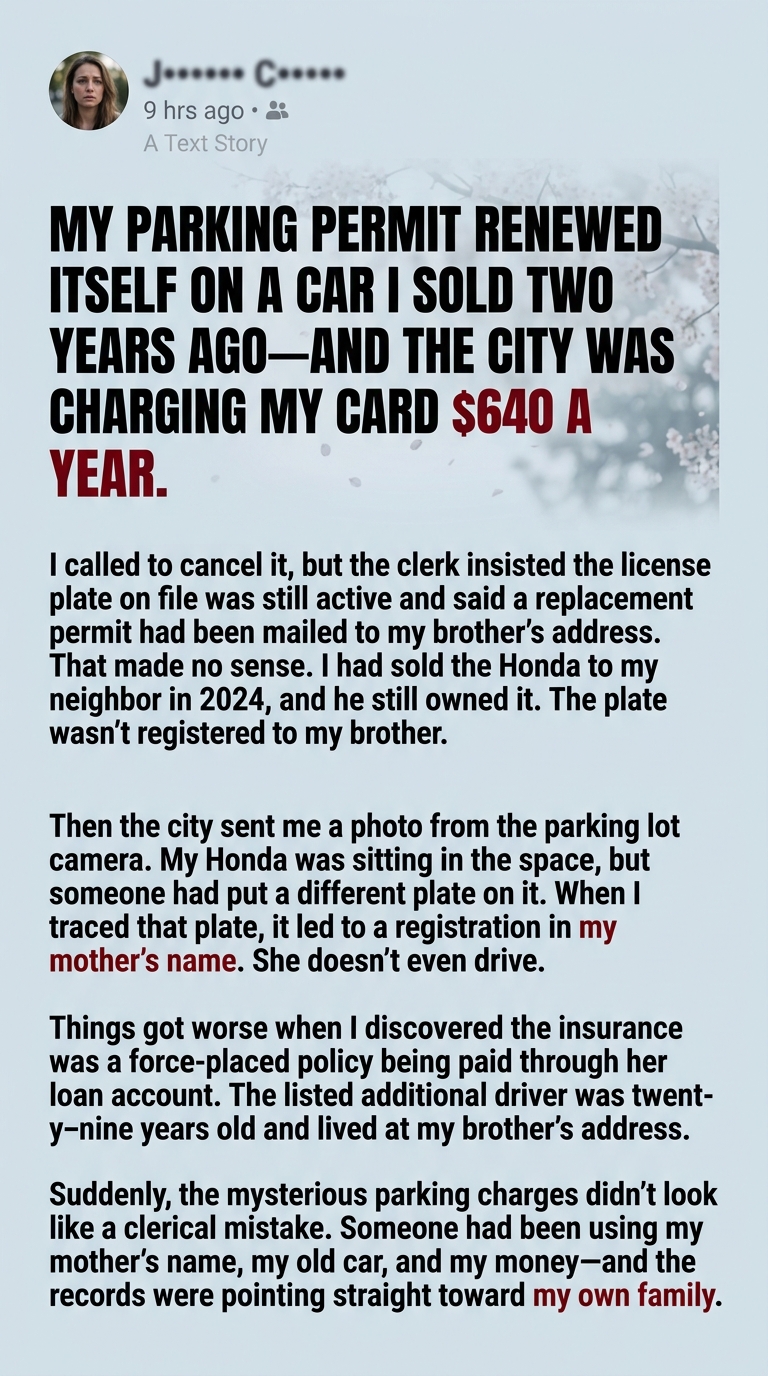
MY PARKING PERMIT KEPT RENEWING ON A CAR I SOLD TWO YEARS AGO—THEN I DISCOVERED WHO WAS REALLY DRIVING IT
The first warning came in the form of a $640 charge on my credit card.
I almost ignored it.
The transaction was labeled Annual Residential Parking Permit Renewal, something I vaguely remembered setting up years earlier when I still owned my Honda.
But I had sold that car to my neighbor in 2024.
I no longer owned it, no longer drove it, and certainly had no reason to pay $640 a year to park it.
So I called the city.
After twenty minutes on hold, a clerk named Denise answered.
“I’d like to cancel a parking permit,” I explained. “It’s still being charged to my card, but I sold the vehicle two years ago.”
She asked for my name, account number, and the old license plate.
There was a long pause as she typed.
“I’m sorry,” she said. “The permit is active, and the vehicle information on file hasn’t changed.”
“That can’t be right. I sold the Honda in 2024.”
“Well, our system shows that a replacement permit was mailed to the address associated with your account.”
“Which address?”
She read it aloud.
My brother Daniel’s house.
I sat up straight.
“Why would you send my parking permit to my brother?”
“I can only see that the mailing address was updated several months ago. I can’t tell you who made the change from this screen.”
I felt a cold sensation spread through my chest.
I hadn’t lived with Daniel in fifteen years. I hadn’t used his address for anything in years.
And the Honda wasn’t even registered to him.
“Please cancel the permit immediately,” I said.
“I can submit a cancellation request, but there appears to be an issue with the vehicle record. We may need additional documentation.”
“What issue?”
“The license plate associated with your account is being flagged as active in our parking system.”
I hung up only after obtaining a case number.
Then I called my neighbor, Peter, who had bought the Honda from me.
“Hey, do you still have the old Honda?”
“Of course,” he replied. “Runs like a dream. Why?”
“Have you changed the license plate?”
“No. Same plate, same registration. What’s going on?”
I explained the parking charges.
Peter sounded just as confused as I was.
He even sent me a photograph of the Honda sitting in his driveway, showing the license plate clearly.
The plate matched the bill of sale.
Whatever was happening, it wasn’t something Peter had done.
That afternoon, the city emailed me a photograph from one of its parking cameras.
I opened the attachment.
There was my old Honda, parked in a reserved residential space.
The color, the scratches on the rear bumper, even the small dent beside the trunk handle were unmistakable.
But the license plate was different.
I zoomed in.
Someone had replaced the original plate with another one.
I ran the plate through the publicly available vehicle information service in my area and discovered that the registration was associated with my mother, Patricia.
My mother was seventy-one years old.
She didn’t drive.
She had never owned a Honda.
For a few seconds, I simply stared at the screen, hoping there was some harmless explanation.
Then I remembered the address.
Daniel’s house.
The replacement permit had been sent there.
The unfamiliar plate belonged to a vehicle record associated with our mother.
And the charges were coming from my credit card.
I called Daniel.
He answered on the fourth ring.
“Hey, what’s up?”
“Did you change the mailing address on my parking account?”
Silence.
Then a laugh.
“What? No. Why would I do that?”
“Someone changed it to your house.”
“Must be a mistake.”
“Daniel, the city has a photograph of my old Honda using a different plate. That plate is associated with Mom.”
His voice changed.
“Maybe Peter sold it to someone else.”
“Peter still has the car. I spoke to him today.”
Another pause.
Then Daniel sighed.
“You always make everything into a big investigation.”
“Because someone is charging my card $640 a year for a car I don’t own.”
“It’s just a parking permit. Call the city and cancel it.”
“I tried. They said the account was updated months ago, and the replacement permit was mailed to you.”
He became irritated.
“I’m busy. Talk to the city.”
He hung up.
That should have been enough to make me suspicious.
Instead, it made me determined to understand what I was looking at.
The next morning, I called my mother.
“Mom, did you register a vehicle recently?”
“No, sweetheart. Why would I?”
“Has anyone asked you to sign paperwork related to a car or insurance?”
She hesitated.
“Daniel brought some papers over last winter. He said the bank needed updated information because of his loan. I signed where he showed me.”
“What kind of papers?”
“I don’t remember exactly. There were so many pages.”
I closed my eyes.
“Did he explain that a vehicle would be registered in your name?”
“No.”
“Did you give him permission to use your identity for anything else?”
“Of course not. Why are you asking me these questions?”
I told her about the parking photograph.
For a moment, she said nothing.
Then she whispered, “Please don’t tell me Daniel has done something foolish again.”
Those words stayed with me.
Again.
I asked what she meant, but she insisted she didn’t want to accuse her son without knowing the facts.
I promised I wouldn’t jump to conclusions.
Then I asked her to check her bank and loan statements.
That was when the second mystery surfaced.
A document in her online account showed an insurance policy connected to the vehicle registration. The policy had been arranged through a lender’s insurance program, and premiums were being added to a loan account in her name.
It appeared to be a force-placed policy, meaning coverage had been arranged through a lender after it determined that the required insurance documentation was missing or insufficient.
But the vehicle information didn’t match anything my mother recognized.
The listed additional driver was twenty-nine years old.
He lived at Daniel’s address.
His name was Marcus Bell.
I had met Marcus twice. He was Daniel’s friend, a man who always seemed to be around whenever money or business opportunities came up.
My mother had never mentioned him.
I searched through the paperwork again and found a notice explaining that the lender had requested proof of insurance for a vehicle associated with the account. When the requested documentation was not received, the lender had arranged coverage and added the premium to the account balance.
Someone had apparently connected a vehicle to my mother’s loan account.
But who?
And why?
I called the insurance company and explained that I was trying to help my mother identify a policy she didn’t recognize.
They couldn’t disclose all the details to me, but they told me what my mother needed to request as the account holder: the policy documents, the vehicle identification number, the basis for the coverage, and the records showing who had submitted the relevant information.
I helped her make that request.
Three days later, an envelope arrived.
Inside were copies of the insurance documents, a vehicle identification number, and a record of the account information used when the policy was established.
My mother recognized the address.
It was Daniel’s.
The vehicle identification number, however, was not the number belonging to Peter’s Honda.
It belonged to a different Honda of the same model and color.
Someone had found a way to connect my old parking permit to a different vehicle, while the insurance records tied that vehicle to my mother’s financial account.
It was no longer a simple clerical error.
Someone had assembled a chain of records that made it look as though my mother was responsible for a vehicle she had never driven.
And someone had used my old parking account to secure a permit for it.
I called the city’s parking enforcement department again.
This time, I requested a formal review and asked them to preserve the camera images, account changes, payment records, and mailing information.
I also reported the suspicious activity to my credit card company and disputed the charges I could not authorize.
The representative canceled future renewals while the dispute was investigated and advised me to replace the card details connected to the account.
Then I helped my mother contact her lender.
She reported that a vehicle and insurance policy had appeared in her records without her understanding or authorization. The lender opened a case and asked her to provide a written statement.
I thought that would finally bring Daniel to the table.
Instead, he called me that evening, furious.
“What have you done?”
“I reported charges on my credit card and an insurance policy Mom doesn’t recognize.”
“You had no right to involve the bank!”
“It’s Mom’s loan account.”
“You’re making this look like fraud!”
“I didn’t create the records, Daniel. I asked the people responsible for them to explain why they exist.”
He lowered his voice.
“You don’t understand the situation.”
“Then explain it.”
He didn’t.
Instead, he accused me of trying to get him into trouble and warned me that Marcus would lose his job if the investigation continued.
That was the first time he had mentioned Marcus’s job.
“What does Marcus have to do with the Honda?”
Daniel went quiet.
Then he said, “Leave it alone.”
I ended the call.
The following morning, my mother received a message from Marcus.
He asked whether she had received any letters about a vehicle or insurance policy and told her not to worry because Daniel was handling everything.
My mother showed me the message.
We forwarded it to the lender’s investigator.
A week later, the city confirmed that someone had changed the mailing address on my parking account using an online request. The records showed the date and the device information available to the department, but they could not conclusively identify the person who had submitted it.
They also confirmed that the photograph showed a plate different from the one originally associated with my Honda.
The city suspended the permit pending review.
My credit card company continued investigating the recurring charges.
Meanwhile, my mother’s lender discovered discrepancies in the vehicle information attached to her account and referred the matter to its fraud team.
The pieces were beginning to connect, but I still didn’t know who had driven the car or who had submitted the documents.
Then Peter called me.
“I think you need to come over,” he said. “There’s something I found in the paperwork from when I bought the Honda.”
I drove to his house that afternoon.
Peter had kept the original bill of sale, the registration transfer confirmation, and a folder containing maintenance records. He had also kept a photograph of the car from the day he bought it.
We compared the documents with the city’s image.
The Honda in the photograph was unmistakably his vehicle.
But the plate belonged to another registration.
Peter pointed to the date on the parking photograph.
“That was the same week Daniel borrowed the car.”
I stared at him.
“Daniel borrowed your Honda?”
“Just for one afternoon. He said he needed to move a piece of furniture and his car was at the mechanic. He brought it back that evening.”
“Did you notice the plate?”
“No. Why would I?”
I asked Peter whether he had noticed anything else.
He remembered that Daniel had asked where Peter kept the spare key and whether the car’s registration papers were still in the glove compartment.
At the time, the questions hadn’t seemed unusual.
Now they mattered.
Peter gave a written statement to the city and agreed to cooperate with the investigation.
I called Daniel again.
This time, I didn’t ask whether he had changed the account.
I asked him why he had borrowed Peter’s Honda during the same week the city photographed it with a different plate.
He said nothing.
Then he finally admitted that he had borrowed the car.
He claimed Marcus had asked him to help move some equipment, and he insisted he had no idea how the different plate ended up on the vehicle.
“Did you change it?” I asked.
“No.”
“Did you know about the parking permit?”
“No.”
“Then why was it mailed to your house?”
“I don’t know!”
He sounded genuinely angry, but anger wasn’t evidence of innocence or guilt.
I told him the city and lender were investigating, and that he should preserve any messages or documents related to the car.
He accused me of threatening him.
I told him I was giving him the same advice I had given our mother: let the records speak for themselves.
Then I hung up.
Several weeks later, the lender’s review established that the insurance policy had been arranged using information that did not accurately reflect my mother’s knowledge or use of the vehicle. The lender corrected the account records and began reviewing the charges connected to the policy.
The city found that the parking permit had been issued based on inconsistent vehicle information and canceled it. My card issuer reversed the disputed charges that it determined were unauthorized and blocked further renewals.
The investigation into who had changed the plate and submitted the information remained separate. The available records raised serious questions, but they did not establish every person’s role.
Marcus eventually contacted my mother through an attorney. He said he had been trying to keep a vehicle on the road while dealing with financial problems and had relied on Daniel to help with paperwork. He denied that he had intended to steal money from anyone.
His explanation did not answer every question.
The authorities continued reviewing the documents, and I refused to accept anyone’s story without evidence.
Daniel eventually admitted that he had allowed Marcus to use his address for correspondence and had helped him navigate some of the paperwork. He claimed he had not understood that the vehicle information was inconsistent or that my parking account had been used.
Whether that explanation accounted for everything was for the investigators to determine.
What mattered immediately was that the false connections had been documented, my card was no longer being charged, and my mother was no longer expected to accept unexplained insurance costs on her loan account.
A few months later, my mother and I sat together at her kitchen table.
She looked exhausted.
“I raised him to know better,” she said quietly.
I reached across the table and took her hand.
“We don’t know every detail yet, Mom. But we know you deserve answers.”
She nodded, tears gathering in her eyes.
For years, our family had treated questions as accusations. If someone asked Daniel to explain a decision, he called it a lack of trust. If someone questioned Marcus, he said people were judging him unfairly.
That habit had allowed strange things to go unexamined for too long.
I had almost ignored the first $640 charge because it seemed too small to matter.
Instead, it led us to a parking permit, a changed address, a different license plate, an unfamiliar insurance policy, and a vehicle connected to my mother’s loan.
I never expected the mystery to reveal so much about the people closest to me.
But I learned something important.
Family loyalty should not mean paying unexplained bills, signing documents you don’t understand, or accepting answers that contradict the records in front of you.
Sometimes the most responsible thing you can do is stop protecting everyone from uncomfortable questions.
Because the truth may not be as simple as the first suspicion.
But it is still worth finding.
And when I finally looked at the last letter the city sent me, I didn’t feel afraid.
I felt relieved.
The permit was canceled. The charges had stopped. My mother had begun taking control of her own records.
And for the first time since that strange parking charge appeared, I knew we were no longer blindly trusting the people who had told us everything was fine.
The mystery had started with $640 a year. It ended with our family learning that a shared last name was never a substitute for accountability.