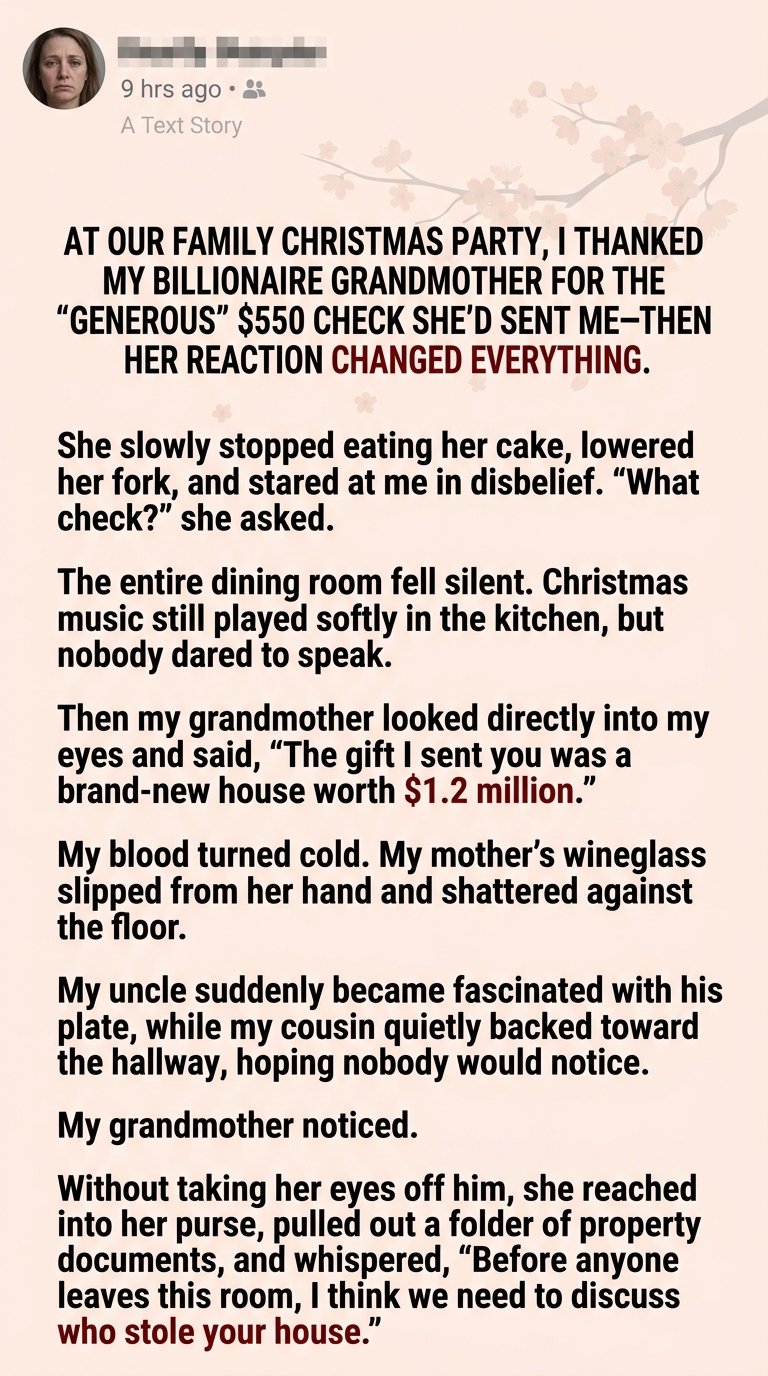
MY BILLIONAIRE GRANDMOTHER GAVE ME A $1.2 MILLION HOUSE—BUT MY FAMILY HANDED ME A $550 CHECK INSTEAD
The moment my grandmother said the words “Who stole your house?” our family Christmas party stopped being a celebration.
My mother stood frozen beside the shattered wineglass at her feet. My uncle stared at his plate as if the turkey had suddenly become the most fascinating thing in the world. And my cousin, Tyler, had stopped halfway toward the hallway.
Nobody moved.
My grandmother, Eleanor Whitmore, was eighty-one years old, worth several billion dollars, and famous for three things: her sharp memory, her impeccable manners, and her absolute refusal to tolerate dishonesty.
She placed the folder on the dining table.
“Sit down, Tyler.”
He turned slowly.
“Grandma, I don’t understand what this is about.”
“Then you should have no trouble explaining yourself.”
I looked at the check I’d received two weeks earlier. Five hundred and fifty dollars, drawn from an account I didn’t recognize, accompanied by a Christmas card in my mother’s handwriting.
Your grandmother wanted you to have something special this year. Merry Christmas.
At the time, I had been genuinely grateful. My name is Claire Whitmore, and unlike most of my relatives, I had never expected my grandmother’s wealth to become mine. I worked as a graphic designer, rented a small apartment, drove a used sedan, and paid my own bills.
I loved my grandmother, but I didn’t measure her affection in money.
Still, $550 was a generous gift.
At least, that’s what I thought.
Now she was telling me she’d intended to give me a house worth $1.2 million.
“I sent the instructions to my attorney six weeks ago,” she continued. “The house on Hawthorne Lane was purchased outright through my family trust. The deed was supposed to be transferred to Claire before Christmas. I personally approved every document.”
She turned toward me.
“Did anyone contact you about signing property papers?”
I shook my head.
“No. I haven’t signed anything.”
My grandmother’s jaw tightened.
“Interesting.”
My mother, Patricia, finally found her voice.
“Eleanor, perhaps there’s been a misunderstanding. These things can get complicated. You know how lawyers are.”
Grandmother slowly turned to her.
“My lawyer has managed my estate for thirty-seven years. He doesn’t confuse a $1.2 million property with a $550 check.”
Nobody breathed.
Then she opened the folder.
Inside were photographs of a beautiful two-story house with white stone walls, a wide front porch, and a garden full of mature oak trees. It had four bedrooms, a renovated kitchen, and enormous windows overlooking a quiet street.
It was the kind of home I had spent years telling myself I might afford someday.
Grandmother slid a photograph toward me.
“I wanted you to have a stable place to live,” she said softly. “Somewhere nobody could threaten your security. Your grandfather always believed that a home was more valuable than a bank account because it gave you somewhere to begin again.”
My throat tightened.
My grandfather had died when I was twenty-three. He’d been the one person in our family who encouraged me to build a life that belonged to me.
He used to tell me, “Never let anyone convince you that accepting help means surrendering your independence.”
I touched the edge of the photograph.
“You bought this for me?”
“Yes, sweetheart.”
“Why didn’t you tell me?”
“I wanted it to be a Christmas surprise.”
Then she turned to the next page.
Her expression changed.
“The property was purchased on November 14. The deed was prepared on November 21. On December 2, my office received confirmation that the transfer process had been initiated.”
She paused.
“On December 9, I was informed that the transfer had been suspended because the beneficiary had supposedly requested a change.”
My stomach tightened.
“What change?”
Grandmother looked toward my mother.
“Apparently, Claire had decided she didn’t want the house and preferred a cash gift instead.”
I stared at her.
“I never said that.”
“I know.”
My grandmother’s answer was immediate.
That was when I noticed the look on my mother’s face.
It wasn’t confusion anymore.
It was fear.
And my cousin Tyler, who had spent the last ten minutes trying to disappear into the hallway, suddenly looked as though he wished the floor would open beneath him.
Grandmother followed my gaze.
“Tyler, come back to the table.”
He swallowed.
“Grandma, I really think we should discuss this privately.”
“No. You had no difficulty involving the family when you thought there was money to be made. We can discuss it here.”
My uncle Richard stood up.
“Eleanor, this is Christmas. We don’t need to turn it into a courtroom.”
She didn’t even look at him.
“Then everyone should have behaved as though they weren’t afraid of one.”
I had never seen my grandmother like that.
She wasn’t shouting. She didn’t need to.
She had the kind of calm that made every person in the room realize that the truth was about to become much more expensive than the lie.
“Claire,” she said, “I want you to hear this directly from me. I never authorized anyone to replace your house with a cash payment. I never approved a $550 gift in its place. And I never gave anyone permission to act on your behalf.”
I looked at my mother.
“Mom, what is she talking about?”
She reached for a napkin and dabbed at her mouth.
“I was trying to help.”
“Help with what?”
She glanced at Tyler.
It was a small movement, but my grandmother caught it.
“So,” she said, “this involved more than one person.”
Tyler abruptly pulled out a chair.
“Okay. I can explain.”
“Please do.”
He rubbed his hands together.
“Mom told me Grandma had decided Claire wasn’t ready to own a house. She said there were concerns about Claire’s finances and that the property would be better managed by someone who understood real estate.”
I stared at him.
“Who?”
Tyler didn’t answer.
“Who, Tyler?”
He looked at the table.
“Me.”
For a moment, I thought I’d misunderstood.
“You were supposed to get my house?”
“Not exactly.”
“Then explain exactly.”
He took a breath.
“I’ve been looking for an investment property. Grandma’s house on Hawthorne Lane was perfect. Mom said she could persuade Grandma to change the arrangement. She told me the property would eventually be transferred to me, and I’d make sure you were taken care of.”
I felt something cold spread through my chest.
“You were going to take a house that Grandma bought for me and give me five hundred and fifty dollars?”
“No! That’s not how it was supposed to work.”
“Then how was it supposed to work?”
He opened his mouth and closed it again.
My grandmother answered for him.
“That’s what we’re about to find out.”
She removed another document from the folder.
“This is a copy of the correspondence my attorney received. Someone submitted a request claiming Claire had declined the gift. The request included a signed statement.”
She laid it on the table.
I looked down.
The signature at the bottom was supposed to be mine.
It wasn’t.
The handwriting was similar enough to fool someone glancing at it quickly, but I knew my own signature. The capital C was wrong, and the final stroke of my surname was missing.
I had never seen the document before.
“Someone forged my signature,” I whispered.
My mother began crying.
“Oh, Claire. Please don’t make this worse than it is.”
I looked up at her.
“Worse than what, Mom? Someone forged my signature to take a house that wasn’t theirs?”
“It was a family arrangement!”
“No. It was my grandmother’s gift.”
My mother’s tears continued, but her expression hardened.
“You don’t understand what Tyler has been going through. His business is struggling. He’s in debt. He has creditors calling him constantly. You have a job, an apartment, and no children to support. You can start over.”
I stared at her.
“So because Tyler made bad financial decisions, you decided I didn’t deserve the house Grandma gave me?”
“I was trying to keep the family together!”
“By stealing from me?”
She flinched at the word.
My uncle Richard finally spoke.
“Patricia, you told me Claire had agreed to the cash gift.”
I turned toward him.
“What?”
He looked uncomfortable.
“She asked me to help Tyler understand the paperwork. She said you were happy with the arrangement and didn’t want the responsibility of owning a large property.”
“I never spoke to you about a house.”
He rubbed his forehead.
“I didn’t know the signature was forged.”
My grandmother’s gaze sharpened.
“Did you submit any documents?”
“No,” he said quickly. “I only spoke to Tyler about financing and maintenance.”
“Then you’ll have no difficulty cooperating with my attorney.”
My uncle nodded.
Tyler looked increasingly desperate.
“Grandma, listen. I was going to pay Claire back. I only needed time. The plan was to put the house into a company, renovate it, and sell it. I would have given her more than $550 eventually.”
I couldn’t believe what I was hearing.
“You were going to sell my house?”
“I was going to make money on it!”
“A house I didn’t even know existed?”
He slammed his hand on the table.
“You have no idea how hard things have been for me!”
“And that gives you the right to steal my future?”
His face reddened.
“You always get everything handed to you!”
The words landed harder than I expected.
I had spent my adult life working, saving, and trying not to depend on anyone. Tyler had been given money for business ventures, help with his rent, and loans that my family quietly called gifts.
Yet somehow, I was the spoiled one because my grandmother had decided to buy me a home.
My grandmother closed the folder.
“Enough.”
Tyler fell silent.
She looked at him with an expression I had never seen before—not anger, exactly, but profound disappointment.
“I helped you when your first business failed. I helped you again when your second one collapsed. I gave you opportunities because I believed you could learn from your mistakes.”
She paused.
“But I never taught you that another person’s future was yours to take.”
Tyler’s eyes dropped.
Then my grandmother turned to my mother.
“And you, Patricia. You are my daughter. I trusted you to help carry out my wishes. Instead, you used that trust to interfere with your granddaughter’s gift.”
My mother shook her head.
“I didn’t think it would go this far.”
“That is what people say when they have already gone too far.”
The room fell silent again.
Then Grandmother did something that surprised everyone.
She pushed the photograph of the house toward me.
“Claire, I want you to know that the house is still intended for you. But I won’t ask you to accept it tonight. You have every right to take time, speak to an independent attorney, and decide what you want.”
I looked at her, fighting back tears.
“I don’t want this to destroy our family.”
Her expression softened.
“Sweetheart, you didn’t create this situation by discovering it. The people who made these decisions are responsible for what follows.”
She was right.
And for the first time that evening, I stopped feeling guilty for being the person who had been wronged.
My grandmother asked everyone to leave the documents where they were. She would have her attorney preserve the records and investigate exactly what had been submitted, who had prepared it, and whether anyone had attempted to transfer or encumber the property.
She made it clear that no one was to contact the property manager, the title company, or her attorney to change anything without authorization.
Then she stood.
“Christmas dinner is over.”
Nobody argued.
As everyone gathered their coats, my mother approached me.
“Claire, please. You know I love you.”
I looked at her for a long moment.
“I believe you love me, Mom. But you still chose to do something that could have taken away my home before I even knew I had one.”
She began crying again.
“I was trying to help Tyler.”
“I know. But helping him didn’t require hurting me.”
She reached for my hand. I let her hold it for a moment, but I didn’t promise everything would be fine.
I couldn’t.
Not yet.
Tyler left without saying goodbye.
My uncle stayed behind long enough to tell Grandmother he would cooperate fully with her attorney. Then he walked out into the winter night.
When the front door finally closed, I sat beside my grandmother.
“Why didn’t you tell me you were buying the house?” I asked.
She smiled faintly.
“Because you would have argued with me about the price.”
I laughed through my tears.
“I probably would have.”
“Of course you would. You’re your grandfather’s granddaughter.”
Then she took my hand.
“He always worried that you would spend your entire life trying to prove you didn’t need anyone. He wanted you to understand that being independent doesn’t mean refusing every kindness.”
I looked at the photograph again.
For years, I had imagined owning a home as something I would achieve through my own savings, years of work, and countless sacrifices. I had never imagined receiving one as a gift.
But I knew what I didn’t want.
I didn’t want the house to become another weapon in my family’s endless struggle over money.
So I told Grandmother I would accept the gift only after everything had been independently reviewed and the title was securely placed in my name. I wanted the process handled properly, with no favors, shortcuts, or family members acting as intermediaries.
She nodded approvingly.
“Good. That’s exactly what I wanted you to do.”
Over the next several weeks, her attorney investigated the documents. The review confirmed that I had never declined the gift and that the signature on the purported statement was not mine. The attempted change had not resulted in a completed transfer, and the property remained under the control of the trust while the matter was resolved.
The attorney also traced the $550 check.
It had not come from my grandmother’s personal account.
It had been issued from an account my mother controlled for household expenses and family reimbursements.
When questioned about it, my mother admitted she had written the check herself. She had wanted to make the cash gift look convincing so I would believe that was all Grandmother had intended for me.
She had never expected Grandmother to ask me about it in front of everyone.
The investigation did not establish every detail of who had prepared the false statement or what each person had known at every stage. My grandmother refused to accept family explanations in place of evidence, and her attorney handled the remaining questions through the proper channels.
Tyler eventually admitted that he had expected to benefit from the property if the proposed change went through. He apologized, but I told him I needed distance before I could decide whether to rebuild a relationship with him.
My mother sent me long messages about how she had acted out of love, fear, and desperation.
I didn’t deny that she had complicated feelings.
But I stopped allowing those feelings to erase the consequences of her choices.
Three months later, after the legal review was complete and the transfer was properly documented, the house on Hawthorne Lane became mine.
The first time I walked through the front door with the keys in my hand, I cried.
Not because the house was worth $1.2 million.
Not because I had suddenly become wealthier than I had ever imagined.
I cried because I could finally see what my grandfather had meant.
A home was not just a building. It was a place where I could make decisions without someone else deciding what I deserved. A place where my future didn’t depend on whether a relative needed money. A place where kindness could be accepted without becoming a debt.
I invited my grandmother over for dinner the following weekend.
We ate at the kitchen island because I hadn’t bought a dining table yet. We drank tea from mismatched mugs and watched the winter sunlight fall across the garden.
She looked around and smiled.
“Does it feel like home?”
I thought about it.
“Yes,” I said. “It finally does.”
She reached across the counter and squeezed my hand.
“Your grandfather would be proud.”
As for my family, things changed.
My uncle apologized for believing the story without asking me directly. I accepted his apology, though I remained cautious. Tyler and I stayed apart while he dealt with his financial problems. My mother and I began rebuilding our relationship slowly, with clear boundaries and no expectation that one emotional conversation could undo what had happened.
Some relatives criticized me for refusing to forgive everyone immediately.
Others said I should have let the matter go because we were family.
But I had learned something that Christmas.
Forgiveness does not require pretending betrayal never happened.
Love does not mean giving someone unlimited access to your life.
And protecting a family does not mean protecting every secret its members want to keep.
On my first Christmas in the house, I placed a photograph of my grandfather on the mantel. Beside it, I kept the original Christmas card my grandmother had written me, along with a copy of the deed.
The $550 check was long gone from my wallet, but I remembered it clearly.
It had been the smallest part of the story—and the reason the truth finally came out.
My grandmother had intended to give me a home.
My family had tried to turn that gift into an opportunity for themselves.
And in the end, the greatest thing I inherited wasn’t the house, the money, or even the security of knowing I would always have somewhere to live.
It was the courage to stop confusing family loyalty with silence.
Because sometimes the person who loves you most is the one who gives you something valuable.
And sometimes the people who claim to love you most are the ones who need to be told that your future is not theirs to take.

