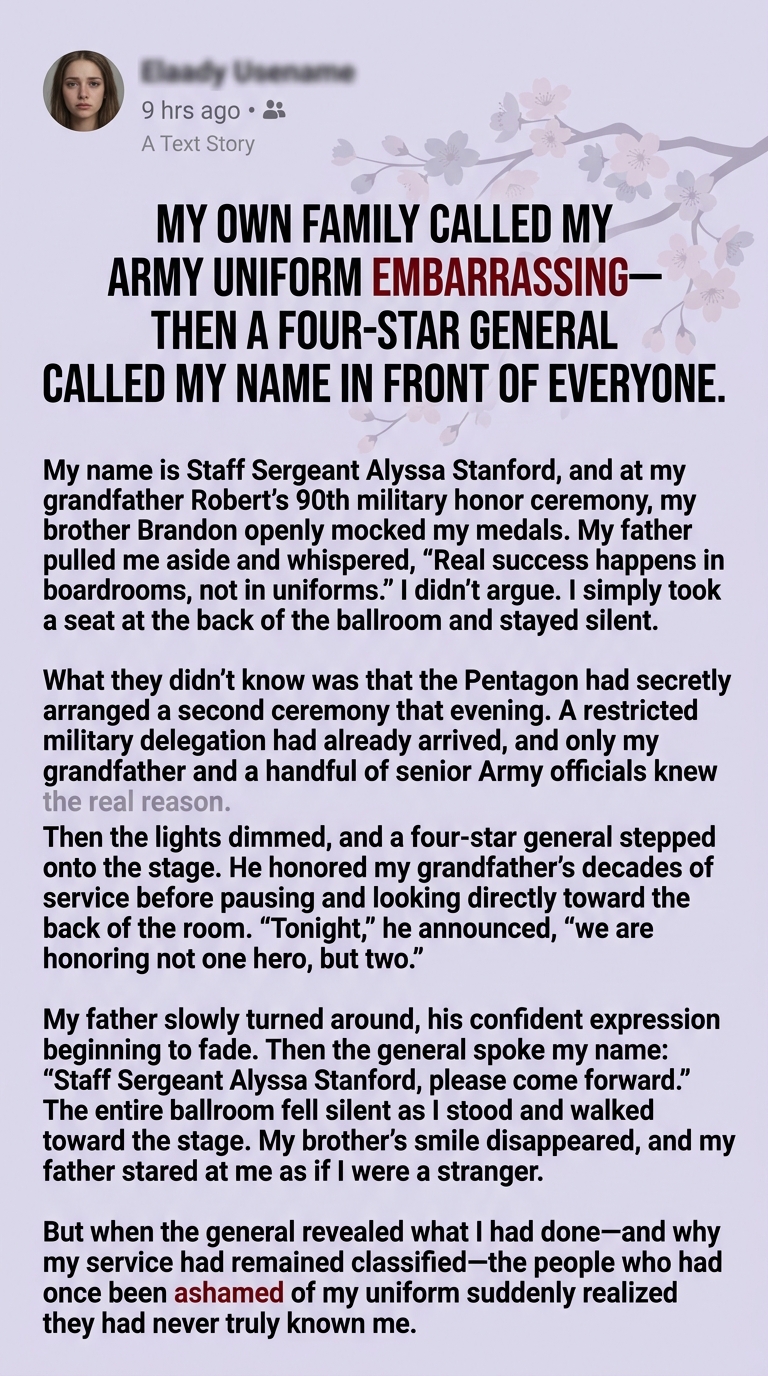
My Family Called My Army Uniform Embarrassing—Then a Four-Star General Revealed the Truth About My Service
My brother laughed at my medals in front of two hundred guests.
My father called my military career a disappointment.
And my own family made me sit at the back of the ballroom during my grandfather’s 90th military honor ceremony, as though my uniform were something shameful.
None of them knew that, before the evening ended, a four-star general would call my name in front of everyone—and reveal a secret that would change the way they saw me forever.
My name is Staff Sergeant Alyssa Stanford.
I was thirty-four years old, had served in the United States Army for twelve years, and had learned to keep my emotions under control even when the people around me tried to break me.
But nothing in my military training had prepared me for the way my family treated me that evening.
My grandfather, Robert Stanford, was the reason I had joined the Army.
He had served for decades, and although he rarely spoke about the hardest parts of his career, he had taught me everything I believed about honor.
“Your uniform doesn’t make you a good soldier,” he once told me. “Your decisions do. And when nobody is watching, those decisions matter most.”
I had carried those words through basic training, deployments, sleepless nights, and assignments I couldn’t discuss with anyone outside the authorized circle.
My father, Richard, had a different definition of success.
He was a successful businessman who believed respect came from expensive suits, impressive job titles, and the ability to command a room.
My older brother, Brandon, had followed in his footsteps. He worked in corporate finance, drove a luxury car, and never missed an opportunity to remind everyone how much money he made.
To them, my Army career was an unfortunate detour.
They had expected me to attend university, join the family business, and eventually become someone they could proudly introduce to their wealthy friends.
Instead, I had enlisted.
At first, my father called it a phase.
When I reenlisted, he called it stubbornness.
And when I returned from my first deployment, he barely asked what I had experienced.
He wanted to know whether I intended to pursue a “real career.”
My grandfather was the only one who never asked me to justify my choice.
He simply shook my hand, looked me in the eye, and said, “I’m proud of you, soldier.”
Those words had meant more to me than any award.
So when the invitation arrived for his 90th military honor ceremony, I rearranged my leave and flew home immediately.
I wore my dress uniform, polished my shoes, and carefully arranged my ribbons and medals.
I wanted my grandfather to see that I had never forgotten what he taught me.
I didn’t expect applause.
I didn’t expect recognition.
I only wanted to stand beside him for one evening.
But the moment I entered the ballroom, I knew my family had other plans.
Brandon spotted me near the entrance.
He looked me up and down, then laughed.
“Wow. You really came dressed like that?”
I glanced at my uniform.
“It’s a military honor ceremony.”
“Exactly,” he replied. “It’s Grandpa’s night. Nobody needs you turning it into a recruitment advertisement.”
A few relatives chuckled.
I ignored them and walked toward my grandfather, who was speaking with several retired officers near the stage.
When he saw me, his face lit up.
“Alyssa!”
He opened his arms, and I hugged him carefully.
“You made it,” he whispered.
“I wouldn’t miss it.”
He stepped back and studied my uniform.
For a moment, his eyes lingered on the decorations above my breast pocket. Something in his expression changed, but before I could ask what he was thinking, my father appeared.
“Richard wants a photograph with the family,” my aunt announced.
My father looked at me.
“Can you take off your jacket for the picture?”
I blinked.
“Why?”
He lowered his voice.
“Because the medals are distracting. This is a family event, not a military briefing.”
I stared at him.
“Grandpa served in the military for most of his life.”
“And tonight is about honoring him,” he replied sharply. “Not making everything about your career.”
“I haven’t said anything about my career.”
“You don’t have to. You’re wearing it.”
For several seconds, I couldn’t find an answer.
Then Brandon stepped beside him.
“Dad’s right. Some of us worked hard to build respectable careers outside the military. You don’t need to make everything about being a soldier.”
I looked at my brother.
I had spent years learning how to remain composed under pressure. I had learned to keep my voice steady when people were angry, to listen when others panicked, and to make decisions without allowing humiliation or fear to control me.
So I did what I had done many times before.
I said nothing.
I moved to the back of the ballroom and took a seat near the wall.
From there, I could see my grandfather at the front of the room, surrounded by people who respected him.
I watched him greet former colleagues, accept congratulations, and smile as photographs were taken.
I was happy for him.
But I couldn’t stop wondering how a family could spend an evening celebrating honor while treating one of its own as though she had none.
Then I noticed something unusual.
Two men in formal military uniforms had entered through a side door. They spoke quietly with the event coordinator before moving toward a restricted seating area.
A few minutes later, another officer approached my grandfather.
He leaned down and whispered something in his ear.
Grandpa’s expression became serious.
He glanced toward the back of the ballroom.
Toward me.
Then he nodded once.
I had no idea what it meant.
The evening continued with speeches and photographs. My father delivered a polished tribute to my grandfather, emphasizing discipline, sacrifice, and the importance of service.
Brandon followed with a story about how Grandpa had taught him to be a leader.
I listened from the back.
Neither mentioned that I had joined the Army because of Grandpa.
Neither mentioned the letters he had sent me during my first deployment.
And neither mentioned that he had once told me I reminded him of the soldier he had been before the world taught him to hide his feelings.
I wasn’t angry anymore.
I was simply tired.
Then the master of ceremonies returned to the microphone.
“Ladies and gentlemen, before we conclude tonight’s program, we have a special presentation.”
The lights dimmed slightly.
A murmur spread through the room as a senior officer walked onto the stage.
He wore four stars on his uniform.
A four-star general.
Every conversation stopped.
My father immediately straightened in his chair. Brandon put his phone away.
The general introduced himself, then spoke about my grandfather’s decades of service. He described a career marked by leadership, loyalty, and a commitment to the soldiers entrusted to his care.
My grandfather sat in the front row, his hands folded over his cane.
He looked overwhelmed.
The general paused.
“Sergeant Major Stanford’s service has influenced generations of soldiers. But tonight, we are here to recognize something else: the legacy of service that continues through the people he inspired.”
He looked down at a card.
“Tonight, we are honoring not one hero, but two.”
My father turned toward the stage.
Brandon leaned forward.
The general continued.
“One of those individuals has served with distinction in circumstances that cannot be discussed publicly in detail. Her actions have demonstrated exceptional courage, sound judgment, and an unwavering commitment to the lives of others.”
My heartbeat quickened.
I had participated in operations that I could never describe to my family. Some details were protected for legitimate security reasons, and I had learned long ago not to confuse silence with a lack of significance.
Still, I had never expected those experiences to be mentioned at my grandfather’s ceremony.
The general lifted his eyes.
“Staff Sergeant Alyssa Stanford, please come forward.”
For one strange second, I thought I had misheard him.
Then hundreds of faces turned toward the back of the ballroom.
My father looked over his shoulder.
Brandon’s smile disappeared.
I stood.
My knees felt unsteady, but my training carried me forward. I walked down the aisle in my polished shoes, the decorations on my uniform catching the light.
The room remained silent.
As I reached the stage, the general extended his hand.
“Staff Sergeant Stanford,” he said, “it’s an honor to meet you in person.”
“Thank you, sir.”
He turned toward the audience.
“This soldier has served in assignments that required extraordinary discretion. During one operation, her team encountered a rapidly deteriorating situation in which communication was disrupted and several personnel were left in immediate danger.”
I stood at attention.
He continued carefully, avoiding operational details that were not appropriate for public disclosure.
“Staff Sergeant Stanford helped coordinate a response under severe pressure, supported the recovery of personnel who might otherwise have been lost, and ensured that critical information reached the people responsible for making life-or-death decisions.”
A quiet murmur moved through the ballroom.
My father stared at me.
The general went on.
“Her contribution was significant not because she sought recognition, but because she continued doing her duty when recognition was impossible and the consequences of failure were grave.”
I remembered that operation.
I remembered the confusion, the fear, and the exhausted faces of the people who depended on one another to get through it.
I remembered promising a fellow soldier that we would do everything possible to bring everyone home.
I also remembered returning to my quarters afterward and writing a letter to Grandpa that I never sent.
I had wanted to tell him what happened.
Instead, I wrote that I was safe and that I hoped he was taking care of himself.
It had been the only answer I could give.
The general turned toward my grandfather.
“Sergeant Major Stanford, your granddaughter has carried forward the principles you taught her. Her record reflects courage, professionalism, and a deep sense of responsibility to the people she serves.”
Grandpa’s eyes filled with tears.
He stood slowly, using his cane.
For a moment, neither of us spoke.
Then he saluted me.
I returned the salute.
The entire ballroom rose to its feet.
The applause began at the front, spreading through the room until the sound seemed to fill every corner.
I stood on that stage, trying to keep my composure.
But when I looked at my grandfather, I could no longer hold back my tears.
He had always believed in me.
Even when the rest of my family didn’t understand what I did, he had never needed an explanation to know that my service mattered.
The general presented me with a formal commendation recognizing my contribution. He did not reveal classified information or disclose the specifics of the operation. He simply acknowledged the nature of my service and the impact it had made.
Then he said something I would remember for the rest of my life.
“Some of the most important acts of service will never make the news. Some sacrifices will never be explained at a dinner table. But the absence of a public story does not mean the absence of courage.”
He paused.
“Staff Sergeant Stanford has earned the respect of the people who have served alongside her. Tonight, her family has the opportunity to recognize what those who know her work have long understood.”
I looked toward my father.
He wasn’t clapping anymore.
He was staring at the stage with a strange expression, as though the daughter he had spent years dismissing had suddenly become someone he had never met.
Brandon sat motionless beside him.
The general concluded the presentation, and I stepped down from the stage.
My grandfather was waiting at the bottom of the stairs.
He took both my hands.
“I wanted to tell them how proud I was of you,” he whispered. “But I promised to respect the boundaries around your service.”
I laughed softly through my tears.
“You didn’t have to arrange all this for me, Grandpa.”
“I didn’t arrange it for you,” he said. “I made sure the right people had the opportunity to recognize you. You earned everything they said.”
Then he pulled me into a hug.
“I knew who you were long before tonight.”
That was when I finally broke down.
Not because of the general.
Not because of the commendation.
Not even because the entire room had applauded.
I cried because the person whose opinion mattered most had never needed me to prove my worth.
My father approached us a few minutes later.
For once, he seemed unsure of himself.
“Alyssa,” he said.
I turned.
He looked at my uniform, then at the commendation in my hand.
“I didn’t know.”
I waited.
He rubbed his palms together.
“You never told us any of this.”
“I couldn’t tell you everything.”
“But you could have told us you were doing something important.”
I took a breath.
“I tried to tell you I was proud of my work. You told me real success happened in boardrooms.”
He looked down.
“I was wrong.”
It wasn’t the apology I had imagined hearing when I was younger. It didn’t erase the years of dismissive comments or the times he had treated my career as a source of embarrassment.
But it was the first time he had acknowledged the damage his words had caused.
Brandon approached us next.
He didn’t make a joke this time.
“I owe you an apology,” he said quietly. “I’ve spent years acting like the only achievements that mattered were the ones I understood.”
I looked at him.
“Yes, you have.”
He nodded, accepting the answer without defending himself.
“I’m sorry.”
I didn’t immediately tell him everything was fine.
Forgiveness, I had learned, wasn’t an obligation to pretend nothing had happened. If our relationship was going to change, it would take more than one emotional evening.
But I accepted his apology.
Later that night, after most of the guests had left, Grandpa and I sat together in a quiet corner of the ballroom.
He asked me about my life, my plans, and whether I was taking care of myself.
For the first time in years, I didn’t feel the need to shorten my answers or hide my exhaustion behind a reassuring smile.
I told him that military life could be difficult, that some memories stayed with you long after a mission ended, and that sometimes I wished my family understood why I couldn’t share everything.
He listened without interrupting.
Then he placed his hand over mine.
“You don’t owe anyone a dramatic story to justify your life,” he said. “You don’t have to make people understand every sacrifice. Just make sure you remember why you chose this path.”
I looked at my uniform.
For years, I had worn it with pride while quietly wondering whether my family saw it as something that separated me from them.
That night, I understood that the problem had never been the uniform.
It had been their assumption that they could measure my worth only by what they recognized.
My father knew how to evaluate a business deal. Brandon knew how to calculate a salary and compare job titles. But neither had understood that some of the most meaningful work in the world happens far away from applause, promotions, and public recognition.
I hadn’t joined the Army to prove them wrong.
I had joined because I believed in serving something larger than myself.
And I would have continued serving even if that ballroom had remained silent.
Before we left, Grandpa asked for one more photograph.
He stood beside me, his medals gleaming under the ballroom lights, while I stood straight in my uniform.
My father and brother joined us.
This time, nobody asked me to remove my jacket.
Nobody complained that my medals were distracting.
And nobody made a joke.
When I looked at the photograph afterward, I realized it captured something more important than a military ceremony.
It captured the moment my family began to see me clearly.
Not as the daughter who had chosen a career they didn’t understand.
Not as the sister who had failed to follow the path they expected.
But as a woman who had made her own choices, carried her own responsibilities, and earned her place through years of quiet work.
I still couldn’t tell them every story.
Some details would remain private, as they should.
But I no longer felt that I needed to explain my silence.
My service spoke for itself.
And my grandfather’s pride reminded me of something I would never forget:
You don’t need the people closest to you to understand every sacrifice you’ve made. But you should never have to feel ashamed of the person you’ve become simply because they don’t understand it.
That evening, my family finally saw the uniform differently.
I had already learned what it meant to wear it.

