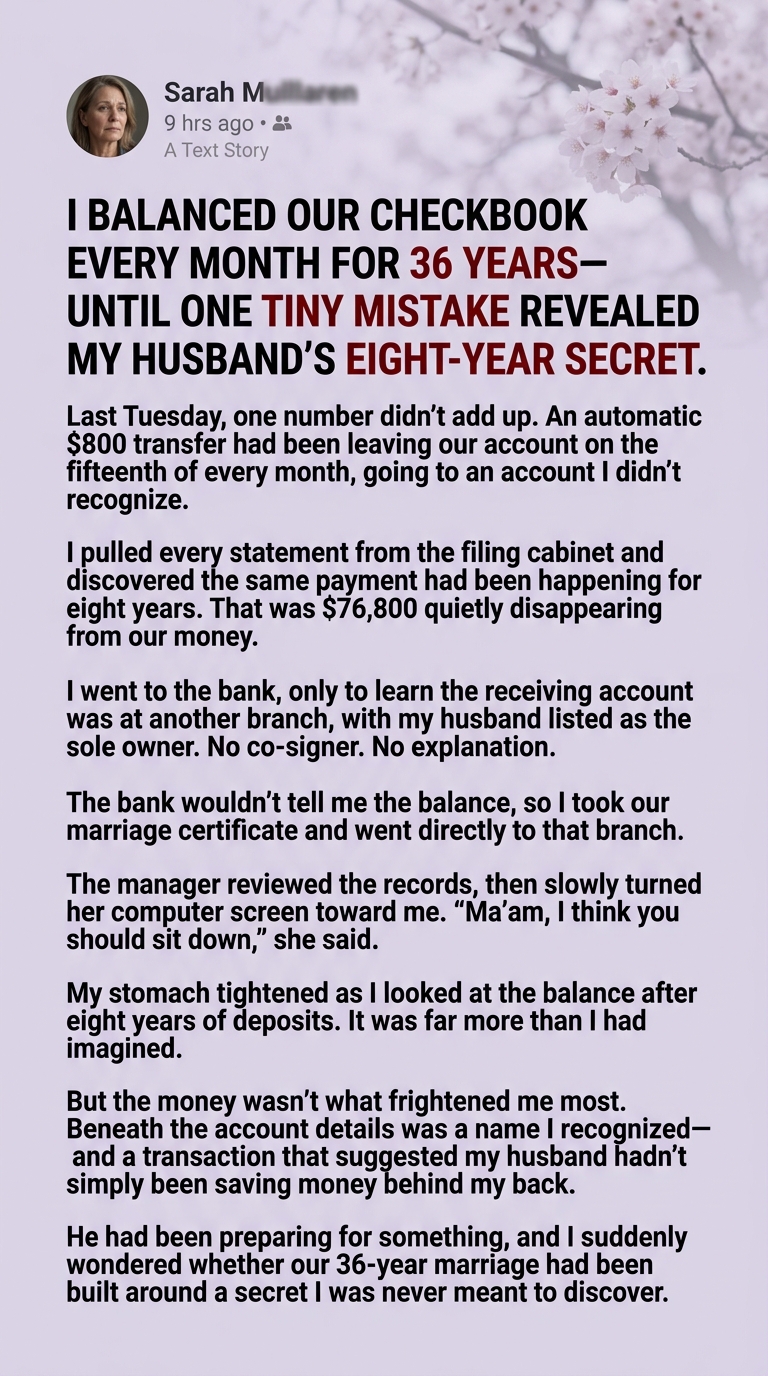
I Balanced Our Checkbook Every Month for 36 Years—Until One Tiny Mistake Revealed My Husband’s Eight-Year Secret
For thirty-six years, I believed I knew everything important about my husband.
I knew how he took his coffee, which side of the bed he preferred, and exactly how he liked his shirts folded. I knew the sound of his car pulling into the driveway and the little whistle he made when he was nervous. I knew that he checked the front door twice every night before going to bed.
And I knew our finances.
At least, I thought I did.
My name is Margaret. I was sixty-two years old, and I had balanced our checkbook every month since the year we got married. My husband, David, always said he hated paperwork, so handling the bills became my responsibility. I paid the mortgage, tracked the utilities, organized the tax documents, and made sure we were saving enough for retirement.
We had built our life carefully. We weren’t wealthy, but we were comfortable. We had paid off our house, raised two children, and spent decades putting money aside for the day when work would finally become optional.
David used to tell me, “We’re a team, Margaret. Nothing gets past us.”
I believed him.
Then, last Tuesday, I made a mistake.
I entered a figure from our bank statement into my spreadsheet and accidentally typed the wrong number. Usually, I would have corrected it immediately. Instead, the error made me look more closely at a recurring transaction I had apparently overlooked for years.
AUTOMATIC TRANSFER — $800.00
It appeared on the fifteenth of every month.
The receiving account number was unfamiliar.
I frowned and checked the previous month’s statement.
There it was again.
I pulled the statements from the filing cabinet, spreading them across the dining room table. January. February. March. Every month, the same $800 transfer.
I went back one year.
Then two.
Then five.
My hands began to shake when I reached the oldest statement.
The payments had started eight years earlier.
Eight years.
Twelve payments a year. Nine thousand six hundred dollars annually. Seventy-six thousand eight hundred dollars in total.
I sat staring at the papers, waiting for a reasonable explanation to appear.
Perhaps it was a retirement account. Perhaps David had arranged a savings plan and simply forgotten to tell me. Perhaps there was a mistake at the bank.
But the account number didn’t match any account in our records.
And I had never authorized the transfers.
When David came home that evening, I almost asked him about it. He walked into the kitchen, kissed my cheek, and complained about the traffic.
I looked at him across the counter.
Thirty-six years of marriage were written into that familiar face. The faint lines around his eyes. The gray at his temples. The wedding ring he still wore.
I wanted to believe there was a simple explanation.
Instead, I asked, “Did you change any of our banking arrangements recently?”
He didn’t even look up from his phone.
“No. Why?”
“Just checking something in the statements.”
He shrugged.
“That’s your department, sweetheart.”
Then he kissed my forehead and went upstairs to shower.
I stood in the kitchen long after I heard the water running.
For the first time in my marriage, I wondered whether the division of responsibilities I had always considered a sign of trust had also made it easy for David to hide something from me.
The next morning, I went to our bank.
I brought my identification, our joint account information, and copies of the statements. The representative confirmed that the recurring transfers were going to an account at another branch.
When I asked who owned it, she checked the records.
“Your husband is listed as the sole account holder,” she explained.
“Is there a balance I can see?”
“I’m sorry, ma’am. You’re not an authorized owner on that account, so I can’t disclose its balance or other private details.”
I felt the blood drain from my face.
“He’s transferring money from our joint account.”
“I understand your concern. I can explain the transactions on the joint account, but I can’t give you access to a separate account without the appropriate authorization.”
I left the bank with more questions than answers.
I could have confronted David that evening. But I knew him well enough to understand that if I asked without knowing anything more, he might offer an explanation that sounded convincing and leave me doubting my own instincts.
So I drove to the branch where the receiving account was held.
I brought our marriage certificate, identification, and every statement I had collected. I wasn’t sure what the manager could legally tell me, but I needed to understand my options and whether any action was possible regarding the money transferred from our joint account.
The manager, a woman named Patricia, listened carefully as I explained.
She reviewed the documents, verified my identity, and checked what information she was permitted to discuss.
Then her expression changed.
She looked at the screen for a long moment before turning back to me.
“Mrs. Margaret, I need to be careful about what I disclose. This is an account solely in your husband’s name.”
“I understand,” I said. “I’m not asking you to break any rules. I just need to know whether I’m misunderstanding something.”
Patricia paused.
“I’m concerned that you may not understand the full financial picture. There are some questions you should address directly with your husband, and you may want independent legal advice before making any decisions.”
My throat tightened.
“Can you at least tell me whether the money is still there?”
She hesitated, then explained what she could confirm through the information I had provided.
The transfers had been arriving consistently. The account had also accumulated interest and received additional deposits that weren’t visible on our joint statements.
I gripped the edge of the chair.
“How much?”
Patricia didn’t give me a number. She wasn’t authorized to disclose the private balance to me.
But she did point out something on the transaction history I had brought with me: a reference linked to a payment arrangement that appeared on our joint account records.
It wasn’t a retirement plan.
It wasn’t a bank error.
And it wasn’t simply a forgotten savings account.
Beneath the account details was a name I recognized.
Helen Whitmore.
My older sister.
For several seconds, I couldn’t breathe.
Helen and I hadn’t spoken in almost nine years.
Our relationship had fallen apart after our mother’s death, when we disagreed over the sale of the family home and how the proceeds should be handled. We had exchanged angry words, made accusations neither of us could take back, and eventually stopped speaking altogether.
David had been there through all of it. He had comforted me when I cried, listened when I raged, and promised that I would never have to deal with Helen’s betrayal again.
Now her name was appearing in the financial trail of an account he had secretly funded for eight years.
“Why is my sister’s name here?” I whispered.
Patricia looked at me with genuine sympathy.
“I can’t tell you what the relationship is between the account holders and the people referenced in these records. But I strongly recommend that you obtain the full documentation you’re entitled to and speak with your husband.”
I thanked her, though I barely heard my own voice.
I walked out into the parking lot and sat in my car.
The money was frightening. Seventy-six thousand eight hundred dollars was not a small sum, especially when we had spent our entire marriage planning carefully for retirement.
But the money wasn’t what made my hands tremble.
It was Helen’s name.
Because if David had been secretly sending money connected to my estranged sister, there was only one question I could no longer ignore.
What had my husband been doing with Helen for the past eight years—and why had they both kept it from me?
I drove home that afternoon with Helen’s name repeating in my mind.
When I pulled into the driveway, David’s car was already there. He was in the living room, watching the evening news, wearing the same comfortable expression he had worn for thirty-six years.
I stood in the doorway, holding the folder against my chest.
“David, do you know someone named Helen Whitmore?”
His eyes moved toward me.
For one brief second, he looked as though someone had struck him.
Then he turned back to the television.
“Of course. She’s your sister.”
“Why is her name connected to the account you’ve been funding for eight years?”
The television continued talking, but David had gone completely still.
I waited.
Finally, he switched it off.
“Margaret,” he said quietly, “I was going to tell you.”
“When?”
He rubbed his face with both hands.
“I don’t know.”
I laughed, but there was no humor in it.
“You’ve moved nearly seventy-seven thousand dollars out of our joint account, and you don’t know when you were going to tell me?”
“It’s not what you think.”
“Then tell me what it is.”
He stood, walked toward the kitchen, and filled a glass of water he never drank. It was a familiar habit. Whenever he faced a difficult conversation, he found a small task to perform while he gathered his thoughts.
For the first time, I hated how well I knew him.
“Eight years ago,” he began, “Helen called me.”
I stared at him.
“You told me you hadn’t spoken to her since the funeral.”
“I know.”
“Did you lie to me?”
He lowered his eyes.
“Yes.”
The word landed harder than any explanation could have.
David sat down at the kitchen table and told me that Helen had contacted him after discovering that the business she had worked for was closing. She had been struggling financially and was terrified of losing her home.
She had also been diagnosed with a condition that required ongoing treatment. She had no children, no partner, and almost no savings.
“She asked me not to tell you,” David explained. “She said you hated her, and she didn’t want to reopen the fight about Mom’s estate.”
“So you decided to help her behind my back?”
“I thought I could help her without hurting you.”
“You took money from our joint account.”
“I know.”
“Every single month.”
He nodded.
I sat opposite him, trying to understand how the man who had always insisted that honesty was the foundation of marriage could have built an entire financial arrangement without telling me.
“Why didn’t you simply ask me?” I whispered.
David’s eyes filled with tears.
“Because I was afraid you’d say no.”
That answer hurt more than I expected.
Not because I knew what I would have said. I couldn’t honestly claim I would have immediately forgiven Helen or agreed to every payment.
It hurt because my husband had decided that my answer didn’t matter.
But there was still something I couldn’t understand.
“If you were helping Helen, why was there so much money in the account? And why did the bank records show additional deposits?”
David took a long breath.
“Because the money wasn’t only for her expenses.”
He went upstairs and returned with a small wooden box I had never seen before. Inside were envelopes, receipts, and a thick packet of documents secured with a blue ribbon.
He placed the packet in front of me.
“I need you to read this.”
The first document was an investment account summary. The second was a series of bank transfers. The third was a letter written in Helen’s handwriting.
I recognized her writing immediately.
Dear Margaret,
If you’re reading this, David has finally told you what we’ve been doing. I asked him to keep this from you because I was ashamed of what happened between us, and because I didn’t know whether you’d ever want to hear from me again.
I stopped reading.
My hands were shaking.
I forced myself to continue.
Eight years ago, I found the letter Mom left with her attorney before she died. It explained something neither of us had known about the family home.
I looked up at David.
“What family home?”
“The house we grew up in,” he said.
I felt my heart begin to pound.
Our mother had died nine years earlier. After her death, Helen and I had argued bitterly about the sale of the house. I believed she had pushed for a quick sale because she wanted the money. She believed I had been trying to control the process.
Neither of us had known the full story.
David explained that Helen had discovered our mother had wanted the property preserved for both daughters if circumstances allowed. But by the time the letter was found, the house had already been sold to a developer, and the proceeds had been divided according to the arrangements in place at the time.
Helen had contacted David because she wanted to find a way to make things right between us.
At first, the monthly transfers were intended to help her stabilize her finances. Later, after she recovered from her treatment and found steady work, she began contributing money back into the account.
Together, she and David had built a fund with one purpose.
They wanted to buy the house back if it ever became available.
I stared at him.
“You’ve been trying to buy our childhood home?”
“Yes.”
“For eight years?”
He nodded.
“The developer planned to sell the property eventually. Helen found out it might be available, but we didn’t have enough money to make an offer. We started saving. Every month, we put aside what we could.”
I looked down at the documents again.
There were records of additional deposits, investment statements, and correspondence with a real-estate attorney. The money had grown beyond the total of the original transfers.
The final page was a recent letter from the attorney.
The property was available.
A purchase proposal had been prepared, but no offer had been finalized.
I looked at David, unable to decide whether I wanted to hug him or walk out of the house.
“You’ve spent eight years planning this without me.”
“I wanted to give you the house back.”
“You wanted to surprise me with something that involved my sister, my mother’s estate, and tens of thousands of dollars from our joint account.”
He nodded, tears slipping down his face.
“I know how it sounds.”
“No, David. You know how it looks. You still don’t understand how it feels.”
He reached for my hand, but I pulled it away.
“I could have helped you,” I said. “I might even have wanted to. But you didn’t trust me enough to let me choose.”
He bowed his head.
“You’re right.”
For the first time that evening, he didn’t offer an excuse.
I spent that night in the guest room.
I couldn’t sleep. I kept thinking about the house with its creaky staircase, the kitchen where our mother taught us to bake, and the old apple tree under which Helen and I had played as children.
I also thought about the woman who had once been my closest friend.
By morning, I knew I needed to hear the story from her.
I called Helen.
She answered on the second ring.
“Margaret?”
Her voice sounded fragile.
“I read the letter.”
There was a long silence.
Then she began to cry.
“I never wanted to hurt you.”
“But you let me believe you were only interested in the money.”
“I was angry. I was ashamed. And when I realized what Mom’s letter meant, I didn’t know how to tell you I’d been wrong about everything.”
I closed my eyes.
“Why didn’t you call me?”
“Because I thought you’d hang up.”
I wanted to tell her that she should have tried anyway. I wanted to remind her that she had been the one who stopped speaking to me.
But I also remembered how stubbornly I had held on to my own version of the past.
For eight years, we had lived as strangers while two people who loved us tried to build a bridge between us without our knowledge.
“I’m not ready to forgive everything,” I told her.
“I understand.”
“But I want to see you.”
She let out a shaky breath.
“I’d like that.”
We met two days later at a small café halfway between our homes.
Helen looked older than I remembered. Her hair had thinned, and there were deep lines around her eyes. She told me about the years of medical appointments, the fear of losing her home, and the shame she felt about how our relationship had ended.
I told her about my anger, my loneliness, and the way I had interpreted her silence as proof that she had never cared about me.
Neither of us was entirely innocent. Neither of us had understood the other.
For the first time in almost nine years, we listened.
When we finally stood to leave, Helen reached for my hand.
“I don’t expect you to forget what happened.”
“Good,” I said. “Because I won’t.”
She nodded, tears in her eyes.
“But I don’t want us to lose another eight years.”
Neither did I.
Over the following weeks, David and I met with an independent financial adviser and reviewed every transaction. We confirmed the total amount transferred, documented Helen’s contributions, and agreed on a clear plan for our shared finances going forward.
I made it clear that no major financial decision would ever again be made without my knowledge and consent.
David agreed.
Rebuilding trust was slower than opening an account. There were difficult conversations, uncomfortable questions, and moments when I wondered whether our marriage could recover from the deception.
But David stopped asking me to move on before I was ready. He answered my questions honestly, even when the answers embarrassed him. For the first time in years, he understood that good intentions did not erase the harm caused by secrecy.
As for the childhood house, we didn’t rush into buying it.
We visited the property together. The old apple tree was gone, and the front porch had been replaced, but the kitchen window still looked out over the same patch of garden where Helen and I had once planted flowers with our mother.
I stood there for a long time.
“I thought this house was lost to us forever,” I whispered.
Helen stood beside me.
“So did I.”
We eventually made an offer through the proper legal channels, using the funds that had been carefully documented and reviewed. The purchase was completed months later, after we confirmed the terms and agreed on how the property would be held and maintained.
It wasn’t a magical fix for everything that had happened.
The house couldn’t return the years we had lost. It couldn’t undo the secrecy in my marriage or erase the pain between two sisters.
But it gave us a place to begin again.
On the day we received the keys, David stood beside me on the front steps.
“I’m sorry,” he said. “I thought I was protecting you.”
I looked at him.
“Protecting me would have meant trusting me with the truth.”
He nodded.
“I understand that now.”
I slipped the key into the lock and opened the door.
For thirty-six years, I had believed that knowing every number in our checkbook meant I understood the financial life we had built together.
One tiny mistake proved otherwise.
The money had been hidden. The truth had been delayed. And my husband had made a decision that changed the way I understood our marriage.
But the most important discovery wasn’t the balance in a secret account.
It was that love without honesty can leave even the closest people living separate lives—and that rebuilding trust begins when the truth is finally allowed into the room.
I still balance our checkbook every month.
But now, we sit at the table together.
And nothing important is kept in the dark.

