They Tried to Turn My Grandson’s Library Into a Testing Center—Then I Revealed Who Really Owned the Building
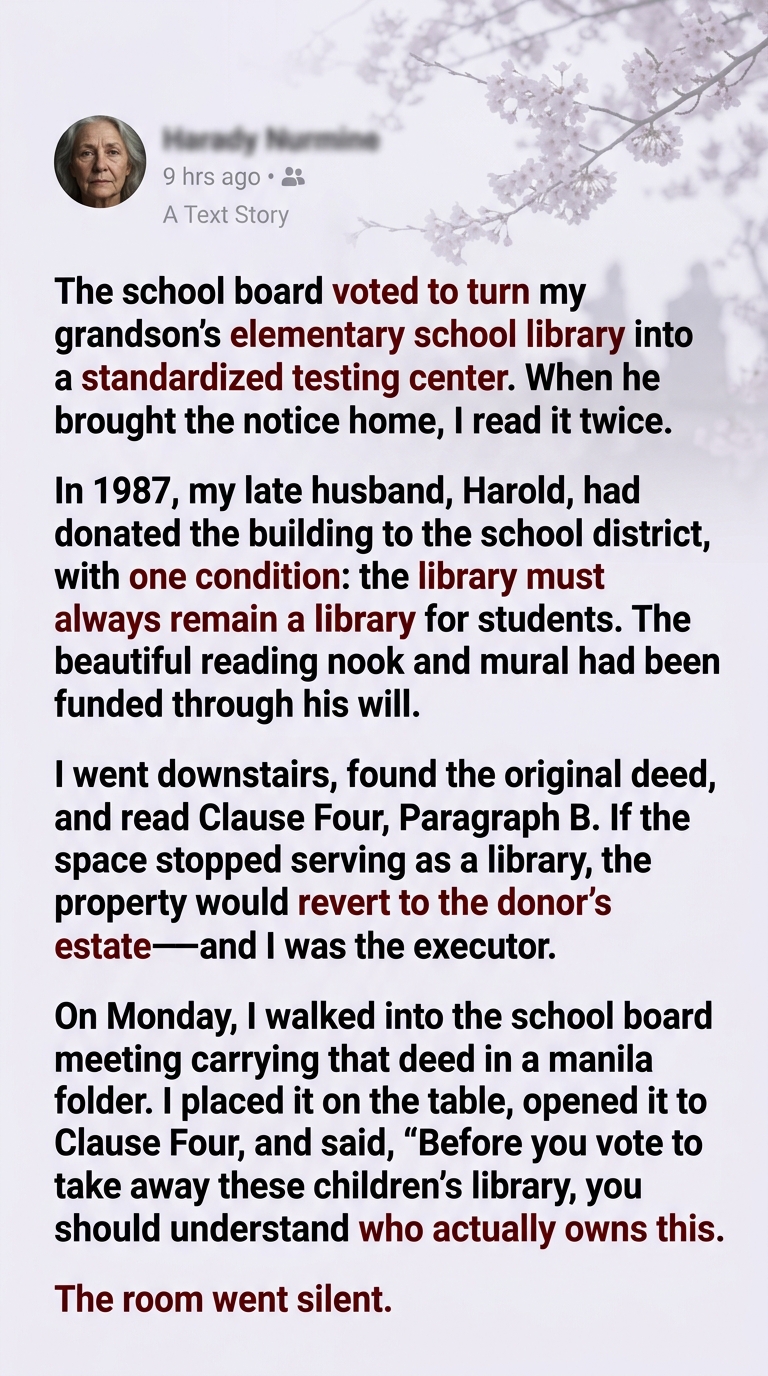
When the school board voted to turn my grandson’s elementary school library into a standardized testing center, I thought there had to be some mistake.
Then my grandson came home carrying the official notice.
“Grandma, does this mean we won’t have story time anymore?” he asked, clutching the paper in his little hands. “What about the mural Grandpa Harold helped pay for?”
I looked at the notice again, and my heart tightened.
My late husband, Harold, had donated that building to the school district in 1987. He believed every child deserved a quiet place to read, dream, and discover a world beyond their neighborhood. He had even funded the beautiful reading nook and the colorful mural through his will.
But Harold had one nonnegotiable condition: the space must always remain a library for students.
I remembered the day he signed the documents. He had squeezed my hand and said, “A school can measure a child’s test scores, but a library helps them imagine who they might become. Never let anyone forget that.”
After Harold passed away, I assumed his gift would be honored long after we were gone.
Apparently, I was wrong.
That evening, after my grandson went to bed, I walked downstairs to the old study Harold had loved so much. I opened the filing cabinet and searched through decades of paperwork until I found the original property deed.
My hands trembled as I turned the pages.
Then I found it.
Clause Four, Paragraph B.
The language was unmistakable. If the donated space ever ceased to function as a student library, ownership of the property would revert to the donor’s estate.
And I was the executor.
I read the clause three times to make sure I wasn’t misunderstanding it. The school board hadn’t simply decided to rearrange a room. If they went through with their plan, they could trigger the very condition Harold had written to prevent.
For a moment, I considered calling the superintendent privately. Perhaps we could resolve everything quietly.
Then I remembered the children who had written their names inside the books Harold had donated. I thought of the little reading nook where struggling readers found confidence and the mural where my grandson loved pointing out the painted animals during family visits.
This wasn’t just about a building.
It was about a promise.
On Monday evening, I walked into the school board meeting carrying the deed in a manila folder. The room was packed with parents, teachers, and community members. At the front, the superintendent stood beside a presentation explaining how the library would become a testing center.
A board member was already congratulating everyone on the district’s “forward-thinking decision.”
I waited until the public comment period.
When my turn came, I stood, walked to the table, and placed the folder in front of the board president.
“Before you vote to take away these children’s library,” I said calmly, “you should understand who actually owns this building.”
The room went silent.
The superintendent frowned. “Ma’am, the district has owned and operated this facility for decades.”
“Operated it,” I corrected. “That is not necessarily the same as owning it without conditions.”
I opened the folder to Clause Four, Paragraph B and slid a copy toward the board president.
He began reading.
At first, his expression was impatient. Then his eyes narrowed. He turned the page, checked the signature, and looked toward the district attorney sitting beside him.
“Where did you get this?” he asked.
“From my husband’s original estate records. Harold donated the property in 1987, and I am the named executor.”
The superintendent leaned over the table. “We were never informed of any restriction like this.”
“Then perhaps you should have reviewed the deed before proposing to change the building’s purpose.”
A murmur swept through the audience.
The board president asked for a recess. The district attorney examined the document while board members whispered among themselves. I sat quietly, keeping my hands folded in my lap.
For the first time that evening, the people making decisions about the library seemed to understand that their decision had consequences.
After nearly twenty minutes, the board reconvened.
The district attorney stood and confirmed that the deed contained a reversion clause that required serious legal review before the district could proceed with its plan. He recommended suspending the conversion proposal immediately while the district verified the property’s legal status.
One board member tried to argue that standardized testing was essential and that the library was being underused.
Before I could respond, a teacher in the second row stood up.
“Underused?” she said. “I bring my struggling readers here every week. Some of these children come from homes without a single book. That library is where they first discover they can love reading.”
Then a parent spoke about how her son had learned English by borrowing picture books from the shelves. Another described how the librarian had helped her daughter find the confidence to read aloud in class.
Soon, the room was filled with stories the board’s presentation had never mentioned.
The library wasn’t an empty room waiting for a new purpose.
It was a place where children had learned to believe in themselves.
The board voted to suspend the conversion plan pending legal review. In the weeks that followed, the district confirmed the deed’s restrictions and began discussions with the estate about how to preserve the library while meeting its testing needs elsewhere.
They eventually abandoned the plan to convert the library.
Instead, the district identified another space for testing and began seeking grants to improve its facilities without sacrificing the library.
A few weeks later, I returned to the school with my grandson.
The mural was still there. The reading nook was untouched. Sunlight fell across the shelves Harold had helped fill with books nearly four decades earlier.
My grandson ran to me, grinning.
“Grandma! We get to keep our library!”
I knelt beside him and nodded. “Yes, sweetheart. Your grandfather wanted every child who came here to have a place to dream.”
He looked around the room before asking, “Did Grandpa know this would happen?”
I smiled sadly.
“I think he knew that someday someone might forget why this place mattered. That’s why he made sure his promise was written down.”
That afternoon, the school librarian showed me a small plaque the children had made. It read:
For Harold, who believed every child deserves a story.
I stood there for a long time, fighting back tears.
Harold had been gone for years, but his promise was still protecting the children he would never meet.
And I finally understood something he had always known: sometimes the most powerful thing you can leave behind isn’t money or property.
It’s a promise strong enough to outlive you.

