My 5-Year-Old Son Started Avoiding His Mom… Then He Told Me the Secret He Had Discovered
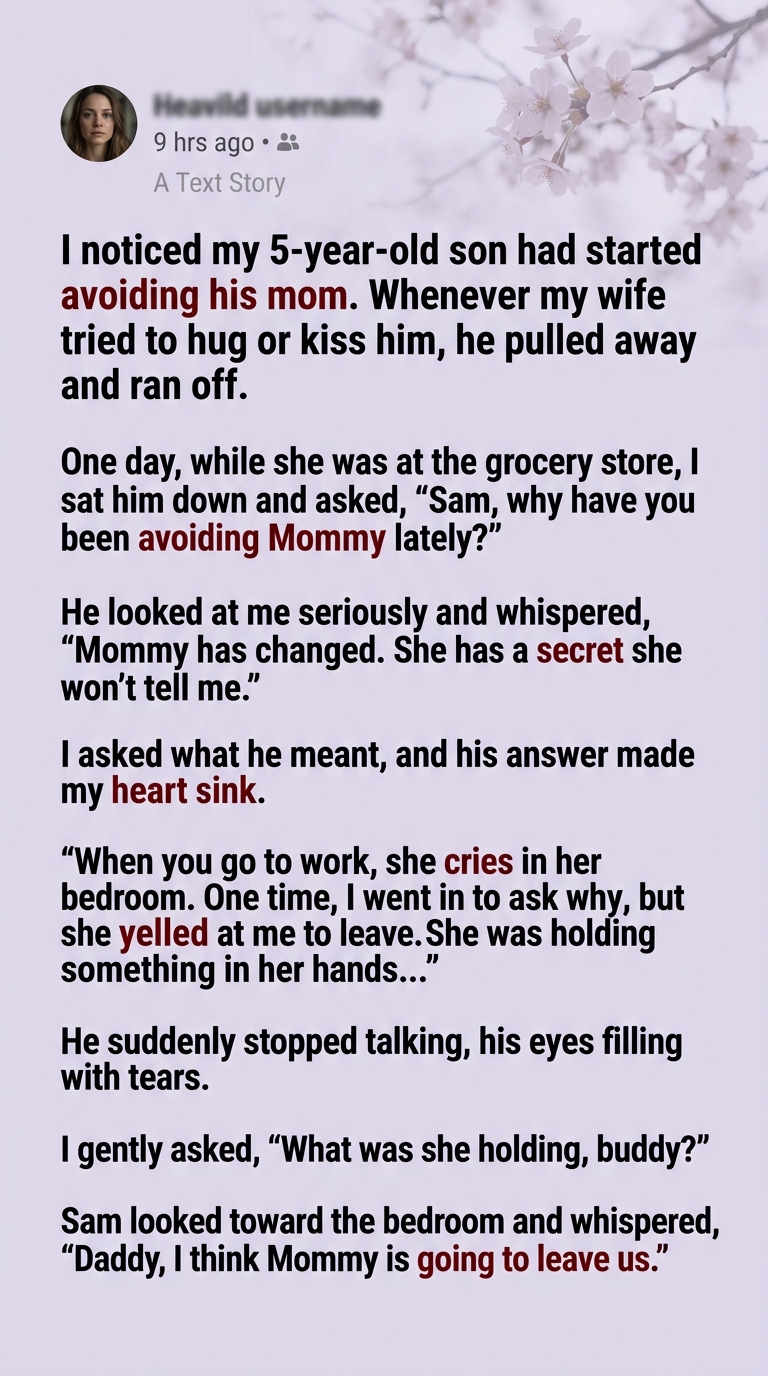
For weeks, I noticed something strange about my five-year-old son, Sam.
He had always been attached to his mother. Every morning, he ran into her arms before I left for work. Every night, he insisted that she read him a bedtime story and kiss his forehead before he fell asleep.
But recently, everything had changed.
Whenever my wife, Emily, tried to hug him, he stiffened and pulled away. When she leaned down to kiss his cheek, he turned his face and hurried into another room.
At first, I thought it was just a phase. Children sometimes go through periods when they want more independence.
But Emily looked increasingly heartbroken.
“Did I do something wrong?” she asked me one night, watching Sam hide behind my legs when she reached for him.
“I’m sure it’s nothing,” I reassured her.
Yet I couldn’t shake the feeling that something was happening in our home that I didn’t understand.
Then, one afternoon, Emily left for the grocery store, and I decided it was time to talk to my son.
I sat beside him on the living room couch and gently asked, “Sam, buddy, why have you been avoiding Mommy lately?”
He stopped playing with his toy car.
For several seconds, he stared at the floor. Then he looked up at me with an expression far too serious for a five-year-old.
“Daddy, Mommy has changed,” he whispered. “She has a secret she won’t tell me.”
My stomach tightened.
“What kind of secret, sweetheart?”
Sam twisted the sleeve of his shirt between his fingers.
“When you go to work, Mommy cries in her bedroom. Sometimes I hear her crying really loudly. One time, I went inside to ask her what was wrong, but she yelled at me to leave.”
He swallowed hard.
“She was holding something in her hands, Daddy. And when she saw me, she hid it.”
I leaned closer.
“What was she holding, buddy?”
Sam’s eyes filled with tears.
“I don’t know. But she looked so sad. And when I asked if she was okay, she said I wasn’t supposed to know.”
He paused, then whispered the words that made my heart sink.
“Daddy, I think Mommy is going to leave us.”
For a moment, I couldn’t speak.
My little boy had been carrying this fear all alone, interpreting his mother’s tears through the only understanding he had of the world. In his mind, if Mommy was crying in secret and refusing to explain why, she must be planning to disappear.
I pulled him into my arms.
“Listen to me, Sam. Mommy loves you more than anything. Whatever is happening, it isn’t your fault. Do you understand?”
He nodded against my chest, but his little shoulders continued to shake.
“Then why doesn’t she want me anymore?” he sobbed.
Those words hurt more than anything I had ever heard.
I wanted to tell him that everything was fine, but I couldn’t honestly promise that without knowing the truth.
When Emily returned from the grocery store, I watched her carefully. She smiled at Sam, offered him his favorite cookies, and asked whether he wanted to help her make dinner.
He immediately hid behind me.
The hurt that crossed her face was unmistakable.
That evening, after Sam fell asleep, I found Emily sitting alone at the kitchen table. Her eyes were red, and she was staring at her hands.
“Emily,” I said quietly, pulling out the chair across from her. “We need to talk.”
She looked up quickly.
“What’s wrong?”
“Sam thinks you’re going to leave us.”
The color drained from her face.
“What?”
“He says you’ve been crying in your bedroom. He says you were holding something you didn’t want him to see. He thinks you’ve stopped loving him.”
Emily covered her mouth. Tears immediately began rolling down her cheeks.
“Oh, God,” she whispered. “I never wanted him to think that.”
“Then please tell me what’s happening. I’ve watched you suffer for weeks, and I don’t know how to help you because you won’t let me in.”
For a long moment, she said nothing.
Then she stood, walked toward our bedroom, and returned carrying a small white envelope.
Her hands trembled as she placed it on the table between us.
“I found out three weeks ago,” she whispered. “I’ve wanted to tell you every day, but every time I try, I start crying. And I keep thinking about how much everything might change.”
I stared at the envelope.
“What is it?”
She pushed it toward me.
“Open it.”
Inside was a folded medical report and a letter from a specialist. I read the first page once, then again, struggling to understand what I was seeing.
Emily began to cry harder.
“I was afraid you’d look at me differently. I was afraid Sam would hear us talking and become scared. So I kept trying to handle it alone.”
I reached across the table and took her hand.
“Emily, whatever this is, we’re a family. You don’t have to carry it alone.”
She squeezed my fingers, then finally told me the truth.
A few weeks earlier, she had gone to the doctor after experiencing persistent symptoms she couldn’t explain. The initial tests had revealed something that required further investigation. She had been referred to a specialist, and the report contained a finding that could have serious implications—but more tests were still needed to determine exactly what it meant.
She had been terrified ever since.
“I didn’t know how to tell you,” she said. “I kept imagining the worst. When Sam walked into the bedroom that day, I was looking at the report. He asked me why I was crying, and I snapped at him. I told him to leave because I couldn’t bear to explain something I didn’t even understand myself.”
She wiped her face.
“He looked so frightened. I wanted to go after him and apologize, but I couldn’t stop crying. After that, every time I tried to hug him, he pulled away. I thought he was angry with me.”
I finally understood.
The secret Sam had mistaken for a plan to abandon us was actually his mother’s fear about an uncertain future.
But there was something else I needed to understand.
“Why didn’t you tell me?” I asked gently.
Emily lowered her eyes.
“Because I thought if I said it out loud, it would become real. And because I was afraid that if the news was bad, I would destroy the life we have.”
I moved to the chair beside her and wrapped my arms around her.
“You haven’t destroyed anything,” I whispered. “You’re scared. I understand that. But you don’t have to protect us by shutting us out.”
For the first time in weeks, she let herself cry without hiding.
The next morning, we sat Sam down together.
Emily knelt in front of him, her eyes level with his.
“Sweetheart, Mommy needs to tell you something. Remember when you came into my bedroom and I yelled at you?”
Sam nodded cautiously.
“I’m sorry,” she said. “You didn’t do anything wrong. Mommy was very worried about something, and I didn’t know how to explain it. But I should never have made you feel like you couldn’t talk to me.”
Sam looked at her, uncertain.
“Are you leaving us?”
Emily’s face crumpled.
“No, baby. I’m not planning to leave you. I love you more than anything in the world.”
“Then why were you crying?”
“Because Mommy has a health problem that the doctors are still trying to understand. I’m scared, but Daddy and I are going to work through it together. You don’t have to fix it, and it’s not your fault.”
Sam studied her face for several seconds.
“Are you going to be okay?”
Emily took a careful breath.
“I hope so, sweetheart. The doctors need to do more tests, and we don’t know everything yet. But whatever happens, you will always be loved, and we will always tell you the truth in a way you can understand.”
Sam’s lower lip trembled.
Then he slowly stepped forward and wrapped his tiny arms around her neck.
Emily held him as though she had been waiting weeks for that single moment.
“I’m sorry I ran away, Mommy,” he whispered.
“Oh, sweetheart,” she cried, kissing his hair. “You never have to apologize for being scared.”
I turned away for a moment, unable to hold back my own tears.
In the weeks that followed, we attended the medical appointments together. We learned to ask questions, wait for answers, and take things one day at a time. Some days were frightening. Others felt almost normal.
We didn’t pretend to know what the future would bring.
But Emily stopped hiding her fear from me, and we became more careful about explaining difficult emotions to Sam. We told him when we were sad, when we were worried, and when we needed a quiet moment—and we always reminded him that grown-up problems were never his responsibility to solve.
Slowly, Sam began reaching for his mother again.
He returned to sitting beside her during bedtime stories. He started bringing her his drawings and asking her to play with his toy cars. One evening, I found him curled against her on the couch, his head resting in her lap while she gently stroked his hair.
I stood in the doorway and watched them.
For weeks, I had believed the greatest danger to our family was whatever Emily was hiding.
I finally understood that the silence between us had become its own kind of fear.
My wife hadn’t been trying to leave us. She had been terrified of losing the life she loved, and in trying to protect us from her uncertainty, she had accidentally made our little boy believe he was about to lose her.
That night, after Sam was asleep, Emily took my hand.
“Thank you for asking me what was wrong,” she whispered.
I kissed her forehead.
“Next time, don’t wait until we’re all scared to tell me.”
She nodded, resting her head against my shoulder.
And as we sat together in the quiet house, I realized something I would never forget:
Sometimes, the secret that frightens a family most isn’t a sign that love is disappearing. It’s a sign that someone is suffering alone—and doesn’t know how to ask for help.

