My Husband Died After 42 Years of Marriage—Then a Hospice Nurse Asked Me One Question That Changed Everything
“Do you know a woman named Maryanne?”
Hospice nurse Paula asked me that question three days after my husband, Thomas, died.
I was sitting in the living room, surrounded by sympathy cards and half-empty cups of tea. Forty-two years of marriage had ended, and I was still struggling to understand how a house could feel so empty when every corner held a memory.
I looked up at Paula.
“No. Why?”
She hesitated.
“Thomas asked for her,” she whispered. “Several times during his final days.”
My stomach tightened.
“Was she a relative? An old friend?”
Paula shook her head.
“He never explained. He just kept asking whether someone had contacted her. Before he passed, he told me, ‘Please make sure she gets the chance to know the truth.’”
The truth.
Those two words followed me long after Paula left.
Thomas and I had been married for forty-two years. We had raised two children, paid off our house, survived financial struggles, and celebrated anniversaries that seemed to arrive faster every year.
I believed I knew my husband.
He wasn’t perfect. He could be stubborn, and he often disappeared into his workshop for hours, repairing clocks, restoring furniture, and building little wooden toys for our grandchildren.
But he had never given me a reason to believe he was living another life.
At least, not one I knew about.
That evening, I went into his workshop for the first time since the funeral.
The room still smelled of cedarwood and machine oil. His glasses rested beside a half-finished birdhouse. A small radio sat on the shelf, the same one he had listened to every Saturday morning for decades.
I began sorting through the drawers, hoping to find something that would explain Paula’s question.
Behind a stack of old invoices, I discovered a metal cashbox.
It wasn’t locked.
Inside were twenty-seven money-order receipts, folded letters, and a small envelope bearing one name.
Maryanne.
My hands began to tremble.
The receipts stretched back nearly thirty years. Some were for modest amounts. Others were larger, sent at regular intervals.
On the back of the oldest receipt, Thomas had written six words:
She deserves to know the truth.
I sat down on his work stool.
For almost three decades, my husband had been sending money to a woman I’d never heard of.
I felt sick.
Had he been supporting another family? Was there a child? Had he been secretly helping someone he loved before he met me?
I wanted to call our children, but I couldn’t bear the thought of telling them that their father’s final secret might be a betrayal of their mother.
So I opened the first letter.
It was written in a woman’s careful handwriting.
Thomas, I received the money. I know you believe you’re helping, but I cannot keep accepting it without knowing why you disappeared. You told me you would explain someday. I’m still waiting.
The letter was dated twenty-eight years earlier.
I read it twice.
Then I opened another.
I don’t want your money. I want the truth about what happened. If you are ashamed of me, just say so. But please stop leaving me to guess.
There were no declarations of love, no romantic promises, and no clear evidence of an affair.
There was only confusion, money, and a woman who believed Thomas had abandoned her without an explanation.
My heart pounded as I searched the remaining papers.
At the bottom of the box, I found a sealed envelope with my name on it.
My dear Margaret,
If you’re reading this, I have probably run out of time to explain something I should have told you years ago.
Maryanne is not a woman I loved behind your back.
She is the daughter I failed.
I stopped breathing.
I read the sentence again, then forced myself to continue.
Before I met you, I was engaged to a woman named Elizabeth. We were young, struggling financially, and convinced that love would somehow solve every problem.
When Elizabeth became pregnant, I panicked.
My father had threatened to cut me off if I married her. I was afraid of disappointing my family, afraid of poverty, and too cowardly to stand up for the woman I claimed to love.
I left.
Elizabeth raised our daughter, Maryanne, without me.
Years later, I learned that Elizabeth had died. I found Maryanne through a distant relative, but by then she was an adult with a life of her own.
I tried to contact her.
She wanted answers I wasn’t ready to give.
I sent money because I thought it was something I could do without forcing myself into her life. I told myself that helping financially was better than making excuses.
But I was wrong.
I should have told you. I should have told our children. And I should have faced my daughter honestly instead of hiding behind envelopes and money orders.
Maryanne deserves to know why I left. She deserves to know that I was afraid, not that she was unwanted.
And you deserve to know what kind of man I was before I became your husband.
I am sorry I waited until my life was nearly over to write this.
Thomas.
I lowered the letter into my lap.
For a long time, I couldn’t move.
My husband had a daughter.
A daughter born before our marriage, a daughter he had abandoned, and a daughter he had spent nearly thirty years trying to help without finding the courage to face her.
I felt anger, sorrow, pity, and an unexpected sense of grief for a young woman I had never met.
Then someone knocked on my front door.
I wiped my face and walked down the hallway.
A woman stood on the porch holding a small handbag. She looked to be in her late fifties, with dark hair streaked with gray and eyes that seemed both hopeful and frightened.
“Are you Margaret?” she asked.
“Yes.”
She swallowed.
“I’m Maryanne. Thomas was my father.”
For a moment, I could only stare at her.
She looked at the letter in my hand.
“He told me you might hate me,” she whispered.
I felt something inside me break.
“Oh, sweetheart,” I said quietly. “I don’t even know you yet. How could I hate you?”
Her eyes filled with tears.
“Because I spent years asking him why he left us. He told me he had made mistakes, but he never gave me the whole story. Then, when he got sick, someone from the hospice called and said he wanted to see me.”
She paused.
“I couldn’t bring myself to go. I thought he wanted to give me money again and ask me to forgive him without explaining anything. I didn’t know he was dying until it was too late.”
She covered her mouth.
“I never got to say goodbye.”
I stepped aside.
“Come in.”
Maryanne entered slowly, looking around the house as though she expected to find traces of a life she had been denied.
I brought her into the living room and showed her Thomas’s letter.
She read it in silence.
When she reached the part where he called himself a coward, she began to cry.
“He always made it sound as though he had no choice,” she said. “I spent years wondering whether I had done something wrong. I thought maybe he looked at me and saw something he couldn’t bear.”
I reached for her hand.
“You were a child. None of this was your fault.”
She shook her head.
“I know that now. But I didn’t know it then.”
We sat together for a long time, two women connected by the same man and wounded in different ways by his silence.
Eventually, I asked her about her life.
She told me she had grown up with her mother, Elizabeth, who worked two jobs to support them. Maryanne had studied accounting, married briefly, and raised a son of her own. Her mother had died years earlier, still carrying the pain of being abandoned.
Thomas had found her when she was in her late twenties. He had sent a letter and offered to help financially.
She had accepted the money a few times because she was struggling, but she had always wanted a conversation more than a payment.
“He never came to see me,” she said. “He said he didn’t want to disrupt my life.”
I looked down at my husband’s letter.
“He may have told himself that,” I replied. “But he was also protecting himself from having to face what he’d done.”
Maryanne nodded slowly.
“That sounds like him.”
I expected to feel jealous hearing her speak about Thomas. Instead, I felt an ache for the years both of them had lost.
I still loved my husband. Forty-two years of shared life could not simply be erased by a revelation.
But love did not require me to pretend his choices had been harmless.
“He should have told me,” I said.
“Yes,” Maryanne answered. “He should have told both of us the truth.”
For the first time, I felt that someone understood the full weight of what I was carrying.
We talked until the evening light faded.
Before she left, Maryanne asked whether she could keep a copy of the letter.
“Of course,” I said. “It’s your story, too.”
She hesitated at the door.
“Do you think he loved me?”
It was the hardest question she could have asked.
I thought about the money orders, the letters, and the years of silence. I thought about a man who had tried to repair an old wound with money because he was too frightened to face the person he had hurt.
“I think he cared about you,” I answered honestly. “I think he regretted what he did. But I also think he spent too long confusing regret with making things right.”
Maryanne wiped her eyes.
“Thank you for telling me the truth.”
After she left, I returned to Thomas’s workshop.
I placed his letter beside the old receipts and sat in his chair.
I was angry with him. I wished he had trusted me enough to tell me while he was alive. I wished Maryanne had been given the chance to speak to him face-to-face. And I wished his apology had arrived before the end of his life.
But I also understood something I hadn’t understood before.
People can spend decades avoiding the consequences of their choices, telling themselves that silence protects everyone involved.
Sometimes it protects only the person who is afraid to speak.
Over the following weeks, Maryanne and I stayed in touch.
At first, our conversations were cautious. We spoke about Thomas, then about our own lives. She showed me photographs of her son and told me stories about her mother.
I showed her pictures of Thomas as a young man, including one taken shortly before our wedding.
She studied the photograph for a long time.
“He looks so young,” she said.
“He was,” I answered. “And he was scared of many things he never admitted.”
Neither of us tried to turn him into a monster or excuse what he had done.
We let the truth remain complicated.
Eventually, I invited Maryanne to meet our children. I told them about their half-sister and showed them Thomas’s letter.
They were shocked and hurt. They needed time to process the news, and I didn’t expect them to welcome everything immediately.
But they listened.
And when Maryanne finally met them, she didn’t demand to be treated as though they had always known her. She simply introduced herself and answered their questions.
We began, slowly, to build a relationship that should never have been left to chance.
Months later, I visited Thomas’s grave with Maryanne.
I brought flowers. She brought a small photograph of her mother.
We stood quietly beside the headstone.
“I don’t know if I forgive him,” Maryanne said.
“You don’t have to decide today,” I told her.
She nodded.
“And you?”
I looked at the name carved into the stone.
“I loved him for forty-two years. I can be grateful for those years and still be hurt by what he hid.”
Maryanne slipped her hand into mine.
We didn’t say anything else for a while.
The wind moved gently through the trees, and the cemetery grew quiet around us.
I realized then that Thomas’s secret had not destroyed everything our family had shared. But it had changed the story we told ourselves about him.
He had been a loving husband in many ways. He had also been a frightened young man who abandoned a child, then spent years trying to ease his guilt without truly facing it.
Both things were true.
And now, at last, Maryanne no longer had to wonder why her father had left.
I could not give her back the years she had lost. I could not give her mother the apology she deserved. And I could not ask Thomas why he had waited so long.
But I could refuse to continue his silence.
Before leaving the cemetery, I placed my hand on the headstone.
“Your daughter knows the truth now,” I whispered.
Then I turned toward Maryanne.
“Would you like to come home with me? There’s a box of photographs I think you should see.”
She smiled through her tears.
“Yes. I would.”
We walked toward the gate together.
For forty-two years, I had believed I knew every important part of my husband’s life.
I was wrong.
But the truth had arrived, and although it hurt, it gave a forgotten daughter something money could never provide: an honest answer.
Thomas could not undo the past. But we could stop allowing his silence to decide our future.
20 Strong Captions
After 42 years of marriage, I thought I knew every secret my husband had. Then a hospice nurse asked, “Do you know a woman named Maryanne?” That question changed everything.
My husband asked for a woman named Maryanne before he died. I searched his workshop and found 27 money-order receipts—and a note saying she deserved the truth.
I thought my husband’s secret might be an affair. Then a stranger knocked on my door and told me, “Thomas was my father.”
For nearly 30 years, my husband had been sending money to a woman I had never heard of. The oldest receipt carried six words that broke my heart: “She deserves to know the truth.”
When Maryanne arrived at my door, she looked terrified. “He told me you would hate me,” she whispered. I invited her inside—and finally learned why my husband had kept her a secret.
My husband died before he could explain himself. All he left behind was a box of receipts, a letter, and a daughter who had waited decades for an answer.
She wasn’t my husband’s mistress. She was the daughter he had abandoned long before we met—and the person he had never found the courage to face.
I had spent 42 years loving my husband. Then I learned he had a daughter he’d kept secret for decades. The truth hurt, but the story was more complicated than betrayal.
Maryanne didn’t want another money order. She wanted to know why her father had left. When I read his letter, I finally understood what he had been too afraid to say.
The hospice nurse told me my husband kept asking for Maryanne. I didn’t understand why until I opened the old cashbox in his workshop.
My husband tried to make amends with money because he couldn’t face the daughter he’d abandoned. His receipts showed years of regret—but regret was not the same as an apology.
When Maryanne asked whether her father had loved her, I couldn’t give her a perfect answer. I could only tell her the truth I had found in his letter.
The woman at my door had spent years believing her father didn’t want her. I couldn’t return the years she lost, but I could stop the family secret from hurting her any longer.
I was angry that my husband had hidden the truth from me. I was heartbroken for the daughter he left behind. And I learned that loving someone doesn’t mean excusing every choice they made.
My children were stunned to discover they had a half-sister. We didn’t become one happy family overnight. We began with honest questions, painful conversations, and a willingness to listen.
At my husband’s grave, Maryanne admitted she didn’t know whether she could forgive him. I told her she didn’t have to decide that day.
My husband had been a loving partner in many ways, but he had also abandoned a child and hidden the truth. Both things could be true, even after he was gone.
The letter didn’t erase the past. It gave Maryanne an answer she’d waited decades to hear—and gave me a reason to stop protecting a secret that should never have been mine to carry.
I couldn’t give Maryanne back the years she lost or the apology her mother deserved. But I could welcome her into the family story she’d been denied.
After 42 years of marriage, I discovered that my husband’s greatest secret was not a hidden romance. It was a daughter who deserved the truth—and a family that finally chose to tell it.

Full Story: At 6:12 on Tuesday Morning, My Hospital Breakfast Arrived With a Hidden Warning
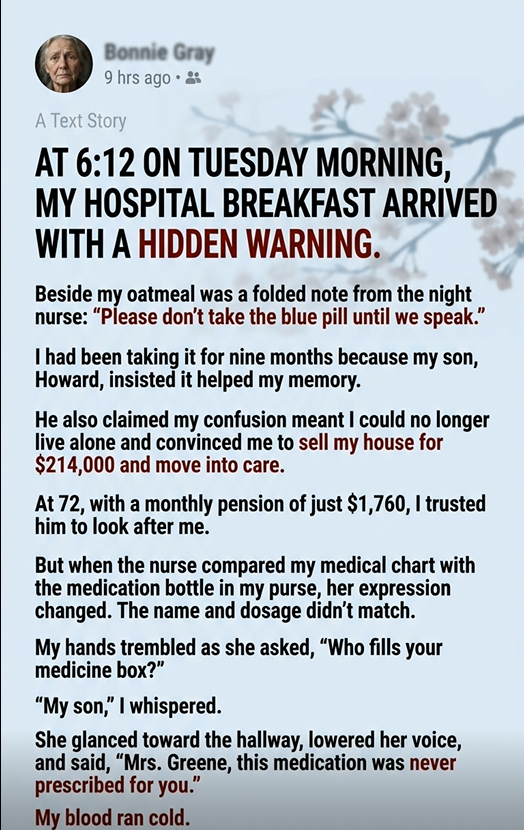
At 6:12 on Tuesday morning, my hospital breakfast arrived with a folded note tucked beside my oatmeal.
I almost threw it away.
Then I read the words written in blue ink.
Please don’t take the blue pill until we speak.
My hands went cold.
For nine months, I had been taking that pill because my son, Howard, insisted it helped my memory. He told me I was becoming forgetful, that I repeated myself, and that I could no longer be trusted to live alone.
At seventy-two, with a monthly pension of just $1,760, I had depended on Howard to help me manage my appointments, bills, and medications.
He was my only child.
When he suggested I sell my house for $214,000 and move into a care facility, I believed he was worried about me.
Now, sitting in a hospital bed with a note beside my oatmeal, I wondered whether I had misunderstood everything.
The night nurse, Patricia, appeared in my doorway a few minutes later.
She glanced at the untouched pill beside my water cup.
“You read my note,” she said quietly.
I nodded.
“What’s happening?”
She closed the door and pulled a chair beside my bed.
“Mrs. Greene, I need you to understand that I’m not accusing anyone of anything yet. But last night, I reviewed your medication records and compared them with the bottle you brought from home.”
She placed two documents on my bedside table.
“The medication listed in your hospital chart is not the same as the medication in your bottle. And the dosage doesn’t match any prescription we can verify.”
I stared at the papers.
“Howard fills my medicine box.”
“Has your doctor prescribed this blue pill?”
“I thought so.”
Patricia’s expression softened.
“Do you remember the doctor’s name?”
I told her.
She checked the chart, then shook her head.
“We contacted the prescribing office. They have no record of ordering this medication for you.”
My stomach twisted.
For nine months, I had swallowed a pill I believed my doctor had approved.
Howard had told me it was a harmless supplement to help me remember things. He said the doctor had recommended it after I forgot an appointment and misplaced my purse.
I had trusted him because he was my son.
“What is it?” I whispered.
Patricia didn’t guess.
“We need a pharmacist and your medical team to identify it properly. Until they do, please don’t take anything that hasn’t been verified by the hospital.”
She explained that she had already notified the attending physician and that the medication would be reviewed. If I had taken anything at home that wasn’t prescribed, they needed to know exactly what it was and how much I had taken.
I began to cry.
Not because I knew what the pill was.
Because I suddenly realized how little I knew about what had been happening to me.
For months, Howard had told me my confusion proved I couldn’t live independently.
If I forgot a word, he looked at me sadly.
If I misplaced my glasses, he reminded me that I was getting older.
If I questioned a bill, he said I was becoming suspicious.
Eventually, I began questioning my own mind.
I had even started apologizing whenever I couldn’t remember something.
Patricia took my hand.
“You’re allowed to ask questions about your own health,” she told me. “And you’re allowed to understand every medication you take.”
Those words stayed with me.
Later that morning, a hospital pharmacist came to review the bottle. The medical team arranged appropriate testing and documented what I had reported. They also contacted my regular physician to obtain my medication history.
The findings raised serious concerns about the pill’s identity and why I had been taking it. The team would not make assumptions about who had supplied it or why without further evidence.
But one thing was clear: it was not a medication I should have continued taking without verification.
I asked the doctor whether it could have contributed to my confusion.
“It is possible that an unverified substance can cause symptoms or interact with other medications,” she explained. “But we need the test results and your medical history before drawing conclusions. We also need to assess your memory independently.”
I nodded.
For the first time in months, someone was taking my concerns seriously without immediately deciding I was incapable.
Then the doctor asked me a question that changed the direction of the entire conversation.
“Mrs. Greene, has anyone been pressuring you to sell your house or sign documents recently?”
I looked at Patricia.
Then back at the doctor.
“Yes,” I whispered. “My son.”
I explained that Howard had been urging me to sell my small house, the home my late husband and I had bought decades earlier. He said the money would help pay for a care facility and that I would be safer if someone else handled my affairs.
He had even brought me documents to sign.
I had refused at first.
Then he began reminding me of every mistake I had made that year.
“You forgot to turn off the stove,” he would say.
“You missed your appointment.”
“You don’t remember what we talked about yesterday.”
Some of those things had happened. Others were harder to remember clearly.
Eventually, I began wondering whether he was right.
Maybe I really couldn’t manage my own life anymore.
Maybe selling the house was the responsible thing to do.
The doctor listened without interrupting.
When I finished, she asked whether I had signed anything.
“No,” I said. “Not yet.”
“Then don’t sign anything while you’re feeling pressured or while your medical situation is being assessed. We can help you contact the appropriate support services.”
For the first time that morning, I felt a small measure of relief.
My house was still mine.
And I had not yet surrendered the right to decide what happened to it.
Howard arrived just after noon.
He carried a bouquet of yellow roses and a bag of my favorite biscuits.
He smiled when he entered the room.
“Mom! How are you feeling?”
I looked at the flowers.
Normally, I would have thanked him immediately.
That day, I couldn’t stop wondering whether he had come because he was worried about me—or because he had discovered that someone had questioned the medication.
“I have some questions,” I said.
His smile faltered.
“About what?”
“The blue pill.”
He put the flowers on the windowsill.
“What about it?”
“The nurse says it wasn’t prescribed to me.”
Howard sighed, as though I were being difficult.
“Mom, we talked about this. It’s just something to help your memory.”
“Who gave it to you?”
He glanced toward the door.
“A friend recommended it.”
“Which friend?”
“I don’t remember the name.”
I stared at him.
“You’ve been giving me a pill for nine months, and you don’t know who supplied it?”
“Don’t make this into something it isn’t.”
His voice had changed.
He sounded less like the concerned son who had brought me flowers and more like the man who had spent months telling me I couldn’t trust my own judgment.
I took a slow breath.
“Howard, I want the medication records. And I want an independent doctor to assess my memory.”
His jaw tightened.
“Mom, this is exactly what I’m talking about. You get confused, then you become suspicious of everyone trying to help you.”
I felt the familiar urge to apologize.
For years, I would have said I was sorry and allowed him to change the subject.
This time, I remembered Patricia’s words.
I was allowed to ask questions about my own health.
“I’m not accusing you,” I said. “I’m asking for answers.”
Howard looked at me for a long moment.
Then he leaned closer.
“You know what happens if the doctors decide you can’t live alone? You’ll have to go into care anyway. We should just get the house sold and get everything arranged.”
There it was.
The house.
Even in a hospital room, with an unverified medication under investigation, he was talking about selling my home.
“I’m not signing anything today,” I replied.
He straightened.
“Fine. But don’t come crying to me when you can’t manage things yourself.”
He picked up his coat and left.
The door clicked shut behind him.
I began to tremble, but this time I knew the shaking wasn’t proof that he was right.
It was fear.
And fear was not the same thing as incapacity.
Over the next several days, I worked with the hospital team and my regular physician.
The medication was identified through the appropriate review, and my doctors assessed whether it could have contributed to the symptoms I had been experiencing. They also arranged an independent evaluation of my memory and daily functioning.
The results did not support Howard’s claim that I was automatically incapable of living alone.
I had experienced genuine lapses in memory, and I would need follow-up care. But I could explain my finances, recognize my medications when they were properly labeled, understand my choices, and describe the support I needed.
My doctors recommended a careful medication review, follow-up appointments, and practical measures to make life at home safer.
They did not recommend that I surrender control of my property.
When I was discharged, Patricia helped me connect with a hospital social worker who explained how to report concerns about suspected medication misuse and possible financial pressure involving an older adult.
I also contacted an attorney who specialized in elder law.
I wanted to understand my rights before making any decisions about my house.
The attorney reviewed the documents Howard had brought me. Some were preliminary forms, while others would have authorized significant financial decisions if I had signed them.
She advised me not to sign anything until I understood exactly what each document would do.
We also discussed safeguards for my bank accounts, medical information, and property records.
I changed my banking passwords, arranged for account alerts, and asked my bank to contact me directly about any significant transactions.
I made sure my doctors had my current medication list and asked that any future prescription changes be explained to me directly.
None of these steps proved that Howard had deliberately harmed me.
But they helped ensure that I would no longer have to depend on his explanations alone.
Two weeks later, Howard came to my house.
I had been home for several days and was beginning to feel like myself again. My neighbor, Mrs. Alvarez, had helped me arrange groceries and check that the smoke detectors worked. I had also scheduled regular visits with my doctor.
When Howard walked through the front door, he looked around as though he expected to find something different.
“You’ve changed the locks?” he asked.
“I had them checked and updated.”
“Why would you do that?”
“Because I wanted to.”
He stared at me.
“Mom, I’m your son.”
“I know.”
“I’ve been trying to help you.”
“Then help me understand what happened with that pill.”
He rubbed his forehead.
“I already told you. Someone recommended it.”
“Who?”
He didn’t answer.
I gestured toward the kitchen.
“Sit down, Howard.”
He sat reluctantly.
I placed a copy of the attorney’s letter on the table. It explained that I would not be signing property documents under pressure and that any future financial discussions would take place with independent advice.
Howard read it, then pushed it away.
“You’re treating me like a criminal.”
“No,” I said. “I’m treating my health and my home as things I have the right to protect.”
He looked genuinely angry.
“Who put these ideas in your head? That nurse? That lawyer?”
I shook my head.
“I’m the one asking the questions.”
For a moment, neither of us spoke.
Then he said something I would remember for the rest of my life.
“You don’t understand how difficult this has been for me. I can’t keep worrying about you every day. The house is worth $214,000. Selling it would solve everything.”
I studied his face.
“What would it solve for you?”
He looked away.
That was the first time I had asked him that question.
He didn’t answer.
I didn’t know whether he was overwhelmed, frightened about his own finances, or hiding something more serious. I wasn’t going to pretend I could read his mind.
But I knew my home was not simply a problem to be solved.
It was my property. My history. My choice.
“I am willing to discuss the help I need,” I told him. “I am willing to consider support at home, medical appointments, and even a care facility if that becomes the right decision for me. But I will not be pressured into selling my house, and I will not take medication that my doctor hasn’t approved.”
Howard stood up.
“So you’re choosing strangers over your own son?”
“No,” I said quietly. “I’m choosing not to make important decisions out of fear.”
He left without saying goodbye.
I cried after the door closed.
I loved my son. That hadn’t changed.
But love could not mean surrendering my health, my judgment, or my home simply to keep him from being angry.
The investigation into the medication and the concerns I had reported continued through the appropriate channels.
I provided the bottle, the records I had preserved, and a timeline of what I remembered. The professionals involved had to determine what the evidence established and whether any further action was warranted.
I did not publicly accuse Howard of a crime before the facts were established.
I didn’t need to.
I needed to be safe, and I needed the truth.
Over time, my health improved with medical follow-up and a clear medication plan. Some memory difficulties remained, so I accepted help with practical tasks and used reminders for appointments and bills.
I learned that accepting support did not mean giving up my independence.
I hired someone to help with heavier housework. I arranged regular transportation for medical appointments. I kept my finances organized and asked a trusted professional to review any major decisions with me.
My monthly pension was still $1,760.
The house still needed repairs.
And I was still seventy-two years old.
But I was no longer allowing someone else’s fear—or someone else’s plans—to decide what I could do.
Months passed before Howard contacted me again.
When he finally did, he asked whether he could come for coffee.
I agreed, with one condition: we would not discuss selling my house unless I chose to raise the subject, and any conversations about medication or finances would remain transparent.
He arrived without flowers this time.
He looked tired.
“Mom,” he said, sitting across from me, “I know you don’t trust me.”
I wrapped my hands around my cup.
“I trusted you enough to take a pill for nine months without questioning where it came from.”
He looked down.
“I thought I was helping.”
“Then why didn’t you ask my doctor?”
He had no answer.
I waited, but he didn’t offer a clear explanation for the medication or the pressure surrounding the house.
I wasn’t going to fill the silence with excuses for him.
Finally, I said, “If you want a relationship with me, it has to be built on honesty. I love you. But I won’t give you control over my health or finances just because you’re my son.”
He nodded slowly.
“I understand.”
I hoped he did.
But trust would not return because of one conversation. It would have to be rebuilt through consistent actions over time.
For now, I kept my safeguards in place.
I continued seeing my doctor. I followed my medication plan. I stayed in my home and made decisions with independent advice.
And every Tuesday morning, at 6:12, I remembered the folded note that had changed everything.
Please don’t take the blue pill until we speak.
I never learned everything I wanted to know that morning. The investigation had to follow evidence, and my relationship with Howard remained complicated.
But I learned something more important than any single answer.
Growing older did not mean I had lost the right to ask questions.
Having memory problems did not mean I had lost the right to make choices.
And being someone’s mother did not mean I had to surrender my safety to prove that I loved him.
I still kept a photograph of Howard as a little boy on my mantelpiece. I wasn’t ready to remove it, and I wasn’t ready to give up on him.
But beside that photograph, I placed a new picture of myself taken after I returned home from the hospital.
In it, I was sitting on my porch, smiling in the morning sunshine.
I looked older than I remembered.
I also looked like a woman who had begun to trust her own voice again.
My son had spent months telling me I couldn’t trust my mind. One nurse’s note reminded me that I still had the right to question, to choose, and to protect the life I had built.