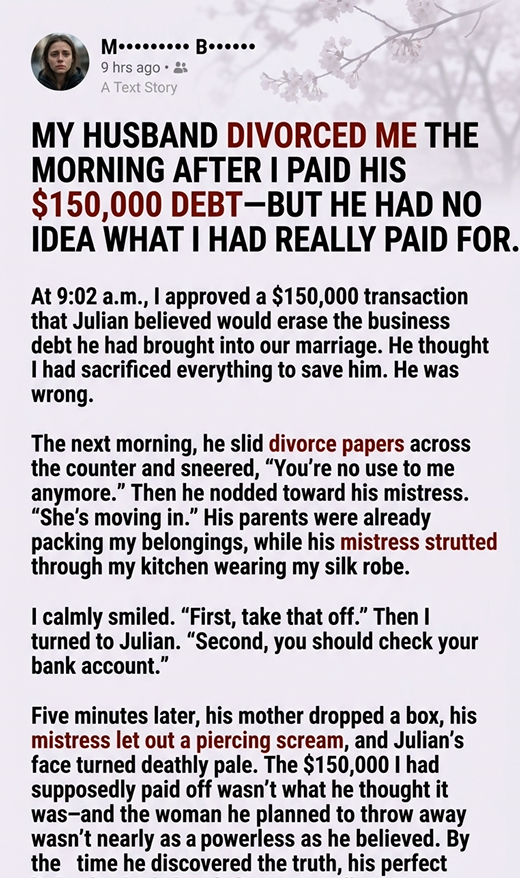
My Husband Divorced Me the Morning After I Paid His $150,000 Debt—But He Had No Idea What I Had Really Paid For
At 9:02 a.m., I approved a $150,000 transaction that my husband, Julian, believed would erase the business debt threatening to destroy our marriage.
He stood beside me in the kitchen, wearing his expensive watch and the confident smile I had once mistaken for strength.
“You’re saving everything,” he said, kissing my forehead. “I’ll never forget what you’ve done for me.”
I wanted to believe him.
For seven years, I had supported Julian through failed investments, business setbacks, and promises that the next deal would finally make us financially secure. I had drained my savings, postponed my own plans, and worked extra hours to help keep his company alive.
This debt was supposed to be the last one.
The money came from an account I had inherited from my grandmother. She had left it to me with one condition written in her letter: Never let anyone make you feel that your future is worth less than theirs.
I had read those words countless times.
Yet there I was, transferring $150,000 to protect a husband who had promised me we were building a future together.
I thought I was paying to save our marriage.
I was wrong.
The next morning, Julian placed a folder on the kitchen counter.
“Sign these.”
I opened it.
Divorce papers.
For several seconds, I couldn’t make sense of what I was seeing.
“What is this?”
He leaned against the counter.
“I’m done, Mara. This marriage hasn’t worked for a long time.”
I looked at him, waiting for a hint of shame or even hesitation.
There was none.
“Yesterday, you told me I was saving everything.”
“And you did help me with the debt,” he replied. “But that doesn’t mean I owe you the rest of my life.”
Then he nodded toward the hallway.
A woman appeared in the doorway wearing a silk robe that belonged to me.
Her name was Vanessa.
She was Julian’s mistress.
I’d suspected something was wrong for months, but he had always found a way to make me doubt myself. Late meetings became business emergencies. Hotel charges became client expenses. Messages disappeared because, according to him, I was being paranoid.
Now Vanessa was standing in my home as though she already owned it.
“She’ll be moving in,” Julian said. “My parents are helping you pack.”
I turned toward the living room.
His mother, Patricia, was carrying one of my storage boxes. His father was removing framed photographs from the shelves.
They weren’t helping me pack.
They were removing me.
Julian pointed at my robe.
“Take that off. Vanessa doesn’t want your things mixed with hers.”
I looked down at the silk fabric.
Then I looked back at him.
Something inside me became very still.
For months, I had been terrified of losing my marriage. I had believed that if I worked harder, gave more, and asked for less, Julian would eventually remember the woman he had married.
But the man standing in front of me wasn’t confused.
He had made a decision.
And he had expected me to accept it quietly.
I slipped off the robe and placed it on the counter.
“First,” I said calmly, “take that off my things.”
Vanessa laughed.
“Your things? Julian said we’re getting rid of everything that belongs to you.”
I ignored her and turned to my husband.
“Second, check your bank account.”
He frowned.
“What are you talking about?”
“Just check it.”
He laughed under his breath, opened his banking app, and stared at the screen.
His smile disappeared.
“What the hell is this?”
Vanessa stepped closer.
“What’s wrong?”
Julian refreshed the page.
Then he did it again.
The color drained from his face.
The $150,000 transaction he believed had cleared his business debt was not what he thought it was.
And the documents in the folder on the counter were about to become a much bigger problem than he had anticipated.
The Money Was Never a Gift
To understand Julian’s panic, you have to understand what happened the night before.
When Julian first told me about the $150,000 debt, he described it as a business loan that had become impossible to manage.
He said the lender was threatening legal action and that the debt could destroy his company.
He showed me statements, payment notices, and a proposed settlement.
I was frightened, but I was also suspicious.
The numbers didn’t quite match the explanations he gave me. Some documents listed a company I had never heard of. Others referred to obligations that appeared to have been transferred between businesses.
When I asked questions, Julian became irritated.
“You don’t understand how business works, Mara.”
Perhaps I didn’t understand every detail of his business.
But I understood that $150,000 was a life-changing amount of money.
So before authorizing anything, I contacted an attorney I had consulted previously about protecting my inheritance. I also requested independent verification of the debt and the proposed payment arrangement.
That was when I discovered the most important detail.
The money was not simply going toward the debt Julian had described.
The documents involved a settlement with a creditor and an agreement concerning assets connected to his company. The arrangement had legal consequences, and the person controlling the funds needed to understand exactly what was being purchased or released.
My attorney advised me not to transfer money based solely on Julian’s assurances.
I followed that advice.
The $150,000 was placed into a documented transaction governed by written terms. The payment was not an unconditional gift to Julian, and it did not give him unrestricted ownership of my inheritance.
The agreement required the parties to complete specific steps and provide records confirming the disposition of the funds.
Julian knew I had arranged the payment.
He did not understand the full terms.
He assumed that because I had approved the transaction, the money was his to use however he wished.
More importantly, he believed I had no independent protection if he abandoned our marriage afterward.
He was wrong about that, too.
I hadn’t hidden money from him or secretly seized any of his property. I had simply refused to transfer my inheritance without documented safeguards.
And I had kept copies of everything.
The Box That Changed Everything
Back in the kitchen, Julian was still staring at his phone.
“Why can’t I access the funds?” he demanded.
“Because you need to read the agreement,” I answered.
“You said the debt was being paid!”
“I said the transaction was being completed under the written terms. You signed the documents acknowledging those terms.”
His mother dropped the box she was carrying.
“What documents?” Patricia asked.
Julian shot her a warning look.
“Stay out of this.”
But she had already noticed the papers on the counter.
Vanessa snatched one up.
“What is this company?”
She read the name twice, then looked at Julian.
“Why does it say you’re personally responsible for the remaining obligations?”
Julian grabbed the paper from her.
“Give me that.”
His hands were shaking.
The documents did not prove that Julian had committed a crime, but they did contradict the story he had told his family about the debt being completely erased without further conditions.
The transaction had been designed to address specified obligations. It did not magically remove every liability, and it did not transfer my inheritance into his personal control.
The box Patricia had dropped contained the remaining records I had gathered before authorizing the payment: copies of the creditor’s correspondence, the signed agreement, a ledger of the business obligations, and the attorney’s instructions.
At the bottom was a letter from the creditor confirming which obligations the payment was intended to settle and which matters still required documentation.
Vanessa read the letter over Julian’s shoulder.
Then she screamed.
“You told me the business was completely clear!”
Julian tried to take the papers from her.
“It’s complicated.”
“No, Julian! You told me we could start over. You said Mara was paying everything off and that we’d have the house, the business, all of it!”
His father slowly lowered himself into a chair.
Patricia stared at her son.
“You told us she was giving you the money because she wanted to help you start a new life.”
Julian didn’t answer.
I stood quietly beside the counter.
For the first time, I could see the story he had been telling each of them.
To me, he had presented himself as a desperate husband trying to save our future.
To his parents, he had described himself as a successful businessman who had finally found a way to escape his debt.
To Vanessa, he had promised a new life financed by money he believed I would surrender without conditions.
Three different stories.
One set of documents.
And now, all three versions were colliding in the same kitchen.
“You Can’t Do This to Me!”
Julian slammed his phone onto the counter.
“You planned this!”
I shook my head.
“No. I planned to protect my inheritance while helping you resolve a debt. You planned to divorce me the morning afterward.”
His expression twisted.
“You knew I was going to leave?”
“I suspected you were hiding something. I didn’t know what you would do.”
“Then why did you go through all this trouble?”
“Because I had questions about the transaction, and I wanted independent advice before risking my future.”
Vanessa stepped away from him.
“You told me she was broke after the payment.”
I looked at her.
“My inheritance was never your money to count.”
She flushed.
Julian pointed at me.
“You’re my wife! You should have trusted me!”
I stared at him in disbelief.
“You brought me divorce papers less than twenty-four hours after asking me to sacrifice my savings. You brought your mistress into my home. You let your parents pack my belongings. And now you’re asking why I didn’t trust you?”
He looked away.
For a moment, I thought he might apologize.
Instead, he said, “You owe me. I built this business.”
“No,” I replied. “You built your business. I helped you when you asked. Those are not the same thing.”
His mother sat down heavily.
“Julian, tell me this isn’t true. Tell me you didn’t plan to leave her as soon as the payment went through.”
He said nothing.
That silence was answer enough for her to understand that his story had changed.
I didn’t celebrate.
There was no satisfaction in watching a marriage collapse in front of the people who had helped destroy it.
I was hurt. I was exhausted. And I knew the financial dispute was far from over.
But I no longer felt obligated to rescue Julian from the consequences of his own choices.
I picked up the divorce papers and placed them back inside the folder.
“I will have my attorney review these,” I said. “You will communicate with me through counsel about the property, the business-related payment, and anything else that requires a legal decision.”
Julian laughed bitterly.
“You think a lawyer is going to save you?”
“No,” I said. “I think a lawyer will help me understand my rights.”
Then I picked up my handbag.
“I’ll be staying somewhere else while this is sorted out. Do not move, sell, or dispose of anything that may belong to me or be relevant to the financial arrangements. My attorney will contact yours.”
Vanessa looked at Julian.
“You said she had nothing.”
I walked toward the door.
Behind me, I heard his mother ask the question that none of them had wanted to ask before.
“Julian, what else have you been lying about?”
He had no answer.
The Truth Came Out in Pieces
The next several weeks were difficult.
Julian’s attorney contacted mine. The lawyers reviewed the payment records, the divorce documents, and the terms of the financial agreement.
I did not assume that the transaction automatically entitled me to every dollar or that Julian’s conduct meant I would win every dispute. The agreement had to be interpreted according to its actual language, and the divorce required its own legal process.
But I had preserved the documents, followed independent advice, and avoided signing away my rights under pressure.
That mattered.
The review confirmed that the $150,000 had been applied according to the documented terms of the settlement. Certain business obligations were resolved, while other responsibilities remained subject to the agreements and records involved.
Julian could not simply treat the transaction as a personal gift and ignore the conditions he had accepted.
Meanwhile, Vanessa moved out.
She had believed Julian’s promises that his finances were secure and that our separation would leave him free to build a comfortable new life with her.
Once she understood that the situation was more complicated, she began asking questions of her own.
I didn’t know everything she had been told, and I had no interest in helping her construct another story about Julian.
She had chosen to participate in the affair.
Julian had chosen to betray his marriage.
Those were their decisions to face.
His parents also stopped calling me to demand that I withdraw my claims. Patricia eventually sent a brief message saying she had misunderstood the situation.
She did not apologize for helping pack my belongings that morning.
I accepted that she was beginning to understand the truth, but I didn’t pretend the damage had disappeared.
I had spent years trying to earn their approval.
I was done making my peace dependent on whether they approved of me.
The Final Meeting
Three months later, Julian requested a meeting through our attorneys.
By then, the divorce was proceeding through the proper legal channels. The financial issues were being handled separately, and neither of us could settle everything with a single angry conversation.
We met in a conference room with our lawyers present.
Julian looked tired.
For the first time in years, he wasn’t wearing his expensive watch.
“I didn’t think you’d actually leave,” he said when the attorneys stepped out briefly.
I looked at him.
“You handed me divorce papers.”
“I thought you’d fight for the marriage.”
“I did fight for the marriage, Julian. I fought for it for years.”
He lowered his eyes.
“I thought once the debt was gone, everything would be easier.”
“Easier for whom?”
He didn’t answer.
I continued.
“You asked me to risk my inheritance to resolve a business problem. I agreed to help under written terms. Then you decided I was no longer useful and expected me to disappear quietly.”
“I didn’t mean for it to happen like that.”
“But it did.”
He rubbed his hands together.
“Vanessa left.”
I felt no triumph.
“I’m sorry things didn’t work out the way you expected,” I said. “But that doesn’t change what happened between us.”
He looked up.
“Don’t you ever think about the good years?”
“Of course I do. They were real. So was the betrayal.”
For a moment, his eyes filled with tears.
“I was scared,” he admitted. “The business was falling apart. I didn’t know how to tell you how bad things had become.”
“You could have told me the truth.”
“I know.”
“You could have asked for help without lying.”
“I know.”
“And you could have ended our marriage honestly before bringing another woman into our home.”
He had no answer.
I wanted him to understand how deeply he had hurt me. But I also knew that no conversation could force him to become the person I had once believed he was.
When our attorneys returned, we continued discussing the legal matters.
We eventually reached a written resolution of the issues that could be settled, while any remaining obligations were handled according to the applicable agreements and procedures.
The divorce was finalized later.
I did not walk away with a magical fortune or a perfect victory. I walked away with my own financial records, a clearer understanding of my rights, and a future I no longer had to organize around Julian’s emergencies.
I moved into a smaller home with a sunny kitchen and a little garden.
I returned to work on projects I had postponed for years. I reconnected with friends I had neglected while trying to keep my marriage afloat.
Some mornings, I still woke up angry.
Other mornings, I missed the man I had believed Julian could become.
Healing was not a straight line.
But every month, I looked at my finances and knew that my future was no longer being decided by someone else’s promises.
The $150,000 transaction had not saved my marriage.
It had forced the truth into the open.
And the morning Julian handed me those divorce papers, he believed he was throwing away a wife who had served her purpose.
He never understood that I had finally stopped treating my own future as the price of keeping him.
I had helped him face a debt. I would not spend the rest of my life paying for his betrayal.