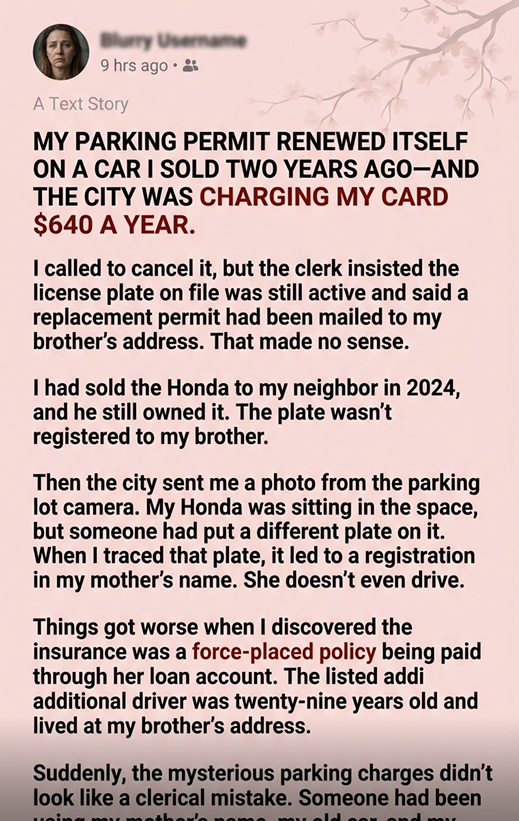
My Parking Permit Renewed Itself on a Car I Sold Two Years Ago—And the City Was Charging My Card $640 a Year
The first warning came on a Tuesday morning.
I was drinking coffee when an email from the city parking department appeared on my phone.
Your residential parking permit has been successfully renewed. Annual charge: $640.
I stared at the screen.
The permit was supposedly attached to a Honda Civic I had sold to my neighbor two years earlier.
I hadn’t owned that car since 2024.
I immediately called the parking department.
After twenty minutes on hold, a clerk named Denise answered.
“I’d like to cancel my residential permit,” I explained. “The car listed on my account was sold two years ago.”
She typed for several seconds.
“Ma’am, the license plate is still active in our system. Your replacement permit was mailed to the address on file.”
“What address?”
She read it aloud.
My brother Michael’s address.
I felt my stomach tighten.
Michael and I hadn’t lived together since we were children. He had his own house, his own car, and his own insurance.
There was no reason for a parking permit in my name to be mailed to his home.
“That’s not my address,” I said. “And I don’t own the vehicle anymore.”
Denise paused.
“I’m seeing a discrepancy. I’ll flag the account, but you’ll need to submit documentation.”
I thanked her and hung up.
At first, I thought it was a clerical error. Someone had entered the wrong address, and the automatic renewal had continued charging my card.
Annoying, but fixable.
Then I remembered something.
When I sold the Honda to my neighbor, Peter, he had sent me a photograph of the completed bill of sale. I had also submitted the required notice of sale to the motor vehicle department.
Peter still owned the car.
The registration had never been in my brother’s name.
So why was the city still issuing permits tied to my old vehicle?
I called Peter.
“Do you still have the Honda?”
“Of course,” he said. “Why?”
“Has anyone else been driving it?”
“Not that I know of. It’s parked in my driveway most days.”
I explained the parking charge.
Peter sounded confused.
“That’s strange. I registered it in my name when I bought it.”
He checked his paperwork while we were on the phone.
Everything appeared correct.
Then I received another email from the city.
It contained a photograph from a parking-lot camera.
The Honda was parked in a downtown space.
But something was wrong.
The car looked like mine, yet the license plate was different.
I zoomed in.
The plate was registered to a vehicle listed under my mother’s name.
My mother, Eleanor, was seventy-two years old.
She hadn’t driven in almost a decade.
I called her.
“Mom, do you own a car?”
“No, sweetheart. You know I don’t.”
“Has anyone registered a vehicle in your name?”
There was a long silence.
Then she asked, “Why are you asking me that?”
I told her about the photograph.
Her voice dropped.
“Your brother said he was helping me with some paperwork last year. He told me I needed to sign a few things so he could keep my insurance records organized.”
“What paperwork?”
“I don’t remember exactly. He brought it over with my bank statements. He said it was routine.”
My hands went cold.
I asked her to look for the documents.
A few minutes later, she called back.
She had found an insurance statement showing a vehicle policy paid through an account connected to a loan in her name. The policy also listed an additional driver: a twenty-nine-year-old man who lived at Michael’s address.
My brother was thirty-four.
I didn’t recognize the additional driver’s name.
The policy also showed a series of payments that my mother couldn’t explain.
Suddenly, the parking charges didn’t look like a mistake.
Someone appeared to be using my identity to maintain one vehicle record while using my mother’s information for another.
But I still didn’t know why.
And I wasn’t going to accuse anyone until I had the records to prove what had happened.
That afternoon, I drove to my mother’s house.
She sat at the kitchen table with a folder of paperwork spread in front of her. Her hands trembled as she passed me each page.
There were insurance notices, loan statements, parking correspondence, and copies of documents she barely remembered signing.
One document contained a signature that looked like hers.
Another listed Michael’s address as the mailing address for an account connected to the vehicle.
Then I found an authorization form.
It allowed someone to manage certain insurance and vehicle-related matters on my mother’s behalf.
The name listed as the authorized contact was my brother’s.
I looked at Mom.
“Did you understand what you were signing?”
She shook her head.
“He said it would make things easier. He told me he would handle everything.”
I wanted to call Michael immediately.
Instead, I took photographs of the documents and put everything back in the folder.
My mother was frightened, and I needed to protect her before confronting anyone.
The next morning, I contacted the parking department again. I requested the full account history, copies of the permit applications, and the records showing how the annual charges had been authorized.
I also contacted the motor vehicle department and the insurer to report possible misuse of personal information.
The answers came slowly.
But one detail stood out.
The parking department’s records showed that the permit had been renewed using my payment card, while the vehicle information and mailing address had been changed more than once.
The city could not immediately explain who had made those changes.
They opened a formal review.
The insurer opened a separate inquiry into the policy and the additional driver.
I then contacted an attorney to help my mother understand the loan documents and determine whether any signatures or authorizations had been misused.
Only after those steps were underway did I call Michael.
He answered cheerfully.
“Hey, what’s up?”
“I need to talk to you about Mom’s vehicle insurance and my old parking permit.”
The silence on the other end lasted only a second, but I noticed it.
“What about them?”
“Why was a replacement parking permit in my name mailed to your house?”
“I have no idea.”
“Why is a vehicle registered to Mom appearing in the city’s parking records with a plate connected to my old Honda?”
“I don’t know what you’re talking about.”
“Then you won’t mind explaining the insurance policy listing an additional driver at your address.”
His voice hardened.
“Why are you going through Mom’s paperwork?”
“Because she’s being charged for things she doesn’t understand, and someone has been charging my card for a vehicle I sold two years ago.”
“You’re making this into a huge deal.”
“Then help me understand it.”
He exhaled sharply.
“I was helping Mom. You know she can’t manage this stuff anymore.”
“Helping her doesn’t explain why my card was charged $640 every year.”
“I’ll look into it.”
“No,” I said. “The city and the insurer are already looking into it. I want you to preserve every document and message related to these accounts.”
He hung up.
I sat at my kitchen table for a long time afterward.
I had spent years believing Michael was the responsible one in our family. He handled paperwork, helped Mom with errands, and always seemed to know which forms needed to be signed.
I had mistaken confidence for honesty.
Over the next two weeks, the inquiries uncovered a more complicated picture.
The insurer confirmed that the policy covered a vehicle associated with my mother’s records, but several details required further verification. The additional driver had been listed through an application submitted using information connected to Michael’s address.
The city confirmed that the parking permit linked to my old account had been renewed repeatedly, despite the notice of sale I had filed. The account history showed that the mailing address had been changed, but the records did not establish who had made every change.
My attorney helped me submit a formal dispute over the charges and request that the permit account be frozen while the city investigated.
The insurer suspended further automatic payments while it reviewed the policy.
Meanwhile, my mother discovered that the loan account used to pay some of the insurance costs had a balance she hadn’t expected.
She had believed Michael was simply helping her organize her bills.
Now she needed independent advice about whether the loan had been properly authorized and what financial obligations she actually had.
We arranged an appointment with a financial counselor and her attorney.
I also helped her contact the relevant agencies to protect her personal information and review her credit records.
Then, one Friday afternoon, Michael showed up at my door.
He looked exhausted.
“Can we talk?”
I let him in, but I didn’t offer him coffee.
He sat on the sofa and stared at his hands.
“I didn’t think you’d involve lawyers,” he said.
“I didn’t think I’d have to investigate why Mom was being charged for things she didn’t understand.”
He swallowed.
“I was trying to keep everything together.”
“For whom?”
He didn’t answer immediately.
Then he admitted that he had been helping a friend arrange vehicle-related paperwork. He had used our mother’s address for some correspondence because he thought it would be convenient. He also admitted that he had allowed information from my old parking account to remain in use longer than it should have.
But his explanation left important questions unanswered.
He claimed he hadn’t intended to steal money from either of us. He said the repeated charges had been overlooked and that he had expected to correct the records eventually.
I listened without interrupting.
“Did you authorize the city to keep charging my card?”
He looked away.
“I thought it was temporary.”
“Did you ask me?”
“No.”
“Did Mom understand the insurance and loan arrangements?”
“I thought she did.”
“She says you told her they were routine forms.”
Michael rubbed his forehead.
“I should have explained them better.”
“That isn’t the same as answering the question.”
He finally looked at me.
“I made a mess. I know that.”
It was the closest he came to admitting responsibility.
I told him that any reimbursement would need to be documented, that he could no longer manage our mother’s financial or vehicle-related paperwork without her informed permission, and that all communication about the disputed accounts would go through the appropriate channels.
He agreed.
But I did not withdraw the reports.
An apology could not replace a proper investigation.
Over the following months, the city reviewed my permit account and corrected the records after verifying the sale documentation. The disputed charges were evaluated under its refund process, and I received a written determination explaining which amounts qualified for reimbursement.
The insurer completed its review separately. Some records were corrected, while other matters involving the vehicle and loan required additional documentation.
My mother’s attorney helped her challenge the charges she did not recognize and establish which obligations, if any, were legally hers.
We did not recover every dollar immediately. Some questions took longer to resolve, and not every discrepancy could be traced to one person’s action.
But the automatic charges stopped.
The old Honda remained registered to Peter, as it should have been.
My mother received clearer records about her insurance and loan accounts, and she changed her account access so that no one could make further changes without her knowledge.
Michael repaid the portion of the disputed costs that he acknowledged had resulted from his decisions, under a written arrangement. The remaining matters were handled through the formal reviews rather than family arguments.
Our relationship did not return to what it had been.
I still loved my brother, but I no longer accepted “I’m helping” as an explanation for anything involving someone else’s money or identity.
My mother learned to ask for independent advice before signing financial documents. I learned to check my accounts instead of assuming that automatic payments were harmless simply because they had continued for years.
And I finally understood why that parking permit had bothered me so much.
It wasn’t only about $640.
It was about discovering that a system tied to my identity had kept operating after I had done everything I thought was required to close it.
It was about my mother’s trust being used without her fully understanding the arrangements.
And it was about how easily a family secret can hide behind paperwork that nobody thinks to question.
Today, I keep the bill of sale for the Honda, the city’s final determination, and the correspondence about my mother’s accounts in a locked file.
Not because I want to keep reliving what happened.
Because I never want to confuse family loyalty with blind trust again.
The most expensive mistake wasn’t the $640 charge. It was believing that someone handling the paperwork must also be handling the truth.