My Mother Kept Her Friday Hair Appointment for 30 Years—Then Her Hairdresser Gave Me a Letter She Had Hidden for Two Summers
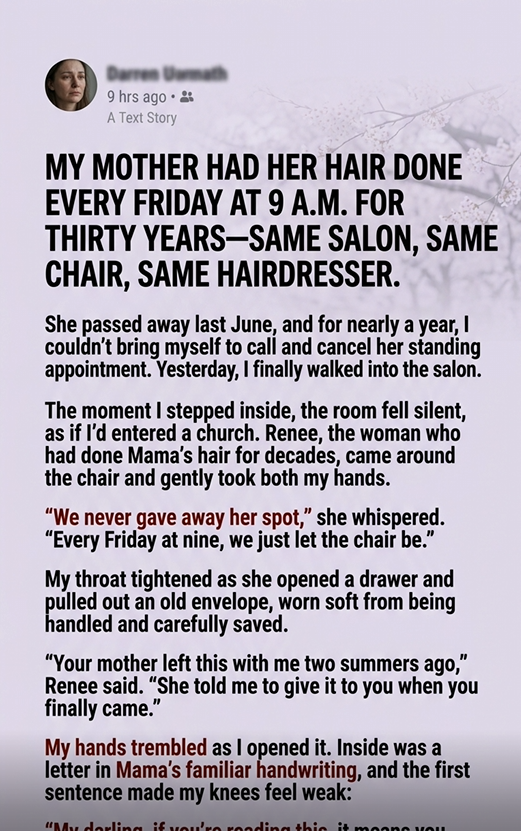
My mother had her hair done every Friday at 9 a.m. for thirty years.
Same salon. Same chair. Same hairdresser.
Her name was Renee, and she had been doing Mama’s hair for so long that she knew how my mother took her coffee, which songs made her hum, and exactly how she liked the curls around her face.
Mama never missed an appointment.
Not when it rained. Not when the roads iced over. Not even when she was feeling under the weather.
“Some things are worth keeping,” she’d tell me whenever I teased her about the routine.
I never understood how much those Fridays meant until she died last June.
For months, I couldn’t bring myself to call Renee and cancel Mama’s standing appointment. I knew it was only a calendar entry, but deleting it felt like admitting that my mother was truly gone.
So I left it there.
Every Friday morning, the reminder appeared on my phone.
Mama — Hair appointment, 9:00 a.m.
I’d stare at it, close my eyes, and try to get through the day.
Then, nearly a year after her funeral, I finally walked into the salon.
The little bell above the door chimed.
The smell of shampoo, hairspray, and freshly brewed coffee hit me immediately. A woman sat beneath a dryer, flipping through a magazine. Someone laughed softly near the reception desk.
Then the laughter stopped.
Renee looked up from the counter.
For a moment, she simply stared at me.
She was older than I remembered, with silver strands in her hair and fine lines around her eyes. But when she recognized me, she came around the counter and took both my hands.
“Oh, sweetheart,” she whispered.
I tried to smile.
“I’m sorry I haven’t been here.”
“You don’t owe me an apology.”
She glanced toward Mama’s old chair.
It was empty.
The other customers had gone quiet, as though they understood they were witnessing something private.
Renee gently squeezed my hands.
“We never gave away her spot,” she said. “Every Friday at nine, we just let the chair be.”
That was when I began to cry.
For thirty years, my mother had sat in that chair, talking about the weather, complaining about grocery prices, and telling Renee stories about her family.
Apparently, she had also talked about me.
A lot.
Renee led me to a small office behind the salon. She offered me coffee, but I couldn’t drink it. My hands trembled too much.
Then she opened a drawer and removed an old envelope.
It was soft at the edges, worn from being handled, but carefully preserved.
“Your mother left this with me two summers ago,” Renee explained. “She told me to give it to you when you finally came here yourself.”
I looked at the envelope.
“Why didn’t she give it to me?”
Renee sat opposite me.
“She said she wanted you to be ready. I asked whether I should call you if something happened to her. She told me not to. She said you needed to come here when you were ready, not because somebody pushed you.”
My throat tightened.
Mama had known she was leaving something behind.
I turned the envelope over. My name was written across the front in her familiar handwriting.
Inside was a folded letter.
The first sentence made my knees weak.
My darling, if you’re reading this, it means you’ve finally found your way back to the chair where I spent so many happy Fridays.
I pressed the letter against my chest.
Then I unfolded it and continued reading.
There are things I’ve wanted to tell you for years, but I kept putting them off because I was afraid of hurting you. I told myself I was protecting you. The truth is, I was protecting myself from having a difficult conversation.
I stopped.
My mother had always been the strongest person I knew. She was the one who kept the family together when money was tight, who remembered everyone’s birthdays, and who could make a meal stretch when unexpected guests arrived.
I’d never imagined she had a secret she was afraid to share with me.
I read on.
You remember the summer you were sixteen, when you asked me why your father stopped sending birthday cards? I told you he was selfish and that he had chosen to leave us. I let you believe he never tried to contact you again.
My breath caught.
My father, Robert, had left when I was young. I remembered his absence more than his face. There had been a few birthday cards when I was little, then silence.
Whenever I asked Mama about him, she said the same thing.
“He made his choice.”
Eventually, I stopped asking.
But Mama’s letter continued.
That wasn’t the whole truth.
I gripped the edge of the desk.
Your father did try to contact you. More than once. I was angry with him, and I believed he had no right to walk in and out of your life whenever he pleased. Some of his messages came at difficult times, and I told myself that keeping them from you was the kindest thing I could do.
I was wrong to make that decision for you.
Tears blurred the words.
I looked at Renee.
“Did you know about this?”
She shook her head.
“No, sweetheart. Your mother never told me what was in the letter. She only asked me to keep it safe.”
I returned to the page.
Mama explained that my father had contacted her several times over the years. Some messages were apologies. Others were requests to speak with me. He had asked whether he could attend my high school graduation and whether he might send me a letter when I turned twenty-one.
Mama had refused.
She said she believed he would only confuse me and reopen old wounds.
She admitted that anger had influenced her decisions more than she wanted to acknowledge.
Then I reached the paragraph that changed everything.
When I was diagnosed with my heart condition, I finally understood that I had spent too many years deciding what other people deserved to know. I asked Renee to keep this letter because I wanted you to have the truth someday, even if I couldn’t find the courage to tell you myself.
My hands shook.
Your father is alive. He lives in Ohio. His last address is written on the separate card inside this envelope. I don’t know whether he still lives there, and I cannot promise that he will welcome you or have the answers you want.
But I don’t want my anger to become your inheritance.
I lowered the letter.
For years, I had believed my father simply hadn’t cared enough to stay in touch.
Now I learned that my mother had made decisions on my behalf, decisions she regretted too late to discuss with me.
I wasn’t sure whether I was angry with her or heartbroken for both of us.
Perhaps I was both.
At the bottom of the envelope was a small card with an address and a phone number.
On the back, Mama had written one final sentence.
You don’t have to forgive him, darling. You don’t have to contact him. Just make the choice for yourself.
I sat in Renee’s office for a long time.
She didn’t rush me.
Eventually, I asked her how Mama had seemed during those final months.
Renee told me that my mother had continued coming every Friday, even when climbing the salon steps became difficult. Sometimes she talked about old memories. Sometimes she sat quietly while Renee brushed her hair.
“She loved you more than anything,” Renee said. “But loving someone doesn’t always mean knowing how to do the right thing.”
I folded the letter carefully.
“I wish she’d told me.”
“So do I,” Renee replied.
Before I left, she walked me to Mama’s old chair.
I touched the armrest and imagined my mother sitting there, laughing at one of Renee’s stories, checking her reflection in the mirror, and insisting that her hair looked better from the left side.
For the first time in months, the memories didn’t feel like a door slamming shut.
They felt like a room I could still enter.
That evening, I placed the letter on my kitchen table and stared at the address.
I didn’t call immediately.
I needed time to think about what I wanted, rather than reacting to the shock of what I’d learned.
Over the next week, I read Mama’s letter several times. I spoke with a counselor about the grief and anger that had surfaced. I also asked a trusted relative whether they knew anything about my father’s life.
They confirmed that he had moved to Ohio many years earlier but didn’t know whether he was still there.
Eventually, I decided to make the call.
A man answered after the third ring.
“Hello?”
I almost hung up.
Then I said, “My name is Claire. I’m Robert’s daughter.”
There was a long silence.
Finally, he replied, “Claire?”
He said my name as though he’d been afraid to say it aloud for years.
We spoke for nearly an hour.
He told me he had remarried, worked as a maintenance supervisor, and retired two years earlier. He admitted that he had made mistakes when I was young. He had left after a bitter separation, convinced that distance would keep the arguments from hurting me.
He also admitted that he had given up too easily when Mama refused his attempts to contact me.
“I should have kept trying in a way that respected you,” he said. “Instead, I let the years pass. I don’t expect you to excuse that.”
I asked him about the letters.
He remembered sending them. He also remembered asking to attend my graduation and being told that I didn’t want him there.
“I believed her,” he said. “I thought it would be selfish to force myself into your life.”
I closed my eyes.
Neither of us could change what had happened.
And I knew his version was still only one side of a complicated history.
But for the first time, I could ask questions directly.
We agreed to meet in a public café the following month.
I didn’t tell myself that one meeting would make us a family again. I didn’t promise him forgiveness, and he didn’t ask for it.
When the day came, I recognized him immediately.
His hair was almost entirely gray. He wore a navy jacket and held a paper cup with both hands.
He stood when I approached.
For a few seconds, we simply looked at one another.
“You look like your mother,” he said.
I felt my eyes sting.
“I know.”
We sat down and talked.
He brought photographs from my childhood, including one of me holding a birthday cake I barely remembered. He had kept a few drawings I’d sent him when I was little, along with the birthday cards he’d received back in the mail.
He hadn’t kept everything. Some years had passed without contact, and there were memories he couldn’t recall clearly.
But he had kept enough to show me that my childhood had mattered to him, even when he had failed to be part of it.
I didn’t leave the café with a new father in the way people describe in stories.
I left with a complicated man I barely knew, a great deal of grief, and the possibility of building something slowly.
That was enough for one day.
Over the next several months, we spoke occasionally. Sometimes our conversations were awkward. Sometimes we laughed about small things. We discussed what had happened without pretending that either of us had a complete understanding of the past.
I also began to see my mother differently.
I was still hurt by her decision to keep those messages from me. Love did not make that choice harmless.
But I could now understand that she had been a frightened, angry person trying to protect her child with the tools she had at the time.
She had also recognized, eventually, that she had made a mistake.
I wished she’d lived long enough to tell me herself.
On the anniversary of her death, I returned to Renee’s salon.
It was Friday morning, just before nine.
Mama’s chair was empty again.
Renee smiled when she saw me.
“Would you like to sit for a while?”
I nodded.
I sat in the chair and looked at my reflection in the mirror.
For thirty years, Mama had come here to have her hair done. She had left behind laughter, stories, familiar routines, and a letter that had taken her two summers to entrust to someone else.
I pulled the letter from my bag and unfolded it one last time.
I don’t want my anger to become your inheritance.
I finally understood what she meant.
The truth had hurt me. It had changed how I remembered my childhood and forced me to reconsider two people I had loved in very different ways.
But it had also returned something to me.
The choice.
I could decide whether to know my father. I could decide how much contact I wanted. I could remember my mother with love without pretending she had never made mistakes.
And I could grieve without letting grief decide the rest of my life.
Renee gently brushed a stray hair from my shoulder.
“Your mother would be glad you came back,” she said.
I smiled through my tears.
“I think she would.”
That Friday, for the first time since Mama died, I didn’t leave the salon feeling that I had lost her all over again.
I left carrying her letter in my bag, my father’s number in my phone, and a little more peace in my heart.
My mother had kept her appointment every Friday for thirty years.
And even after she was gone, the chair she left behind helped me find my way toward the truth.
Because sometimes the last gift someone leaves you isn’t an answer. It’s the freedom to ask the questions they were too afraid to answer themselves.