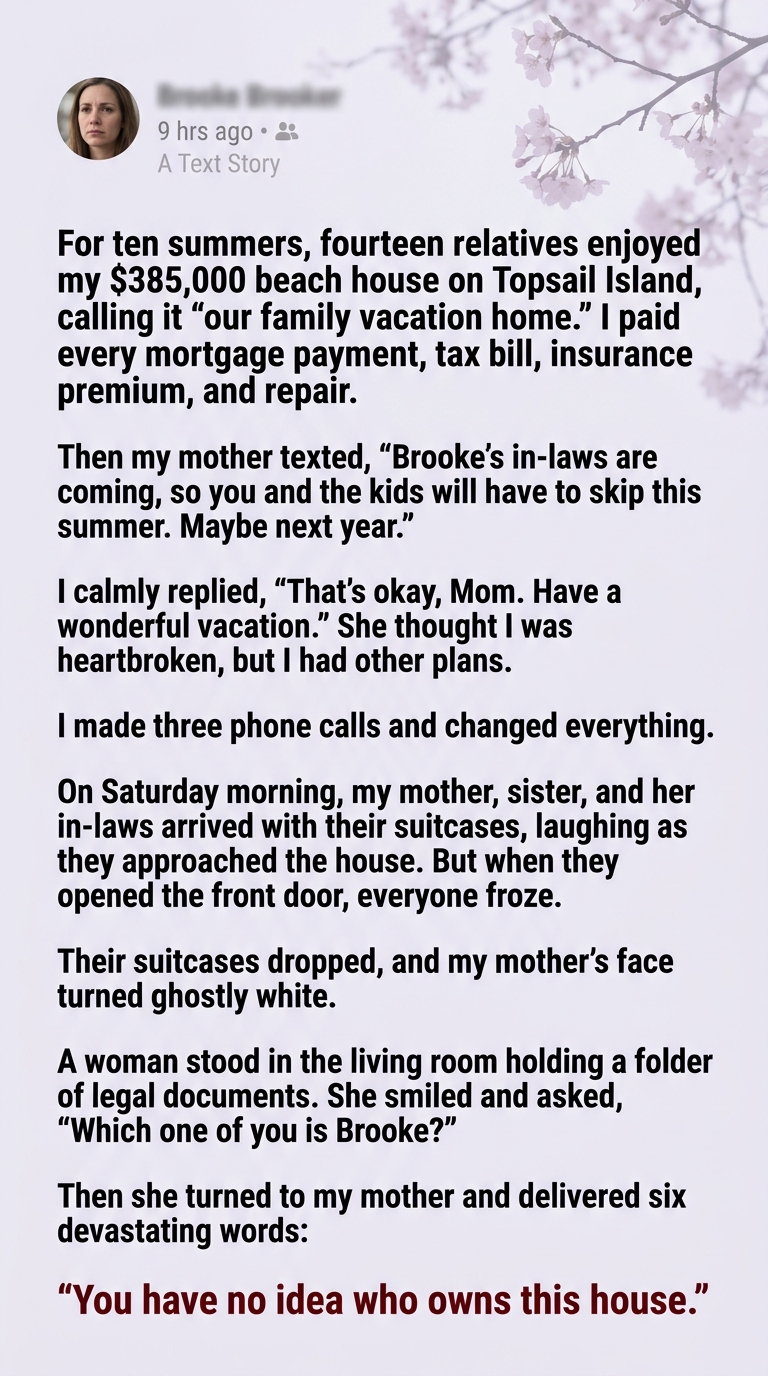
My Family Called My $385,000 Beach House “Ours”—Until a Lawyer Opened the Door
For ten summers, my family treated my beach house on Topsail Island like a birthright.
Fourteen relatives came every year. My mother claimed the master bedroom because, as she liked to say, “Mothers deserve the best room.” My younger sister, Brooke, brought her husband and children. My aunt and uncle arrived with coolers, folding chairs, and enough groceries to feed a small army. Eventually, Brooke’s in-laws started joining us, too.
Everyone called it our family vacation home.
There was just one problem.
It wasn’t theirs. It was mine.
I was the one who had purchased the $385,000 property. I was the one who paid the mortgage, property taxes, insurance, utilities, and repair bills. When a storm damaged the deck, I paid for the contractor. When the air conditioner failed during the hottest week of July, I paid for the replacement. When the roof began leaking, I spent thousands fixing it before the next hurricane season.
My relatives never offered to contribute.
Not once.
I didn’t mind at first. I loved seeing my children build sandcastles with their cousins. I loved watching my mother sit on the porch at sunset, telling stories about our family. I believed the house was bringing us closer together.
But over time, something changed.
My mother began telling me which weekends I could visit my own property. Brooke started rearranging the furniture without asking. Her husband once complained that the towels I provided weren’t soft enough.
And whenever I reminded them that I was paying for everything, my mother gave me the same wounded expression.
“Why do you always have to make everything about money?”
So I stopped mentioning it.
I kept paying the bills.
I kept opening the doors.
And I kept hoping that one day, my family would remember that generosity was a gift, not an obligation.
Then came the text that finally changed everything.
It arrived on a Tuesday morning in May.
I was sitting at my kitchen counter, helping my youngest child with homework, when my phone buzzed.
It was my mother.
Brooke’s in-laws are coming this summer, so you and the kids will have to skip the beach house. There won’t be enough room for everyone. Maybe next year.
I read it twice.
Then I looked toward the living room, where my children had already started talking excitedly about the beach. They had been counting down the days since spring break.
My mother had just decided that the children who belonged to the woman paying for the house were less entitled to stay there than the in-laws of the daughter who contributed nothing.
I felt the familiar sting of rejection.
But this time, something else rose beneath it.
Clarity.
I typed a reply.
That’s okay, Mom. Have a wonderful vacation.
She responded with a heart emoji.
I stared at the screen for a moment, then put my phone down.
My mother thought I was heartbroken.
She had no idea that I had just made a decision.
For ten years, I had confused keeping the peace with being a good daughter. I had allowed my family to mistake my generosity for permission to control my property.
That afternoon, I made three phone calls.
The first was to my attorney, Melissa Grant.
I explained the situation, including the text message and the history of my family using the house without contributing to its expenses.
Melissa listened carefully.
“Before we do anything,” she said, “I want to review your deed, your insurance documents, and any agreements you’ve made about access. We need to establish exactly what rights everyone has.”
I sent her the documents that evening.
The second call was to my property manager, who handled inspections and maintenance when I wasn’t on the island. I instructed him to stop giving relatives access to the house and to make sure all keys and access codes were accounted for.
The third call was to a licensed locksmith.
I wasn’t trying to create a dramatic scene. I wanted to make sure the property was secure and that access was controlled by the person legally responsible for it.
Over the next several days, Melissa reviewed the records.
The deed listed me as the sole owner. The mortgage was in my name. The taxes and insurance were paid from my accounts. There was no written agreement giving my relatives permanent access, and no one else had an ownership interest.
Melissa also advised me to preserve the text messages and keep records of all communications.
“Your family may be accustomed to using the house,” she explained, “but that doesn’t automatically make it theirs. We’ll communicate the boundaries clearly and handle any dispute through the proper process.”
She drafted a formal notice stating that my relatives no longer had permission to use the property without my written approval.
I signed it.
Then I waited.
Saturday morning arrived bright and warm.
While I was at home several hours away, my mother, Brooke, her husband, and Brooke’s in-laws drove toward Topsail Island with their suitcases packed.
I knew they were coming because Brooke had posted a photograph of their car on social media with the caption:
Family beach week starts now!
My mother had even sent me a message that morning.
We’ll send pictures. The kids are going to have such a wonderful time.
I didn’t respond.
At approximately eleven o’clock, my property manager called.
“They’re here,” he said.
“Did you give them the notice?”
“Yes. Your attorney’s representative is also here, as arranged. No one has entered the house.”
I took a slow breath.
“Thank you. Please let Melissa handle the conversation.”
A few minutes later, my phone rang.
It was Brooke.
I answered.
“What did you do?” she shouted.
I could hear my mother crying in the background. Someone else was demanding to know why the locks had been changed.
“Good morning to you, too,” I said.
“There’s a woman standing in the living room with legal papers! She says we can’t stay here!”
“Then you should read the papers.”
“Mom said this was our family house!”
I closed my eyes briefly.
“No, Brooke. Mom said that. I paid for the house.”
“You can’t just throw us out!”
“I’m not throwing anyone out. You were told you didn’t have permission to stay there this summer. You chose to come anyway.”
She fell silent.
Then I heard my mother take the phone.
“How could you humiliate us like this?” she demanded. “Your sister’s in-laws are here! They’re standing outside with their luggage!”
“I didn’t invite them.”
“You could have warned us!”
“I did. I told you I wouldn’t be coming this summer, and the formal notice explained that the house wasn’t available to you.”
“You know what I meant!”
For the first time in my life, I didn’t rush to soothe her.
“Mom, I spent ten years paying for that house so our family could enjoy it. I never charged you rent. I never asked anyone to reimburse me for the repairs. I never complained when fourteen people arrived and left me with the cleaning bills. But when it came time to decide who could use the house, you excluded me and my children.”
“That’s not fair,” she snapped.
“Then tell me what would be fair.”
She had no answer.
Instead, she passed the phone back to Brooke, who muttered something about me ruining the vacation before hanging up.
I sat quietly for a moment.
I expected to feel victorious.
Instead, I felt sad.
I had not wanted a confrontation. I had wanted my family to treat me with the same consideration I had shown them.
But sometimes, the moment you stop accepting unfair treatment is the moment other people accuse you of becoming cruel.
That afternoon, Melissa called with an update.
The formal notice had been delivered. My relatives had been told they could not occupy the property without permission. They were given time to collect their belongings from the exterior storage area and make alternative arrangements, and the property manager documented the interaction.
There had been no forced removal and no public spectacle. Melissa had made it clear that if anyone challenged the ownership or access arrangements, the matter would be handled through the appropriate legal channels.
My mother and Brooke eventually left.
They booked hotel rooms farther down the island, although I heard later that Brooke’s in-laws were furious about the unexpected expense.
For the next three days, my phone barely stopped buzzing.
My aunt called me selfish.
My cousin sent a message saying I had destroyed a family tradition.
Brooke posted a vague social media status about how money could turn people cold.
My mother didn’t call at all.
I didn’t respond to the accusations.
Instead, I took my children to the beach.
We stayed at a small oceanfront hotel, ate ice cream after dinner, collected shells, and watched the sunset. They were disappointed that we weren’t staying at the house, but they were too young to understand the conflict.
I didn’t tell them their grandmother had excluded them.
I simply told them that plans had changed and that we were going to make our own vacation.
On the third evening, while we were walking along the shore, my oldest child took my hand.
“Mom, are we still going to the beach house next year?”
I looked toward the waves.
“Maybe,” I said honestly. “But if we do, it will be because we choose to go—not because anyone expects us to.”
My child nodded and ran ahead to join the others.
For the first time in years, I realized that I wasn’t just protecting a property.
I was teaching my children that love did not require them to surrender their boundaries.
A week later, Brooke asked to meet me.
We sat in a quiet café near my home. She looked exhausted.
“Mom says you’re trying to punish the whole family,” she began.
“I’m not trying to punish anyone.”
“Then why did you have to make such a big deal out of it?”
I looked at her.
“Would you let fourteen people use your house for ten years while you paid every bill? And if you did, would you be okay with someone telling you that you and your children couldn’t come because their in-laws needed the space?”
Brooke looked down at her coffee.
“It’s different.”
“How?”
She didn’t answer immediately.
Finally, she admitted that she had assumed the beach house would always be available. She had never really thought about the costs because I had never asked her to.
“I thought you liked doing it,” she said quietly.
“I did. I liked sharing the house. I didn’t like being treated as though I had no say in it.”
Her eyes filled with tears.
“I didn’t think Mom would actually tell you not to come.”
“But she did. And you accepted it.”
Brooke had no defense for that.
We spoke for nearly an hour. She apologized for taking the house for granted, although she still struggled to understand why the consequences had been so immediate.
I told her that she could visit again someday, but only if we agreed on dates, house rules, and shared responsibilities in advance.
She nodded.
It wasn’t a perfect reconciliation, but it was an honest beginning.
My mother took longer.
For several weeks, she insisted that I had embarrassed her in front of Brooke’s in-laws. She seemed more upset about losing her place as the person who organized the family vacation than about the way she had treated me.
Eventually, I invited her to my home for coffee.
She arrived carrying a small box of photographs from our previous summers at the beach.
We sat at the kitchen table, looking through pictures of children building sandcastles, relatives gathered around the grill, and sunsets viewed from the porch.
For a while, neither of us spoke.
Then my mother touched a photograph of the house.
“I always thought of it as ours,” she said.
“I know.”
“I didn’t think you would ever stop letting us come.”
I looked at her gently.
“That’s exactly the problem, Mom. You thought I would never say no.”
Her eyes filled with tears.
“I suppose I did.”
I took a breath.
“I love you. I love Brooke. I love our family. But I won’t keep paying for something while being treated like a guest who can be excluded whenever someone else wants my place.”
My mother stared at the photographs.
After a long silence, she whispered, “I’m sorry.”
It wasn’t a dramatic apology. She didn’t suddenly understand every hurtful thing she had done. But it was the first time she had acknowledged that I had a reason to be hurt.
I accepted the apology without promising that everything would return to how it had been.
Because it couldn’t.
The following summer, I returned to Topsail Island with my children.
The house was freshly painted, the deck had been repaired, and the porch chairs faced the ocean exactly as I liked them.
For the first time in ten years, I didn’t spend the week preparing for fourteen relatives.
I made pancakes with my children. We swam until our fingers wrinkled. We watched movies on rainy afternoons and ate dinner on the porch without worrying about whether everyone had enough food.
The house felt different.
It felt peaceful.
Later that summer, Brooke visited for a weekend after we agreed on the dates and responsibilities in advance. She brought groceries, helped clean, and thanked me before leaving.
My mother came for an afternoon visit.
She stood on the porch, looking out over the ocean.
“I understand now,” she said quietly. “It’s your house. You were generous enough to share it, but we shouldn’t have treated that as something we were owed.”
I nodded.
“That’s all I ever wanted you to understand.”
We sat together as the sun began to set.
The relationship wasn’t perfect. There were still difficult conversations ahead, and I knew trust would take time to rebuild. But we had finally stopped pretending that a family tradition mattered more than the person who had made it possible.
My beach house was still worth $385,000.
I still paid the mortgage, taxes, insurance, and repairs.
But I no longer measured the value of the house by how many relatives filled its bedrooms.
I measured it by the peace I felt when I walked through the front door.
And I learned something I wish I had understood ten summers earlier:
Being generous does not mean surrendering ownership. Loving your family does not mean allowing them to decide how you are treated. And sometimes, the most important thing you can do for a family is stop letting them take you for granted.