My Daughter Expected Me to Serve 15 People on Christmas—Until Her Father-in-Law Opened the Envelope
For seven years, Christmas had not really belonged to me.
It belonged to my daughter, Taryn, her husband, Colin, and his family.
Every December, my house became their holiday headquarters. Fifteen people sometimes crowded into my living room. Coats covered the guest bed. Shoes lined the hallway. Children ran through the house while adults sat around discussing their plans, their jobs, and their expensive purchases.
And I cooked.
I cooked the turkey, mashed the potatoes, roasted the vegetables, prepared three kinds of dessert, and made enough food for everyone to take leftovers home. I washed dishes until my hands were raw. I cleaned the bathrooms before they arrived and scrubbed the kitchen after they left.
I even gave up my own bedroom so Colin’s parents could sleep comfortably.
I was sixty-eight years old, widowed, and living on a modest retirement income. My late husband, Robert, had spent thirty-five years working beside me to build the home we loved. After he died, the house became my refuge—a place where I could remember him, tend my garden, and enjoy the quiet life we’d planned together.
But Christmas turned that quiet refuge into a hotel where I was expected to work without pay.
Whenever I complained, Taryn gave me the same answer.
“Mom, it’s only once a year.”
The first time, I accepted it.
The second time, I swallowed my frustration.
By the fourth year, I had begun telling myself that this was simply what mothers did.
Then, last Christmas, something happened that I couldn’t forget.
I had spent three days preparing dinner. My knees ached, my back hurt, and I had barely sat down all afternoon.
When everyone finally gathered around the table, Colin’s father, Richard, lifted his glass.
“To family traditions,” he announced. “There’s nothing like having someone who knows how to make Christmas feel special.”
Everyone raised their glasses.
Then Richard looked directly at me and chuckled.
“Of course, it helps when someone else does all the work.”
A few people laughed.
I waited for Taryn to say something.
She didn’t.
Instead, she leaned toward me and whispered, “Mom, please don’t make this awkward.”
I stood there holding a serving dish, feeling something inside me grow very still.
That night, after everyone had gone to bed, I sat alone in my kitchen. The counters were covered with dirty dishes. A half-eaten pie sat beside the sink. Someone had spilled red wine on the rug.
I looked at the clock.
It was nearly two in the morning.
I had given up my bedroom, my holiday, and my peace of mind—and somehow, I was still the person being asked not to make things awkward.
I thought about Robert.
He had always told me that kindness was something we chose to give, not something other people had the right to demand.
I finally understood what he meant.
The following morning, I began making a plan.
Not a revenge plan.
A boundary plan.
I spent the next several months reviewing my finances, organizing my paperwork, and deciding what I wanted the rest of my life to look like. I spoke with my attorney about my estate documents and made sure my house and financial affairs were arranged according to my wishes.
I also contacted a local holiday catering service and learned what a catered Christmas dinner would cost. I could afford it if I wanted to—but I realized that paying someone else to cook would not solve the real problem.
The real problem was that my family had stopped asking whether I wanted to host.
They simply assumed I would.
So I decided that this Christmas would be different.
I would not spend three days cooking.
I would not give away my bedroom.
I would not wash dishes while everyone else watched television.
And I would not apologize for any of it.
In early December, Taryn called.
“Mom! Christmas is coming up so quickly. Colin’s parents are bringing some relatives this year, so there’ll be fifteen of us. You’ll have enough plates, right?”
I looked out the kitchen window at the bare branches of the maple tree Robert had planted decades earlier.
“Of course, sweetheart,” I said.
She sounded relieved.
“Wonderful! I’ll bring the children on Christmas Eve. We can get everything organized when we arrive.”
“That sounds fine.”
After we hung up, I smiled.
Taryn thought she had secured another year of free labor.
She had no idea that I had already made other arrangements.
First, I sent a message to everyone who had been invited.
I explained that I would not be hosting the traditional Christmas dinner this year. I was happy to see family, but I would no longer be responsible for preparing and serving a meal for fifteen people. Anyone who wanted to gather could help arrange a restaurant reservation or organize a shared meal elsewhere.
I offered several dates when I would be available for a short visit.
Then I contacted my attorney again.
There was one more issue I needed to address: the way Richard had begun speaking about my home.
Over the previous two years, he had repeatedly made comments about how fortunate Taryn and Colin would be to inherit a house in such a desirable neighborhood. Once, while helping himself to coffee, he had even said, “When this place eventually passes down, we’ll have to modernize the kitchen.”
I had laughed politely at the time.
But I had never promised anyone my house.
My attorney helped me review my estate plan, including the beneficiary arrangements I had made after Robert’s death. I made the decisions privately, without allowing pressure or guilt to influence them.
I wasn’t trying to punish anyone.
I simply wanted my future to be mine to decide.
Finally, I prepared an envelope containing a letter explaining my decision not to host Christmas anymore, a copy of the message I’d sent the family, and a written reminder that my home was not an inherited asset available for anyone to claim before I was gone.
The letter was firm, but respectful.
I placed it in my desk drawer.
Then I waited for Christmas Eve.
At four o’clock that afternoon, the first car pulled into my driveway.
Taryn came through the front door carrying a large handbag and immediately handed me her coat.
“Mom, it’s freezing outside! Where did you put the turkey?”
I took her coat and hung it on the rack.
“There isn’t a turkey, sweetheart.”
She laughed.
“Very funny. Where is it?”
“There isn’t one.”
Her smile faded.
Behind her, Colin entered with two bags of groceries. Richard and his wife, Margaret, followed, accompanied by relatives carrying suitcases, bottles of wine, and gifts.
Within minutes, my hallway was crowded.
Taryn walked into the dining room.
Then she stopped.
The table was empty.
There were no plates, no silverware, no candles, and no steaming dishes waiting to be served. The kitchen counters were clean. The oven was cold.
She turned toward me slowly.
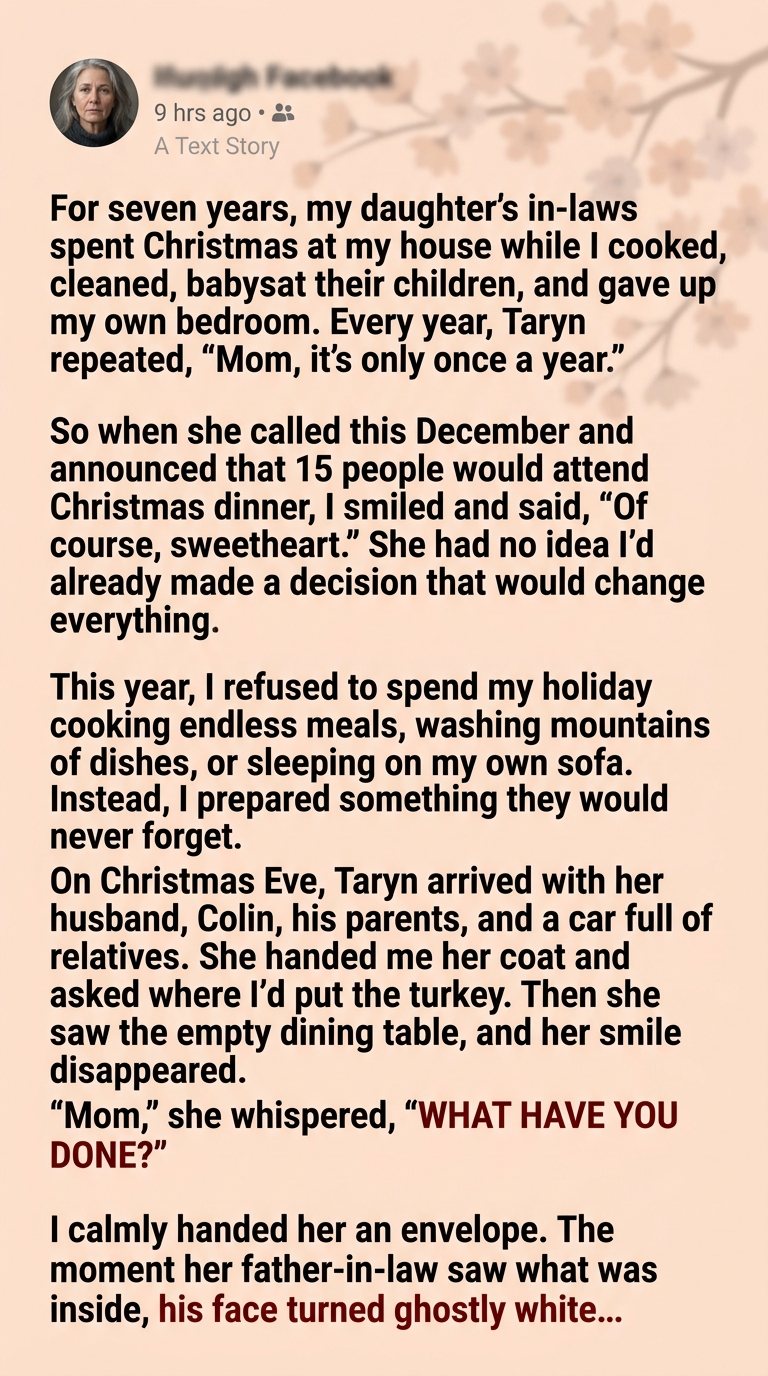
“Mom,” she whispered, “WHAT HAVE YOU DONE?”
I walked over to the desk, retrieved the envelope, and placed it in her hands.
“I’ve made a decision about Christmas.”
She opened the envelope with shaking fingers.
Colin leaned over her shoulder. His mother moved closer.
Richard stood beside the dining table, looking increasingly impatient.
“What is all this?” he demanded.
Taryn read the letter aloud, her voice becoming quieter with every sentence.
It explained that I would no longer host the annual Christmas dinner. I was happy to maintain a relationship with everyone, but I would no longer be expected to cook, clean, provide accommodation, or surrender my personal space simply because the family had developed a tradition around my labor.
It also stated that my home remained my own and that any future arrangements involving the property would be my decision alone.
When Taryn finished reading, the room fell silent.
Richard reached for the second document in the envelope.
His eyes moved across the page.
Then his face turned ghostly white.
“Where did you get this?” he asked.
I looked at him calmly.
“From my attorney.”
He stared at the document again.
It wasn’t a deed transferring the house to someone else. It wasn’t a surprise eviction notice. It was a letter confirming that I had reviewed my estate arrangements and that no one had been promised ownership of my property.
The letter also clarified that the house was not a family asset simply because relatives had spent holidays there.
Richard’s expression changed.
“You can’t just change everything without discussing it with the family!”
I raised my eyebrows.
“Discuss what, Richard? My own house?”
He opened his mouth, then closed it.
For years, he had spoken about my home as though it were already part of his family’s future. He had assumed that because I was older and widowed, I would eventually hand over control.
My attorney’s letter made one thing clear: I had made no such promise.
Taryn stared at me.
“Mom, you can’t do this to us on Christmas Eve.”
I felt a familiar ache in my chest, but this time I didn’t let guilt decide my answer.
“I didn’t do anything to you, sweetheart. I stopped doing everything for you.”
Her eyes filled with tears.
“But we’ve been coming here for seven years!”
“Yes,” I replied. “And for seven years, I’ve cooked, cleaned, babysat, and given up my bedroom. I thought I was sharing Christmas with my family. Somewhere along the way, you began treating it as something I owed you.”
“That’s not true,” she whispered.
“Then why didn’t you ask whether I wanted to host fifteen people this year?”
She looked away.
Colin placed the grocery bags on the kitchen counter.
“Maybe we should have talked about this earlier,” he said quietly.
I nodded.
“You’re right. We should have.”
Richard, however, was not ready to let it go.
“This is a family tradition,” he insisted. “You can’t simply end it because you’re tired.”
I looked directly at him.
“Traditions are supposed to bring people together. They aren’t supposed to turn one person into the household staff.”
No one spoke.
Then I said the words I had rehearsed for months.
“I love my daughter. I love my grandchildren. I have enjoyed many wonderful Christmases with all of you. But I am no longer willing to sacrifice my health, my rest, and my happiness to maintain a tradition that everyone else enjoys at my expense.”
Taryn began to cry.
“Why didn’t you tell me you felt this way?”
I almost laughed, but there was no humor left in me.
“I did. Every year, I told you I was tired. I told you I needed help. And every year, you said it was only once a year.”
She covered her mouth.
For the first time, she seemed to remember those conversations.
I walked to the kitchen and returned with a small card.
“I made a reservation at a restaurant for two tomorrow afternoon. Just you, Colin, the children, and me. If you’d like to come, I’d love to see you.”
Taryn looked at the card.
“What about everyone else?”
“They’ll need to make their own plans.”
Richard shook his head in disbelief.
“You expect us to find somewhere to eat on Christmas Eve?”
“I expect adults to make arrangements when the person who usually hosts tells them she won’t be hosting.”
That was the moment the room truly changed.
For years, I had been the person who fixed everything. If someone forgot a gift, I found one. If a child spilled juice, I cleaned it. If dinner was late, I apologized. If an argument began, I changed the subject.
Everyone had grown accustomed to me absorbing the inconvenience.
This time, I let the inconvenience remain where it belonged.
Colin quietly suggested that they find a nearby restaurant still accepting reservations. His mother began searching on her phone. Richard complained under his breath, but eventually followed them toward the door.
Taryn stayed behind.
She stood in my living room, holding her coat.
“Are you really going to let us leave like this?”
I walked over and hugged her.
“I’m not making you leave, sweetheart. I’m simply not serving dinner tonight.”
She cried against my shoulder.
I held her for a moment, because she was still my daughter and I still loved her.
But when she stepped back, I didn’t offer to cook.
I didn’t promise to change my mind.
And I didn’t apologize.
They eventually left to find dinner elsewhere.
When the front door closed, my house became quiet.
I walked into the kitchen, made myself a cup of tea, and sat beside the window.
For the first time in seven years, there were no dirty dishes waiting for me.
No turkey to carve.
No guest demanding another blanket.
No bedroom I had to surrender.
I looked at the clock.
It was only five-thirty.
I had the entire evening ahead of me.
I heated a bowl of soup, wrapped myself in the blanket Robert had given me on our twentieth anniversary, and watched an old Christmas movie.
At one point, I began to cry.
Not because I regretted my decision, but because I realized how long I had been waiting for someone to notice that I was tired.
I had waited for Taryn to offer help.
I had waited for Colin to say I deserved a rest.
I had waited for Richard to acknowledge the work I did.
But the person who needed to change something was me.
I had to stop making it so easy for everyone to overlook my needs.
The next morning, Taryn arrived at my door alone.
She wasn’t carrying a coat to hand me or a list of instructions.
She was holding a small gift bag.
“Can I come in?” she asked.
I stepped aside.
We sat together in the living room. She placed the gift bag on the coffee table and wiped her eyes.
“I didn’t understand how much I was asking of you,” she said. “I thought because you always did it, you wanted to.”
“I wanted to spend Christmas with you,” I told her. “I didn’t want to spend Christmas working for everyone.”
She nodded.
“I’m sorry, Mom.”
I looked at her for a long moment.
“Thank you for saying that.”
She reached for my hand.
“I don’t want you to feel like that again.”
“Then things have to change. If we host a family gathering in the future, everyone will help plan it, pay their share where appropriate, and clean up afterward. And I won’t be giving up my bedroom.”
Taryn gave a small, embarrassed laugh through her tears.
“Fair enough.”
We went to the restaurant that afternoon with Colin and the children. It wasn’t the enormous Christmas feast our family had enjoyed in previous years, but the meal was warm and pleasant. The children told stories, Colin helped the youngest with a stubborn packet of crackers, and Taryn kept asking whether I was comfortable.
For once, I was able to enjoy my own holiday.
Over the following months, things changed gradually.
Taryn began calling simply to ask how I was doing, not to arrange a gathering. When she visited, she brought food and helped wash the dishes. Colin apologized for taking my hospitality for granted.
Richard never offered a heartfelt apology, but he stopped making assumptions about my home.
I didn’t change my estate plan because of his reaction. My attorney had helped me make those decisions based on my own wishes, and I kept them that way.
The following December, Taryn called again.
“Mom, we’re thinking about having a small Christmas dinner. Would you like to come?”
I smiled.
“I’d love to.”
“Colin and I will cook. The children want to help decorate. And we’re booking a place for everyone to stay so you won’t have to give up your bedroom.”
I looked around my quiet house, where Robert’s photograph still stood on the mantel.
“That sounds wonderful, sweetheart.”
And it was.
The next Christmas was not perfect. Someone burned a tray of vegetables, one of the children spilled juice, and the dessert arrived later than expected.
But I wasn’t responsible for fixing everything.
I sat at the table with my family, laughing at the stories, eating the food, and enjoying the evening.
For the first time in years, I was a guest in the best possible sense: someone who was welcome, respected, and free to enjoy the holiday.
And I finally understood that the envelope I had handed Taryn on Christmas Eve hadn’t destroyed our family tradition.
It had given us a chance to build a better one.
Because love should never require you to disappear so everyone else can be comfortable. Sometimes, the greatest gift you can give your family is the courage to say, “I love you—but this year, things will be different.”