My Husband Divorced Me Six Days After We Won $2.4 Million—But He Forgot One Crucial Detail
For nineteen years, I played the same lottery numbers every Friday.
My name is Patricia Dunn, but everyone calls me Patty. I was fifty-six years old, married to Gary for twenty-three years, and the mother of two grown children. We weren’t wealthy. Gary worked in sales, and I worked part-time at a local bakery while managing most of the household responsibilities.
Every Friday afternoon, I stopped at the same convenience store on my way home from work and bought one lottery ticket.
The numbers were special to me.
They represented our children’s birthdays, the date Gary and I married, and the day my mother died. I had chosen them after she passed away, during a time when I needed something small to look forward to.
I never spent more than I could afford on a single ticket, although Gary acted as though I was throwing away our entire paycheck.
“Buying that ticket again?” he’d sneer whenever he noticed the little slip of paper in my purse.
“It’s only a few dollars, Gary.”
“A few dollars every week adds up, Patty. You might as well throw our grocery money in the toilet.”
I would smile weakly and put the ticket away.
What Gary never understood was that the lottery had never been about becoming rich. It was a tiny ritual that reminded me of the people I loved and the life we’d built together.
At least, that’s what I believed our life was.
Looking back, I can see that our marriage had been deteriorating for years.
Gary had become increasingly critical. He complained about the meals I cooked, the clothes I wore, and the way I spent my time. He’d started sleeping in the guest room, claiming my snoring disturbed him. When our children visited, he talked over me and made jokes at my expense.
I kept telling myself that every marriage had difficult seasons.
I thought we’d grow old together.
Then came the Saturday morning that changed everything.
I was standing in the kitchen, pouring coffee, when I checked the lottery numbers on my phone.
At first, I thought I was reading them incorrectly.
I checked again.
Then I grabbed my purse, pulled out Friday’s ticket, and compared every number.
My hands began to shake.
Every single number matched.
I sat down so suddenly that the chair scraped against the floor.
The prize was $2.4 million.
I stared at the screen, then at the ticket, then back at the screen. I called the lottery’s official verification line and followed the instructions to confirm that the drawing information was correct.
It was real.
After nineteen years, my numbers had finally won.
I began crying.
Not because of the money alone, but because I imagined what it could mean. Our mortgage could be paid off. Our children could have help with their futures. We could finally stop worrying about every unexpected bill.
I imagined telling Gary and watching his face soften when he realized that something I’d believed in for nineteen years had finally come true.
He walked into the kitchen while I was still holding the ticket.
“What’s wrong with you?” he asked.
I looked up, laughing and crying at the same time.
“Gary, we won.”
He frowned.
“What are you talking about?”
“The lottery. Our numbers. We won $2.4 million!”
He snatched my phone, checked the results, and then grabbed the ticket from my hand.
For a moment, he looked stunned.
Then he smiled.
It was the first genuine smile I’d seen on his face in months.
“Well, I’ll be damned,” he said.
He pulled me into a brief hug, but his attention was already on the ticket.
“We need to get this claimed immediately.”
“We should call a lawyer first,” I suggested. “We need to understand the taxes and how the payout works.”
He waved his hand dismissively.
“I’ll handle it.”
Something about his tone unsettled me, but I pushed the feeling aside.
That afternoon, Gary began making phone calls. He researched the lottery’s claim procedures and talked about the house we’d buy, the car he’d purchase, and the trips he’d take.
He spoke as though the money already belonged entirely to him.
I reminded him that we’d won together.
He laughed.
“Don’t start, Patty. It’s our ticket. We’ll figure it out.”
For the first time, I noticed that he never said we when describing what he planned to do with the money.
Still, I wanted to believe the windfall would bring us closer.
I was wrong.
Six days after the winning numbers were announced, Gary came home carrying a thick envelope.
He placed it on the kitchen table.
“We need to talk,” he said.
I looked at the envelope.
“What is it?”
“Divorce papers.”
For several seconds, I couldn’t understand the words.
“What?”
“I’ve spoken with an attorney. I’m filing for divorce.”
My stomach dropped.
“Gary, why? We just won the lottery. We were going to start over.”
He gave me a cold, impatient look.
“Exactly. I’m not spending the rest of my life dragging this marriage around.”
I stared at the man I’d shared twenty-three years with.
“You waited until we won to tell me?”
He shrugged.
“The timing is unfortunate.”
“Unfortunate?”
He leaned forward.
“Listen carefully, Patty. The ticket is in my possession, and I’m handling the claim. You don’t have a job that pays much, you don’t understand investments, and you certainly don’t know how to manage $2.4 million. My lawyer will handle the divorce. You’ll get whatever you’re entitled to under the law, but don’t expect to walk away with half my money.”
“Half your money?” I whispered. “We won that money together.”
He laughed.
“Prove it.”
Then he picked up the winning ticket.
I reached for it instinctively, but he pulled it away.
“Don’t touch it.”
“Gary, that’s our ticket!”
“Not anymore.”
He walked toward the door.
Before leaving, he turned around and delivered the words that would haunt me for days.
“Half of nothing, Patty. You’ll never touch a penny.”
The door slammed behind him.
I stood in the kitchen, staring at the divorce papers.
Twenty-three years of marriage had apparently meant so little to him that he could discard me in less than a week after we became millionaires.
I sank into a chair and cried until my head hurt.
I thought about our children. I thought about the years I’d spent supporting Gary, the holidays I’d organized, the sacrifices I’d made, and the countless times I’d defended him when others said he treated me poorly.
And I wondered how long he’d been planning to leave.
The next morning, I contacted a family-law attorney of my own. She advised me not to sign anything, not to make assumptions about the ticket’s ownership, and not to rely on Gary’s claims about what I could or couldn’t receive.
She explained that lottery winnings and divorce rights depend on the applicable law and the specific circumstances. We would need to establish the facts before deciding what claims I could make.
I agreed to let her review everything.
But I was still terrified.
Gary had the ticket. He had already contacted the lottery office. He had an attorney. I had a stack of divorce papers and a nearly empty savings account.
I spent the next two days barely sleeping.
Then, on Wednesday morning, my phone rang.
The caller identified herself as Elaine, a senior representative at the lottery claims office.
“Mrs. Dunn,” she said carefully, “your husband is here to claim the prize. But there’s a serious problem with his ticket.”
I sat upright.
“What kind of problem?”
“I need you to come to our office immediately. Please bring identification. And, if possible, don’t tell your husband we called.”
My heart began pounding.
“Why? What’s happening?”
She paused.
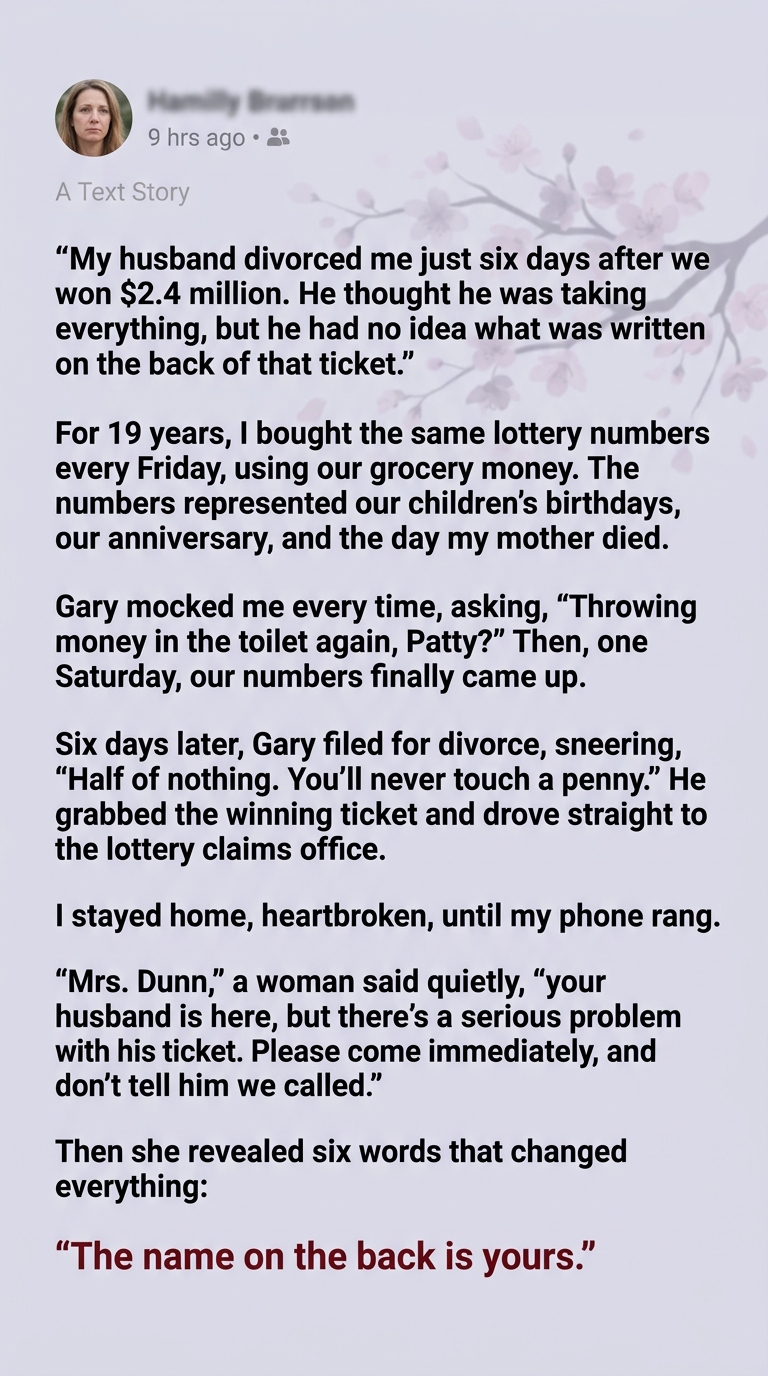
Then she said six words that changed everything.
“The name on the back is yours.”
I stopped breathing.
“What?”
“Mrs. Dunn, your name and signature are on the back of the original ticket. We need to clarify the circumstances of the claim before we can proceed.”
I gripped the edge of the table.
I remembered signing the ticket.
I always signed my lottery tickets as soon as I bought them. I’d started doing it years earlier after reading that a signature could help establish possession if a ticket were lost.
Gary had mocked me for that habit, too.
“Who do you think is going to steal your little lottery ticket, Patty? The president?”
But I’d continued signing every ticket.
Including the winning one.
“I’ll be there,” I whispered.
I called my attorney, told her what the lottery representative had said, and asked whether she could accompany me. She agreed to meet me at the claims office.
Then I drove across town with shaking hands.
When I entered the building, I saw Gary sitting in a private conference room. The winning ticket lay inside a clear protective sleeve on the table.
His lawyer was beside him.
Elaine greeted me and invited me to sit.
Gary turned sharply.
“What are you doing here?”
“The lottery office called me.”
His expression hardened.
“You had no right to come.”
Elaine calmly interrupted.
“Mr. Dunn, we asked Mrs. Dunn to attend because her signature appears on the back of the ticket. We need to establish the circumstances of its purchase and ownership before determining how the claim can proceed.”
Gary’s face went pale.
“That doesn’t mean anything,” he said quickly. “She’s my wife. We live together. The ticket was bought with household money.”
Elaine nodded.
“That may be relevant to the legal determination, but it doesn’t resolve the question by itself. We need to follow the claims process and any applicable requirements.”
My attorney placed a folder on the table.
Inside were copies of my bank statements, the lottery purchase records I’d kept, and photographs I’d taken of the ticket after the numbers were announced.
I had taken those photographs on Saturday morning, before Gary ever picked it up.
They showed the winning numbers, the ticket serial number, and my signature on the reverse.
Gary stared at the photographs.
“Where did you get those?”
“From my phone,” I answered quietly.
He looked at me with something close to hatred.
“You planned this.”
I shook my head.
“No, Gary. I bought a lottery ticket on Friday, just as I’d done for nineteen years. I signed it, just as I’d done for nineteen years. You were the one who decided that winning meant you could leave me with nothing.”
He opened his mouth, but no words came out.
Elaine explained that the lottery could not simply award the prize to whichever spouse demanded it. The office had to verify the ticket, review the claimant information, and follow its established procedures. Because ownership was disputed, the claim would be placed on hold pending legal review.
Gary exploded.
“This is ridiculous! I’m the one who brought the ticket here!”
“Mr. Dunn,” Elaine replied firmly, “presenting the ticket does not automatically resolve a disputed ownership claim.”
For the first time in days, I felt the ground beneath my feet.
Gary had assumed that possession alone would give him control.
He had forgotten that he hadn’t bought the ticket himself.
He had forgotten that I had signed it.
And he had forgotten that I had spent nineteen years purchasing those same numbers with my own money.
But the signature was not a magical guarantee that I would receive the entire prize. The legal ownership question still had to be resolved, particularly because Gary and I were married when the ticket was purchased and won.
What mattered was that he could no longer claim the ticket was unquestionably his alone.
For the first time, I had a chance to protect my rights.
The meeting ended without a payout.
Gary stormed out, muttering that he would sue everyone in the room.
My attorney and I remained behind to discuss the next steps.
We requested written confirmation that the claim was on hold, preserved the documents, and began preparing for the legal proceedings that would determine the status of the winnings.
It was a slow process.
There were no instant victories and no dramatic moment when a judge handed me a check for $2.4 million.
Instead, there were financial records, legal arguments, negotiations, and difficult conversations.
Gary’s attorney argued that the ticket had been purchased with marital funds and that the winnings should be treated as marital property. My attorney argued that Gary’s attempt to claim the entire prize while excluding me from the process was improper and that my ownership evidence needed to be considered.
The court would ultimately have to determine the applicable rights.
During those weeks, Gary continued to contact me.
At first, he was furious.
“You’ve ruined everything,” he shouted during one phone call.
I held the phone away from my ear.
“You filed for divorce, Gary.”
“I never said you couldn’t have something!”
“You said I’d never touch a penny.”
He fell silent.
Then he tried a different approach.
“Patty, we’ve been together for twenty-three years. We can work this out privately.”
I nearly laughed.
“Privately? You brought divorce papers to our kitchen six days after we won.”
“I was angry.”
“You were planning your future without me.”
He didn’t deny it.
I ended the call.
Months later, after reviewing the records and hearing both sides, the parties reached a court-approved settlement regarding the divorce and the disputed lottery proceeds. The agreement accounted for the applicable marital-property rules, the evidence surrounding the ticket, and the financial issues involved in ending the marriage.
The exact distribution was set out in the settlement documents, not in a dramatic announcement at the lottery office.
I received a substantial share of the winnings, enough to secure my future and rebuild my life without depending on Gary.
He did not walk away with everything.
And I did not have to spend the rest of my life wondering whether one signature could have saved me.
When the final documents were signed, I sat alone in my attorney’s office and cried.
Not because of the money.
Because I was finally free to stop begging a man to treat me with basic respect.
I bought a small, comfortable home with a sunny kitchen and a garden where I planted roses in memory of my mother. I set aside money for retirement and established a sensible investment plan with a qualified financial adviser.
I also helped our children with some of their expenses, carefully and without promising more than I could responsibly give.
Gary moved into a condominium across town.
I heard through mutual friends that he had expected the lottery money to make him feel powerful. Instead, the divorce and legal dispute consumed months of his life, and he discovered that money couldn’t erase the consequences of his choices.
He eventually sent me a letter.
He wrote that he was sorry for the way he’d handled the divorce and admitted that he had been more concerned with winning than with being fair.
I read it twice.
Then I placed it in a drawer.
I didn’t need to hate him, but I didn’t need to invite him back into my life, either.
One Friday afternoon, several months after the settlement, I stopped at the same convenience store where I’d bought my ticket for nineteen years.
The cashier recognized me.
“Still playing your numbers?” she asked with a smile.
I laughed.
“Not every week anymore.”
I bought one ticket.
Not because I expected to win again, but because the numbers still reminded me of my children, my anniversary, and my mother.
This time, I signed the back carefully.
Then I placed the ticket in my purse and walked out into the sunshine.
For years, Gary had mocked my little Friday ritual. He’d called it a waste of money and laughed at the numbers I’d chosen to remember the people I loved.
But when those numbers finally won, he revealed something far more valuable than his opinion of the lottery.
He revealed who he had become when he thought money gave him the power to discard me.
And I discovered who I could become when I stopped believing his threats.
The signature on the back of that ticket didn’t magically settle every legal question. It did something just as important: it preserved evidence that gave me a voice when Gary tried to take control of everything.
He thought the lottery had made him rich enough to leave me with nothing. Instead, the ticket he grabbed in triumph became the very thing that stopped him from writing me out of the story.
And for the first time in twenty-three years, the future belonged to me.