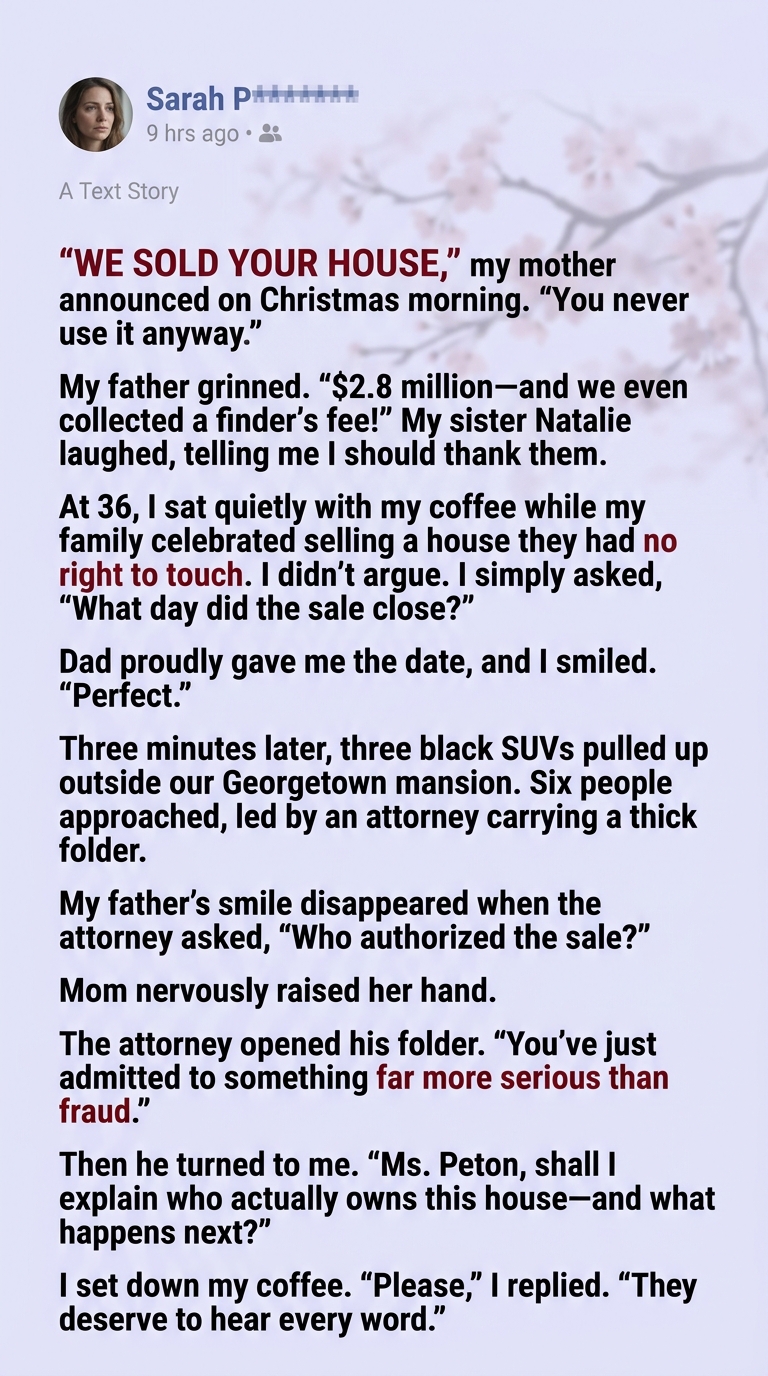
“WE SOLD YOUR HOUSE,” MY MOTHER ANNOUNCED ON CHRISTMAS MORNING. THREE MINUTES LATER, SIX PEOPLE ARRIVED TO EXPOSE EVERYTHING.
“We sold your house,” my mother announced on Christmas morning, reaching for another piece of cinnamon toast as if she had just told me she’d bought a new set of curtains.
“You never use it anyway.”
My father, Robert Peton, leaned back in his chair and grinned.
“Two-point-eight million dollars,” he said proudly. “And we even collected a finder’s fee!”
Across the table, my younger sister Natalie burst out laughing.
“You should thank them, honestly. That house was just sitting there. What were you going to do with it? Visit twice a year?”
I looked at the three of them.
My mother wore the pearl earrings I had given her for her sixtieth birthday. My father was drinking coffee from a mug I had bought him in London. Natalie had her feet tucked beneath her on the chair, scrolling through her phone and smiling at whatever congratulatory messages she was receiving.
They looked happy.
Triumphant, even.
And none of them seemed to understand that they had just confessed to something that could destroy their lives.
I was thirty-six years old. I had spent the previous twelve years building my own investment firm, working through weekends, missing birthdays, and turning down vacations while other people my age were learning how to relax.
The house they had supposedly sold was a historic Georgetown mansion I had purchased seven years earlier for $2.1 million.
I had spent another $400,000 restoring its original staircase, repairing the stone façade, and renovating the interior without destroying its character.
It was my home.
My property.
My investment.
And I had never authorized anyone to sell it.
I took a slow sip of coffee.
“What day did the sale close?” I asked.
My father’s grin widened.
“December eighteenth.”
“Interesting.”
“Why?” Natalie asked. “Are you upset we didn’t tell you sooner?”
I placed my cup on its saucer.
“No,” I said calmly. “I’m actually relieved.”
My mother frowned.
“Relieved about what?”
“That you told me the date.”
My father chuckled.
“Honestly, sweetheart, this is why you need us. You get so wrapped up in your business that you forget about real life. We handled everything.”
“Who handled the closing?”
“Your mother and I, obviously.”
“And who signed the deed?”
My father waved his hand dismissively.
“All the paperwork was taken care of.”
“By whom?”
His smile faltered for half a second.
Then Natalie intervened.
“Why are you interrogating them? They did you a favor. Besides, Dad said the buyer was thrilled. They paid quickly, and the commission was generous.”
I turned toward her.
“Commission?”
She froze.
My father shot her a warning look.
But the word had already escaped.
I leaned back in my chair.
“How generous?”
Nobody answered.
Then my father cleared his throat.
“That’s none of your concern.”
I nodded slowly.
“Of course.”
My mother’s expression hardened.
“Don’t start your usual drama, Claire. We are your parents. We have done everything for this family, and you act as though every dollar you earn makes you better than us.”
I almost laughed.
For years, I had been accused of being selfish whenever I refused to pay another bill, cover another debt, or rescue Natalie from another disastrous decision.
I had funded my parents’ mortgage payments during a difficult period. I had paid off Natalie’s student loans after she promised to finish her degree. I had even covered the legal expenses when my father’s small construction company nearly collapsed.
Every time I helped, they treated it as proof that they were entitled to more.
But selling my house without permission was something else entirely.
I glanced at the clock.
Three minutes had passed since my father had given me the closing date.
Right on schedule, a low engine rumble rose from the street outside.
My father looked toward the window.
“What on earth is that?”
Three black SUVs pulled up in front of the mansion.
The first parked beside the gate. The second stopped behind it. The third settled directly across the driveway.
Six people stepped out.
Four wore dark business suits. One carried a thick leather folder. The last was a woman in a charcoal coat who spoke briefly into her phone before joining the others.
My mother’s face drained of color.
“Claire,” she whispered, “who are those people?”
I stood and smoothed the front of my sweater.
“People who have been waiting for you to tell the truth.”
My father pushed back his chair.
“What does that mean?”
Before I could answer, the doorbell rang.
I walked to the entrance and opened the door.
A tall attorney with silver hair stood at the front, holding a leather folder against his chest.
“Ms. Peton?” he asked.
“Yes.”
“I’m Daniel Mercer. We spoke this morning.”
“Thank you for coming.”
His gaze shifted toward the dining room.
“Are your parents here?”
“They are.”
“Then I suggest we all sit down.”
I led him inside.
My father had risen to his feet. He was trying to look authoritative, but the sight of the attorney and the people behind him had unsettled him.
“Who are you?” he demanded.
Daniel placed his folder on the dining table.
“Daniel Mercer, counsel for Ms. Claire Peton and the registered owner of the property at 14 Hawthorne Place.”
My father frowned.
“We know who owns that property. We sold it.”
Daniel looked directly at him.
“That is precisely why I’m here.”
My mother gripped the edge of her chair.
Natalie slowly put down her phone.
Daniel opened the folder.
“Before we proceed, I want to establish one fact. Mr. and Mrs. Peton, did either of you have written authorization from your daughter to sell her property?”
My father lifted his chin.
“We’re her parents.”
“That was not my question.”
“We were acting on her behalf.”
“Do you have a valid power of attorney authorizing the transaction?”
Silence.
Daniel waited.
My mother finally spoke.
“We had documents.”
“What documents?”
“Some papers with her signature.”
Daniel’s expression changed.
“Where did you obtain those documents?”
My mother glanced at my father.
He stared at the attorney.
Then he said, “This is ridiculous. We are not answering questions without knowing what this is about.”
“That’s your choice,” Daniel replied. “But I strongly recommend that you understand the seriousness of the situation before making any further statements.”
He removed several pages from the folder.
“The property was purchased by Ms. Peton in 2019. The deed identifies her as the sole owner. No other individual has an ownership interest in the property.”
He placed the deed on the table.
“According to the records available to us, the purported sale was completed using documents that appear to have been submitted as authorization from Ms. Peton.”
My father swallowed.
Daniel continued.
“We have obtained copies of the recorded deed, the transaction file, the notary documentation, and the instructions provided to the settlement company. Several items raise serious questions about the legitimacy of the transaction.”
My mother shook her head.
“We didn’t do anything wrong. We were helping our daughter.”
Daniel looked at her.
“Then you should have no difficulty explaining who authorized you to sign her name.”
My mother’s eyes filled with tears.
“I didn’t sign her name.”
My father turned sharply toward her.
“Margaret!”
She flinched.
Daniel remained still.
“Mrs. Peton, did you participate in preparing or submitting documents that represented you had authority to sell your daughter’s property?”
My mother pressed her lips together.
“I only did what Robert told me.”
For the first time that morning, I felt something other than anger.
I felt disappointment.
Not because my mother had implicated my father.
Because she still seemed to believe that obeying him made her innocent.
Daniel closed one section of the folder and opened another.
“Mr. Peton, the settlement records indicate that you communicated directly with the buyer and represented that you had authority to act for the owner. Is that correct?”
My father said nothing.
“Did you receive any money from the transaction?”
He folded his arms.
“That money was compensation for arranging the sale.”
“Compensation from whom?”
“The buyer.”
“Under what written agreement?”
My father looked away.
Daniel turned a page.
“Was the payment disclosed to the owner?”
“No,” I answered.
Everyone looked at me.
I kept my voice level.
“I knew nothing about the sale until my mother announced it this morning.”
Daniel nodded.
“Thank you. That is consistent with the information we have reviewed.”
Natalie suddenly stood.
“This is insane! They were trying to help Claire. She has plenty of money. She won’t even notice two-point-eight million dollars missing from her accounts!”
I turned toward my sister.
“The house wasn’t an account, Natalie. It was my property.”
She rolled her eyes.
“Oh, please. You have three other properties. Why do you care so much about one house?”
“Because it belongs to me.”
“And family is supposed to help family!”
I held her gaze.
“Helping family means asking before making decisions about someone else’s property.”
She opened her mouth, then closed it.
Daniel gently pushed another document across the table.
“There is one additional issue we need to address.”
My father looked increasingly pale.
“What now?”
“The buyer’s payment instructions included a separate transfer to an entity associated with a family member.”
Natalie went completely still.
My mother turned toward her.
“What entity?”
Daniel did not immediately answer.
He checked the page before him.
“Northstar Property Advisory LLC.”
Natalie’s lips parted.
I watched her carefully.
For a moment, she looked less angry than frightened.
My father slammed his palm against the table.
“This has nothing to do with Natalie!”
Daniel raised his eyes.
“Then you should have no objection to explaining the payment.”
My father stared at him.
Daniel continued.
“The records show that the buyer transferred $2.8 million in connection with the transaction. A separate payment was also arranged. We are working to establish who ultimately received those funds and why.”
My mother began crying.
Natalie sank back into her chair.
I finally understood why my father had sounded so proud when he mentioned the finder’s fee.
He hadn’t merely sold my house.
He had arranged the transaction to benefit himself and someone else.
But I was not going to speculate about who had done what before the records were fully examined.
That was Daniel’s job.
And there was another reason I had remained calm.
The date.
December eighteenth.
It was the date my father had given me without hesitation.
And it was the date that confirmed the one thing I had suspected when I first heard about the sale.
The transaction had already been flagged.
THE REASON THE ATTORNEY ARRIVED
Three weeks before Christmas, I had received an automated notice from the title-monitoring service I used for my properties.
The notice concerned a change in the recorded ownership information for the Georgetown mansion.
At first, I assumed it was a routine data error.
Then I saw a reference to a pending transfer.
I contacted Daniel Mercer immediately.
He pulled the public records, requested the available transaction documents, and contacted the appropriate professionals to determine what had happened.
The evidence was troubling.
Someone had represented that they possessed authority to act for me.
Someone had supplied documents purporting to support that claim.
And someone had attempted to transfer ownership of my property without my consent.
Daniel advised me not to confront my family until we understood the situation.
He also advised me not to make accusations we could not yet prove.
So I waited.
I gathered my purchase records, the original closing documents, and the correspondence establishing that I had never granted my parents authority to sell the house.
The title company and its counsel began examining the transaction.
The appropriate authorities were notified, and the people involved were asked to preserve relevant records.
Then, on Christmas morning, my mother announced the sale over breakfast.
Her words confirmed that the transaction was not merely a clerical mistake.
My father knew about it.
My mother knew about it.
And they believed I would accept their explanation because they were my parents.
I had called Daniel as soon as my father gave me the closing date.
He told me his team was already nearby and could come over to discuss the situation in person.
That was why the SUVs had arrived three minutes later.
They were not there to frighten my family.
They were there because the situation had reached the point where the documents and the people involved needed to be addressed formally.
And because I was no longer willing to let my family control the story.
THE DOCUMENT THAT CHANGED EVERYTHING
Daniel turned to a section near the back of the folder.
“Ms. Peton, would you like me to explain the ownership records and the next steps?”
I looked at my parents.
My mother was wiping her eyes with a napkin.
My father had gone unnaturally quiet.
Natalie was staring at the name of the company printed on the page.
“Yes,” I said. “Please. They deserve to hear every word.”
Daniel removed a certified copy of the original deed.
“This property was purchased by Claire Peton using her own funds. She is the sole registered owner. We have found no valid instrument granting either parent the authority to sell it.”
He placed a second document beside the first.
“This is the recorded transfer associated with the purported sale. Its validity is now in question.”
My father shook his head.
“You can’t just cancel a sale because someone regrets it.”
“Correct,” Daniel replied. “That is not what we’re proposing.”
He explained that the legal process would depend on the evidence, the buyer’s position, and the applicable property laws.
The transfer could not simply be erased because I was unhappy.
But a transfer allegedly made without the owner’s authorization could be challenged through the appropriate legal procedures.
The parties would need to preserve evidence, notify the relevant institutions, and seek any necessary court orders.
The buyer would have to be considered, too.
If the buyer had acted in good faith, their rights and potential claims would need to be addressed through the legal process.
My father looked relieved for approximately two seconds.
Then Daniel added, “However, if the evidence establishes that material documents were knowingly falsified or that the transaction involved deliberate deception, the consequences could extend beyond a property dispute.”
My mother began sobbing harder.
“What consequences?”
“Potential civil liability and, depending on what the investigation establishes, possible criminal consequences. That determination belongs to the relevant authorities.”
Daniel turned to my father.
“You have the right to obtain independent legal advice. I strongly recommend that you do so before making any further statements.”
My father leaned forward.
“Claire, tell him to stop. We can settle this privately.”
I stared at him.
“Privately?”
“Yes. We’re family.”
“You sold my house without asking me.”
“We thought you’d understand.”
“You accepted money.”
“It was a business arrangement.”
“You represented that you had authority you did not have.”
His jaw tightened.
“We raised you!”
The words came out so loudly that everyone fell silent.
There it was.
The argument my father had used for as long as I could remember.
We raised you.
We fed you.
We paid for your childhood.
Therefore, you owe us.
Therefore, your success belongs to us.
Therefore, your boundaries are an insult.
I stood slowly.
“You raised me because I was your child. That was your responsibility, not a loan you could collect whenever you wanted.”
My father stared at me as if I had slapped him.
I continued.
“I have helped you financially for years. I helped with your mortgage. I helped with your business. I helped Natalie. I did those things because I loved you.”
I took a breath.
“But I never gave you permission to sell my home.”
My mother whispered, “We thought you wouldn’t mind.”
I looked at her.
“You didn’t ask because you knew I might say no.”
She had no answer.
And that silence told me more than any confession could.
THE BUYER’S PHONE CALL
Daniel’s phone vibrated.
He glanced at the screen and stepped into the adjoining room to take the call.
When he returned, his expression was serious.
“The buyer’s attorney has been contacted regarding the disputed transfer. They have agreed to preserve the transaction records and refrain from taking further steps involving the property while the parties address the legal issues.”
My father gripped the table.
“So the sale is canceled?”
“No,” Daniel said. “Not at this stage. The transaction is disputed. Its legal status must be resolved through the appropriate process.”
My father looked furious.
“Then what exactly are we doing here?”
“Establishing the facts, protecting our client’s interests, and ensuring that relevant evidence is preserved.”
He placed another sheet of paper on the table.
“This is a written request concerning the documents and communications associated with the sale. It is not a criminal verdict, and it does not establish guilt. It identifies materials that may be relevant to the dispute.”
My father refused to touch it.
Daniel did not push it toward him again.
Instead, he addressed my mother.
“Mrs. Peton, if you believe you were misled or pressured by another person, you should discuss that with your own attorney. You should not destroy documents, delete messages, or coordinate accounts of what happened.”
My mother looked at my father.
He glared back at her.
For the first time in my life, she seemed to understand that he could not protect her from the consequences of her own choices.
And he could not protect himself by blaming everyone else.
THE FINDER’S FEE
After Daniel finished explaining the next steps, he asked a question that changed the atmosphere in the room.
“Mr. Peton, you mentioned a finder’s fee. How much did you receive?”
My father looked at me.
“This is between me and the buyer.”
“If the payment is connected to the disputed transaction, it may be relevant to the investigation.”
My father rubbed his forehead.
“It was two hundred thousand dollars.”
My mother made a small choking sound.
“Robert, you told me it was fifty thousand!”
He spun toward her.
“Be quiet!”
She recoiled.
Natalie stared at him.
“You said there was only one payment.”
I felt the last remaining piece of my anger settle into something colder.
Two hundred thousand dollars.
My father had celebrated that amount at my Christmas table as though he had won a prize.
He had never stopped to consider what it meant to me.
He had never wondered whether I had plans for the house, whether I had memories attached to it, or whether I trusted him enough to let him near the property.
He had seen an opportunity.
And he had taken it.
Daniel made a note.
“We will need documentation concerning that payment. Please preserve any agreements, emails, bank records, and messages relating to it.”
My father looked toward the window.
For the first time that morning, he seemed unable to find an argument.
NATALIE’S SECRET
After Daniel and the other professionals had finished their initial discussion, my mother asked for a glass of water.
One of the visitors brought it to her.
My father remained seated, staring at the papers.
Natalie was the first to speak.
“Claire, I didn’t know they were going to sell the house.”
I looked at her.
“You mentioned the commission before anyone else did.”
“I knew Dad was arranging something.”
“What did you know?”
She rubbed her palms against her trousers.
“He told me he had a buyer. He said you weren’t using the property and that you had agreed to let him handle it.”
“Did you see my authorization?”
“No.”
“Did you ask me?”
She shook her head.
“Why not?”
Her eyes filled with tears.
“Because he promised to help me.”
I waited.
She finally confessed that she had been struggling with debt after a failed business venture.
My father had told her that the transaction would give the family enough money to help her start over.
He had also told her that she would receive a portion of the proceeds through Northstar Property Advisory LLC.
She claimed she had believed the arrangement was legitimate.
I listened without interrupting.
“Did you receive any money?” I asked.
She hesitated.
Then she admitted that a payment had been promised, although she had not yet received the amount she expected.
Daniel advised her not to speculate about the transaction and to discuss the matter with independent counsel.
She nodded.
I wanted to believe her.
She was my sister, after all.
But wanting to believe someone and having reason to trust them were two different things.
“Natalie,” I said quietly, “if you knew they were selling my property and you didn’t ask me, you made a choice.”
“I was desperate.”
“So was I, once. When I started my business, I nearly lost everything. I didn’t solve that problem by taking what belonged to someone else.”
She covered her face.
“I know.”
“No,” I said. “I don’t think you do. Not yet.”
I turned away before she could ask me to forgive her.
I wasn’t ready.
WHAT HAPPENED NEXT
The weeks that followed were neither as fast nor as dramatic as my family might have expected.
There was no single phone call that instantly restored my ownership.
No judge appeared out of nowhere to declare everyone guilty.
Real legal disputes are rarely resolved that way.
Instead, there were records to collect, documents to authenticate, interviews to arrange, and competing claims to evaluate.
Daniel coordinated with the appropriate professionals to challenge the transfer and protect my interests.
The title and settlement records were reviewed.
The buyer’s representatives supplied additional documents.
Financial records were examined to trace the proceeds and the alleged finder’s fee.
My parents were advised to obtain separate legal representation.
Natalie was also told to seek independent advice regarding her potential involvement.
I did not interfere with the investigation.
I did not contact the buyer to threaten them.
And I did not publish accusations online.
I wanted the truth established through evidence, not through another family argument.
Eventually, the records supported a challenge to the purported transfer.
The buyer agreed to cooperate in resolving the ownership dispute, subject to the legal protections and terms negotiated by the parties.
After further proceedings and formal documentation, the transaction was unwound, and the property was restored to my ownership.
The process cost me money, time, and months of emotional exhaustion.
But the house was mine again.
The financial inquiry continued separately.
The available evidence raised serious questions about the representations made during the sale and the payments connected to it. Those questions were referred to the appropriate authorities for further review.
I learned that the money my father had described as a finder’s fee had been routed through arrangements that were not disclosed to me.
The full purpose of those payments was investigated.
I refused to accept a private explanation in exchange for silence.
Whatever the outcome, I wanted the records to speak for themselves.
And I wanted my family to understand one thing:
I was no longer going to protect them from the consequences of choices they had made themselves.
THE CHRISTMAS THAT CHANGED OUR FAMILY
By the following Christmas, I was living in my Georgetown mansion again.
The staircase had been restored to its original condition. The old fireplace was working, and the windows looked out over the quiet street.
I hosted a small dinner for friends who had stood beside me during the legal battle.
There were no expensive gifts.
No dramatic speeches.
Just good food, honest conversations, and people who understood that love did not give anyone permission to cross a boundary.
My parents did not attend.
My father sent a short message saying he hoped I was happy with the damage I had caused the family.
I read it twice, then deleted it.
My mother sent a longer message.
She apologized for allowing my father to make decisions on her behalf and admitted that she had chosen not to ask questions because she wanted the money and feared confronting him.
Her apology was not perfect.
She still explained herself too much.
She still wanted me to understand how difficult things had been for her.
But for the first time, she acknowledged that what she had done was wrong.
I told her I needed time.
I didn’t promise that everything would return to normal.
Because it wouldn’t.
My relationship with Natalie changed, too.
We exchanged occasional messages, but I stopped lending her money and stopped treating her financial problems as my responsibility.
She eventually found work and began paying down her debts.
Whether she had genuinely changed or simply learned a painful lesson remained to be seen.
I decided I did not need to answer that question immediately.
As for my father, he continued to insist that he had acted in the family’s best interests.
He never fully accepted that his intentions did not erase his actions.
That was his choice.
I could not make him understand what he refused to acknowledge.
But I could decide what I would allow in my life.
THE LAST CONVERSATION
Several months later, my mother asked if she could visit.
I agreed to meet her at a small café near the waterfront rather than invite her into the house.
She arrived early, carrying a handbag and looking more tired than I remembered.
For a while, we spoke about ordinary things.
The weather.
Her garden.
A cousin’s upcoming wedding.
Then she folded her hands on the table.
“Your father says you have destroyed this family.”
I looked at her.
“Do you believe that?”
She stared into her coffee.
“I used to.”
“And now?”
She swallowed.
“Now I think we destroyed something ourselves.”
I said nothing.
She continued.
“When he told me about the sale, I knew you hadn’t agreed to it. I told myself you would understand afterward. I told myself the money would help everyone. I told myself it wasn’t really stealing because you had more than enough.”
Her voice broke.
“I kept changing the story until I could live with it.”
For the first time, I saw her take responsibility without immediately shifting the blame.
“I am sorry, Claire.”
I believed that she was sorry.
But an apology could not restore the trust we had lost overnight.
“I appreciate you saying that,” I replied. “But I can’t promise things will go back to the way they were.”
“I know.”
“And I won’t be giving anyone control over my property or finances again.”
She nodded.
“I understand.”
We sat quietly for a moment.
Then she asked, “Do you think you can ever forgive me?”
I watched the sunlight move across the café table.
“I think forgiveness is something I may choose over time,” I said. “But trust is something you have to rebuild.”
She wiped her eyes.
“I understand.”
This time, I believed she was beginning to.
We finished our coffee and said goodbye.
There was no embrace that magically repaired everything.
There was no promise that our family would become what it had been before.
There was only a small, honest conversation between two people who had finally stopped pretending that love made wrongdoing harmless.
And for that day, it was enough.
THE HOUSE WAS NEVER JUST A HOUSE
People sometimes ask why I fought so hard to get the mansion back.
They assume it was about the money.
Two-point-eight million dollars is a great deal of money, and I won’t pretend it didn’t matter.
But the house represented something far more personal.
I had purchased it after years of building a life that belonged to me.
Every repair, every renovation, every difficult financial decision had been made with care.
It was proof that I could create security for myself without relying on anyone else’s permission.
When my parents sold it, they weren’t simply transferring a property.
They were acting as though my achievements belonged to the family, as though my boundaries were optional, and as though I had no right to decide what happened to something I had worked for.
They expected me to protest.
They expected me to cry.
They expected me to negotiate.
Most of all, they expected me to forgive them because they were my parents.
Instead, I asked for the closing date.
And that small question changed everything.
I learned that being calm does not mean being weak.
That refusing to argue does not mean accepting what happened.
And that loving someone does not require protecting them from accountability.
My family had spent years teaching me that loyalty meant keeping the peace.
I finally understood that real loyalty cannot survive when only one person is expected to sacrifice.
The mansion still stands on its quiet Georgetown street.
In winter, the windows glow warmly against the dark, and the old staircase creaks when I walk upstairs.
Sometimes I remember that Christmas morning.
My mother’s announcement.
My father’s grin.
Natalie’s laughter.
The way they celebrated a decision they had no right to make.
Then I remember the moment the three black SUVs pulled up outside.
Not because I wanted revenge.
But because it was the moment I stopped believing that silence was the price of belonging.
I had spent years trying to prove that I was a good daughter and a generous sister.
That Christmas, I finally learned that I could be both loving and firm.
I could care about my family without surrendering my life to them.
And I could forgive someone someday without giving them another opportunity to hurt me.
The house was mine again.
But the greatest thing I reclaimed was not the property.
It was the right to say no—and know that I did not owe anyone an apology for it.