My In-Laws Called Me a “Walking Wallet”—So I Canceled Their Luxury Vacation
The moment I heard my mother-in-law raise her champagne glass and call me a “walking wallet,” something inside me finally went quiet.
We were in the lobby of an exclusive resort overlooking the ocean. My husband, Daniel, sat beside his brother, laughing with the rest of his family. Crystal glasses sparkled beneath the chandeliers, and the reception staff moved gracefully between guests dressed in designer clothes.
I had paid nearly $20,000 per room to give them the vacation they had dreamed about for years.
And now they were laughing at me.
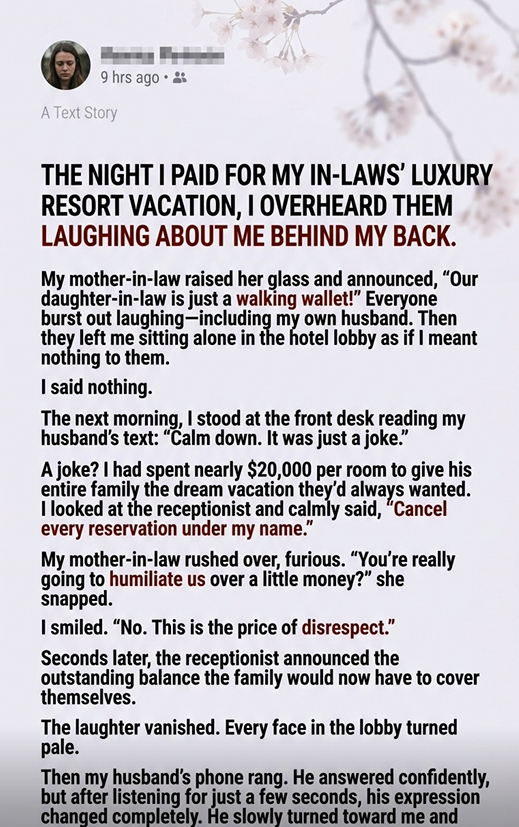
“Our daughter-in-law is just a walking wallet!” my mother-in-law, Patricia, announced.
The entire group burst into laughter.
I waited for Daniel to defend me.
He didn’t.
Instead, he lifted his glass and smiled as if his mother’s insult were the funniest thing he’d heard all evening.
Then they walked away together, leaving me sitting alone in the hotel lobby.
I said nothing.
Not because I wasn’t hurt, but because I suddenly understood something I had spent years refusing to admit: these people didn’t appreciate what I did for them. They had begun to believe they were entitled to it.
The next morning, I stood at the front desk with my phone in one hand and a cup of untouched coffee in the other.
Daniel had texted me.
“Calm down. It was just a joke. Don’t make this awkward for everyone.”
I read the message twice.
A joke?
I had worked overtime for months to afford the vacation. I had coordinated flights, selected rooms, arranged transportation, and handled the endless requests from his relatives. Patricia had insisted on ocean-view suites. Daniel’s brother wanted a private boat excursion. His sister requested a spa package that cost more than some people’s monthly rent.
I had agreed because I wanted everyone to enjoy themselves.
I had believed that generosity would bring us closer.
Instead, it had made me a target.
I looked at the receptionist.
“Please cancel every reservation under my name that hasn’t already been used.”
She paused.
“Every reservation, ma’am?”
“Yes. The rooms, the remaining excursions, and the additional services I’ve prepaid. Please explain any cancellation fees and refund terms before processing anything.”
She began reviewing the bookings.
A few charges were nonrefundable. Some services had already been provided. Other reservations could still be canceled, subject to the resort’s policies.
I understood that I might lose some money.
For the first time, that didn’t frighten me as much as the thought of continuing to pay people who openly mocked me.
Patricia came rushing across the lobby before the receptionist had finished.
“What are you doing?” she demanded.
I turned toward her.
“Canceling the arrangements I’ve been paying for.”
Her face flushed.
“You can’t do that! Everyone is here. The rooms are booked. The excursions are planned!”
“I know. I arranged them.”
She stared at me as if I’d suddenly started speaking another language.
“Are you really going to humiliate us over a little money?”
I gave her a small, tired smile.
“No, Patricia. I’m responding to the way you’ve treated me.”
She lowered her voice.
“You’re being childish. It was a joke.”
“Then you shouldn’t have any trouble understanding why I’m no longer paying for it.”
The receptionist quietly explained that the remaining charges would be recalculated according to the cancellation terms. Any outstanding balance for services already used or reservations that couldn’t be canceled would remain payable by the person or party responsible under the booking agreements.
Patricia looked toward the desk.
“Wait. What does that mean?”
“It means,” I said, “that anything I can no longer cancel will be handled according to the original payment arrangements. Anything you and the others choose to keep will need to be paid for.”
Her expression changed.
“But we don’t have that kind of money!”
I looked at her steadily.
“Then perhaps you should have treated the person paying for your vacation with a little more respect.”
Within minutes, the lobby had filled with angry relatives.
Daniel’s brother demanded to know who had canceled his boat excursion. His sister complained that the spa had removed her appointment. Patricia insisted that I was trying to destroy the family.
I didn’t argue with any of them.
I asked the receptionist for written confirmation of the canceled bookings and the remaining charges. Then I stepped away from the desk.
That was when Daniel’s phone rang.
He answered confidently.
“Yes, everything’s fine. We’re just having a small misunderstanding.”
He listened.
His smile slowly disappeared.
“What do you mean the payment arrangements have changed?”
He listened again, then looked at me.
“What have you done?”
I didn’t answer.
He ended the call and approached me, his face pale.
“Patricia’s room isn’t covered anymore. My brother’s excursion is canceled. The resort says there are charges we need to settle ourselves.”
“That’s correct.”
“You can’t just leave everyone stranded!”
“I haven’t left anyone stranded. The resort can explain the available options. You and your family can decide what you want to keep and pay for.”
Daniel stared at me.
“After everything we’ve planned?”
I felt the familiar urge to apologize, to smooth things over, to make sure nobody was uncomfortable.
But I resisted it.
“Daniel, last night your mother called me a walking wallet in front of everyone. You laughed with her. Then you texted me this morning and told me not to make things awkward.”
He looked away.
“I didn’t think you’d take it so seriously.”
“That’s the problem. You didn’t think about me at all.”
For once, he had no quick response.
I picked up my handbag.
“I’ve arranged my own room for tonight. I’ll be speaking with the resort about my remaining charges, and I’ll decide what I want to do next.”
Daniel reached for my arm, then stopped.
“Please. Don’t turn this into something bigger than it is.”
I looked at him.
“You already made it bigger when you decided my dignity was worth less than your family’s entertainment.”
Then I walked away.
That afternoon, I sat alone on the terrace of my room, watching the waves roll toward the shore.
I expected to feel triumphant.
Instead, I felt exhausted.
For years, I had confused being generous with being loved. I had paid for birthday dinners, covered unexpected bills, bought thoughtful gifts, and offered help before anyone even asked. Whenever Daniel’s relatives made an unreasonable demand, I told myself that keeping the peace was worth the cost.
But peace that required me to swallow every insult wasn’t peace.
It was silence purchased with my own money.
My phone buzzed repeatedly.
Patricia sent a message accusing me of embarrassing the family.
Daniel’s sister said I had ruined a once-in-a-lifetime vacation.
His brother demanded that I reinstate the boat trip.
I didn’t respond to any of them.
Instead, I called my sister, Rachel.
When she answered, I tried to explain what had happened, but my voice broke halfway through.
“Oh, sweetheart,” she said. “You don’t have to buy your place in that family.”
That sentence made me cry harder than Patricia’s insult had.
Because it was true.
The next morning, Daniel came to my room.
He looked as if he hadn’t slept.
“Can we talk?”
I let him sit down, but I remained standing near the window.
He rubbed his hands together.
“My family is furious. My mother says you owe everyone an apology.”
I stared at him.
“Do you believe that?”
He hesitated.
“I think you could have handled it differently.”
I nodded slowly.
“Of course you do. You’re still more concerned about how your family feels than about what they did.”
“That’s not fair.”
“Then tell me what you said to your mother after she called me a walking wallet.”
He opened his mouth.
Nothing came out.
“Tell me you asked her to apologize. Tell me you told your brother and sister that they were responsible for their own expenses. Tell me you defended me when they laughed.”
Daniel looked down at the carpet.
“I should have said something.”
“Yes. You should have.”
He finally looked up.
“I was embarrassed.”
“So was I. But I was the one being insulted, and you were the one laughing.”
His eyes filled with tears.
“I didn’t realize how much this hurt you.”
I took a breath.
“That’s because you were comfortable. You were enjoying the vacation, enjoying the attention, enjoying the fact that I had taken care of everything. You didn’t have to think about the cost, the planning, or how I felt. You only had to show up.”
He sat silently for a long time.
Then he asked, “What happens now?”
“I don’t know yet.”
I meant it.
I wasn’t going to promise that everything would be fine because he had finally become uncomfortable. I needed time to decide what our marriage could become if I stopped carrying all its responsibilities.
“I want us to speak with a counselor,” I said. “And I want to review our finances. No more paying for your family’s expenses out of our shared budget without an agreement. No more assuming I’ll organize everything. And no more telling me to accept disrespect because that’s how your family is.”
Daniel nodded.
“Okay.”
“And I need you to understand that an apology isn’t enough. I need to see you set boundaries, even when your mother gets angry.”
He swallowed.
“I understand.”
For the first time since the incident, I believed he might be listening.
But I also knew that the real test wouldn’t happen in my hotel room.
It would happen when Patricia called him again.
And she did.
That evening, she demanded that Daniel convince me to restore the remaining reservations. She said she had already told relatives how luxurious the vacation would be and couldn’t bear the embarrassment of explaining the changes.
Daniel listened quietly.
Then he said something I had never heard him say before.
“Mom, she doesn’t owe us this vacation. We were wrong to laugh at her. I was wrong, too. If we want to keep any of the reservations, we’ll have to pay for them ourselves.”
Patricia began shouting.
“You’re choosing your wife over your own mother!”
“No,” Daniel replied. “I’m asking you to treat my wife with respect. Those are not the same thing.”
He ended the call.
Then he turned toward me.
“I should have said that last night.”
“Yes,” I replied. “You should have.”
It wasn’t a magical resolution. His mother didn’t suddenly become kind, and our marriage wasn’t repaired by a single phone call.
But something had changed.
For the first time, Daniel had taken responsibility for his own choice instead of asking me to absorb the consequences.
Over the next several weeks, we began counseling. We reviewed our finances and established clear boundaries around gifts, loans, and family expenses. Daniel learned to say no without expecting me to be the villain. I learned that I could love someone without automatically solving every problem they brought into my life.
Patricia eventually sent a short message.
“I shouldn’t have called you that. I was angry about the vacation.”
It wasn’t the apology I would have chosen, but I accepted that it was a beginning. I didn’t immediately offer to pay for another trip or pretend everything was normal.
Respect would have to be demonstrated over time.
As for the vacation, the family paid for the reservations they chose to keep, while the resort processed the cancellations and any eligible refunds according to its policies. Some plans were abandoned. Others went ahead at a smaller scale.
They survived.
The family did not collapse because I stopped paying for everything.
And that was perhaps the most revealing part of all.
Months later, Daniel and I took a weekend trip together. It wasn’t extravagant. We chose a comfortable hotel, split the planning, and agreed on the budget before booking anything.
At dinner, he reached across the table and took my hand.
“I’ve been thinking about what happened,” he said. “I used to think being generous meant making sure everyone had what they wanted. I didn’t realize I was letting you pay for that with your money and your dignity.”
I looked at him.
“Being generous is a choice. It stops being generosity when people treat it as an entitlement.”
He nodded.
“I know that now.”
I hoped he did.
Because the lesson I learned on that expensive vacation had nothing to do with luxury resorts, champagne, or the price of a room.
It was about the price of disrespect.
I had spent years trying to earn a place in a family that measured my value by what I could provide.
That morning, I finally stopped paying admission.
And for the first time, I could afford something far more valuable than a five-star vacation.
My peace.