My Son Sold My House Without Telling Me—Then the Document He’d Forgotten Changed Everything
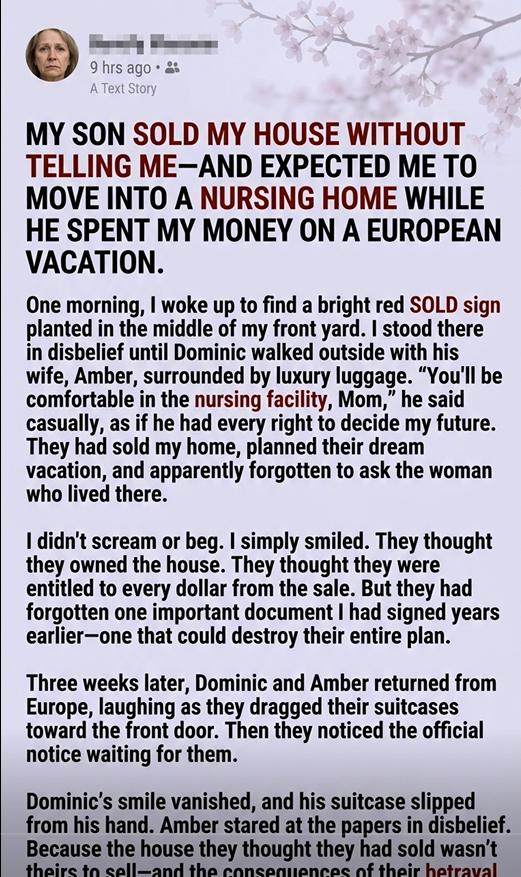
The first thing I saw that morning was a bright red SOLD sign planted in the middle of my front yard.
For several seconds, I stood on the porch, staring at it as if the letters might rearrange themselves into something less impossible.
My name is Margaret Ellis. I was seventy-one years old, and I had lived in that house for thirty-eight years. My late husband, Arthur, and I had raised our son, Dominic, there. We had painted the bedrooms, planted the roses, measured Dominic’s height against the kitchen doorframe, and spent countless evenings watching the sunset from the back porch.
After Arthur died, the house became more than a home.
It was the last place where I could still hear his laughter in my memory.
And now someone had sold it.
Before I could even reach for my phone, Dominic walked out of the house with his wife, Amber. Both were surrounded by expensive luggage. Amber wore oversized sunglasses, and Dominic carried a leather travel bag over his shoulder.
He looked remarkably relaxed for someone who had apparently sold his mother’s home without asking her.
“Good morning, Mom,” he said.
I pointed toward the sign.
“Dominic, what is that?”
He glanced at it as though I’d asked him about the weather.
“The house is sold. We closed the deal last week.”
My mouth went dry.
“You sold my house?”
“Our house needed to be handled eventually,” he replied. “You can’t maintain this place forever.”
“Our house?” I repeated. “Dominic, your father and I bought this house. I’ve lived here for thirty-eight years.”
Amber stepped forward, her voice sweet and rehearsed.
“We’ve already made arrangements for you, Margaret. You’ll be comfortable in the nursing facility. They have activities, meals, nurses—everything you need.”
I stared at her.
“A nursing facility?”
Dominic checked his watch.
“Mom, don’t make this difficult. The sale has gone through, and we have a flight to catch. We’re going to Europe for three weeks. You can settle into the facility while we’re away, and when we return, everything will be organized.”
He said it as if he were arranging a routine doctor’s appointment.
As if I were a problem that could be moved out of his way.
I looked from my son to his wife.
“Where is the money from the sale?”
Dominic’s expression hardened.
“We’ll discuss the finances later.”
“Later?”
“Mom, please. Don’t start.”
He walked toward the waiting car.
Amber followed, dragging her suitcase over the walkway Arthur had built with his own hands.
I watched them leave.
I didn’t scream.
I didn’t beg.
I didn’t chase the car down the driveway.
Instead, I walked back inside, sat at the kitchen table, and opened the drawer where I kept Arthur’s important papers.
For years, Dominic had believed that because I was getting older, I had become incapable of managing my own affairs. He had gradually taken over conversations with banks, insisted on helping with paperwork, and told relatives that I was becoming forgetful.
I had trusted him because he was my son.
But years earlier, after Arthur’s death, I had sought independent legal advice to make sure no one could force me out of the house or sell it without my consent.
I had signed a document that Dominic knew nothing about.
And that document was about to become very important.
I called my attorney, Helen Brooks.
When she answered, I kept my voice calm.
“Helen, it’s Margaret. I need you to look at something immediately. My son appears to have sold my house without my permission.”
Her tone changed at once.
“Are you safe?”
“Yes. I’m at home.”
“Good. Don’t sign anything, don’t agree to move anywhere, and don’t confront him until we’ve reviewed the records. I’ll come over this afternoon.”
I sat by the window, watching the red SOLD sign sway in the breeze.
Dominic believed he had taken control of my future.
He had forgotten that I had protected it years earlier.
And he had no idea what his European vacation was going to look like when he returned.
Helen arrived with a leather briefcase and a stack of documents.
I explained everything from the SOLD sign to Dominic’s announcement about the nursing facility. She listened without interrupting, then asked me to show her the papers I had signed after Arthur’s death.
I found the document tucked inside a blue folder.
Helen read it carefully.
Then she looked up.
“Margaret, this is exactly why we prepared this years ago.”
The document was a recorded deed establishing my lifetime right to occupy the property. Under its terms, I retained a life estate in the house, meaning I had the legal right to live there for the rest of my life. Dominic could not simply sell the property as though that right did not exist.
Helen checked the property records and contacted the title company involved in the sale.
Within hours, she discovered that the transaction had been presented as though the house could be transferred free of my interest. The title company had not been given the complete documentation concerning my recorded rights.
“Did Dominic know about this deed?” Helen asked.
“He knew I had signed papers after Arthur died. He said they were just estate-planning documents.”
“Then we’ll need to establish what he knew and what he represented to the people involved in this transaction.”
She contacted the closing attorney and formally notified the relevant parties of my recorded interest. She also advised me not to surrender possession of the house or agree to move into any facility.
The sale was now in dispute.
Helen was careful to explain that the document didn’t automatically erase every part of the transaction. The buyer’s rights, the title company’s responsibilities, and Dominic’s conduct would all need to be examined. But my lifetime occupancy rights could not simply be ignored because my son had decided I should leave.
For the first time that day, I felt I could breathe.
I wasn’t powerless.
I had only been treated as though I was.
Over the next three weeks, Helen worked with the closing attorney to preserve the records, clarify the title issues, and determine how the transaction could be resolved. I stayed in my home. I continued watering Arthur’s roses and making breakfast in the kitchen where I had raised Dominic.
I also learned something else.
The money from the sale had not been placed in an account for my future care, as Dominic had implied. Documents obtained through the legal process showed that he had arranged for a substantial portion of the proceeds to be directed toward accounts he controlled.
His plans included paying off personal debts and covering the European vacation he and Amber had already booked.
I didn’t know whether all the money could be recovered, but Helen made it clear that the transfers would have to be examined carefully.
“If he used money that wasn’t legally his to use,” she told me, “we’ll pursue the appropriate remedies. We won’t make assumptions, but we won’t ignore the evidence either.”
I nodded.
“That’s all I want. The truth.”
Meanwhile, Dominic sent me cheerful photographs from Europe.
There was one of him standing beside a blue convertible. Another showed Amber on a balcony overlooking the sea. In a third, they sat at an elegant restaurant with expensive wine between them.
He didn’t ask whether I had moved into the nursing facility.
He didn’t ask whether I had found somewhere to stay.
He simply sent a message:
Hope you’re settling in, Mom. Enjoy the change. We’ll talk when we get back.
I read it once, then handed my phone to Helen.
She saved the message with the other records.
“Don’t respond,” she advised. “Let the legal process speak for itself.”
So I did.
For three weeks, I remained in the home my husband and I had built together. I cooked my own meals, spoke with my neighbors, and slept in my own bedroom.
Every morning, I opened the curtains and looked out at the front yard.
The SOLD sign remained there for a while, a ridiculous red announcement planted in the soil beneath the roses Arthur had loved.
Eventually, the buyer’s representative arranged to remove it after receiving notice of the dispute.
I watched the sign being carried away.
I didn’t cheer.
I simply went back inside and made myself a cup of tea.
Three weeks later, Dominic and Amber returned from Europe.
I knew because my doorbell rang shortly after noon.
Through the window, I saw them approaching with their suitcases. Dominic was laughing at something Amber had said. He looked relaxed, tanned, and pleased with himself.
Then he noticed the empty patch of lawn where the SOLD sign had stood.
His smile faltered.
He tried the front door.
It opened because I had never left.
“Mom?” he called, stepping inside. “Why are you still here?”
I was sitting in the living room with Helen’s legal representative and a folder of documents on the coffee table.
Amber stopped in the doorway.
“What is all this?” she asked.
Dominic stared at the papers.
I stood.
“Welcome home.”
He glanced at the legal representative.
“Who is this?”
“My attorney’s representative. Helen has been handling the matter on my behalf.”
Dominic’s face tightened.
“Mom, what have you done?”
“What have I done?” I repeated. “You sold my house without my permission and told me I was going into a nursing facility.”
“We discussed this!”
“No. You announced it.”
He dropped his suitcase beside the sofa.
“The sale was completed. The money has already been allocated.”
“That is precisely the problem,” the representative replied. “The recorded deed establishing your mother’s lifetime occupancy rights was not properly addressed during the transaction. The buyer and title company have been formally notified, and the sale is now subject to legal resolution.”
Amber’s suitcase slipped from her hand.
“What does that mean?”
“It means the transaction cannot simply proceed as though Margaret has no rights to the property,” the representative explained. “The parties must resolve the title issues. There are also questions concerning the handling of the proceeds.”
Dominic turned toward me.
“You knew about this document?”
“Yes.”
“Why didn’t you tell me?”
I stared at him.
“Because you knew I lived here. You knew I had signed legal documents protecting my right to remain here. And you decided that my future was yours to arrange without even asking me.”
He opened his mouth, but no words came.
The representative slid a notice across the table.
It outlined the disputed transaction, the legal steps already taken, and the actions required to preserve the parties’ rights while the matter was resolved.
Dominic read it.
Then he read it again.
His face drained of color.
“The buyer is going to sue me,” he whispered.
“That is a possibility you need to discuss with your attorney,” the representative replied. “The outcome will depend on the evidence, the contracts, and the applicable law.”
Amber looked at Dominic.
“You told me everything was settled. You said the house was yours to sell.”
Dominic didn’t answer.
She picked up the notice and began reading it herself.
For the first time since I had known her, she seemed genuinely unsure of what to say.
Then she turned to my son.
“You told me your mother agreed to move.”
I watched him struggle to respond.
“I thought she’d understand eventually.”
“Understand what?” I asked. “That you sold the place where I live and planned to spend the proceeds on yourself?”
He looked at the floor.
I had spent years defending him when relatives criticized his selfishness. I had made excuses when he borrowed money and failed to repay it. I had ignored his growing impatience with my age and my independence because I believed that beneath everything, he still cared about me.
But standing there, watching him search for a way to make himself the victim, I finally understood that loving my son did not require me to excuse what he had done.
“Dominic,” I said quietly, “I didn’t want to fight you. I wanted to grow old in my own home. I wanted to know that the child I raised understood that I was still a person with rights, choices, and a life of my own.”
He looked up.
“Mom, I made a mistake.”
“You made a decision. Several decisions, actually. You sold the house, arranged for the proceeds to be used, and told me where I would live without asking what I wanted.”
His eyes filled with tears.
“I thought I was helping.”
“Then you should have asked me.”
Silence filled the room.
Amber sat down heavily on the sofa.
“What happens to the money?” she asked.
Helen had already explained the next steps to me. The funds would have to be traced, the disputed transfers reviewed, and any claims handled through the proper legal process. The buyer’s position also had to be resolved. No one could simply declare the sale void because I was upset, and I couldn’t promise that every dollar would be recovered.
But my recorded rights gave me a strong basis to challenge the way the property had been sold.
I looked at Dominic.
“That is for the lawyers and the courts to resolve. You will have to answer for your decisions.”
He wiped his face.
“Can we talk privately?”
I thought about it.
“Not today.”
He looked wounded, as though he had expected a mother’s forgiveness to erase everything the moment he asked for it.
“I’m not saying I’ll never speak to you again,” I continued. “But I won’t let you pressure me into settling this privately or surrendering my rights. Everything will be handled properly.”
He nodded slowly.
Over the following months, the dispute moved through the legal process. The buyer’s rights were negotiated through the attorneys, and the parties worked toward a resolution that accounted for my recorded lifetime interest. The handling of the sale proceeds was also examined, and Dominic was required to account for funds that had been directed toward expenses unrelated to my care.
The outcome wasn’t instant, and it wasn’t painless.
Dominic had to face financial consequences. He and Amber canceled some of their planned expenses and sold assets to help address the obligations arising from the transaction. The precise recovery and allocation of the money were determined through the settlement process, rather than by any dramatic announcement in my living room.
I remained in my house.
I continued to make my own decisions about my health, my finances, and my future. I met with my attorney to update my estate plan and ensure that the people I trusted—not simply the people related to me—would have clearly defined roles if I ever needed assistance.
I also made sure that my wishes were documented.
Because the most important lesson I had learned wasn’t that a clever document could defeat a selfish son.
It was that I should never have to rely on a last-minute legal discovery to make my own family respect my independence.
Several months later, Dominic came to visit.
He arrived alone, carrying a small box of photographs that had been stored in his garage. Inside were pictures of Arthur building the garden path, Dominic as a little boy holding a fishing rod, and our family standing in front of the house on Christmas morning.
He sat across from me at the kitchen table.
“I know I can’t undo what I did,” he said. “I was thinking about the money and what I wanted. I convinced myself that because you were getting older, I had the right to make decisions for you.”
I listened without interrupting.
“I was wrong,” he continued. “I’m sorry, Mom.”
I looked at the photographs.
I wanted to believe him. I wanted my son to become the man I had hoped he would be.
But I also knew that forgiveness was not the same as trust.
“Thank you for apologizing,” I said. “I love you, Dominic. But if we’re going to have a relationship, it has to be one where you respect my choices—even when you disagree with them.”
He nodded.
“I understand.”
This time, I didn’t promise him that everything would be fine.
We would have to rebuild our relationship slowly, through actions rather than words.
After he left, I carried the photographs into the living room and placed one of Arthur beside the window.
Then I stepped outside.
The roses were blooming again. The afternoon sun rested on the roof, and the wind moved gently through the trees.
For thirty-eight years, this house had been the setting for my life.
It was where I had loved, lost, raised a child, and learned how much a home could hold.
My son had thought he could turn it into money and send me somewhere else.
He had forgotten that I was not a piece of property to be transferred.
I was a woman who had built a life, made her own decisions, and deserved to remain in control of her future.
And as I stood in the garden Arthur had planted, I finally felt at peace.
Not because my son had been punished.
Not because I had won a fight.
But because I was still home.
And this time, nobody was going to decide my future without me.