My Brother Ignored Me for Five Years—Then I Found Dozens of Letters Locked Away in His Bedroom
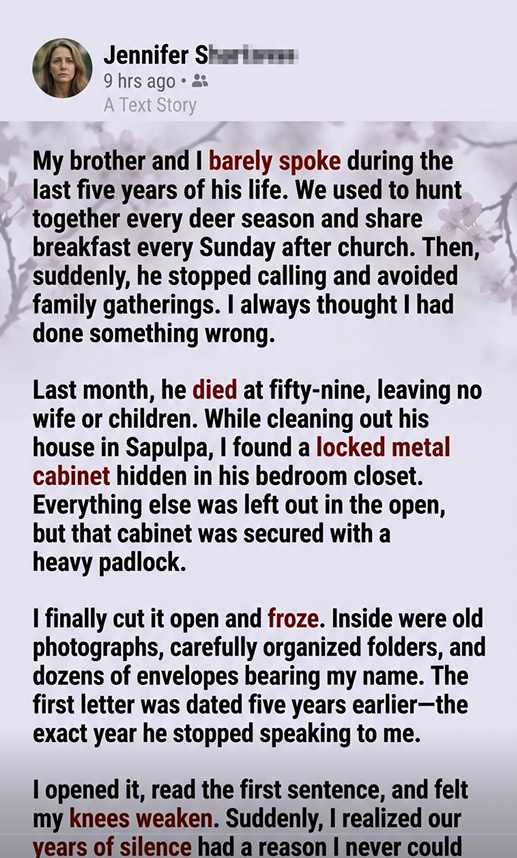
My brother and I barely spoke during the last five years of his life.
We used to be inseparable.
Every deer season, we hunted together in the woods outside Sapulpa, Oklahoma. Every Sunday after church, we shared breakfast at the same little diner, arguing about football, swapping stories, and laughing about things nobody else understood.
He was my younger brother, Daniel, and for most of our lives, he had been my best friend.
Then, without warning, everything changed.
He stopped calling.
He skipped family gatherings. When I showed up at his house, he sometimes wouldn’t answer the door. If we happened to meet at the grocery store, he would nod politely and walk away as though I were an acquaintance he barely recognized.
At first, I assumed he was busy.
Then I wondered whether he was depressed.
Eventually, I began searching my own memories for something I might have done to hurt him.
Had I offended him during our last hunting trip? Had I said something cruel without realizing it? Had I embarrassed him in front of someone?
I called him repeatedly.
I sent birthday cards.
I left voicemails telling him I missed him and wanted to talk.
He never answered.
The silence became so painful that I eventually stopped reaching out. I convinced myself that if Daniel wanted me in his life, he knew where to find me.
I was wrong about one thing.
I thought we had five years of unanswered questions.
I didn’t know he had spent those same five years writing me letters.
Last month, Daniel died at fifty-nine.
He had never married and had no children. He lived alone in the modest house where we had grown up visiting our grandparents, surrounded by old hunting equipment, fishing rods, and photographs from our childhood.
After the funeral, I volunteered to clean out his house.
I wanted to make sure his belongings went to people who would appreciate them. I packed his clothes, organized his tools, and wrapped his favorite coffee mug in newspaper.
His bedroom was the last room I cleaned.
Most of it was exactly as I remembered. His boots stood beside the closet. His hunting jacket hung behind the door. A stack of old magazines sat on his nightstand.
Then I noticed something unusual.
A narrow metal cabinet stood against the far wall, partially hidden behind an old dresser.
It had a heavy padlock.
I had never seen it before.
I tried the handle, but it wouldn’t budge.
Curiosity got the better of me. I eventually managed to open it, and when the door swung outward, I froze.
Inside were dozens of envelopes, neatly arranged in chronological order.
Every single one bore my name.
I pulled out the first envelope.
The date was five years earlier—the exact year Daniel had stopped speaking to me.
My hands began to tremble.
I opened it and unfolded the letter.
The first sentence read:
If you’re reading this, it means I never found the courage to tell you what really happened that afternoon in the woods.
I sat down on the bedroom floor.
What afternoon?
I read the letter again, then reached for the next envelope.
But before I opened another, I noticed a photograph tucked beneath the stack.
It showed Daniel and me standing beside our father’s old pickup truck. We were both teenagers, grinning at the camera, holding up a deer we had spent an entire morning tracking.
On the back, Daniel had written four words:
My brother. My hero.
I pressed the photograph against my chest.
For five years, I had believed my brother hated me.
Now I was beginning to suspect that something far more complicated had happened.
I opened the next letter.
And then the next.
By the time the sun began setting, I had read six of them.
Each one revealed a little more about the day our relationship changed.
And with every page, I realized that the truth had been sitting inside that locked cabinet all along.
The first letter explained what had happened five years earlier.
Daniel and I had gone hunting together, just as we had every deer season since we were boys. It had been a cold morning, and we had spent hours walking through the woods, talking about our father’s declining health and the changes happening in our family.
At one point, we argued.
It wasn’t unusual. We had disagreed about plenty of things over the years.
But this time, the argument had been different.
Daniel had been struggling financially. His small repair business had lost several major customers, and he had borrowed money from a friend to keep it running.
I had offered to help.
He had refused.
I remembered the conversation now. I had told him that there was no shame in accepting help from family.
He had snapped that he didn’t need me rescuing him.
I had responded with something I regretted almost immediately.
“Maybe if you’d listened to me years ago, you wouldn’t be in this mess.”
It was a cruel thing to say.
I had apologized before we left the woods that day, and Daniel had seemed to accept it. We drove home together, stopped for coffee, and said goodbye as usual.
I assumed the argument was over.
According to his letter, it wasn’t.
You probably don’t remember the phone call I received that evening, he wrote. I didn’t tell you about it because I was ashamed.
The next paragraph made my stomach tighten.
Daniel had received a call from a man named Robert, an old business partner who had accused him of mishandling money from their company.
The accusation was serious, and Daniel was frightened. He worried that people would assume the worst before he had a chance to explain himself.
Then he wrote something I hadn’t expected.
I remembered what you said in the woods. I convinced myself that you had always thought I was irresponsible, that you had spent your life looking down on me. I took your words and turned them into proof of something I was already afraid of.
I stared at the page.
That wasn’t the whole story, but it explained the beginning.
Daniel had been hurt, embarrassed, and frightened. Instead of telling me what was happening, he had decided that I didn’t respect him.
The second letter was dated three months later.
It described a family gathering I remembered well. I had arrived at our aunt’s house and asked where Daniel was.
Someone told me he was busy with work.
I had called him that evening, but he didn’t answer.
In his letter, Daniel explained that he had heard me ask about him. He had wanted to come, but he was ashamed of his financial troubles and worried that I would ask questions he couldn’t answer.
I know you would probably have helped me, he wrote. That’s what makes it worse. I didn’t want to be the little brother who always needed you.
I put the letter down and covered my face.
Daniel had always been proud.
When we were children, he would rather walk home with a broken bicycle than admit he needed help carrying it. As adults, he had built his entire identity around being independent.
I had mistaken his pride for stubbornness.
He had mistaken my concern for judgment.
And in the silence between us, both of us had allowed our assumptions to grow.
But the third letter revealed something that changed everything.
It was dated nearly a year after we stopped speaking.
I finally learned the truth about Robert’s accusation, Daniel wrote. The money wasn’t missing. The records had been entered incorrectly by the accountant, and the problem was eventually resolved.
I exhaled.
At least that part of his life had been settled.
But then I reached the next paragraph.
I wanted to call you that night. I picked up the phone three times. Every time, I imagined you asking why I had stayed away so long. I couldn’t bear the thought of explaining myself.
He had stayed silent because he was ashamed of being wrong.
Then he had become ashamed of the silence itself.
By the time he wanted to repair our relationship, he no longer knew how to begin.
I looked at the dates on the envelopes.
There were letters from the second year, the third year, the fourth year.
Dozens of them.
Some were only a few paragraphs long. Others filled several pages.
He had written about our childhood, our parents, the hunting trips we had taken together, and the Sunday breakfasts he still remembered.
In one letter, he described driving past the diner where we used to eat every week.
I almost stopped, he wrote. I saw your truck in the parking lot. I sat across the street for twenty minutes, trying to convince myself to walk inside.
He never did.
Another letter contained a photograph of the two of us standing beside our grandfather’s old barn.
I miss the days when we could argue about something stupid and be laughing again ten minutes later, he wrote.
I began to cry.
I had spent five years believing Daniel wanted nothing to do with me.
All that time, he had been missing me, too.
But the final envelope was different.
It was thicker than the others and had been sealed with clear tape. On the front, Daniel had written:
Open this last.
I sat for several minutes before I finally broke the seal.
Inside were several documents, a folded note, and a small digital recorder.
The documents concerned Daniel’s old business dispute. They showed that Robert’s accusation had been resolved years earlier, with the financial records corrected and the remaining disagreements settled.
There was no hidden crime, no secret fortune, and no dramatic betrayal by another family member.
The truth was more ordinary—and somehow more heartbreaking.
Daniel had built an entire wall between us because he was ashamed of needing help.
Then he had spent years believing that the wall was too high to climb.
I picked up the folded note.
I don’t know whether I’ll ever give you these letters, he wrote. Maybe I’ll find the courage one day. Maybe I’ll wait too long.
My hands shook.
I want you to know that I never stopped loving you. I was angry at first, but eventually I was mostly angry with myself. You were the one person who had always stood beside me, and I let one argument convince me that you didn’t respect me.
The next lines blurred through my tears.
I kept thinking that if I waited until I had everything figured out, I could call you and explain it all. But life doesn’t wait for us to become brave.
I pressed the note against my forehead.
Then I reached for the digital recorder.
It contained a single audio file.
I pressed play.
At first, there was a click and a little background noise.
Then Daniel’s voice filled the room.
It was older than I remembered, rougher and more tired, but unmistakably his.
“Hey, brother.”
I began crying immediately.
“I don’t know if you’ll ever hear this. I’ve recorded it three times, and I keep starting over because I don’t know how to say what I need to say.”
He paused.
“I was wrong about that argument. I know that now. You weren’t trying to humiliate me. You were trying to help, and I was too proud to accept it.”
A long silence followed.
Then he continued.
“I told myself I stopped talking to you because I needed space. That’s what I told everyone. But the truth is, I was afraid you’d see how much I’d messed up.”
I closed my eyes.
“I thought I could fix everything first, then come back and be your brother again. I didn’t understand that you weren’t asking me to be successful. You were just asking me to be there.”
His voice cracked.
“I miss you. I miss our breakfasts. I miss the hunting trips. I miss calling you when something funny happens and knowing you’ll understand why it’s funny.”
He took a shaky breath.
“I’m sorry I wasted so much time.”
The recording ended.
I sat on the floor until the room grew dark.
For five years, I had wanted an explanation.
I had imagined that if Daniel ever told me why he had left, I might finally understand what I had done wrong.
But the truth was that neither of us had been entirely wrong or entirely right.
I had spoken carelessly during an argument.
He had interpreted my words through his own shame.
I had apologized, but I hadn’t understood how deeply the moment had wounded him.
He had wanted to reconnect, but pride and fear kept him from taking the first step.
We had both waited for the other person to make things right.
And time had passed while we waited.
The following morning, I took the letters home.
I placed them on my kitchen table and read them again, slowly, from beginning to end.
Then I called our aunt and asked whether she remembered Daniel talking about me during those years.
She was quiet for a moment.
“He asked about you more than you know,” she finally said. “He always wanted to know whether you were doing well. But whenever I suggested he call you, he would say he wasn’t ready.”
“Why didn’t anyone tell me?”
“I thought you knew he was stubborn,” she replied gently. “I didn’t realize you thought he had stopped loving you.”
I sat quietly after the call ended.
That afternoon, I returned to Daniel’s house and stood in the bedroom where I had found the locked cabinet.
I had already packed most of his belongings, but I left the cabinet open.
I couldn’t bear the thought of locking those letters away again.
Before leaving, I placed the photograph of us beside his favorite chair.
On the back, beneath the words My brother. My hero, I wrote a sentence of my own.
You never had to be perfect to be loved.
I don’t know whether Daniel would have called me if he had lived another year.
I don’t know whether we would have repaired our relationship, gone hunting again, or sat across from each other at our old diner, laughing about the five years we had lost.
Those moments are gone now.
But I no longer believe my brother spent those years forgetting me.
He remembered everything.
He remembered our childhood, our arguments, our shared meals, and the promises we had made when we were young.
He remembered me so much that he filled a locked cabinet with letters he was too frightened to send.
And perhaps that is the part I will carry with me for the rest of my life.
We had loved each other for decades.
Then pride, shame, and a few misunderstood words kept us apart for five years.
I cannot change that ending.
But I can change what I do with the truth.
I can stop waiting for perfect words before reaching out to the people I love.
I can apologize without demanding that someone else apologize first.
And when someone I care about becomes distant, I can ask what is wrong instead of assuming I already know the answer.
Because life doesn’t wait for us to become brave.
And sometimes, the letter we keep meaning to send becomes the letter someone finds after we’re gone.
My brother left me dozens of letters because he couldn’t bring himself to make one phone call. I wish he had known that all I ever wanted was my brother back.