My Daughter Was Humiliated at Her Mother-in-Law’s Funeral—Then She Opened the Envelope
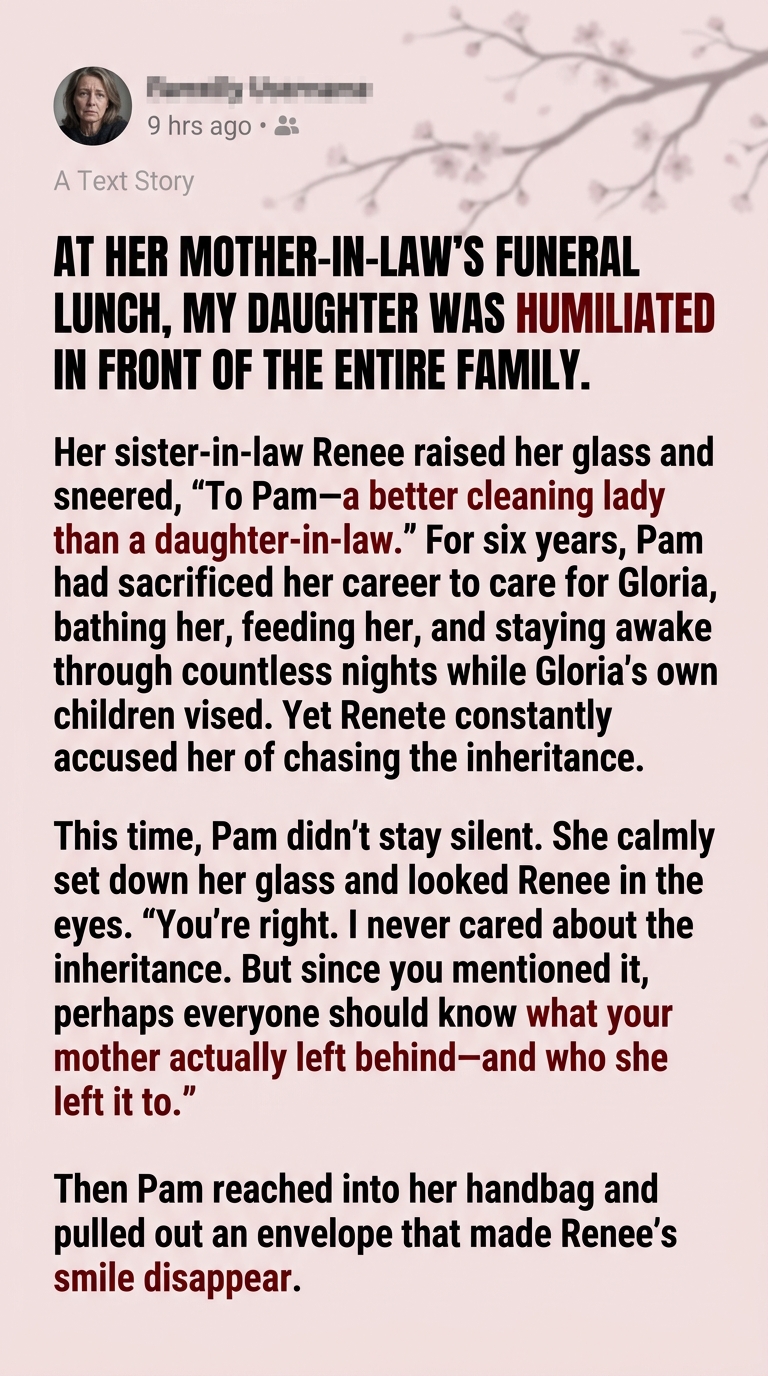
At her mother-in-law’s funeral lunch, my daughter was humiliated in front of the entire family.
Renee, her sister-in-law, raised her glass and sneered:
“To Pam—a better cleaning lady than a daughter-in-law!”
Several relatives laughed.
Pam didn’t.
She simply lowered her eyes and placed her fork beside her plate.
I sat across the room, watching my daughter swallow another insult from a woman who had spent six years making her life miserable.
For six years, Pam had sacrificed her career to care for Gloria, her husband’s mother.
She had bathed her, prepared her meals, managed her medications, changed her bedding, and stayed awake through countless nights when Gloria couldn’t sleep.
When Gloria suffered a fall, Pam was the one who rushed her to the hospital.
When she developed mobility problems, Pam learned how to help her move safely around the house.
When Gloria became frightened at night, Pam sat beside her until she fell asleep.
Her own children, Renee and Michael, barely visited.
Renee usually arrived with expensive gifts, stayed long enough to take a photograph, and left before dinner.
Yet she constantly accused Pam of chasing the inheritance.
“You’re only doing all this because you think Mom will leave you something,” she often said.
Pam never argued.
She simply continued caring for Gloria.
But that afternoon, at the funeral lunch, something changed.
Renee had just finished making her toast when Pam calmly set down her glass.
“You’re right,” she said.
Renee smiled.
Pam continued.
“I never cared about the inheritance. But since you mentioned it, perhaps everyone should know what your mother actually left behind—and who she left it to.”
Then Pam reached into her handbag and pulled out an envelope.
Renee’s smile disappeared.
The room became completely silent.
Michael leaned forward.
“Pam, what are you talking about?”
Pam placed the envelope on the table.
“This was given to me by your mother’s attorney three days before she died.”
Renee immediately shook her head.
“That’s impossible. Mom’s will was already handled. We discussed everything months ago.”
Pam looked at her.
“Apparently, you discussed what you wanted to believe.”
Renee reached for the envelope, but Pam kept her hand on it.
“Before anyone opens this, I want everyone to understand something. I didn’t ask Gloria for money. I didn’t ask her to change her will. And I certainly didn’t spend six years caring for her because I expected to inherit anything.”
She paused.
“Your mother knew that.”
Then she opened the envelope.
Inside was a letter written in Gloria’s unmistakable handwriting, along with a copy of a legally prepared estate document.
Pam unfolded the letter.
“Gloria asked me to read this if anyone questioned why she made her final decisions.”
Renee folded her arms.
“Go ahead. Let’s hear it.”
Pam began reading.
To my children,
If you are hearing this, I am no longer here to explain myself.
I know some of you believe Pam cared for me because she wanted something in return.
That belief has hurt me more than you will ever understand.
For six years, Pam was the person who showed up. Not because she was obligated by blood, but because she loved someone who needed help.
I remember the nights she slept in the chair beside my bed. I remember her holding my hand when I was afraid. I remember asking her to go home and hearing her say, “I’m not tired yet, Gloria.”
I also remember the empty chairs at my medical appointments.
I remember the birthdays when I waited for phone calls that never came.
I remember being told everyone was too busy.
Pam’s voice trembled slightly.
She paused before continuing.
I am not leaving my estate according to who has the loudest opinion about what they deserve. I am leaving it according to my wishes and the decisions I made while I was fully capable of making them.
Renee interrupted.
“That’s enough. We don’t need to hear some emotional letter.”
Pam looked up.
“Your mother wanted everyone to hear it.”
The attorney’s document was a properly executed amendment to Gloria’s estate plan.
It had been signed several months earlier, witnessed, and prepared after Gloria received independent legal advice.
The document explained that Gloria had made specific arrangements for her remaining assets.
The family home was to be sold, with the proceeds divided between her children according to the terms of the estate.
Her savings and investments were also allocated through the will.
But there was one additional provision.
A separate account had been established to reimburse Pam for documented expenses she had personally paid while caring for Gloria.
The amount was $38,400.
Renee immediately stood up.
“Thirty-eight thousand dollars? For what? She lived in our mother’s house!”
Pam remained calm.
“That money isn’t a prize. It’s reimbursement for expenses I paid from my own savings. Medication, transportation, medical supplies, groceries, and other costs that weren’t covered.”
Michael looked confused.
“Why didn’t you tell us?”
Pam opened another folder.
“Because every time I asked for help, I was told Mom’s care was my responsibility since I was already there.”
Renee scoffed.
“You’re making it sound like we abandoned her.”
Pam looked directly at her.
“You visited eleven times in six years. I kept the calendar.”
Renee’s face reddened.
“That’s not true!”
Pam placed a small notebook on the table.
It contained dates of medical appointments, hospital visits, medication schedules, and records of the times family members had visited.
Michael slowly opened it.
He turned several pages.
Then he stopped.
There were months with no visits recorded from either sibling.
Not one.
But the envelope contained something else.
A second letter.
This one was addressed specifically to Renee.
Pam hesitated before opening it.
“Gloria asked me to give you this personally.”
Renee crossed her arms.
“I don’t want anything from her.”
Pam placed the letter in front of her anyway.
“Then you don’t have to read it.”
For several seconds, Renee stared at the handwriting.
Finally, she picked it up.
The letter was short.
My dear Renee,
I know you believe Pam has taken something from you.
But I want you to understand that she gave me something you cannot put a price on.
She gave me her time when I was lonely.
She gave me patience when I was difficult.
She gave me dignity when I could no longer do things for myself.
You told me once that she was only a cleaning lady.
I wish you had understood that caring for someone is never a small job.
I don’t expect you to agree with every decision I have made. But I hope one day you understand why I made them.
Love, Mom.
Renee lowered the letter.
Her expression had changed.
For the first time that afternoon, she had nothing to say.
Michael picked up the estate document.
“So the house is still being divided between us?”
Pam nodded.
“According to the will, yes. The reimbursement is separate. Everything is being handled through the attorney.”
Renee looked up.
“Then why did you bring this here? Were you trying to embarrass me?”
Pam took a breath.
“No. You embarrassed yourself. I brought the documents because you publicly accused me of caring for your mother only for money. I wanted everyone to know the truth.”
Renee shook her head.
“Mom shouldn’t have done this.”
Pam replied quietly:
“She didn’t do it to punish you. She did it because she had the right to decide what happened to her own belongings.”
Michael looked at his sister.
“Maybe we should stop.”
Renee turned toward him.
“You’re taking her side?”
“I’m taking Mom’s side. She made her wishes clear.”
For once, nobody laughed.
After lunch, Pam and I walked outside together.
She was holding the envelope against her chest.
I touched her shoulder.
“You didn’t have to read all that.”
She shook her head.
“Yes, I did.”
We stood beside the parking lot for a moment.
Then she began crying.
Not loudly.
Just the quiet tears of someone who had held everything inside for far too long.
“I never wanted them to think I was doing it for money,” she whispered.
I hugged her.
“I know, sweetheart.”
She wiped her eyes.
“Sometimes I wondered whether I was foolish for giving up so much of my life.”
I looked at her.
“You gave Gloria comfort when she needed it. That wasn’t foolish.”
Pam nodded.
Then she told me something I hadn’t known.
During Gloria’s final weeks, Gloria had asked her to sit beside her and hold her hand.
She had whispered:
“Pam, I know I can’t repay you for everything. But I don’t want you leaving this house believing your kindness meant nothing.”
Pam had promised she wouldn’t.
And now, after the funeral, she finally understood what Gloria had meant.
The following weeks were difficult.
The estate went through the usual legal process. The attorney verified the will, confirmed the reimbursement records, and arranged for the property and financial assets to be handled according to Gloria’s documented wishes.
Renee initially threatened to challenge the arrangements.
But the attorney provided the execution records and confirmed that Gloria had received independent legal advice.
There was no evidence that Pam had pressured her.
Eventually, Renee stopped making threats.
Michael later called Pam and apologized for not helping more during his mother’s final years.
Pam accepted the apology, although she didn’t pretend the past hadn’t happened.
She also made a decision about the reimbursement.
After recovering the documented expenses, she used part of the money to repay a loan she had taken out during Gloria’s illness.
The remainder went into savings.
She didn’t buy a new car.
She didn’t take an expensive vacation.
Instead, she began rebuilding the career she had paused six years earlier.
She had once worked as a nursing administrator, and after Gloria’s death, she started applying for positions again.
A few months later, she received an offer.
On her first day, she called me.
“Mom, I got the job.”
I could hear the happiness in her voice.
“I’m so proud of you.”
She laughed.
“Gloria would have been proud too.”
I knew she was right.
Nearly a year after the funeral, Pam received a handwritten card from Michael.
It contained only a few lines.
I should have been there more. I should have helped you. I didn’t understand what Mom was going through until it was too late. Thank you for being there when I wasn’t.
Pam placed the card beside Gloria’s photograph.
She never received an apology from Renee.
And eventually, she stopped waiting for one.
At family gatherings, Renee was more careful with her words. She never again called Pam a cleaning lady.
But Pam didn’t need Renee’s approval anymore.
One evening, I visited her apartment and noticed Gloria’s old photograph sitting on a shelf.
“Do you miss her?” I asked.
Pam smiled sadly.
“Every day.”
Then she added:
“But I don’t regret a single day I spent with her.”
I looked at my daughter and understood something.
Gloria’s greatest gift hadn’t been the money.
It was the written acknowledgment that Pam’s years of care had mattered.
The inheritance had settled the financial questions.
But the letter had restored something money couldn’t buy.
Her dignity.
Renee raised a glass to humiliate the woman who cared for her mother. She never expected Gloria’s final words to remind the entire family who had truly been there.