My Husband Left a Shoebox With Our Neighbor—What I Found Inside Changed Everything
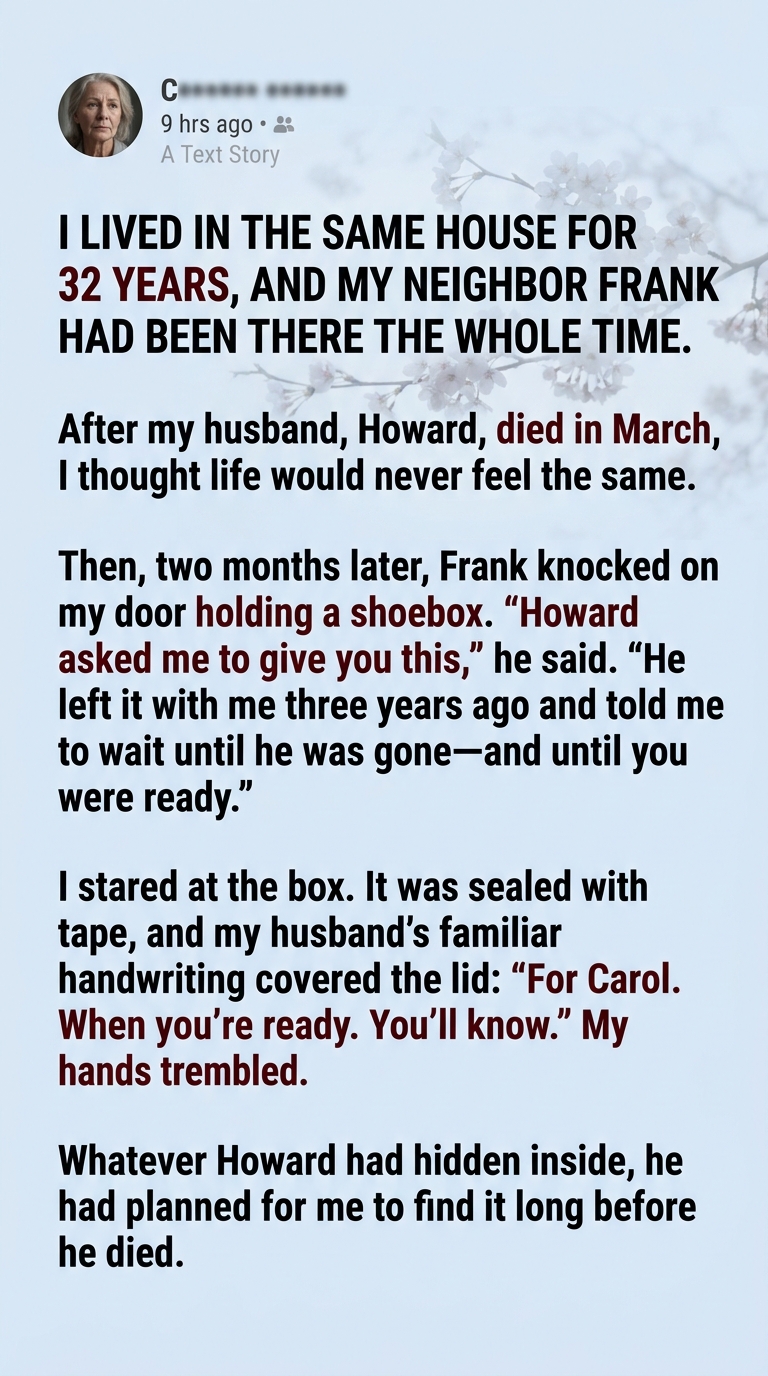
I lived in the same house for thirty-two years, and my neighbor Frank had been there almost as long.
After my husband, Howard, died in March, I thought life would never feel the same.
The house was too quiet. His coffee mug still sat beside the kitchen sink. His reading glasses remained on the nightstand, and his favorite chair faced the television as if he might return any minute.
I couldn’t bring myself to change anything.
Then, two months after the funeral, Frank knocked on my door.
He was holding a small shoebox.
“Carol, Howard asked me to give you this.”
I stared at it.
“He did?”
Frank nodded.
“He left it with me three years ago and told me to wait until he was gone—and until you were ready.”
My hands trembled.
The box was sealed with tape, and my husband’s familiar handwriting covered the lid:
FOR CAROL. WHEN YOU’RE READY. YOU’LL KNOW.
I invited Frank inside.
He placed the box on the kitchen table, the same table where Howard and I had eaten breakfast for decades.
“Did he tell you what was inside?”
Frank shook his head.
“He told me it was something important. He also made me promise not to give it to you while he was alive.”
I ran my fingers over Howard’s handwriting.
Then I carefully cut the tape.
Inside were three envelopes, an old photograph, a small brass key, and a folded piece of paper.
The photograph showed Howard standing beside Frank in front of a little wooden building I had never seen before.
On the back, Howard had written:
The place where everything began.
I opened the first envelope.
It contained a letter.
My dearest Carol,
If you’re reading this, I’ve probably left you with more questions than answers.
I know you spent the last few years worrying about me. I also know there are things I never told you because I wanted to handle them before they became your burden.
Please don’t be angry. I wasn’t trying to keep secrets from you forever. I was trying to leave you something that would make your life easier when I was no longer beside you.
I stopped reading.
My eyes filled with tears.
What had Howard been planning?
I opened the second envelope.
Inside was a bank statement and a document showing regular deposits into an account I had never heard of.
The account had been opened thirty-one years earlier.
The first deposit was only $200.
But the most recent statement showed a balance of $184,700.
I stared at the number.
“Frank, do you know anything about this?”
He shook his head.
“Howard never discussed the details with me.”
I turned to the third envelope.
It contained a handwritten note with a name and an address.
The address belonged to an old property on the other side of town.
I recognized the street.
Thirty-two years earlier, before Howard and I bought our house, he had worked at a small woodworking shop there.
He used to tell me stories about that place.
He had always loved building furniture, but after we married, he took a steady office job because we needed reliable income.
I had assumed the shop was sold years ago.
Then I noticed the brass key.
A small paper tag was attached to it.
UNIT 17.
I looked at Frank.
“Do you know what this opens?”
He nodded slowly.
“I think it’s time you visited the place.”
The next morning, Frank drove me to the address.
The old building was still standing, although the paint had faded and the windows needed cleaning.
A sign above the entrance read:
RIVER STREET WORKSHOPS.
I remembered it immediately.
Howard had once told me that he and Frank used to spend their weekends there repairing furniture and building cabinets.
Inside, the building had been divided into small storage and workshop units.
We walked down a narrow hallway until we reached Unit 17.
The brass key fit perfectly.
When I opened the door, I stopped.
The room was filled with furniture.
A beautiful oak dining table stood in the center. Against one wall were handcrafted cabinets, wooden chairs, and several small boxes with delicate carvings.
Every piece was made by hand.
And every piece carried Howard’s initials underneath.
I touched the dining table.
I recognized the design.
It was almost identical to the table Howard had once promised to build for our anniversary.
He had never finished it.
Or so I thought.
Frank watched me quietly.
“Howard came here every Saturday for years,” he said. “Sometimes I’d help him. Sometimes he’d work alone.”
I looked around.
“Why didn’t he tell me?”
Frank smiled sadly.
“He wanted to surprise you. But there was another reason.”
He walked toward a workbench and opened a drawer.
Inside was a notebook.
The cover was worn, and the pages were filled with measurements, sketches, and handwritten calculations.
On the first page, Howard had written:
Carol’s future.
I opened it.
The notebook explained everything.
Thirty-one years earlier, Howard had purchased the workshop unit with money he had saved before our marriage.
He had never told me because he considered it his personal hobby space.
Over the years, he had built furniture and occasionally sold pieces to collectors.
At first, he made very little.
But one of his dining tables had attracted the attention of a local antique dealer.
The dealer began buying his work regularly.
Howard kept most of the money in a separate savings account.
He didn’t spend it on himself.
Instead, he used it to purchase better equipment, materials, and eventually additional workshop space.
The business had grown slowly.
Not into a huge company, but into a successful little woodworking operation with a loyal group of customers.
The $184,700 in the bank account represented years of savings and business income.
The workshop itself was also valuable.
But that wasn’t the biggest surprise.
I turned another page.
There was a list of people.
Several were names I recognized from our neighborhood.
One was Frank.
Another was a young man named Daniel, whose father had once struggled to find work after losing his job.
Howard had quietly taught Daniel woodworking and helped him establish a small repair business.
There were also records showing that Howard had paid for tools and training for two other young people.
He had never told me.
I sat down on a wooden chair.
“Frank, how long have you known about all this?”
“About the workshop? Most of it. About the money he left for you? Only the last three years.”
I looked at him.
“Why did Howard wait so long to tell me?”
Frank took a breath.
“Because he wanted to make sure everything was properly arranged before you had to deal with it.”
Then Frank pointed toward a small wooden cabinet at the back of the workshop.
“There’s one more thing.”
I opened it.
Inside was a framed photograph of Howard and me on our wedding day.
I remembered that picture.
It had disappeared years earlier when we renovated the bedroom.
Beneath it was another envelope.
My name was written across the front.
I opened it.
Carol,
You once told me you wished we had taken more risks when we were younger.
You were right.
I spent too many years believing that providing for our family meant giving up everything I loved. But building things in this workshop reminded me that I was still allowed to dream.
I didn’t tell you because I wanted this to be something I could give you without asking you to worry about it.
The workshop is yours. The savings account is yours, subject to the documents I’ve arranged. And the people who work here know that the place must continue operating if you want it to.
But there’s something more important.
I want you to use this place for something that makes you happy.
You spent thirty-two years making our house a home. I spent those same years trying to build something that would remain after I was gone.
Now I want you to have the choice.
Love always, Howard.
I pressed the letter against my chest.
For several minutes, I couldn’t speak.
Howard hadn’t been hiding another family or a secret life.
He had been quietly building something he hoped would give me security and purpose after he was gone.
But there was one more page in the notebook.
At the bottom, he had written:
If Carol doesn’t want to run the workshop, Frank knows how to help her find someone trustworthy. Never let anyone pressure her into selling it.
I looked at Frank.
He nodded.
“He made me promise to help you understand your options. He didn’t want anyone taking advantage of you.”
I began to cry.
Even after death, Howard was still trying to protect me.
Over the following weeks, I met with Howard’s attorney and an accountant.
We reviewed the workshop’s ownership records, the savings account, and the business documents.
Everything had been arranged legally.
The property was transferred through the appropriate estate documents, and the financial account was handled according to the beneficiary arrangements Howard had established.
I also learned that the workshop had several regular customers who wanted to continue buying Howard’s furniture.
At first, I considered selling everything.
I was seventy years old. I had never run a woodworking business, and I didn’t know anything about managing employees.
But then Daniel, the young man Howard had helped years earlier, came to see me.
“Mrs. Carol, your husband gave me a chance when nobody else would,” he said. “I’d be happy to help keep the workshop going.”
He explained that he now had his own repair business and could manage the daily operations.
I thought about Howard’s letter.
Use this place for something that makes you happy.
So I made a decision.
I kept the workshop.
Daniel agreed to manage the business, and we established a small program where young people could learn woodworking skills.
We also set aside a corner of the building as a memorial to Howard.
His tools remained on the original workbench.
His sketches stayed in their folders.
And the unfinished dining table was finally completed.
Six months later, Frank and I stood inside the workshop during its reopening.
Several neighbors came.
Daniel brought his family.
A few former customers arrived with photographs of furniture Howard had made for them years earlier.
I stood beside the oak table and looked around the room.
Then Frank handed me a small wooden plaque.
It read:
HOWARD’S WORKSHOP — BUILT WITH PATIENCE, LEFT WITH LOVE.
I couldn’t hold back my tears.
Frank put a hand on my shoulder.
“He knew you’d keep it alive.”
I smiled.
“I wish he could see it.”
Frank looked around.
“I think he’d be proud.”
That evening, I returned home and placed the shoebox on the kitchen table.
The same table where I had first opened it.
I carefully folded Howard’s letters and returned them to the box.
Then I noticed something I hadn’t seen before.
At the very bottom, beneath the lining, was a tiny folded piece of paper.
It was one final note.
Only two sentences.
Carol, if you ever feel lonely, go to the workshop. You’ll find pieces of me in every corner.
And remember, my love was never something I left behind. It is something you get to carry forward.
I sat there until the sun disappeared.
For months, I had thought losing Howard meant losing the life we had built together.
But he had left me more than money, property, or furniture.
He had left me a reason to get out of bed in the morning.
A place filled with memories.
And proof that even when someone is gone, the love they leave behind can continue creating something beautiful.
I thought Frank had brought me a box of old memories. Instead, my husband had left me the keys to a future he had spent thirty years quietly building.