My Brother Stole $400 From Our 88-Year-Old Mother Every Month—Then the Bank Teller Revealed Something Worse
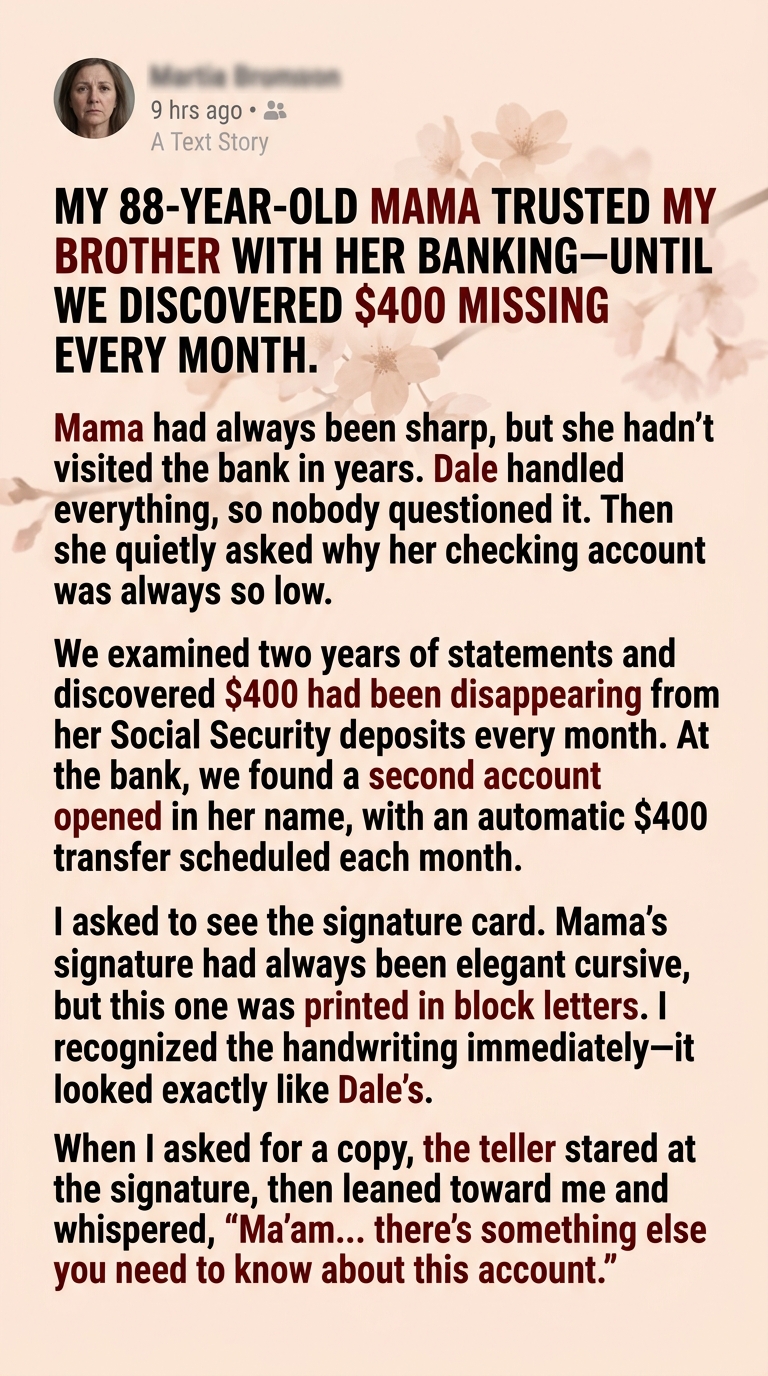
My 88-year-old mama trusted my brother Dale with her banking—until we discovered $400 missing every month.
Mama had always been sharp.
She still remembered everyone’s birthdays, knew exactly how much her groceries cost, and could tell you the date of every important family event.
But she hadn’t visited the bank in years.
Dale handled everything.
He paid her bills, checked her deposits, and took care of whatever paperwork needed signing.
Nobody questioned it.
After all, he was her son.
Then one afternoon, Mama called me.
“Sweetheart, can you come over? I think something’s wrong with my money.”
When I arrived, she was sitting at her kitchen table with her bank statement.
“Your brother says everything is expensive,” she explained. “But I don’t understand why my checking account is always so low.”
I looked through the statements.
Her Social Security deposits arrived every month.
But immediately afterward, a $400 transfer appeared.
Month after month.
For two years.
Twenty-four transfers.
A total of $9,600.
I felt sick.
“Mama, do you know where this money goes?”
She shook her head.
“Dale said he was keeping some aside for emergencies.”
I looked at her.
“Did you agree to that?”
She hesitated.
“I don’t remember signing anything.”
The next morning, we went to the bank.
The teller reviewed the account history and discovered a second account opened in Mama’s name.
Every month, an automatic $400 transfer moved money from her checking account into that account.
I asked to see the signature card.
The teller brought out a scanned copy.
Mama’s signature had always been elegant cursive, with a long sweeping line beneath her name.
But this signature was printed in block letters.
I recognized the handwriting immediately.
It looked exactly like Dale’s.
I asked for a copy.
The teller stared at the signature, then leaned toward me.
“Ma’am, there’s something else you need to know about this account.”
I felt my stomach tighten.
“What?”
She lowered her voice.
“The account isn’t just receiving the monthly transfers. Someone has been withdrawing money from it.”
I stared at her.
“How much?”
She turned the monitor slightly.
The account balance was almost zero.
But the transaction history showed repeated withdrawals.
Some were ATM withdrawals.
Others were transfers to an outside account.
The teller continued.
“There’s also a second person listed as an authorized signer.”
“Who?”
She hesitated.
Then she said:
“Your brother, Dale.”
I felt my hands go cold.
He hadn’t simply been putting Mama’s money aside.
He had access to the account receiving it.
But the teller wasn’t finished.
“There is another issue. This account was opened using a power of attorney document. The document on file gives your brother authority to manage certain financial matters.”
I stared at her.
“Mama never told me she signed a power of attorney.”
The teller looked toward my mother.
“Mrs. Wilson, do you remember signing this document?”
Mama studied the paper for a long time.
Then she shook her head.
“No. I remember Dale bringing me something to sign last year. He said it was about the insurance on the house.”
I looked at her.
“What did you sign?”
“I don’t know, sweetheart. He had several papers.”
The teller recommended that we speak with the bank’s fraud department immediately.
For the first time, I realized the missing $400 might be only one part of something much bigger.
We requested copies of the account-opening documents and the power of attorney.
The bank placed a temporary restriction on the suspicious account while its fraud department reviewed the activity.
We also contacted an attorney who specialized in elder financial exploitation.
Mama was upset.
Not because of the money.
Because of Dale.
“He’s my son,” she whispered on the drive home. “Why would he do this?”
I reached over and held her hand.
“I don’t know, Mama. But we’re going to find out.”
That evening, I called Dale.
I kept my voice calm.
“Did you open another bank account in Mama’s name?”
There was a long pause.
Then he laughed.
“What are you talking about?”
“The account receiving $400 every month.”
“Oh, that. It’s her emergency fund.”
“Then why are you withdrawing the money?”
His voice changed.
“Who told you that?”
“The bank.”
He became defensive.
“I’ve been handling her finances for years. You have no idea how much work it takes.”
“That doesn’t answer my question.”
He sighed.
“Look, I was going to explain everything.”
“When?”
“When the time was right.”
I stared at the phone.
“Dale, that’s nearly ten thousand dollars.”
“Don’t exaggerate. I was borrowing it.”
“Did Mama agree?”
Silence.
Then he said something that made my blood boil.
“She doesn’t need all that money anyway.”
I ended the call.
The following morning, our attorney contacted the bank’s fraud department.
We also arranged for Mama to speak privately with an investigator trained in elder financial exploitation.
She was asked simple questions about her banking arrangements, her understanding of the documents, and whether anyone had pressured her to sign anything.
Mama was clear about one thing.
She had never knowingly agreed to give Dale access to a separate account for his personal use.
The investigator requested records of the transfers and withdrawals.
Then we discovered another troubling detail.
The second account had been opened using an email address that didn’t belong to Mama.
It belonged to Dale.
The phone number associated with the account was also his.
And the mailing address was his home.
I looked at Mama.
“Did you ever receive statements for this account?”
She shook her head.
“No. Dale said everything came electronically.”
The bank confirmed that all account notifications had been sent to Dale’s email address.
Mama had never received them.
It was becoming clear that she had been kept unaware of the account’s actual activity.
A week later, the bank provided a detailed transaction report.
The $400 transfers had begun twenty-four months earlier.
The first few withdrawals were small.
Then they became regular.
Some money went toward Dale’s mortgage.
Other payments went to a credit card.
There were also transfers to an online account associated with his personal expenses.
The total missing amount was more than $9,600.
But the most disturbing discovery came when the attorney reviewed the power of attorney.
The document appeared to authorize Dale to manage Mama’s finances.
However, there were questions about whether Mama had understood the document when she signed it and whether the signature and witnessing process had been completed properly.
Mama remembered being given paperwork at the kitchen table.
She remembered Dale telling her it was necessary for insurance.
She did not remember anyone explaining that it gave him broad financial authority.
The attorney warned us that the document’s validity would need to be formally examined.
We didn’t make assumptions.
We gathered the evidence.
Two weeks later, Dale showed up at Mama’s house.
He walked straight into the kitchen.
“Mom, what is all this? The bank has frozen the account!”
Mama looked at him.
“Why were you taking my money?”
Dale threw his hands up.
“I wasn’t stealing anything. I was managing it!”
“You told me you were saving it.”
“I was going to put it back.”
Mama’s voice trembled.
“When?”
He didn’t answer.
I stepped forward.
“You used her money to pay your mortgage.”
Dale turned toward me.
“Stay out of this. You don’t know anything about what I’ve done for her.”
I kept my voice steady.
“We know what the statements show.”
He looked at Mama.
“Mom, tell her I had permission.”
Mama stared at him.
“I trusted you.”
Those four words seemed to stop him.
For several seconds, nobody moved.
Then Dale said:
“I needed help. I was behind on bills. I thought I could borrow it and replace it before anyone noticed.”
Mama’s eyes filled with tears.
“You let me worry every month about whether I could afford my medicine.”
Dale lowered his head.
I had never seen my mother look so disappointed.
The investigation continued.
The bank reviewed the account-opening process and preserved the relevant records.
The attorney helped Mama revoke any questionable financial authority and arrange new protections.
We also changed her account access, updated her contact information, and established that no one could move money without her direct authorization.
Dale was required to account for the missing funds.
The matter was referred to the appropriate authorities, who examined the suspected misuse of Mama’s identity and the financial documents.
The process took months.
Eventually, Dale agreed to a repayment arrangement as part of resolving the financial dispute.
He also lost his access to Mama’s accounts.
But the emotional damage was harder to repair.
Mama stopped asking him to handle her bills.
She learned how to check her balances with assistance from a trusted financial adviser.
I visited every week, not to take control of her money, but to make sure she understood what was happening.
She wanted to remain independent.
And I wanted her to have that independence.
One afternoon, several months later, Mama and I sat on her porch.
She was holding a cup of tea and watching birds gather near the garden.
“Do you think I was foolish?” she asked.
I looked at her.
“Why would you think that?”
“Because I trusted my own son.”
I took her hand.
“Trusting your family doesn’t make you foolish. Someone choosing to misuse that trust is responsible for their own actions.”
She looked down at her tea.
“I don’t know if I can ever look at Dale the same way.”
“You don’t have to decide that today.”
She nodded.
Then she smiled faintly.
“At least I know where my money is going now.”
I laughed softly.
For the first time in months, she seemed relieved.
A year later, Mama’s finances were stable.
The missing money had been addressed through the repayment arrangement, and her accounts were protected by safeguards she understood.
Dale eventually sent her a letter apologizing.
He admitted that he had used her money to cover personal expenses and had convinced himself he would replace it before she noticed.
Mama read the letter twice.
Then she placed it in a drawer.
She didn’t immediately forgive him.
But she didn’t ask me to hate him either.
“He’s still my son,” she said. “But he won’t handle my money again.”
I agreed.
One evening, as I helped her organize her paperwork, she handed me an old photograph.
It showed her standing with my brother and me when we were children.
“Look at those two,” she said, smiling.
I smiled too.
Then she looked at me.
“Promise me something.”
“Anything.”
“If I ever need help again, don’t let anyone make me feel like I have to give up being in charge of my own life.”
I squeezed her hand.
“I promise.”
And I meant it.
Because the real lesson wasn’t that we had discovered $9,600 missing from an elderly woman’s account.
It was that financial abuse doesn’t always begin with a stranger.
Sometimes it begins with someone who knows your birthday, remembers your favorite meal, and has been trusted with your house keys for decades.
My mother had trusted my brother with her money for years. The bank statement showed what he had taken—but the signature card revealed how easily family trust could be turned into a weapon.