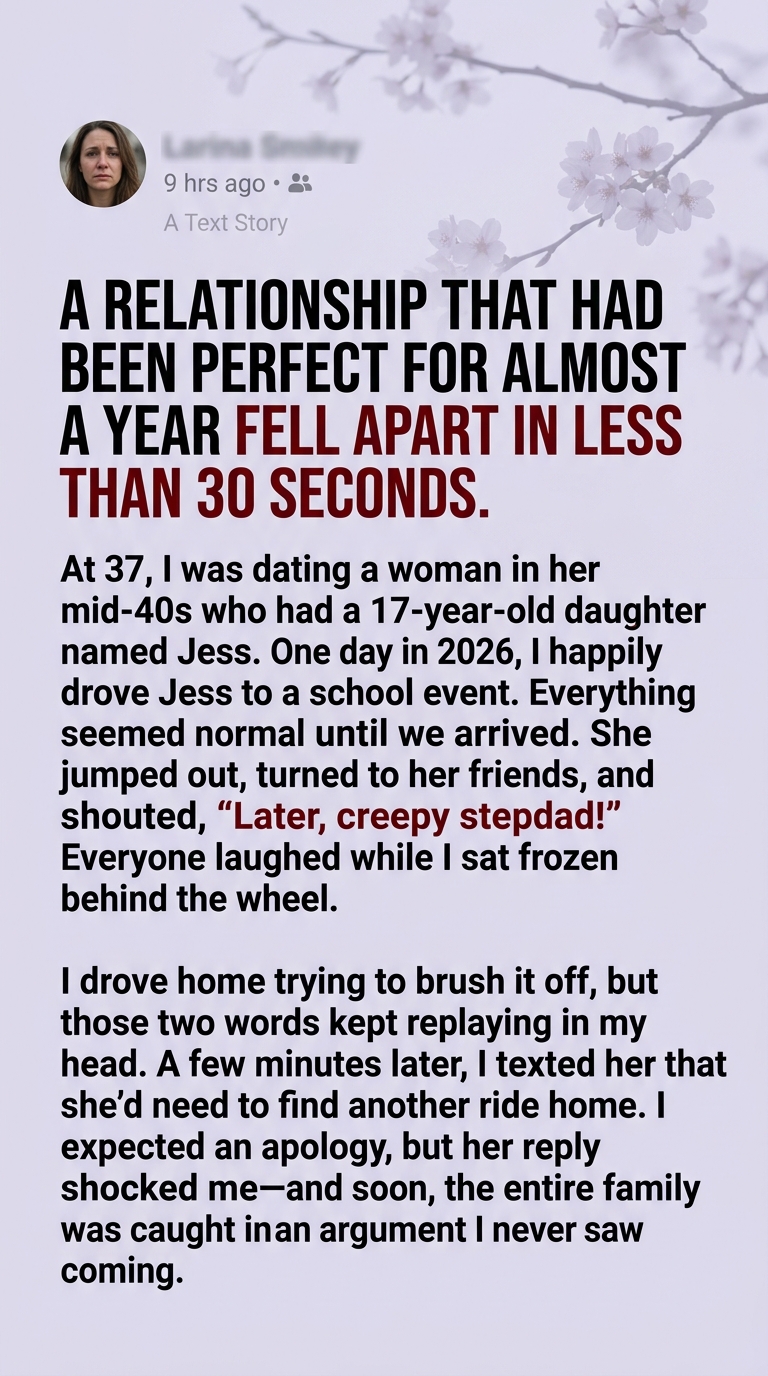
A RELATIONSHIP THAT HAD BEEN PERFECT FOR ALMOST A YEAR FELL APART IN LESS THAN 30 SECONDS. ALL BECAUSE MY GIRLFRIEND’S 17-YEAR-OLD DAUGHTER CALLED ME A “CREEPY STEPDAD” IN FRONT OF HER FRIENDS.
At 37, I thought I had finally found the kind of relationship I had always wanted.
Her name was Laura.
She was in her mid-40s, intelligent, funny, independent, and had a daughter named Jess who was seventeen.
I knew dating a woman with a teenage daughter would come with challenges.
I wasn’t trying to replace Jess’s father.
I wasn’t trying to become her best friend overnight.
I simply wanted to be someone she could trust.
For almost a year, things seemed wonderful.
Laura and I traveled together, cooked dinner, watched movies, and talked about our future.
Jess and I were getting along reasonably well, too.
She wasn’t particularly affectionate, but she was polite most of the time.
I drove her to school occasionally, helped her with small things, and even bought her concert tickets when she passed an important exam.
I never expected her to call me Dad.
I didn’t even expect her to like me.
I just wanted mutual respect.
Then came the Thursday that changed everything.
Laura had an important meeting at work, and Jess needed a ride to a school event.
I offered to take her.
She climbed into my car wearing headphones and spent most of the drive looking at her phone.
Nothing unusual.
When we arrived, several of her friends were standing near the entrance.
Jess opened the door, grabbed her bag, and jumped out.
Then she turned toward her friends and shouted:
“Later, creepy stepdad!”
Everyone laughed.
I froze behind the steering wheel.
For a moment, I wondered whether I had heard her correctly.
She was already walking away, laughing with her friends.
I didn’t shout.
I didn’t get out of the car.
I simply drove home.
The entire journey, those two words kept replaying in my head.
Creepy stepdad.
I had spent months trying to make her feel comfortable around me.
I had never demanded affection.
I had never crossed any boundaries.
And now, in front of a group of teenagers, she had reduced me to a joke.
When I got home, I sent her a message.
“Since I’m apparently a creepy stepdad, you’ll need to arrange another ride home today. I’m not comfortable being treated that way.”
I expected an apology.
Maybe an explanation.
Instead, her reply shocked me.
“LOL. You’re not even my stepdad. Stop acting like you own me. My mom is dating you, not me. Get over yourself.”
I stared at the screen.
Then another message arrived.
“And don’t tell my mom. She already thinks you’re trying too hard to be my father.”
I put my phone down.
That last sentence hurt more than the insult.
Because suddenly I wondered whether Laura had been telling Jess things about me that I didn’t know.
I called Laura.
She answered cheerfully.
“Hey, everything okay?”
“No. We need to talk about what Jess said today.”
There was a pause.
“What did she do?”
I explained what happened.
Laura sighed.
“She’s seventeen, honey. Teenagers say stupid things.”
“She called me a creepy stepdad in front of her friends.”
“She was joking.”
“It wasn’t funny to me.”
“You’re taking this too personally.”
I felt my frustration rising.
“I’m not asking her to love me. I’m asking her not to humiliate me.”
Laura became defensive.
“Well, maybe she feels uncomfortable because you’re trying to act like her father.”
I went silent.
“What does that mean?”
“You know what I mean. You drive her places, buy her things, and constantly try to be involved. Sometimes she feels like you want to control her.”
I couldn’t believe what I was hearing.
“I offered to drive her today because you were working.”
“Nobody asked you to.”
That sentence changed something inside me.
For months, I had believed Laura appreciated my efforts.
Now it sounded as if she had been tolerating them.
I asked her directly.
“Have you been telling Jess that I’m trying too hard?”
Laura didn’t answer immediately.
That was enough.
Then she said something I wasn’t prepared for.
“I told her that if she ever felt uncomfortable around you, she should tell me. I don’t want her thinking she has to accept you just because we’re together.”
I nodded slowly, even though she couldn’t see me.
“That’s fair. She should always be able to tell you if something makes her uncomfortable. But why did you let her believe that basic respect was optional?”
Laura raised her voice.
“Because she’s my daughter!”
“And I’m your partner!”
The conversation ended badly.
She told me I was making a huge issue out of a teenage joke.
I told her I needed some time to think.
That evening, Laura came home and found me sitting on the sofa.
Jess was with her.
She looked annoyed.
“Are we seriously having a family meeting because I made one joke?”
I looked at her.
“No. We’re having a conversation because you publicly insulted someone who has spent months trying to treat you respectfully.”
She rolled her eyes.
“You’re not my father.”
“I know.”
“Then stop acting like one.”
I nodded.
“That’s exactly what I’m going to do.”
Laura looked confused.
“What does that mean?”
“It means I’m no longer going to take responsibility for things that aren’t my responsibility. I’ll respect your role as her mother. I’ll respect Jess’s boundaries. But I won’t continue doing favors for someone who treats me like a joke.”
Jess laughed.
“Good. Nobody asked you to.”
Laura immediately told her to stop.
But the damage had already been done.
I turned to Laura.
“Can we speak privately?”
We went into the kitchen.
I asked her whether she genuinely believed I was trying to control Jess.
She shook her head.
“No. I know you mean well.”
“Then why did you say that?”
She looked exhausted.
“Because I feel caught between you two. Jess has had a difficult relationship with men since her father left. She gets defensive whenever she thinks someone is trying to take his place.”
I softened slightly.
“Then why didn’t you tell me that?”
“Because I didn’t want you to treat her differently.”
I understood that.
But understanding didn’t make the situation disappear.
I asked one more question.
“Did you tell her I was trying too hard?”
Laura nodded.
“I told her I thought you were moving too quickly into a family role. I didn’t mean it as an insult.”
I took a breath.
“Then you need to understand something. I wasn’t trying to become her father. I was trying to become someone who could be part of your life without making hers harder.”
Laura began crying.
“I know.”
But before either of us could continue, Jess appeared in the doorway.
“Mom, can we go?”
Laura turned toward her.
“Jess, we’re talking.”
Jess folded her arms.
“I don’t want him around. I told you that.”
The room went silent.
I looked at Laura.
She looked at her daughter.
Then I asked quietly:
“Is that how you really feel, Laura?”
She started crying.
“I don’t know what to do.”
I nodded.
“That’s the problem. You shouldn’t have to choose between us. But I also shouldn’t have to stay in a relationship where I’m constantly treated like an unwanted guest.”
I went to the bedroom and packed a bag.
Laura followed me.
“Please don’t leave over this.”
“I’m not leaving because of one joke. I’m leaving because of what happened afterward. You dismissed my feelings, blamed me for trying to help, and allowed this situation to become a competition between your daughter and me.”
She held my arm.
“Can we work this out?”
I looked at her.
“I love you. But love doesn’t mean I have to accept disrespect.”
I left that night.
For the next few days, Laura sent messages asking me to come home.
Some were apologetic.
Others were defensive.
Eventually, she asked me to meet her for coffee.
I agreed.
She arrived alone.
She looked tired.
“Jess and I talked,” she said.
I waited.
“She admitted she called you creepy because her friends were making jokes about her having an older mother’s boyfriend. She wanted to look cool in front of them.”
I nodded.
“That explains it. It doesn’t excuse it.”
Laura agreed.
“She also admitted she knew you were only trying to help. She said she felt guilty because you were kinder to her than she expected.”
I looked down at my coffee.
“Then why did she treat me like that?”
Laura sighed.
“Because she’s seventeen. She’s trying to figure out who she is, and sometimes she pushes away people who make her feel vulnerable.”
I understood teenage insecurity.
But I also knew that I couldn’t build a healthy relationship by constantly excusing hurtful behavior.
Laura reached across the table.
“I want us to try again. But I understand if you need boundaries.”
I thought carefully before answering.
“If we try again, three things have to change.”
She nodded.
“First, Jess never has to pretend I’m her father. She can call me whatever she’s comfortable with.”
“Okay.”
“Second, you handle discipline and transportation arrangements with her. I won’t be expected to fill a parental role when it suits you and then be criticized for doing so.”
Laura nodded again.
“And third, if she has a problem with me, she can speak honestly. But humiliation and insults aren’t acceptable.”
Laura wiped her eyes.
“That’s fair.”
We decided not to move back in together or rush anything.
For several weeks, we took things slowly.
Jess eventually sent me a message.
It was short.
Sorry about what I said at school. I was trying to make my friends laugh. It wasn’t fair.
I read it twice.
Then I replied:
“Thank you for apologizing. You don’t have to see me as family, but I hope we can treat each other with respect.”
She responded with a simple thumbs-up.
It wasn’t a beautiful emotional reconciliation.
But it was honest.
Months later, Laura and I were still together.
Our relationship was different, though.
I stopped trying to earn Jess’s affection through favors and gifts.
I stopped assuming I needed to solve every problem.
And Laura became more careful about not putting me in the middle of conflicts between her and her daughter.
One evening, Jess asked me for a ride to the library.
I looked at Laura.
She smiled.
“Only if you want to.”
I turned toward Jess.
“Sure. What time?”
She gave me a small smile.
“Thanks.”
It wasn’t a grand gesture.
But it was a beginning.
I learned something important from that experience.
A teenager doesn’t owe a parent’s partner love.
A partner doesn’t automatically become a stepparent.
And nobody should be forced into a family role they haven’t agreed to.
But respect must go both ways.
The relationship didn’t fall apart because a seventeen-year-old made one cruel joke. It nearly ended because the adults forgot that love, boundaries, and respect must all exist together.