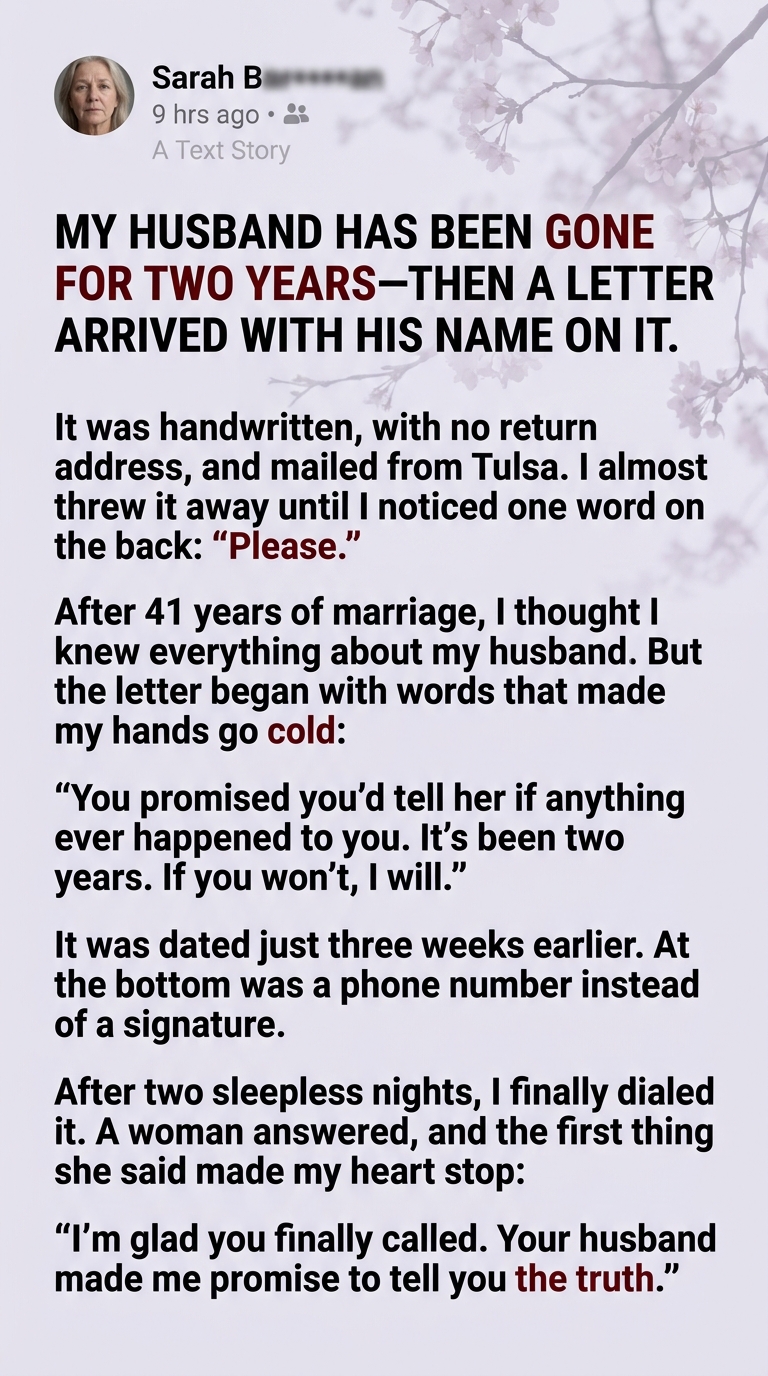
MY HUSBAND HAD BEEN GONE FOR TWO YEARS—THEN A LETTER ARRIVED WITH HIS NAME ON IT. WHAT THE WOMAN ON THE PHONE REVEALED CHANGED EVERYTHING.
My husband had been gone for two years when the letter arrived.
His name was written across the front in familiar handwriting, the same careful lettering I had seen on birthday cards, grocery lists, and anniversary notes for forty-one years.
There was no return address.
The envelope had been mailed from Tulsa, Oklahoma.
I almost threw it away.
After all, my husband, Robert, had been dead for two years. I had buried him, sold his old truck, donated most of his clothes, and slowly learned how to sleep on one side of the bed without reaching for someone who wasn’t there.
But something made me turn the envelope over.
On the back, written in a different hand, was one word.
Please.
My fingers trembled as I opened it.
Inside was a single sheet of paper.
You promised you’d tell her if anything ever happened to you. It’s been two years. If you won’t, I will.
The letter was dated three weeks earlier.
At the bottom was a phone number.
No signature.
No explanation.
I read it again and again, trying to understand what it meant.
What promise?
What had Robert failed to tell me?
And who was this person who believed my husband still owed them the truth?
I didn’t sleep that night.
For forty-one years, I had believed Robert and I had shared everything. We had raised two children, survived financial difficulties, buried parents, celebrated anniversaries, and built a life in a quiet neighborhood outside Tulsa.
He had been a patient man, a devoted father, and the kind of husband who remembered how I liked my coffee.
He wasn’t perfect, but I had never doubted his love.
Two years earlier, he had died suddenly after suffering a heart attack while visiting his brother. There had been no long illness, no final conversation, and no chance to ask him the questions that now filled my mind.
I had spent those two years believing I knew the whole story of our marriage.
Apparently, I didn’t.
After two sleepless nights, I finally dialed the number.
A woman answered.
“Hello?”
“I’m calling about a letter addressed to my late husband. His name was Robert.”
There was a long silence.
Then she said something that made my heart stop.
“I’m glad you finally called. Your husband made me promise to tell you the truth.”
I gripped the telephone.
“Who are you?”
“My name is Helen. I knew Robert for a very long time.”
My stomach tightened.
“Were you having an affair with my husband?”
“No,” she said immediately. “I know why you’re asking, but that’s not what this is about.”
“Then what is it about?”
She took a shaky breath.
“Your husband had another daughter.”
The room seemed to tilt.
I sat down.
“What?”
“Her name is Lily. She’s thirty-nine years old.”
I couldn’t speak.
Robert and I had two children, Michael and Sarah. Both were grown, married, and living in different states.
I had given birth to both of them.
There had never been another child.
At least, not one I knew about.
Helen continued.
“Robert was twenty-three when Lily was born. Her mother was my younger sister, Claire.”
I closed my eyes.
“Are you telling me my husband had a child before we met?”
“Yes.”
I stared at the wall.
“Why didn’t he tell me?”
“Because he was afraid.”
“Afraid of what?”
“Losing you.”
I almost laughed.
After forty-one years of marriage, the idea that my husband had hidden an entire child because he was afraid of losing me felt impossible.
Helen explained that Robert and Claire had been young when they met. They had dated briefly, but their relationship ended before Claire discovered she was pregnant.
Robert was working out of state at the time. Claire was afraid of raising a child alone, and her family persuaded her not to contact him.
But Robert eventually found out.
He had visited Claire and met Lily when she was still an infant.
He wanted to be part of her life.
Claire refused.
She believed Robert would eventually leave them, and she didn’t want Lily growing up caught between two families.
Robert tried to challenge that decision, but he had very little money and no legal support. Eventually, Claire moved away.
He lost contact with them.
A year later, Robert met me.
“He told me he would explain everything to you someday,” Helen said. “But the years passed. He married you, had your children, and became afraid that telling you would destroy the life he’d built.”
I felt tears running down my face.
“So he just forgot her?”
“No,” Helen answered softly. “Never.”
She told me that Robert had searched for Lily several times over the years. He had eventually found her through an old family contact, but he never approached her directly.
Instead, he began sending birthday cards and occasional letters.
At first, Lily refused to respond.
She was angry that her father had been absent for so much of her childhood.
But eventually, she agreed to meet him.
That meeting had taken place seven years earlier.
Robert had told her about his marriage, his children, and the life he had built.
He had also told her that he loved her, even though he had failed to be the father she deserved.
I wiped my face.
“Did my children know?”
“No. Robert asked Lily not to contact them until he had spoken with you.”
I felt something break inside me.
He had made promises to everyone except the person who had shared his life.
Helen paused.
“There’s something else.”
I looked at the letter.
“What?”
“Robert left something for you.”
“What kind of something?”
“A box. He gave it to me shortly before he died. He asked me to deliver it if he ever passed away before telling you.”
I couldn’t believe what I was hearing.
“Why didn’t you send it two years ago?”
“Because he made me promise to wait. He wanted you to have time to grieve. He thought you might need to hear it when you were ready.”
I was angry.
But beneath the anger was a terrible curiosity.
“Where is this box?”
“I live in Tulsa. If you’re willing, I can bring it to you.”
I hesitated.
Then I gave her my address.
Three days later, Helen arrived.
She was a woman in her late sixties, with gentle eyes and silver hair. She carried a small wooden box wrapped in a faded blue cloth.
We sat at my dining room table.
She placed it between us.
“Robert wanted you to open this yourself.”
I slowly lifted the lid.
Inside were photographs, letters, a hospital bracelet, and a small envelope with my name written on it.
The first photograph showed Robert holding a baby.
He looked impossibly young.
On the back, he had written:
Lily. Three weeks old. The day I became a father.
I started crying.
There were photographs of Lily growing up, most of them taken from a distance. Some showed her standing outside a school, others at a birthday celebration.
Robert had kept them for decades.
At the bottom of the box was a thick envelope containing letters he had written to Lily but never sent.
I opened the final envelope.
It was addressed to me.
My darling Margaret,
If you’re reading this, then I’ve run out of time to tell you something I should have told you years ago.
Before I met you, I became the father of a little girl named Lily.
I wanted to raise her. I wanted to be there for her first steps, her first day of school, and every ordinary moment a father should never take for granted.
But her mother and I could not agree on what was best for her. By the time I found you, I had convinced myself that the past was something I could leave behind.
I was wrong.
I never stopped thinking about her.
I know I should have told you. I was afraid you would look at me differently. I was afraid that the life we built together would never feel the same.
But I need you to know that loving Lily never meant loving you less.
You gave me forty-one beautiful years. You gave me two wonderful children and a home I was proud to return to every night.
I didn’t tell you because I was afraid. That was my mistake, and I am sorry.
If you decide to meet Lily, please don’t feel obligated to love her immediately. She is not responsible for my silence. Neither are you.
I only hope you can see her as a person who lost a father she never had enough time with.
I love you.
Robert.
I put the letter down.
For several minutes, neither Helen nor I spoke.
Finally, I asked the question that had been sitting in my chest since the phone call.
“Does Lily know he died?”
Helen nodded.
“She does. She was devastated. She wanted to attend the funeral, but Robert had never told you about her. She didn’t want to cause you more pain.”
I stared at her.
“Did she want to meet me?”
Helen smiled sadly.
“She has wanted that for years. But she told me she would never force herself into your life.”
I looked at the photographs again.
There was one from Robert’s sixtieth birthday.
He was standing beside Lily, smiling in a way I hadn’t seen in years.
I recognized the shirt he was wearing.
I had bought it for him.
That detail hurt more than I expected.
He had been living two lives, even if he hadn’t intended to deceive me forever.
I wasn’t sure whether I could forgive him.
But I knew Lily hadn’t written that letter.
She hadn’t hidden anything from me.
She was simply another person who had lost someone she loved.
I asked Helen for her number.
Then I sat alone for nearly an hour before calling.
A woman answered.
“Hello?”
“Is this Lily?”
“Yes.”
“My name is Margaret. I’m Robert’s wife.”
There was a long silence.
Then she began crying.
“I’ve wanted to hear your voice for so long,” she whispered.
I closed my eyes.
“I don’t know what to say.”
“Neither do I.”
We talked for almost two hours.
She told me about the few years she had spent with Robert, the birthday calls, the letters, and the Sunday afternoons when he would drive to see her.
She told me that he had never spoken badly about me.
“He always said you were the best thing that ever happened to him,” she said.
I swallowed.
“Then why didn’t he tell me?”
“I asked him that once. He said he was afraid of losing the family he loved.”
I looked toward the photograph of Robert holding the baby.
“He lost the chance to let us decide for ourselves.”
“Yes,” Lily whispered. “He did.”
That was the first moment I felt we understood each other.
We arranged to meet the following month.
When Lily arrived, I recognized Robert immediately in her face. She had his eyes, his smile, and the same small crease between her eyebrows when she was nervous.
She stood at my front door holding a bouquet of yellow flowers.
“I don’t know if I should hug you,” she said.
I looked at her.
“I’m not sure either.”
Then I stepped forward.
We hugged.
It wasn’t a perfect reunion. We didn’t suddenly become mother and daughter. There were too many years, too many unanswered questions, and too much grief between us.
But we sat together and looked through the photographs.
She told me about her childhood.
I told her about Robert’s life with our family.
We laughed at some of his old habits and cried when we realized how much he had missed.
Before she left, Lily handed me a small envelope.
“Dad asked me to give you this if we ever met.”
Inside was a photograph of Robert and Lily standing beside a lake.
On the back, he had written:
Two families. One heart. I wish I had been brave enough to bring them together.
I held the photograph against my chest.
For two years, I had believed that my husband’s story ended when he died.
But the letter from Tulsa had shown me that a part of his life had remained unfinished.
I still wished Robert had trusted me enough to tell the truth.
I still felt hurt that he had carried such a secret through forty-one years of marriage.
Forgiveness didn’t arrive all at once.
But I made a decision that day.
I would not punish Lily for a mistake she hadn’t made.
Over the following months, we began talking regularly. She met Michael and Sarah, who were shocked at first but eventually welcomed the opportunity to know their half-sister.
Our family wasn’t the same as before.
It was bigger, more complicated, and filled with questions we would never be able to ask Robert.
But it was honest.
And perhaps that was what he should have given us all those years ago.
One evening, I placed his letter back inside the wooden box.
I looked at his photograph and whispered:
“You should have trusted me, Robert. I might have been hurt, but I would have listened.”
Then I closed the lid.
The letter from Tulsa had not brought my husband back.
It had brought someone else into my life.
A daughter he had loved quietly.
A daughter who had waited years to know where she belonged.
And a truth that arrived two years too late—but not too late to change the rest of our lives.