My Mother Left Me a Safe Deposit Key and Said, “Whatever You Do, Don’t Tell Your Brother”
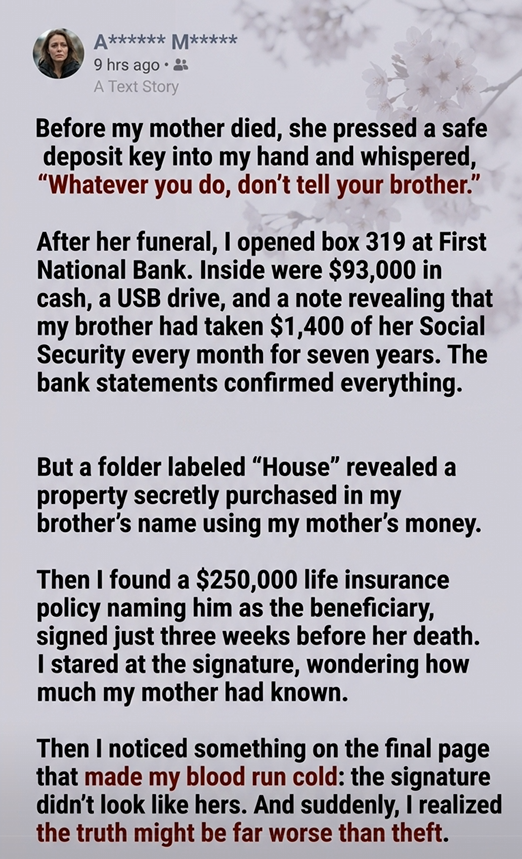
My mother gave me the key three days before she died.
She was lying in her hospital bed, barely strong enough to lift her hand. I thought she wanted me to take her jewelry home.
Instead, she pressed a small brass key into my palm.
“Box 319,” she whispered. “First National Bank.”
I leaned closer.
“What’s inside, Mom?”
Her eyes moved toward the hospital door.
“Whatever you do, don’t tell your brother.”
I stared at her.
“Why? What’s going on?”
She squeezed my fingers.
“Promise me.”
I promised.
She tried to say something else, but her voice faded. A nurse entered, and the conversation ended.
Three days later, my mother passed away.
My brother, Michael, cried at the funeral. He stood beside the casket and told everyone how much he loved her.
I watched him carefully.
For the past seven years, I had noticed strange things about Mom’s finances. She lived on Social Security, complained about rising grocery prices, and sometimes asked me to pay for small household repairs.
Yet Michael always seemed to have money.
He bought a new truck, renovated his kitchen, and eventually purchased a second property.
Whenever I asked how he afforded it, he said his business was doing well.
I never questioned him further.
Until I opened box 319.
The morning after the funeral, I drove to First National Bank.
The manager verified my identification and the documents authorizing access to the box.
When she opened it, I saw three things immediately.
A stack of cash.
A USB drive.
And a handwritten envelope with my name on it.
I counted the money.
Ninety-three thousand dollars.
My hands began trembling.
Then I opened the envelope.
Mom’s handwriting filled the first page.
My darling daughter,
If you’re reading this, I’ve probably run out of time to explain everything myself.
For seven years, your brother has been taking $1,400 from my Social Security every month.
He told me it was necessary to help manage my bills. I trusted him because he was my son.
But I eventually discovered that the money wasn’t going toward my expenses.
I kept copies of everything.
I stopped reading.
Seven years.
Eighty-four months.
At $1,400 each month, that was $117,600.
I pulled out the bank statements.
The withdrawals were there, month after month. Some were transfers to an account bearing Michael’s name. Others went toward payments I couldn’t identify.
The records matched Mom’s calculations.
I felt sick.
Then I found a folder labeled HOUSE.
Inside was a property purchase agreement.
It showed that a house had been purchased in Michael’s name several years earlier.
The down payment had come from an account funded by Mom’s money.
There were also bank transfers, closing documents, and handwritten notes showing that Mom had discovered the arrangement.
I sat back in the chair.
My brother hadn’t simply borrowed money.
He had used our mother’s retirement income to purchase property for himself.
But the next document was worse.
It was a life insurance policy worth $250,000.
Michael was listed as the beneficiary.
The policy had been signed three weeks before Mom died.
I stared at the signature.
Something was wrong.
The handwriting looked similar to Mom’s, but the letters were uneven. The final stroke was too sharp, and her middle initial was written differently.
I had watched her sign birthday cards, checks, and Christmas envelopes for decades.
That wasn’t how she signed her name.
I turned the page over.
There was a second signature.
This one belonged to Michael.
And beneath it was a handwritten note:
Client unable to attend in person. Documents completed at residence.
I felt a chill.
Mom had been in the hospital during that period.
How could she have signed the policy at home?
I looked again at the USB drive.
A small label was attached.
READ LAST.
I returned to the bank manager.
I told her I had discovered documents that might involve financial exploitation and a potentially forged insurance application.
She advised me to preserve everything and contact an attorney and the appropriate authorities.
I didn’t tell Michael.
I didn’t even call him.
Instead, I went straight to an attorney named Mrs. Lawson, who had helped Mom prepare her will years earlier.
She examined the documents carefully.
“Don’t confront your brother yet,” she advised. “We need to establish what is genuine, what was authorized, and what may have been falsified.”
She arranged for copies to be made and recommended that the original documents remain protected.
Then we examined the USB drive.
It contained photographs, scanned statements, audio recordings, and several short videos.
The first video showed Mom sitting at her kitchen table.
She looked tired but alert.
She spoke directly into the camera.
“If you’re watching this, I’ve finally managed to put everything together.”
She explained that Michael had originally offered to help with her bills after Dad died.
At first, he had genuinely helped.
He paid a few utilities, collected prescriptions, and handled occasional bank visits.
But gradually, he began insisting that she let him manage everything.
He told her she was forgetting things.
He said online banking was too confusing.
He encouraged her to sign documents without reading every page.
Then she noticed money disappearing.
When she questioned him, he became angry.
He told her she was ungrateful and that he deserved compensation for helping her.
She said she tried to confront him, but he threatened to stop visiting.
“I was afraid of being alone,” she whispered.
Then she looked directly into the camera.
“But I wasn’t going to let him take everything.”
The next video showed her holding a folder.
She explained that she had started keeping copies of every statement and transfer.
She had also contacted the bank to request an independent review of the transactions.
Then came the part that made my hands go numb.
“Michael brought me insurance papers three weeks ago. He said they were necessary for my medical expenses. I didn’t sign them. I told him I wanted my attorney to read them first.”
She paused.
“He became very angry.”
The video ended.
I looked at Mrs. Lawson.
“Are you saying my brother may have taken out a policy in Mom’s name without her permission?”
“We cannot conclude that from this video alone,” she said. “But the signature discrepancy and the circumstances require immediate investigation.”
Then we opened the final file.
It was a recording from Mom’s bedroom.
She was speaking to someone off camera.
I recognized the voice immediately.
Michael.
“Just sign the last page, Mom. It’s nothing.”
Mom replied:
“I told you I wasn’t signing anything else.”
“You’re making this difficult.”
“I know what you’ve been doing with my money.”
There was silence.
Then Michael said something that made my blood run cold.
“You don’t understand what will happen if you keep fighting me.”
The recording ended.
I sat motionless.
For years, I had thought my brother was simply irresponsible with money.
Now I wondered how much more Mom had endured in silence.
The attorney contacted the insurance company.
They confirmed that an application had been submitted, but the signature was under review.
The company agreed to preserve the application records and cooperate with the investigation.
The bank also began examining the transfers from Mom’s Social Security account.
Meanwhile, we contacted the authorities about the suspected financial exploitation, unauthorized transactions, and potentially falsified insurance documents.
A forensic handwriting examiner was asked to compare the disputed signatures with verified examples of Mom’s handwriting.
The preliminary assessment identified significant inconsistencies.
But there was another discovery.
The insurance application included a medical authorization supposedly signed by Mom.
The hospital records showed that she had been receiving treatment and was not at the address listed on the application when it was allegedly completed.
The insurance company had not yet paid any benefits.
That was important.
The policy was now under formal investigation, and the company placed a hold on any claim while the disputed documents were reviewed.
I finally understood why Mom had been so frightened.
She wasn’t only afraid of losing her money.
She was afraid that Michael had gone much further than she had imagined.
Two weeks later, Michael called me.
“Have you been going through Mom’s things?”
I kept my voice calm.
“Yes.”
“Did you find anything unusual?”
I looked at the folder on my table.
“Why do you ask?”
He paused.
“Because some financial documents are missing.”
I felt my stomach tighten.
“What documents?”
“Insurance papers. Bank records. Things I was helping Mom with.”
I said nothing.
Then he became impatient.
“Listen, I know she had some cash. If you found it, we need to divide it fairly.”
I almost laughed.
“Fairly?”
He raised his voice.
“Don’t start acting like you’re better than me. I was the one handling her affairs.”
I took a breath.
“Michael, did Mom authorize you to take $1,400 from her Social Security every month?”
Silence.
Then he said:
“She gave me permission to manage her money.”
“Did she give you permission to buy a house with it?”
His voice changed.
“Where did you hear that?”
I looked at the phone.
There it was.
He hadn’t denied it.
He had asked how I knew.
“Did Mom sign the life insurance application?”
Michael became angry.
“You’re twisting everything. She wanted me to have that money.”
“Then why is the signature being investigated?”
He stopped speaking.
A few seconds later, he hung up.
The investigation took several months.
The bank records confirmed that more than $117,000 had been transferred out of Mom’s account over seven years.
Some payments had gone toward legitimate household expenses, but a substantial portion had been diverted into accounts controlled by Michael.
The property records also confirmed that money originating from Mom’s account had funded the down payment on the house purchased in his name.
The insurance company determined that the disputed application required further investigation and did not release any benefits.
The authorities eventually established that the documents had been submitted without Mom’s valid authorization.
Michael was charged in connection with the financial exploitation and fraudulent paperwork.
He denied wrongdoing at first.
But the recordings, bank statements, transfer records, and disputed signatures made it increasingly difficult for him to maintain his story.
The legal process continued, and the property and financial losses became part of the recovery proceedings.
I didn’t celebrate when he was charged.
I felt no victory.
I simply wished Mom had never needed to spend her final years collecting evidence against her own son.
One afternoon, Mrs. Lawson called me.
She had found another envelope inside the safe deposit box, tucked beneath the bottom lining.
It was smaller than the others.
On the front, Mom had written:
For my daughter, when she is ready.
I opened it at the attorney’s office.
Inside was a photograph of Mom and me when I was about ten years old.
We were standing in the garden, both laughing.
On the back, she had written:
You were always the one who asked if I was okay.
Even when you were little, you noticed when someone was hurting.
I didn’t want you to spend your life fighting your brother. I wanted you to know the truth, protect yourself, and remember that none of this was your fault.
Then came the final paragraph.
I know you may wonder why I didn’t stop him sooner. I was ashamed. I was frightened. And I kept hoping he would become the son I remembered.
Please don’t make the same mistake I made. Love your family, but never let anyone use that love to take away your safety.
I pressed the photograph against my chest.
For months, I had been angry with Mom for not telling me sooner.
Now I understood that she had been struggling with fear, shame, and the hope that her son would change.
She had not been weak.
She had been a mother trying to believe there was still something good left in her child.
A year after Mom’s funeral, I visited her grave.
I brought white roses.
I told her the bank had recovered part of the money through the legal process and that the insurance company had closed its investigation without paying the disputed claim.
I told her I had kept the photograph.
Then I sat quietly for a while.
I thought about the $93,000 in the safe deposit box.
It had been money Mom saved over many years. Some of it came from careful budgeting, some from selling belongings, and some from small deposits she had made whenever she could.
She had hidden it because she wanted to leave something behind.
But the money wasn’t what I remembered most.
I remembered the brass key.
Her trembling fingers.
And those final words.
“Whatever you do, don’t tell your brother.”
I had thought she was hiding money from him.
Now I understood she had been trying to protect the truth from someone she once trusted with everything.
Before leaving, I placed the photograph beside the flowers.
“You’re safe now, Mom,” I whispered.
Then I stood and walked back to my car.
My brother had wanted her money.
He had wanted her property.
He had even tried to claim the insurance money.
But he never understood what he had truly destroyed.
He had broken the trust of the one person who had spent her entire life believing in him.
My mother left me $93,000, a box of evidence, and one final warning.
But the most valuable thing she left me was the courage to stop protecting someone who had spent years hurting her.