My Mother-in-Law Ordered $23,289 Worth of Food—Then I Put a Black Folder Beside Her Bill
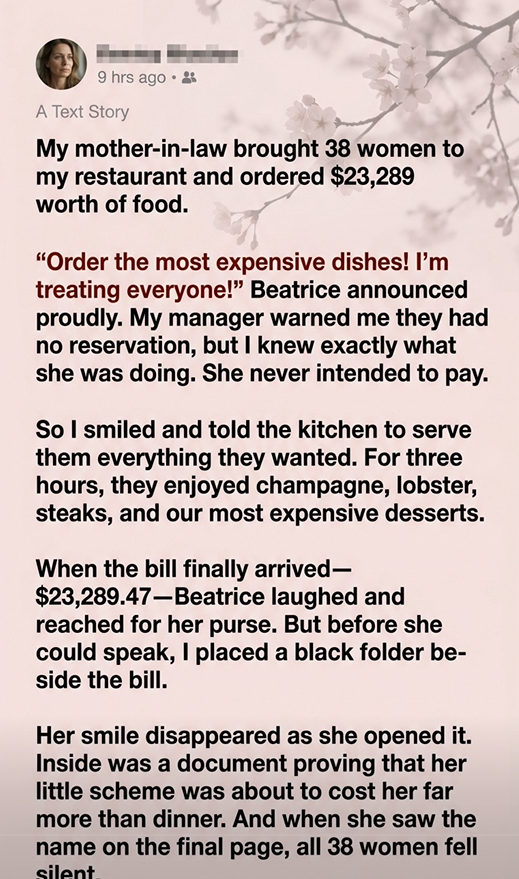
My mother-in-law, Beatrice, walked into my restaurant with thirty-eight women behind her.
She was dressed in a designer suit, wearing enormous pearl earrings, and carrying the kind of smile that usually meant trouble.
“Everyone, order whatever you want!” she announced. “The most expensive dishes! I’m treating!”
My manager, Daniel, hurried into my office.
“There’s a problem,” he whispered. “They don’t have a reservation. Your mother-in-law says she’s hosting a private celebration, but nobody has paid a deposit.”
I looked through the glass toward the dining room.
I knew exactly what Beatrice was doing.
She had spent years telling people that my restaurant was practically her family’s business. She regularly introduced herself as the owner’s mother, even though I had built the place myself with my savings, a small business loan, and twelve years of hard work.
She also had a habit of expecting free meals.
Last Christmas, she brought eleven relatives and told the staff to put everything on the family account.
There was no family account.
I had paid that bill myself just to avoid an argument.
But this time, she had brought thirty-eight people.
“Should we ask them to leave?” Daniel asked.
I smiled.
“No. Let them order.”
He looked confused.
“Everything?”
“Everything they want. Record every item accurately. Don’t offer discounts, and don’t change the prices.”
For the next three hours, the dining room became a celebration.
They ordered lobster tails, premium steaks, seafood platters, expensive desserts, and bottles of champagne.
Beatrice moved between tables like a celebrity.
She raised her glass several times.
“To friendship! To generosity! And to never having to worry about money!”
The women laughed and applauded.
I watched from my office.
Not because I enjoyed seeing people spend money, but because I knew Beatrice had no intention of paying.
And I finally had a reason to show everyone what she had been doing.
At 9:15 p.m., Daniel brought me the bill.
$23,289.47
I placed it inside a black folder.
Then I walked into the dining room.
Beatrice was telling a story when I approached.
“Well, ladies,” I said pleasantly, “I hope you enjoyed dinner.”
She smiled.
“Absolutely! Everything was wonderful.”
I placed the bill in front of her.
Her smile widened.
“Of course. Put it on the family account.”
I gently placed the black folder beside it.
“Before you pay, I think you should read this.”
Her expression changed.
“What is it?”
“Something you might want to explain to your guests.”
She opened the folder.
The first page was a collection of printed messages.
The second contained bank transfer records.
The third was a signed agreement.
And the final page contained a name.
Beatrice stopped breathing for a moment.
Then she looked around the table.
All thirty-eight women had gone silent.
Because the name on that final page wasn’t mine.
It was hers.
Six weeks earlier, Beatrice had contacted me.
She claimed she wanted to organize a private investment dinner at my restaurant.
She said she was bringing several successful women from her social circle who were interested in supporting local businesses.
I told her we could discuss a proper event contract.
She never followed up.
I thought she had changed her mind.
What I didn’t know was that Beatrice had been telling those women something entirely different.
She had claimed I was planning to sell a portion of my restaurant business.
According to her, she had negotiated an exclusive opportunity for her friends to become investors.
Each woman could purchase a small ownership share.
The minimum investment was $1,000.
Some had contributed more.
Beatrice told them the money would go toward securing their shares, and that dinner would be a private celebration of their new business partnership.
She even showed them a document with my restaurant’s logo.
There was only one problem.
I had never offered ownership shares to anyone.
I had never authorized Beatrice to collect money.
And I had never signed the document she showed them.
When one of the women contacted my restaurant to confirm the investment arrangements, Daniel forwarded the inquiry to me.
That was when I began investigating.
The woman who contacted us was named Patricia.
She had transferred $2,500 to Beatrice.
She believed she was buying a small ownership interest in my restaurant.
I explained that no such offer existed.
Patricia was horrified.
She told me she had attended several meetings where Beatrice presented herself as my business representative.
I asked her to send me everything she had received.
Over the following days, I received messages, payment confirmations, and copies of documents from several women.
The total amount Beatrice had collected was staggering.
$38,500.
Thirty-eight women had trusted her.
Some had contributed their savings. One had borrowed money from her sister. Another had used funds she had set aside for her daughter’s education.
And Beatrice had apparently spent much of the money before the dinner even began.
I hired an attorney.
We reviewed every document.
The supposed investment agreement contained my restaurant’s business name, address, and logo.
But the signature authorizing the offer was not mine.
The company registration details were also incorrect.
My attorney explained that we needed to preserve the evidence and avoid making unsupported accusations in public.
We sent formal notices to the relevant parties and began preparing a complaint regarding the unauthorized use of my business identity and the money collected.
Then we discovered something even worse.
Beatrice had not simply invented an investment opportunity.
She had used my husband’s name.
My husband, Andrew, had signed a document months earlier allowing his mother to help organize a family charity event.
The document gave her no authority to sell shares, collect investments, or represent my company.
But Beatrice had copied his signature from that paperwork and placed it on another document.
Andrew was devastated when I showed him.
“She told me she was organizing a dinner for her friends,” he said. “I had no idea she was using my name.”
I believed him.
But I also knew that believing him wasn’t enough. The documents needed to be examined.
My attorney arranged for the signature comparison and notified the appropriate authorities.
Then came the strangest discovery.
In one of Beatrice’s messages, she had written:
Once the women have invested, we can tell them the restaurant needs additional capital. They’ll have to contribute more if they want to protect their shares.
She wasn’t planning to stop at $38,500.
She was planning to ask those women for even more money.
And she had chosen my restaurant because she thought the family connection would make her story believable.
Now, standing in the dining room, I watched Beatrice read the final page.
It was a formal notice from my attorney explaining that the supposed investment agreement was unauthorized and that the restaurant had never offered ownership shares.
Attached were copies of the messages and payment records that had been provided by the women.
At the bottom was Beatrice’s own signature.
She had signed a written statement acknowledging that she had collected the money from the participants.
The document had been obtained through the attorney handling the investigation.
Beatrice slowly looked up.
“What is this supposed to mean?”
I remained calm.
“It means these women were told they were investing in my restaurant. They weren’t.”
Patricia stood.
“Beatrice, you told me the money was for shares.”
Another woman opened her handbag and pulled out a receipt.
“You told me the restaurant was already preparing the ownership documents.”
A third woman began crying.
“I gave you my retirement savings.”
Beatrice stood abruptly.
“This is a misunderstanding!”
I looked at her.
“Then explain why you collected $38,500 using my restaurant’s name without my permission.”
She turned toward the women.
“I was going to make everything right!”
Patricia shook her head.
“You told us the investment was already secured.”
Beatrice’s voice became louder.
“I was helping everyone! I was trying to give you an opportunity!”
I pointed to the final page.
“Then why did you sign a statement acknowledging that you collected the money?”
She stared at the document.
For once, she had no answer.
Then Patricia asked a question that changed the entire room.
“Beatrice, where is our money?”
Nobody moved.
Beatrice looked toward the exit.
My attorney had already advised me not to handle the financial dispute myself. The women had been given instructions on how to report their losses and preserve their payment records.
I had also prepared a separate invoice for the restaurant.
The dinner was not part of the supposed investment agreement.
It was a separate purchase.
Beatrice had ordered the food.
She was responsible for the bill.
She looked at me.
“You can’t seriously expect me to pay twenty-three thousand dollars!”
I glanced at the bill.
“You told thirty-eight people you were treating them. You chose the food. You approved every order. And you never asked for a discount.”
“But I’m your mother-in-law!”
I nodded.
“And I’m the owner of this restaurant.”
She lowered her voice.
“Andrew will never forgive you for embarrassing me.”
I looked toward the entrance.
Andrew had just walked in.
He had seen the messages and documents before coming.
He approached his mother.
“Mom, did you use my signature?”
Beatrice’s face crumpled.
“Andrew, sweetheart, let me explain.”
“Did you?”
She didn’t answer.
Andrew looked at the women.
“I’m sorry. I didn’t know she was doing this.”
Then he turned toward Beatrice.
“You need to tell the truth and return their money.”
She began crying.
“You can’t take their side over your own mother!”
Andrew’s voice shook.
“They trusted you. And you used my name to make them believe something that wasn’t true.”
The room fell silent again.
The women eventually left after collecting copies of the documents and exchanging contact information.
Some were crying.
Others were furious.
A few simply sat quietly, unable to believe what had happened.
Beatrice remained at the table.
She refused to pay the restaurant bill.
I didn’t argue.
My attorney had already explained the next steps for recovering the amount owed. We documented the order, preserved the receipts, and issued a formal invoice.
The restaurant’s claim would be handled separately from the investigation into the money she had collected.
Over the following weeks, the women provided statements and payment records.
The investigation confirmed that Beatrice had collected money using false representations about ownership in my business.
The matter proceeded through the appropriate legal channels.
She was eventually required to repay the women through a court-approved financial arrangement, and the restaurant pursued its own claim for the unpaid dinner bill.
It took time.
Some of the money was recovered quickly. Other payments required continued enforcement.
But the women were no longer being told to trust Beatrice’s promises.
They had the documents.
They had the records.
And they had each other.
A few months later, Andrew and I sat at our kitchen table.
He looked exhausted.
“She says I’m abandoning her.”
I folded my hands.
“You’re not abandoning her. You’re refusing to lie for her.”
He nodded.
“I spent my whole life believing she could do no wrong.”
I looked at him.
“That’s why she thought she could use your name.”
He reached across the table and held my hand.
“I’m sorry I didn’t see it sooner.”
I squeezed his fingers.
“I just wish she hadn’t dragged so many people into it.”
We sat quietly for a while.
Then Andrew asked:
“Do you regret letting them have dinner?”
I thought about the thirty-eight women sitting in my restaurant.
I thought about Patricia crying over her retirement savings.
I thought about Beatrice announcing that she was treating everyone.
And I shook my head.
“No. Because now they know the truth.”
Six months later, Patricia returned to the restaurant.
This time, she came alone.
She brought a small envelope and placed it on my desk.
Inside was a handwritten note.
Thank you for not letting us continue believing a lie. I lost money, but I could have lost much more. I hope you know that what you did mattered.
I read it twice.
Then I placed it in my office drawer.
That evening, I walked through the dining room after closing.
The tables were clean.
The chairs were pushed in.
The kitchen was quiet.
I thought about the night Beatrice had arrived with thirty-eight women and ordered more than $23,000 worth of food.
She had thought she was walking into a restaurant she could control.
She had thought my relationship with her son would protect her.
And she had thought those women would never discover the truth.
But she had made one mistake.
She had confused my kindness with weakness.
I had built my restaurant from nothing.
I wasn’t going to let anyone use its name to steal from people who trusted them.
Beatrice came to my restaurant expecting a free dinner.
She left facing something far more expensive: the truth about what she had done.