FULL STORY WITH ENDING
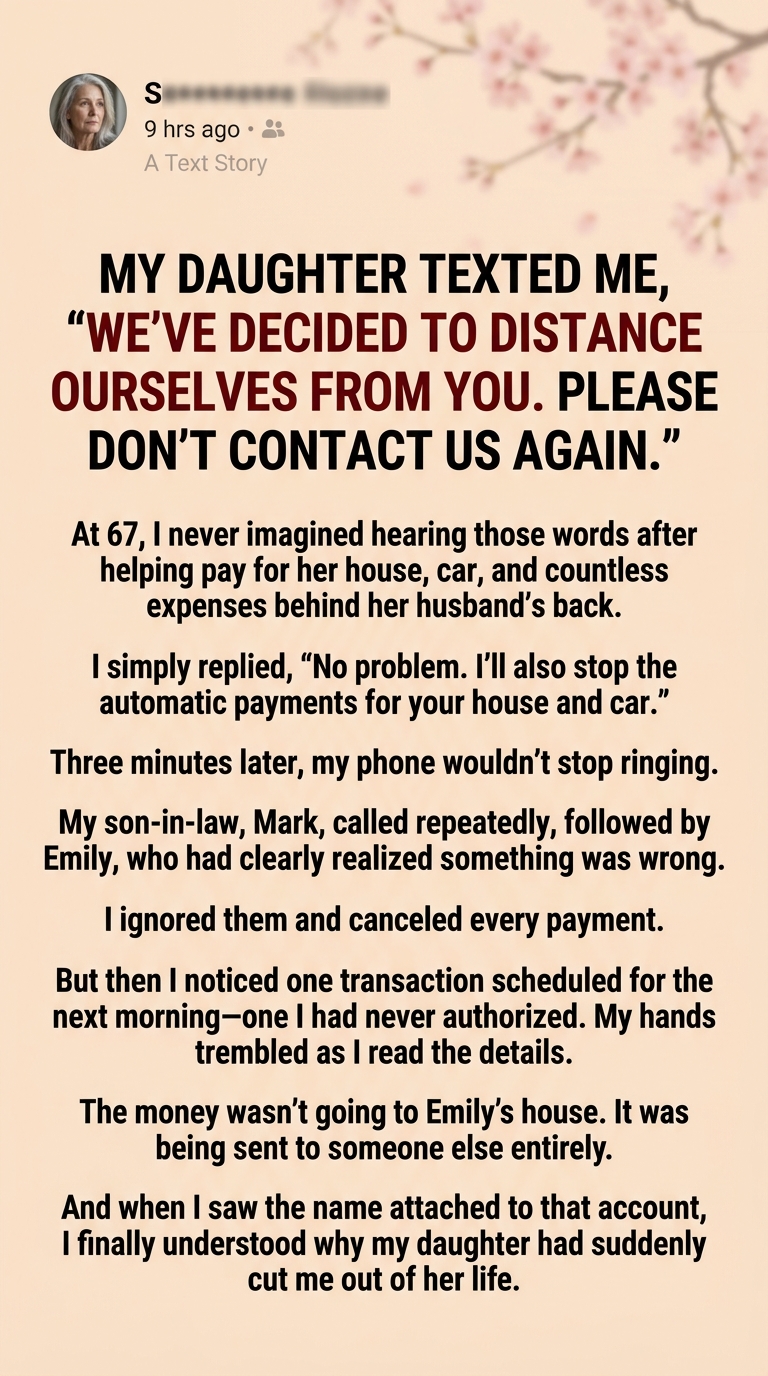
MY DAUGHTER TEXTED ME, “WE’VE DECIDED TO DISTANCE OURSELVES FROM YOU. PLEASE DON’T CONTACT US AGAIN.” At 67, I never imagined hearing those words after everything I had sacrificed for her. But when I stopped paying her bills, my phone exploded with calls—and one mysterious bank transfer revealed the real reason she wanted me gone.
My name is Margaret, and I’m 67 years old.
For most of my life, I believed being a good mother meant putting your children before yourself.
I raised my daughter, Emily, after her father passed away when she was young. I worked two jobs, skipped vacations, wore the same winter coat for years, and saved every extra dollar I could.
I wanted Emily to have opportunities I never had.
When she married Mark, I welcomed him into our family like my own son.
They seemed happy, but money was always a problem.
First, they needed help with their house deposit.
Then came the mortgage payments.
After that, Mark needed a reliable car for work, so I helped with the monthly payments.
There were also unexpected expenses: insurance, repairs, credit card bills, and medical costs.
I never complained.
Emily always promised they would eventually become financially independent.
“Mom, we’ll pay you back someday,” she would say.
I always answered the same way.
“Don’t worry about it. I just want you two to be happy.”
For years, I quietly paid their expenses through automatic bank transfers.
I even kept some of the payments secret from Mark because Emily told me he felt embarrassed accepting financial help.
I thought I was protecting their marriage.
I had no idea I was helping hide something much bigger.
Then, one Tuesday morning, everything changed.
I was sitting in my kitchen drinking coffee when my phone buzzed.
It was a message from Emily.
I opened it, expecting another request or perhaps an invitation to visit.
Instead, I read:
“We’ve decided to distance ourselves from you. Please don’t contact us again. We need peace, and we think it’s best if you stay out of our lives.”
I read it several times.
My daughter.
The little girl I had raised alone.
The woman whose house, car, and lifestyle I had helped pay for.
She was telling me never to contact her again.
I felt something inside me break.
I wanted to call her immediately and ask what I had done wrong.
But then I looked at the automatic payments listed in my banking app.
Every month, money left my account for people who apparently no longer wanted me in their lives.
For the first time, I wondered why I was still paying.
So I typed a short response.
“No problem. I’ll also stop the automatic payments for your house and car.”
I pressed send.
Three minutes later, my phone started ringing.
First, Mark.
Then Emily.
Then Mark again.
I watched the screen light up repeatedly.
I didn’t answer.
Instead, I opened my banking application and canceled the mortgage assistance, car payment, insurance contribution, and every other recurring transfer I had established for them.
I thought that was the end of it.
But while reviewing my scheduled transactions, I noticed something strange.
There was a transfer scheduled for the following morning.
It was for $4,800.
I frowned.
I had never authorized a payment for that amount.
I opened the transaction details.
The money wasn’t going to Emily’s mortgage account.
It was going to an unfamiliar bank account.
I looked at the recipient’s name.
My hands began to tremble.
The recipient was Daniel Reeves.
I knew that name.
Daniel was my late husband’s younger brother.
But he had been dead for almost three years.
I stared at the screen, trying to understand what I was seeing.
Why was my money being transferred to an account under his name?
And why was Emily involved?
I immediately contacted my bank and reported the transaction as unauthorized.
The representative explained that the transfer had been scheduled through an external payment authorization and that the bank would investigate its origin.
I also requested that all future transfers to that account be blocked.
Then I searched through my old emails.
I found something that made my stomach turn.
Almost eight months earlier, Emily had asked me to sign some documents.
She told me they were necessary to update the financial arrangements for the house.
I remembered her sitting at my kitchen table with a folder.
“Mom, it’s just paperwork. Mark’s accountant needs your signature because you’ve been helping with the mortgage.”
I trusted her.
I had signed several pages without reading every line carefully.
Now I wondered what I had actually agreed to.
I called my attorney, Susan.
She asked me to send her copies of the documents and bank statements.
An hour later, she called back.
“Margaret, I need you to come to my office tomorrow. There’s something important you need to understand.”
I barely slept that night.
The next morning, I met Susan.
She spread the documents across her desk.
Then she pointed to one particular page.
“This isn’t simply a mortgage payment authorization.”
I leaned forward.
“What is it?”
She explained that the document appeared to authorize a recurring transfer from my account to an account controlled by a financial management company.
The company was called Reeves Family Holdings.
I had never heard of it.
Susan continued reading.
“There’s also a beneficiary designation attached to the account.”
“Who is the beneficiary?”
She looked at me.
“Mark’s mother, Linda.”
My stomach dropped.
Linda?
Mark’s mother?
Why would my daughter be sending my money to her?
Susan explained that the paperwork alone didn’t establish whether the authorization was valid. We would need the original records, the bank’s verification logs, and the company’s registration documents.
But something was clearly wrong.
I asked her to investigate everything.
That afternoon, I received another call from Emily.
This time, I answered.
“Mom, what are you doing?”
Her voice was sharp.
“Hello to you too, Emily.”
“You canceled the house payment!”
“I did.”
“And the car payment!”
“I canceled that too.”
She sounded furious.
“How could you do this without talking to us?”
I couldn’t believe what I was hearing.
“You told me not to contact you again.”
“That’s different!”
“How is it different?”
She became quiet.
Then she said, “Mom, Mark and I are dealing with something complicated. You don’t understand.”
I took a deep breath.
“Then explain the $4,800 transfer scheduled for tomorrow.”
Silence.
A long silence.
Finally, she asked:
“What transfer?”
“An automatic payment to Reeves Family Holdings. The beneficiary is Linda.”
I heard her breathing change.
“Mom, you shouldn’t be looking through those transactions.”
That sentence told me more than she intended.
“Why, Emily? What exactly am I not supposed to see?”
She hung up.
I sat there holding the phone.
For the first time, I realized that my daughter might not have cut me out of her life because she wanted peace.
She might have wanted me to stop asking questions.
And she might have known exactly what I would discover if I looked closely enough.
The following day, Susan contacted the bank and requested the original authorization records.
She also investigated Reeves Family Holdings.
What she discovered was shocking.
The company had been established by Linda and Mark approximately two years earlier.
It wasn’t a legitimate mortgage servicing company.
It was a private financial account used to receive money from several sources.
And my scheduled $4,800 transfer was not the first payment.
There had been several previous transfers.
Some were for $2,000.
Others were for $3,500.
Over the previous eleven months, more than $38,000 had been transferred from my account to the company.
I felt sick.
I had believed I was helping my daughter pay for her home.
Instead, a substantial amount of my money had been going somewhere else.
Susan advised me not to confront anyone until we understood the full arrangement.
Then, two days later, the bank sent us additional documentation.
The authorization had been submitted using my online banking credentials.
However, the device information and verification records raised serious questions about who had actually initiated it.
Susan looked at me.
“Margaret, did you ever give Emily access to your online banking?”
I shook my head.
“No. But she used to help me with my phone whenever I had trouble.”
Susan nodded.
“That may be important. We need the bank to investigate how this authorization was created.”
Then she showed me another document.
It was an email recovered from the company’s records.
The sender was Linda.
The recipient was Emily.
The subject line read:
WHEN YOUR MOTHER STOPS PAYING.
I felt my heart sink.
Susan asked whether I wanted to read it.
I nodded.
The message was short.
Linda had written:
“Once your mother stops contributing, we need to make sure everything is already transferred. Mark says she won’t question anything as long as you keep her away from our financial discussions. Don’t let her speak to the bank before we finish.”
I read it twice.
Then I read it again.
My daughter hadn’t suddenly decided she needed distance.
She had been planning to keep me away from the truth.
But the worst discovery was still waiting.
Susan found another email from Mark.
It contained a proposed financial plan.
Mark and Linda had discussed using the money from Reeves Family Holdings to pay off a property that Linda owned.
The property wasn’t Emily’s house.
It was Linda’s vacation home.
My money had been helping finance a house I had never even seen.
And the scheduled $4,800 transfer was intended to cover another payment toward that property.
I finally understood why Emily had sent that message.
She didn’t want me asking questions.
She didn’t want me reviewing my bank statements.
And she certainly didn’t want me discovering that my financial support had been benefiting her husband’s family.
But I wasn’t finished.
Susan advised me to preserve every document, continue cooperating with the bank, and allow the investigation to determine whether the transfers were authorized or fraudulent.
I also formally revoked every financial authorization connected to Emily, Mark, and Reeves Family Holdings.
The bank temporarily restricted the disputed account while it investigated the transfers.
A few days later, Mark appeared at my front door.
He looked furious.
“Margaret, we need to talk.”
I didn’t invite him inside.
“What do you want?”
He lowered his voice.
“Emily is very upset. You need to reverse those cancellations.”
I looked at him.
“Why?”
“Because you’re putting our family in a terrible position.”
I almost laughed.
“Your family?”
He looked uncomfortable.
“That’s not what I meant.”
I folded my arms.
“Then explain why my money was being sent to your mother’s company.”
His expression changed.
For several seconds, he didn’t speak.
Then he tried to explain that it was a temporary investment arrangement.
He claimed Linda had promised to return the money.
I asked him one question.
“Did Emily know?”
He looked away.
That was enough.
I told him that all further communication would go through my attorney.
He became angry.
“You can’t just destroy everything we’ve built!”
I looked at him calmly.
“Mark, I didn’t build your mother’s vacation home. I paid for it without knowing that was where my money was going.”
He walked away without another word.
The bank’s investigation continued for several weeks.
Eventually, it confirmed that the disputed transfer authorization had been created through a device previously used to access my account, but the bank could not establish from that fact alone who had operated it.
The bank reversed some disputed transactions while reviewing the remaining payments, and my attorney began pursuing recovery of the funds through the appropriate legal channels.
During that process, Emily finally contacted me again.
This time, she wasn’t angry.
She was crying.
“Mom, please. Can we talk?”
I agreed to meet her at a small coffee shop.
When she arrived, she looked exhausted.
She sat across from me and immediately began crying.
“I’m sorry.”
I didn’t say anything.
She wiped her eyes.
“Mark told me the money was going into an investment. He said his mother would eventually pay everything back.”
“Did you know the money was being used for her vacation home?”
She stared at the table.
After a long silence, she nodded.
“Yes.”
That answer hurt more than anything else.
“How long have you known?”
“Several months.”
I felt tears filling my eyes.
“Emily, why didn’t you tell me?”
She began crying harder.
“Mark said if you found out, you would stop helping us. He told me we needed to keep you away from the financial arrangements.”
I shook my head.
“So you decided to keep me away from your life instead?”
She couldn’t answer.
Then she reached across the table.
“Mom, I need your help. Mark and I are having problems. I think he used me too.”
I gently moved my hand away.
“Emily, I love you. That will never change. But loving you doesn’t mean I have to keep paying for lies.”
She cried quietly.
For the first time, I saw that she was beginning to understand what she had done.
But forgiveness wasn’t something I could give her simply because she was afraid of losing the money.
I told her that if she wanted a relationship with me again, it would have to be built on honesty.
No more secret payments.
No more financial arrangements.
No more treating me like a bank account instead of a mother.
Months later, the financial investigation and recovery proceedings resulted in a settlement. A portion of the money was returned, and the remaining disputed amount was addressed through the legal process.
Emily eventually separated from Mark after discovering additional financial problems he had hidden from her.
She started working again and began rebuilding her life.
Our relationship didn’t become perfect overnight.
Trust takes much longer to rebuild than it takes to destroy.
But we slowly started talking again.
Sometimes she visited me on Sundays.
Sometimes we had coffee and talked about ordinary things.
And sometimes, when she looked at me, I could still see the little girl who used to hold my hand while crossing the street.
One Sunday, she came to my house and placed a small envelope on the kitchen table.
Inside was a check.
It wasn’t a large amount.
It was simply her first repayment toward the money I had spent helping her.
I looked at her.
“What’s this for?”
She smiled sadly.
“Because I don’t want you to think I only call when I need something.”
I held her hand.
For the first time in a long time, I felt like I was speaking to my daughter again.
I didn’t need the money as much as I needed the honesty.
At 67, I finally learned a lesson I wish I had understood much earlier.
Helping your children is an act of love.
But allowing someone to take advantage of that love is not an obligation.
I still love Emily.
I probably always will.
But I no longer pay her bills, finance her lifestyle, or sacrifice my own security to make someone else’s life easier.
And the next time my phone buzzes with an unexpected financial request, I remember the morning my daughter told me never to contact her again.
Because sometimes, the most painful betrayal doesn’t come from strangers.
It comes from the people you spent your entire life trying to protect.