MY SEVEN-YEAR-OLD DAUGHTER WHISPERED, “MOMMY, THE BUS DRIVER STOPS AT A HOUSE SOMETIMES.” WHAT I DISCOVERED CHANGED EVERYTHING.
My seven-year-old daughter whispered something at bedtime that made me sit upright.
“Mommy, the bus driver stops at a house sometimes.”
I put down the book I was reading.
“What house, sweetheart?”
She pulled her blanket up to her chin.
“A gray one. He tells us to stay quiet, then he goes inside.”
I felt a chill run through me.
“Does he leave you alone on the bus?”
She nodded.
“Sometimes. He says we’re not supposed to tell because it’s a secret stop.”
I tried to keep my voice calm.
“How long does he stay?”
“Until the little clock on the dashboard goes around a lot.”
I kissed her forehead and told her she had done the right thing by telling me.
But after she fell asleep, I couldn’t stop thinking about it.
The next morning, I called the school.
I explained what my daughter had told me and asked whether Route 12 had any scheduled stops between the school and our neighborhood.
The transportation administrator sounded irritated.
“Mr. Doyle has been driving that route for eighteen years. He’s one of our most experienced employees. There have never been unauthorized stops.”
I explained that my daughter was seven and had no reason to invent something like this.
He promised to look into it.
By the afternoon, I still hadn’t received an answer.
So I decided to follow the bus.
I parked a few cars behind it as it left the school.
For the first fifteen minutes, everything seemed normal.
It followed the usual roads, stopped at the usual intersections, and dropped children off along the route.
Then something strange happened.
Instead of turning toward the main road, the bus entered a narrow dirt road surrounded by trees.
I slowed down.
There were no houses nearby.
No school buildings.
No businesses.
Four miles later, the bus stopped in front of a gray ranch house.
I pulled over behind a row of bushes.
Mr. Doyle opened the driver’s door, stepped down, and walked toward the house.
He didn’t speak to anyone.
He simply unlocked the front door and disappeared inside.
Six children remained on the bus.
I looked at my watch.
One minute passed.
Then five.
Then ten.
At thirteen minutes, I began recording.
The bus was still there.
I could see the children through the windows. One little boy was standing in the aisle, looking toward the house.
I called the police.
I gave them the address and explained what I had witnessed.
The dispatcher asked me to remain at a safe distance.
Then an officer called me back.
“Ma’am, I need you to listen carefully. That house is registered to a woman who filed a missing-persons report two years ago.”
My blood ran cold.
“Who disappeared?”
There was a pause.
“Her name is Rebecca Doyle.”
I looked at the house again.
“Doyle? Is she related to the driver?”
The officer didn’t answer immediately.
“We’re checking that now. Please don’t approach the property.”
I wanted to ask a hundred questions.
But before I could say anything, the front door opened.
Mr. Doyle stepped outside.
And he wasn’t alone.
A woman walked behind him.
She looked pale and thinner than I expected, with dark hair pulled into a loose ponytail.
She was holding a little boy’s hand.
Then the boy turned toward the road.
I recognized him.
It was Noah.
My daughter’s classmate.
The same boy whose mother had supposedly moved away two years earlier.
I stared through my windshield.
Noah’s mother had disappeared when he was five. The school had told parents that he was living with relatives while the family dealt with a private situation.
But there he was.
Standing beside the missing woman.
And when Rebecca looked toward the bus, she did something that made my stomach tighten.
She shook her head.
Not at the driver.
At the children.
As if warning them not to say anything.
Then Mr. Doyle turned and looked directly toward my car.
He had seen me.
I ducked instinctively.
A moment later, I heard sirens.
Two police vehicles entered the dirt road from the opposite direction.
Mr. Doyle immediately stepped away from Rebecca.
The officers ordered everyone to remain where they were.
I watched as they approached the bus and began checking on the children.
One officer came toward my car.
“Are you the person who called?”
“Yes.”
“Stay here. We need your video.”
I handed him my phone.
He watched the recording, then looked toward the house.
“Did you see anyone else?”
I shook my head.
“Just the woman and the little boy.”
He nodded.
“That’s enough for now.”
I wanted to know what was happening.
But the officer told me the children needed to be checked first.
A second officer escorted Mr. Doyle away from the house.
Rebecca remained on the porch, holding Noah’s hand.
Then I heard something that made my heart race.
One of the officers asked her:
“Rebecca, did you know the children were being brought here?”
She started crying.
“No. I swear I didn’t know he was bringing them.”
The officer looked at Mr. Doyle.
“Then why were you taking this bus to her property?”
Mr. Doyle refused to answer.
I sat in my car, trying to understand what I was witnessing.
The police had identified Rebecca as a missing person, but she was standing right there.
And the driver had been bringing children to her home without the school’s knowledge.
What could possibly connect all of them?
About twenty minutes later, an officer returned to speak with me.
He introduced himself as Detective Harris.
“Your daughter is safe,” he said. “The other children are being reunited with their families.”
I exhaled for the first time in what felt like an hour.
“What was Mr. Doyle doing here?”
The detective glanced toward the house.
“We’re still establishing that. But the woman inside has an unusual history.”
He explained that Rebecca had disappeared two years earlier after a serious dispute with her husband, Daniel.
Her family had reported her missing.
Her husband had told investigators she had left voluntarily.
But her disappearance had never been fully resolved.
The house had remained in her name.
“Then why is she here?” I asked.
“That’s what we’re trying to establish.”
The detective paused.
“There’s something else. Mr. Doyle is Rebecca’s brother.”
I stared at him.
“What?”
He nodded.
“And the little boy is her son, Noah.”
I looked toward the house.
“Why did everyone think she was missing?”
Detective Harris explained that Rebecca had been reported missing after she stopped communicating with her family. Her husband had claimed she had abandoned the child, while her brother had provided information that supported the husband’s account.
But Rebecca was now telling investigators a very different story.
She said she had left because she feared her husband.
She had contacted her brother for help, believing he would protect her.
Instead, he had helped her stay hidden.
I couldn’t understand why.
Then the detective showed me something on his phone.
It was a photograph of an old family document.
A custody agreement.
Rebecca had been trying to leave an abusive marriage, but her husband had threatened to take Noah away from her. Her brother had convinced her that disappearing temporarily would give her time to gather evidence and protect her son.
But the arrangement had become something else.
Mr. Doyle had begun bringing children to the property during his route because he believed it would keep Rebecca from being discovered by anyone outside their small circle.
The children were never supposed to leave the bus.
He claimed he was only checking on his sister and nephew.
But he had no authorization to make those stops, and he had put six children in an unsafe situation.
The police were now investigating whether anyone else had been involved and why the school had never been informed.
I looked at the detective.
“Was my daughter in danger?”
He answered carefully.
“We haven’t found evidence that the children were harmed, but the driver had no right to take them off their authorized route or leave them unattended. You did the right thing by reporting it.”
I thanked him.
Then I asked whether I could speak to Rebecca.
He said it might be possible later, but not while the investigation was ongoing.
That evening, the school district sent a message to parents confirming that Mr. Doyle had been removed from driving duties pending an investigation.
The school also arranged a meeting with the families whose children had been on the bus.
I took my daughter into my arms when she came home.
“Sweetheart, you did something very brave by telling me what happened.”
She looked worried.
“Is Noah in trouble?”
“No, baby. The grown-ups are figuring things out.”
She hugged me.
“I didn’t like the secret stop.”
I kissed her forehead.
“You never have to keep a secret that makes you feel scared or uncomfortable.”
Over the next few weeks, the investigation revealed more about Rebecca’s disappearance.
She had been living under severe pressure after leaving her marriage. Her brother had hidden her location because he believed he was protecting her, but he had also made decisions that endangered children and prevented the authorities from understanding what had happened.
Rebecca was eventually able to speak with investigators and receive help through the appropriate family and legal services.
Her son was placed in a safe arrangement while the custody situation was reviewed.
Mr. Doyle faced consequences for violating school transportation rules and for the decisions he had made during his route. The school district also changed its procedures for tracking buses and verifying unexpected route deviations.
As for Noah, he eventually returned to school.
A few weeks later, my daughter came home with a drawing.
It showed two children standing beside a yellow school bus.
Underneath, she had written:
Friends should be safe.
I put it on the refrigerator.
Sometimes I still think about that afternoon.
I think about how easily I could have dismissed my daughter’s words as a child’s imagination.
I think about how many adults had accepted Mr. Doyle’s reputation without asking the right questions.
And I think about the little boy standing beside his mother on that porch.
There were adults who believed they were protecting him.
But the truth was that a child should never have to depend on secret arrangements to feel safe.
The most important thing that happened that day wasn’t discovering why the bus stopped at the gray house.
It was that one little girl trusted her mother enough to speak up.
And because I listened, six children were no longer being taken to a place their parents knew nothing about.
20 STRONG CAPTIONS
My seven-year-old daughter told me the school bus stopped at a strange house. The police discovered a missing woman inside.
The school insisted the driver had an perfect record. Then I followed Route 12 and saw where he was really going.
My daughter whispered, “Mommy, the bus driver tells us to stay quiet.” I knew I couldn’t ignore her.
I followed the school bus for four miles. What I found at the gray house left me speechless.
The driver left six children alone on the bus for thirteen minutes. Then a woman walked out of the house.
The police told me the gray house belonged to a woman reported missing two years earlier. I never expected to see who was standing beside her.
Everyone trusted Mr. Doyle because he had driven the school bus for eighteen years. One secret stop changed everything.
My daughter was afraid to tell me about the secret stop. I’m glad she finally found the courage.
I thought I was investigating an unauthorized bus stop. I accidentally uncovered a missing-person case.
The bus driver wasn’t alone when he came out of the house. The person behind him changed the entire investigation.
A seven-year-old’s bedtime confession led police to a gray house and a woman nobody had seen in two years.
The school told me there was nothing to worry about. My own eyes told me something very different.
I watched the clock as the bus driver disappeared inside the house. Thirteen minutes later, I called the police.
The missing woman’s name was Rebecca Doyle. The bus driver’s last name was Doyle too.
My daughter said the driver told the children to keep the stop secret. That was the moment I decided to follow the bus.
I never expected a routine school pickup to uncover a family mystery involving a missing mother and her son.
Six children were sitting on that bus while adults kept a secret none of their parents knew about.
The driver thought nobody would notice his detour. He never expected one concerned mother to follow him.
My daughter didn’t know she had uncovered a missing-person case. She only knew something about that bus stop felt wrong.
Sometimes the most important warning comes from a child who is brave enough to tell the truth.
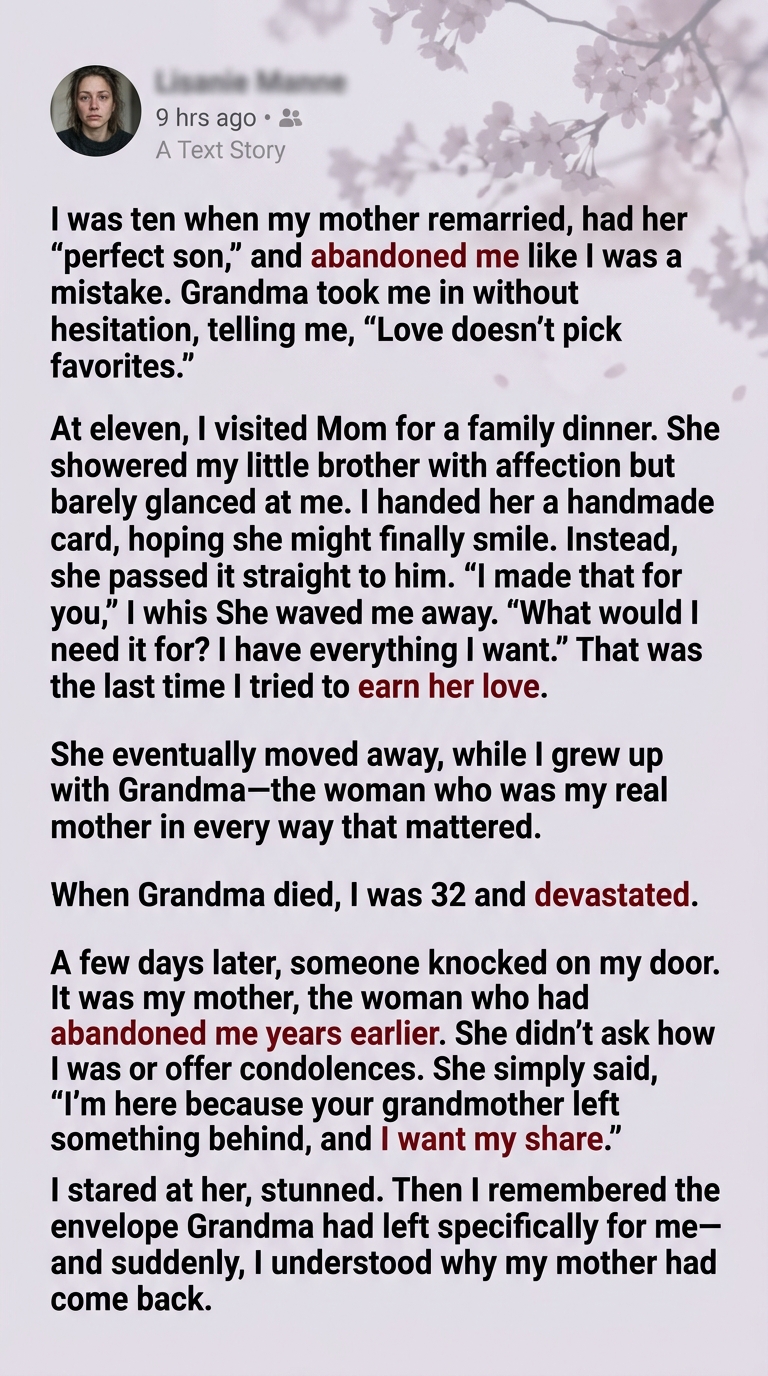
MY MOTHER ABANDONED ME FOR HER “PERFECT SON”—THEN RETURNED AFTER GRANDMA DIED DEMANDING HER SHARE
I was ten years old when my mother remarried and decided she finally had the family she wanted.
Her new husband, Richard, had a good job, a beautiful house, and a son from a previous relationship. A year later, she gave birth to a baby boy of her own.
His name was Ethan.
From the moment he arrived, everything changed.
My mother called him her miracle baby. She filled his room with expensive toys, took hundreds of photographs, and spent hours holding him.
Meanwhile, I became the child who was always in the way.
At first, I thought it was temporary.
I thought maybe she was tired from having a baby. Maybe she was adjusting to her new marriage. Maybe if I behaved better, helped more, or made her proud, she would eventually love me the way she used to.
But one afternoon, she sat me down and told me something I would never forget.
“Your grandmother has been asking about you. Maybe you should stay with her for a while.”
I looked at her.
“For how long?”
She avoided my eyes.
“We’ll see.”
I packed a small suitcase that evening.
Grandma arrived the next morning.
She didn’t ask why my mother wanted me gone. She didn’t criticize her or make me feel like a burden.
She simply hugged me and said:
“Come on, sweetheart. Your room is ready.”
That night, while she tucked me into bed, I asked her a question I had been afraid to ask anyone.
“Grandma, did I do something wrong?”
She sat beside me and brushed my hair away from my face.
“No, darling. Children are never responsible for the love adults fail to give them.”
Then she kissed my forehead.
“Love doesn’t pick favorites.”
I believed her.
And slowly, Grandma became my entire world.
She attended my school events, helped me with homework, taught me how to cook, and celebrated every little achievement.
When I got sick, she stayed awake beside me.
When I had nightmares, she held my hand.
When I graduated, she cried harder than anyone in the audience.
My mother, meanwhile, became a distant name.
She occasionally sent birthday messages, usually late and without much emotion. Sometimes she called around Christmas, but most conversations ended with her saying she was busy.
I kept hoping things would change.
Until I turned eleven.
That year, Grandma encouraged me to visit my mother for a family dinner.
“She’s still your mother,” she said gently. “You don’t have to stop loving someone just because they’ve disappointed you.”
So I went.
I spent the entire afternoon making a handmade card.
I decorated it with little flowers and wrote:
Dear Mom, I hope one day we can spend more time together. I miss you. Love, your daughter.
I even drew a picture of the two of us holding hands.
When I arrived, my mother barely looked up.
“Put your coat over there,” she said.
Ethan was sitting beside her, wearing a little birthday crown.
She kissed his cheeks, served him food, and laughed at everything he said.
I sat quietly at the other end of the table.
After dinner, I gathered my courage and handed her the card.
“I made this for you.”
She opened it, glanced at the drawing, and then passed it straight to Ethan.
“Look what your sister made. You can have it.”
I stared at her.
“I made that for you,” I whispered.
She waved her hand.
“What would I need it for? I have everything I want.”
I felt my throat tighten.
I looked at Ethan, who was too young to understand why I was crying.
Then I quietly picked up my coat.
I didn’t ask her to keep the card.
I didn’t ask for a hug.
I went home to Grandma and never tried to earn my mother’s love again.
Years passed.
I finished school, went to college, and eventually built a life of my own.
Grandma was there through all of it.
She helped me move into my first apartment, attended my graduation, and celebrated when I got my first real job.
She never had much money, but she gave me something more valuable.
A place where I never had to wonder whether I belonged.
My mother eventually moved away with Richard and Ethan. I heard through relatives that Ethan was doing well and that they had a comfortable life.
I didn’t ask for details.
By the time I was thirty-two, I had accepted that my mother and I would probably never have the relationship I once wanted.
Then Grandma died.
It happened unexpectedly after a short illness.
I was devastated.
She had been my mother in every way that mattered. Losing her felt like losing the person who had made the world safe for me.
I spent the following days arranging the funeral, meeting with the funeral director, and trying to make decisions through my grief.
A few days after the service, someone knocked on my apartment door.
I opened it.
My mother stood outside.
She looked older, but her expression was exactly the same.
No hug.
No apology.
No question about how I was coping.
She simply said:
“I’m here because your grandmother left something behind, and I want my share.”
I stared at her.
“Hello to you too.”
She sighed.
“Don’t start. I know she had money. I was her daughter, and I have rights.”
I felt something cold settle inside me.
“Grandma’s funeral was three days ago.”
“I know. That’s why we need to discuss the estate before everything gets distributed.”
I stepped aside, more out of disbelief than politeness.
She entered my apartment and looked around.
“You’re doing well for yourself.”
I didn’t answer.
She sat down without being invited.
“Your grandmother always favored you. She made that very clear. But I am still her daughter. Whatever she left should be shared fairly.”
I looked at her.
“Where were you when she needed you?”
My mother rolled her eyes.
“I had my own family to take care of.”
“And I was your family too.”
She looked away.
“Let’s not bring up the past.”
I almost laughed.
She had spent twenty-two years pretending I wasn’t part of her family, and now she wanted to discuss fairness.
Then I remembered the envelope.
Two weeks before Grandma died, she had called me into her bedroom.
She was tired, but her mind was perfectly clear.
She handed me a sealed envelope with my name written across it.
“Don’t open this until after I’m gone,” she had said.
I had promised.
Now I walked to my desk and took it out of the drawer.
My mother immediately leaned forward.
“What’s that?”
“Something Grandma left for me.”
She reached for it.
I pulled it away.
“It’s addressed to me.”
Her expression changed.
I opened the envelope.
Inside was a handwritten letter, a copy of Grandma’s will, and a document from her attorney.
I began reading.
My dearest girl,
If you’re reading this, I am no longer beside you. I wish I could have had more time, but I want you to know that you were never a burden to me.
My eyes filled with tears.
I continued.
I know your mother may come asking for things. I also know she may tell you that she deserves a share because she is my daughter.
I looked up.
My mother had gone completely still.
I continued reading.
I have spent years watching you grow into a kind, independent woman. I have also watched your mother make choices that hurt you. I cannot change the past, but I can make sure that my final wishes are clear.
Then came the part that made my mother sit forward.
I have left my house, savings, investments, and personal belongings to you. This is not because I love your mother less or because I want to punish anyone. It is because I have already given her substantial financial assistance over the years, and I want the remainder of my estate to go to the person I chose.
I looked at the attached document.
Grandma’s will had been properly signed and witnessed. Her attorney had prepared it several years earlier, and the estate records included a detailed list of her assets.
My mother snatched the letter from the table.
“She can’t do this!”
I took it back.
“She did.”
“I’m her daughter!”
“And I was her granddaughter.”
“She was my mother!”
“And she was the person who raised me.”
My mother stood up.
“This is ridiculous. I’ll challenge the will.”
I didn’t argue.
I simply handed her the attorney’s business card.
“Then you should speak to him.”
She looked at the documents again.
Then she noticed another page.
It was a record of financial assistance Grandma had given her over the years.
There were dates, amounts, and signed acknowledgments.
The total was substantial.
My mother looked at me.
“Why did she keep records of this?”
“Because Grandma was careful with money.”
She shook her head.
“She never told me she was doing this.”
I stared at her.
“Maybe she knew you would come asking for more.”
My mother slammed the papers onto the table.
“You think you’re better than me because she left you everything?”
“No.”
I paused.
“I think I was lucky because she loved me without making me compete for it.”
She stared at me.
For the first time, I saw something other than entitlement in her expression.
But it wasn’t regret.
It was anger.
“You’ve always turned her against me.”
I shook my head.
“No, Mom. You did that yourself.”
She left without saying goodbye.
The next few weeks were difficult.
My mother contacted relatives, telling them I had manipulated Grandma and stolen her inheritance.
Some family members called me asking for explanations.
I didn’t respond to every accusation.
Grandma’s attorney handled the estate process and provided the necessary documents.
The will was admitted through the appropriate legal process, and the estate was distributed according to Grandma’s documented wishes.
My mother eventually stopped calling.
But one afternoon, I received a message from Ethan.
He was twenty-one by then.
He wrote:
I heard what happened. Mom says Grandma left you everything. I don’t know what to believe.
I stared at the message for a long time.
Then I replied:
Grandma loved you too. This isn’t about you. If you ever want to know what happened, I’ll tell you the truth.
A few days later, he called.
We spoke for almost an hour.
He admitted he had always wondered why I wasn’t around when he was growing up. He remembered seeing the handmade card I had given him when he was little.
He still had it.
“I found it in an old box,” he said. “I never knew it meant that much to you.”
I began crying.
“It did.”
He apologized for something that hadn’t been his fault.
And for the first time, I realized that my mother’s choices didn’t have to determine every relationship in my life.
I kept Grandma’s house.
I didn’t sell it.
I turned the spare bedroom into a small reading room, filled with her favorite books and the photographs we had taken together.
Above the fireplace, I framed one of her handwritten notes.
It said:
Love doesn’t pick favorites.
Sometimes I still miss her so much that I catch myself reaching for the phone to call her.
But when I remember the last thing she told me, I feel a little less alone.
My mother came back because she wanted an inheritance.
She thought she could walk into my home after twenty-two years and claim what Grandma had left behind.
But she had forgotten something important.
Grandma had spent my entire childhood teaching me that love was something you showed through your actions.
And she had shown me more love in one lifetime than my mother had ever offered.
My mother gave me away when I was ten. Grandma gave me a home. And when the time came, Grandma made sure the woman who raised me was never forgotten.