AT 87, I WAS TOLD I WASN’T WELCOME AT MY SON’S DINNER—SO I CANCELED ALL 174 PAYMENTS
At 87 years old, I still believed there were certain things money couldn’t buy.
A place at your child’s table.
A phone call on a birthday.
The feeling that your family wanted you around.
Apparently, I had been wrong about all three.
My name is Margaret Whitmore. I was married to my husband, Arthur, for fifty-eight years before he passed away. We raised one son, Wesley, in a comfortable home outside Chicago. I thought we had raised him to understand gratitude, loyalty, and kindness.
I was wrong about that, too.
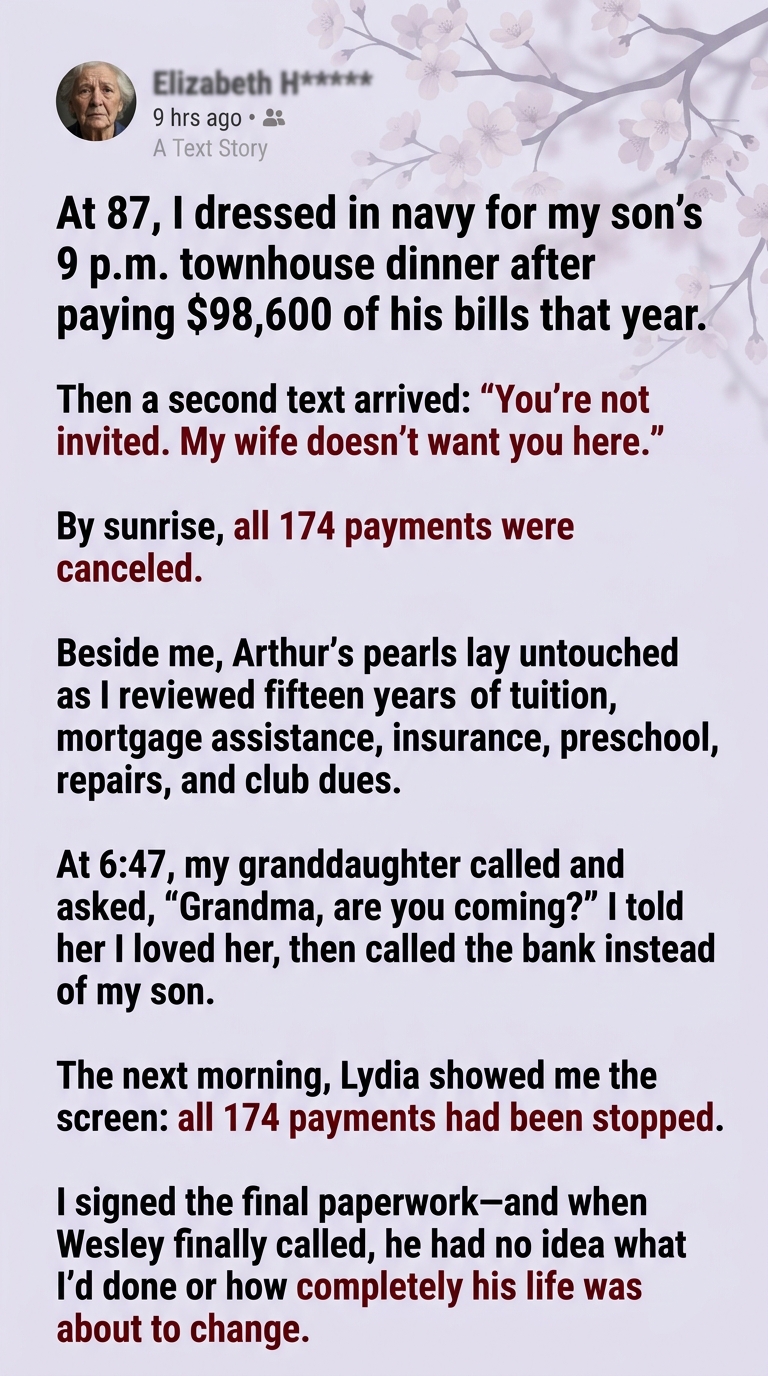
On a Thursday evening, I stood in front of my bedroom mirror wearing a navy-blue dress.
I had carefully chosen pearl earrings and Arthur’s favorite necklace. I was preparing to attend dinner at Wesley’s townhouse at nine o’clock.
He had invited me three days earlier.
“Just a small family dinner, Mom,” he had said. “Come around nine. The kids will be excited to see you.”
I was especially looking forward to seeing my granddaughter, Emma.
She was twelve and had always been affectionate with me. Every time she visited, she asked me to tell stories about her grandfather.
I had bought her a little silver music box for Christmas.
I placed it in a gift bag beside my handbag.
Then my phone buzzed.
It was a message from Wesley.
Mom, don’t come tonight. Something came up.
I stared at the screen.
Before I could respond, another message arrived.
You’re not invited. My wife doesn’t want you here.
I read it twice.
I thought perhaps there had been a misunderstanding.
I called him.
He rejected the call.
I sent a message asking whether I had done something wrong.
He replied:
Please don’t make this difficult. Just respect our decision.
I sat on the edge of my bed.
The navy dress suddenly felt ridiculous.
I removed Arthur’s pearls and placed them on the dresser.
Then I looked at the gift bag.
I had spent the entire afternoon getting ready to see my family.
And my own son had just told me I wasn’t welcome.
What made it worse was that I had spent $98,600 supporting his household that year.
Not because Wesley had asked me to attend dinner.
Not because I expected special treatment.
I had helped because I loved him.
For fifteen years, I had quietly paid bills that allowed his family to live comfortably.
The mortgage assistance began when Wesley’s business struggled.
Then came the children’s preschool fees.
Their health insurance premiums.
Emergency plumbing repairs.
Property taxes.
Car insurance.
Private club dues.
School tuition.
And countless smaller expenses that seemed harmless individually.
Every month, another payment left my account.
Some months, there were ten.
Other months, there were fifteen.
By the time I added everything up, I had made 174 recurring or scheduled payments connected to Wesley’s household.
I had never complained.
I had never demanded a thank-you.
But that night, something changed.
I walked downstairs and opened Arthur’s old financial folder.
He had always believed in keeping careful records.
Inside were fifteen years of statements, payment confirmations, and signed arrangements.
I sat at the kitchen table until after midnight.
At first, I cried.
Then I started reading.
And eventually, I stopped crying altogether.
At 6:47 the following morning, my phone rang.
It was Emma.
“Grandma?”
Her little voice sounded sleepy.
“Good morning, sweetheart.”
“Are you coming over today? Dad said you weren’t coming last night.”
I closed my eyes.
“No, darling. Not today.”
“Why?”
I looked at Arthur’s pearls sitting beside the folder.
“Sometimes grown-ups make decisions that hurt other people. But I want you to know something. I love you very much, and that will never change.”
She was quiet.
Then she asked:
“Did you do something wrong?”
My throat tightened.
“No, sweetheart. You didn’t do anything wrong, and neither did I.”
I didn’t tell her about the money.
I didn’t want her carrying adult problems.
After we hung up, I called Lydia.
Lydia had been my financial adviser for nearly twenty years. She knew Arthur’s estate, my accounts, and the financial arrangements I had made for Wesley.
When she answered, I didn’t waste time.
“I need you to review every payment connected to my son.”
There was a pause.
“All of them?”
“All 174.”
“Margaret, are you sure?”
I looked at the folder.
“Yes. I want to know which ones can be stopped immediately, which ones are legally binding, and which ones require notice.”
Lydia arrived at my house two hours later.
She spread the documents across my dining table.
We reviewed every account.
Some payments were straightforward recurring gifts. Others were direct payments to service providers. A few involved written agreements that required careful handling.
Lydia explained that we couldn’t simply cancel every obligation without checking the terms.
I agreed.
I wasn’t interested in creating a legal mess.
I wanted to stop voluntarily supporting a household that had decided I wasn’t welcome in it.
By lunchtime, we had a complete list.
The payments included:
-
Monthly mortgage assistance.
-
Private school and tuition contributions.
-
Preschool and childcare fees.
-
Health and supplemental insurance premiums.
-
Vehicle insurance.
-
Home maintenance and repair arrangements.
-
Property-related expenses.
-
Membership and club dues.
-
Several household subscriptions and recurring transfers.
Lydia reviewed each one.
“You’re not obligated to continue most of these,” she said. “But we’ll handle the contractual arrangements separately.”
I nodded.
“Then let’s do it properly.”
By the next morning, the bank had processed the cancellations and suspensions we had authorized.
Lydia showed me the updated screen.
All 174 payment arrangements had been stopped, canceled, or placed on hold according to their terms.
I signed the final paperwork.
For the first time in fifteen years, my money was no longer automatically flowing into Wesley’s household.
I thought I would feel guilty.
Instead, I felt strangely peaceful.
Then my phone began ringing.
At 8:12 a.m., Wesley called.
I let it ring.
At 8:19, he called again.
Then came a message.
Mom, something is wrong with the mortgage payment.
I didn’t respond.
Another message arrived.
The school says the tuition payment didn’t go through. Did you change something?
I placed my phone face down.
A few minutes later, he called again.
This time, I answered.
“Good morning, Wesley.”
“Mom! What happened?”
“Good morning to you, too.”
“Why did you stop the payments?”
I took a breath.
“Because I decided to stop paying your bills.”
He laughed nervously.
“Okay, but this isn’t funny. The mortgage payment is due, and the school is contacting us.”
“I understand.”
“Mom, you can’t just do this without telling me!”
I glanced at the navy dress hanging over the chair.
“Interesting. You didn’t seem to think I deserved a conversation before telling me I wasn’t welcome at your house.”
He became quiet.
Then he said:
“That’s completely different.”
“Is it?”
“Mom, my wife was upset. We had a disagreement. It wasn’t supposed to become this big.”
“What disagreement?”
He hesitated.
“She thinks you interfere too much.”
I looked at the photographs on my mantel.
Arthur and I at our wedding.
Wesley as a little boy.
Wesley holding Emma when she was born.
“I have paid your mortgage, your children’s tuition, your insurance, and your household expenses for fifteen years. What exactly have I interfered with?”
He sighed.
“That’s not what I meant.”
“Then explain it.”
He didn’t.
Instead, he asked:
“Are you really going to punish your grandchildren because you’re angry with me?”
That sentence hurt more than the original message.
“I am not punishing Emma or her brother. I’m stopping payments that I have voluntarily made for you and your wife. You are their parents. Their expenses are your responsibility.”
“But we can’t afford everything without your help!”
I looked at the paperwork.
“Then you should have considered that before treating my presence like an inconvenience.”
He lowered his voice.
“Mom, please. We need to talk about this.”
I answered calmly.
“We can talk when you’re ready to discuss our relationship, not just your bank account.”
Then I ended the call.
I expected him to be angry.
I didn’t expect what happened next.
That afternoon, my daughter-in-law, Claire, sent me a message.
I hope you’re happy. You’ve put the children in an impossible position.
I read it carefully.
Then I replied:
The children have done nothing wrong. I love them and will always be here for them. But I will no longer pay for a household where I am considered unwelcome.
She didn’t respond.
Over the next week, the situation became increasingly uncomfortable for Wesley.
He discovered that the financial support I had provided was much larger than he had acknowledged.
He had built his household budget around payments he never personally made.
Without my assistance, he had to review his spending, contact lenders, and make new arrangements with service providers.
Some expenses could be reduced.
Others required difficult decisions.
He and Claire canceled their club membership.
They sold a second vehicle.
They contacted the school to discuss a payment plan.
And they had to reconsider their housing expenses.
I didn’t celebrate any of it.
I wasn’t trying to ruin my son’s life.
I simply refused to keep funding a lifestyle that depended on my silence.
A few weeks later, Wesley came to my house.
He stood on the porch holding a small box of flowers.
I opened the door but didn’t immediately invite him inside.
“Can we talk, Mom?”
“Of course.”
He looked exhausted.
“I’ve made mistakes.”
I waited.
He continued.
“Claire and I were under pressure. The bills were getting bigger, and we thought we could manage everything if you kept helping.”
I said nothing.
“She didn’t want you at dinner because she thought you would bring up the money.”
That surprised me.
“I wasn’t planning to discuss money.”
“I know.”
“Then why did you let her send that message?”
He looked down.
“I didn’t want another argument with her.”
I stared at my son.
“You were willing to hurt your mother to avoid an uncomfortable conversation with your wife?”
He didn’t answer.
I stepped aside and let him enter.
We sat in the living room.
For the first time, I told him exactly how the second message had made me feel.
I told him about the dress.
The pearls.
The gift for Emma.
The dinner I had spent the day preparing for.
And the fact that after fifteen years of helping him, he couldn’t even tell me to my face that I wasn’t welcome.
He began crying.
“Mom, I’m sorry.”
I looked at him.
“Are you sorry you hurt me, or are you sorry the payments stopped?”
He wiped his face.
“I don’t know how to answer that.”
“Then take some time and figure it out.”
He sat quietly for several minutes.
Finally, he asked:
“Will you ever help us again?”
I didn’t give him the answer he wanted.
“I don’t know. But if I ever choose to help you financially again, it will be because I want to—not because you expect it.”
He nodded.
Then he asked whether he could bring Emma to visit.
“Of course,” I said. “She is always welcome.”
And I meant it.
A month later, Emma came over with a school project.
She ran through my front door and hugged me so tightly that I nearly lost my balance.
“Grandma! I missed you!”
I held her for a long time.
We spent the afternoon making a scrapbook about her grandfather.
She asked about Arthur’s childhood, his favorite food, and the stories he used to tell.
I showed her photographs and let her choose one to take home.
Before she left, she handed me a folded piece of paper.
It was a drawing.
Three people stood beneath a bright yellow sun.
One was a little girl.
One was a grandmother.
And the third was a man holding a fishing rod.
Underneath, she had written:
I wish Grandpa could have met me when I was bigger.
I cried after she left.
Not because I regretted stopping the payments.
Because I realized how much more valuable those afternoons were than all the money I had spent.
Wesley eventually apologized again.
This time, he didn’t mention the mortgage.
He asked whether we could start having Sunday lunch once a month.
I agreed.
Our relationship wasn’t magically repaired.
Trust takes time.
But we began again, slowly.
I never restarted the 174 payments.
And I didn’t need to.
At eighty-seven, I finally understood that being a good mother did not mean financing every decision my adult son made.
I could love Wesley without paying his bills.
I could love Emma without funding her parents’ lifestyle.
And I could miss my husband without allowing loneliness to make me accept disrespect.
The navy dress is still in my closet.
Arthur’s pearls are still in their little box.
Sometimes I look at them and remember the night I thought I was losing my family.
But I wasn’t losing my family that night.
I was finally learning which parts of it were built on love—and which parts had been built on my money.
And when Wesley called me the next morning, he thought I had canceled 174 payments.
What he didn’t understand was that I had also canceled the assumption that my love would always come with a blank check.