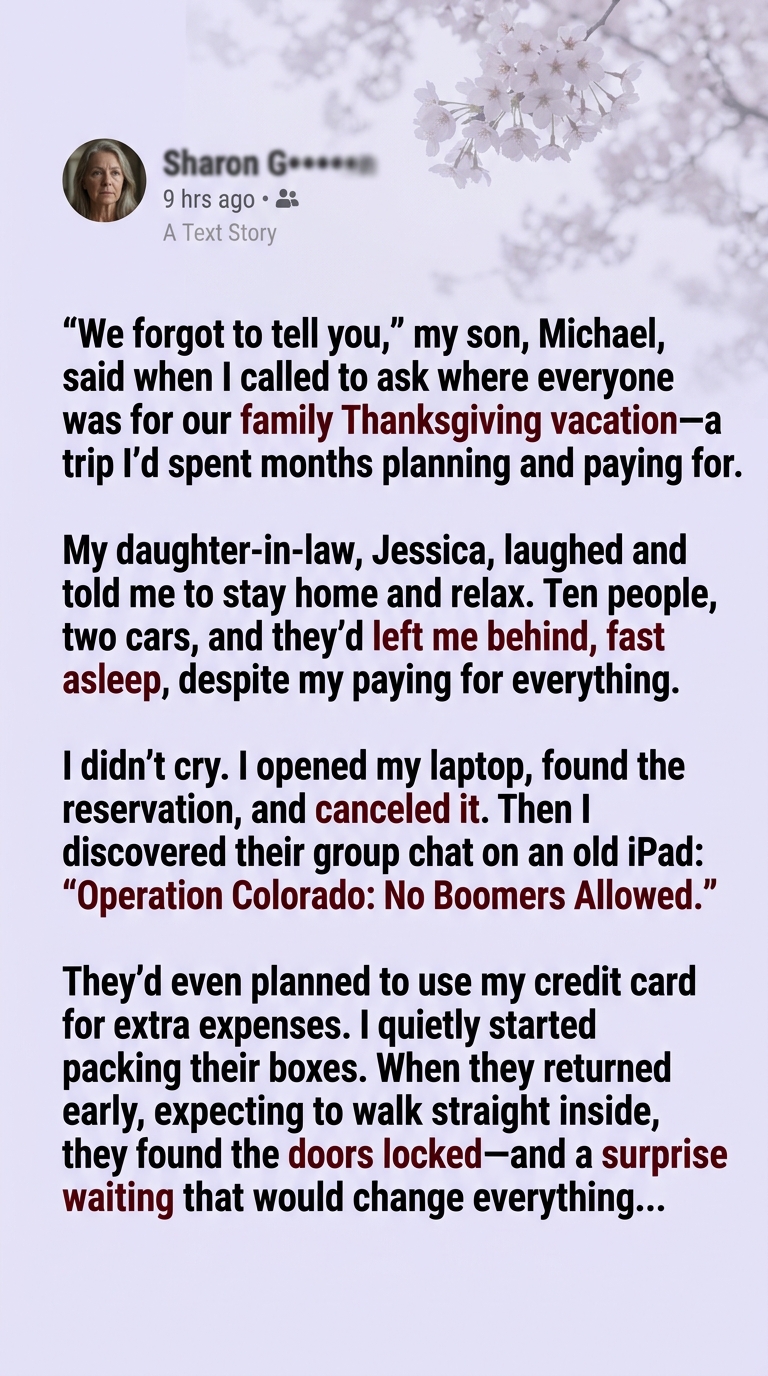
MY FAMILY LEFT ME BEHIND ON THE THANKSGIVING VACATION I PAID FOR—WHEN THEY RETURNED, THEY FOUND THE DOORS LOCKED
“We forgot to tell you.”
Those were the first words my son said when I called to ask where everyone was.
I was standing in my kitchen wearing the new sweater I’d bought specifically for our Thanksgiving trip to Colorado. My suitcase was beside the front door. My winter boots were lined up neatly underneath the coat rack.
Outside, the morning was bright and cold.
Inside, the house was silent.
“Michael, what do you mean you forgot to tell me?”
He sighed.
“Mom, we’re already on the road.”
I stared at the suitcase.
“On the road where?”
“To Colorado. We’re heading to the cabin.”
I felt my stomach tighten.
“What about me?”
There was a pause.
Then I heard my daughter-in-law, Jessica, laughing in the background.
“Oh, tell her we thought she’d prefer staying home.”
Michael lowered his voice.
“Mom, Jessica thinks you should just relax at home. The drive is long, and the kids have been excited about the trip.”
I couldn’t believe what I was hearing.
I had spent four months organizing that vacation.
I had booked a beautiful mountain cabin with five bedrooms, arranged transportation, paid for the rental vehicles, purchased the groceries, and covered the reservation deposits.
Ten people were supposed to go.
My son, his wife, their three children, my daughter and her husband, my nephew, and me.
I had paid for nearly everything.
And now they were telling me I wasn’t invited.
“Michael, did you leave without waking me?”
He hesitated.
“Yeah. You were sleeping, and we didn’t want to disturb you.”
I looked at the clock.
It was 7:42 in the morning.
I had gone to bed early because we were supposed to leave at eight.
“You could have woken me up.”
“Mom, please don’t make this a big deal.”
Jessica took the phone.
“Honestly, you should be grateful. You get the house to yourself for a few days. You can watch your shows, relax, and enjoy some peace.”
I stood completely still.
“Jessica, I paid for this trip.”
She laughed.
“And we appreciate it. But that doesn’t mean you have to come.”
Then she ended the call.
I didn’t cry.
I didn’t scream.
I simply walked to the kitchen table, opened my laptop, and logged into the travel account.
The cabin reservation was still active.
The rental vehicles were still booked.
The grocery delivery was scheduled.
And every charge was connected to my credit card.
I stared at the screen for several minutes.
Then I began canceling.
The cabin reservation went first.
Then the two rental vehicles.
Then the prepaid activities.
I contacted the grocery service and canceled the delivery.
Some payments were refundable. Others weren’t.
I didn’t care.
I wasn’t going to keep financing a vacation for people who had deliberately excluded me.
But I wasn’t finished.
While searching through my email for the reservation confirmation, I remembered an old iPad Michael had left at my house months earlier.
It was sitting in a drawer in the guest room.
I turned it on.
The device was still connected to a family messaging account.
I wasn’t looking for anything private.
I was trying to find the booking details.
But a group chat notification appeared on the screen.
The title made my stomach drop.
OPERATION COLORADO: NO BOOMERS ALLOWED
I opened it.
The first message was from Jessica.
Okay, everyone. Remember, don’t tell Margaret the departure time. If we leave before she wakes up, we won’t have to deal with the guilt trip.
My daughter had responded with laughing emojis.
Michael wrote:
She’ll get over it. She’s always trying to make everything about herself.
Then Jessica sent another message.
The best part is that she already paid for everything. We can use her card for the extra expenses once we’re there.
My nephew replied:
Does she know we’re planning to charge the ski rentals to her card?
Jessica answered:
No. She won’t notice until after Thanksgiving.
I felt my hands go cold.
There were more messages.
They had discussed leaving me behind weeks earlier.
They had even planned to tell the grandchildren that I had chosen not to come because I was too old for the trip.
One message from Michael made me stop breathing for a moment.
Just tell the kids Grandma wanted to stay home. No reason to make this complicated.
I closed the iPad.
For a long time, I sat at the table without moving.
I had raised Michael alone after his father died.
I had worked two jobs to put him through college.
I had helped him buy his first house.
I had paid for his wedding reception when his finances were tight.
And now he was participating in a plan to use my money while pretending I didn’t exist.
I looked at the family photograph on the wall.
Everyone was smiling.
I wondered how long I had been the only person who believed that picture represented something real.
Then I picked up my phone and called my attorney.
Her name was Laura Bennett.
She had helped me manage my husband’s estate and prepare my financial documents.
When I explained what happened, she listened without interrupting.
Finally, she asked:
“Are any of these people living in your house?”
I looked toward the hallway.
Michael and Jessica had been staying with me for the past six months while renovating their home.
They had moved in temporarily with their three children.
The arrangement had become less temporary every week.
They used my kitchen, my laundry room, my internet, and my utilities.
They contributed very little toward expenses.
And I had allowed it because they were family.
“Yes,” I answered.
“Then don’t change the locks or remove anyone’s belongings until we review the occupancy arrangement and the applicable rules. We need to handle this correctly.”
I agreed.
I wasn’t interested in doing something reckless.
I wanted my home and finances protected.
Laura asked me to gather the documents relating to the arrangement, the payments I had made, and the messages from the group chat.
I took screenshots of everything.
Then she gave me a list of steps to follow.
The first was to protect my financial accounts.
I called the credit card company and removed the additional spending authorization I had previously given Michael for household purchases.
I changed my online passwords.
I canceled the saved payment methods on the travel accounts.
Then I reviewed my bank statements.
What I found made me even angrier.
There were several charges I didn’t recognize.
A restaurant bill.
A clothing purchase.
A weekend hotel reservation.
And a large payment to a sporting goods store.
They had been using my card for personal expenses for months.
I documented everything and sent it to Laura.
By lunchtime, I had made another decision.
I would no longer allow Michael and Jessica to treat my home as though it belonged to them.
Laura prepared the appropriate written notice regarding their living arrangement and advised me on the next steps.
I followed her instructions carefully.
I also arranged for a professional to help me inventory the belongings they had brought into the house.
I wasn’t throwing anything into the street.
I wasn’t destroying their property.
I simply wanted everything documented and ready for a properly handled move-out.
I packed my own belongings first.
Then I moved the family photographs from the hallway into my bedroom.
I removed the extra credit cards from the household drawer.
I gathered the spare keys and reviewed who had access to the property.
By late afternoon, the house felt different.
For the first time in months, it felt like my home again.
Then my phone rang.
It was Michael.
“Mom, something’s wrong.”
I looked at the screen.
“What happened?”
“The cabin reservation was canceled.”
“Yes.”
“Why?”
“Because I canceled it.”
He went silent.
Then Jessica’s voice came through.
“Are you serious?”
“Yes.”
“You can’t do that! We’re already halfway there!”
I glanced at the old iPad.
“Were you planning to charge extra expenses to my credit card?”
Neither answered.
I continued.
“I read your group chat.”
The silence was immediate.
Michael finally spoke.
“You went through my messages?”
“You left the device in my house. But that’s not the important part. You planned to leave me behind, lie to the children, and continue using my money.”
Jessica snapped:
“We were trying to have one vacation without you making everything about yourself!”
I laughed quietly.
“You planned a vacation using my money without inviting me. I think I understand exactly what you wanted.”
Michael lowered his voice.
“Mom, can we please talk about this when we get back?”
“Of course.”
“Good. We’ll be home Sunday.”
I looked at the written notice on the table.
“Actually, we have a few things to discuss before then.”
He didn’t respond.
I ended the call.
But the biggest surprise came the following morning.
My daughter, Rachel, called.
“Mom, what is going on?”
I asked her what she meant.
“Jessica says you canceled everything because you were upset about not coming. She says you’re threatening to throw them out.”
I took a breath.
“Rachel, did you read the group chat?”
She hesitated.
“No.”
“Would you like to?”
I sent her the screenshots.
Twenty minutes later, she called again.
Her voice was shaking.
“I didn’t know they planned this.”
I believed her.
She had participated in the trip, but she hadn’t written the messages about using my credit card or lying to the children.
Still, I needed her to understand that staying silent had consequences.
“Rachel, I love you. But I need you to understand that I cannot keep paying for everyone while being treated like an inconvenience.”
She apologized.
I thanked her.
Then I returned to the paperwork.
On Sunday morning, my doorbell rang.
I looked through the window.
Michael’s SUV was in the driveway.
Jessica’s car pulled in behind it.
The children climbed out, carrying backpacks and shopping bags.
They were laughing.
They clearly expected to walk inside, unload their belongings, and continue their comfortable lives.
Michael stepped onto the porch and reached for his key.
It didn’t work.
He tried again.
Then he knocked.
“Mom! Open the door!”
I stood behind the glass.
“Good morning, Michael.”
He looked confused.
“Why isn’t the key working?”
“Because the access arrangements have changed.”
Jessica stepped forward.
“What does that mean?”
I opened the door but remained in the doorway.
Behind me, on the dining table, were three folders.
One contained the canceled vacation reservations and the financial records.
Another contained the credit card statements and screenshots from their group chat.
The third contained the paperwork prepared by Laura regarding their living arrangement and the required next steps.
Michael stared at the folders.
“What is all this?”
“An explanation.”
Jessica folded her arms.
“You can’t just lock us out!”
“I haven’t removed anyone’s belongings, and I have followed the legal process my attorney advised. But you need to understand that this arrangement is ending.”
Michael looked at me.
“Mom, we’re your family!”
I nodded.
“Yes. And that’s why this hurts so much.”
I stepped aside and let them enter under the arrangements Laura had advised.
The children ran toward the living room.
I greeted them warmly and took them into the kitchen.
I didn’t want them involved in an argument they didn’t understand.
Then I returned to the dining room.
Michael had opened the first folder.
He stared at the canceled reservations.
Jessica picked up the screenshots.
Her face changed.
“You actually saved these?”
“Yes.”
She threw the pages onto the table.
“This is private!”
I looked at her.
“Using my credit card without permission is not private.”
Michael rubbed his forehead.
“Mom, we made a mistake. We shouldn’t have left you behind.”
I waited.
He continued.
“We can fix this. We’ll pay you back for the extra expenses.”
I shook my head.
“That’s not what this is about anymore.”
“Then what do you want?”
I looked at my son.
“I want my home back. I want control of my money. And I want you to understand that being my child doesn’t give you permission to use me.”
Jessica scoffed.
“You’re choosing a vacation over your family?”
I looked directly at her.
“No. I’m choosing not to finance people who deliberately excluded me from their family.”
Michael looked down.
For once, he didn’t have an answer.
Laura’s paperwork made the next steps clear.
The family had a reasonable period to make arrangements for moving out, and we would follow the required process. Any disputed charges would be reviewed separately.
There would be no shouting matches, no surprise lockouts, and no threats.
Just boundaries.
Over the following weeks, Michael and Jessica arranged a new living situation.
They had to reconsider their spending and take responsibility for expenses they had previously expected me to cover.
I didn’t pay their rent.
I didn’t pay their moving costs.
I didn’t pay their credit card bills.
But I continued to see my grandchildren.
I made sure they knew the situation was between adults and that none of them had done anything wrong.
A month later, Michael came to visit alone.
He sat across from me at the kitchen table.
“Mom, I’m sorry.”
I looked at him.
“For what?”
“For leaving you behind. For the messages. For using your card. For letting Jessica treat you that way.”
I nodded.
“Thank you for saying that.”
He looked down.
“I don’t know why I thought you would just keep helping us no matter what.”
I answered honestly.
“Because I always had.”
He began to cry.
I reached across the table, but I didn’t immediately take his hand.
“Michael, I love you. But I can’t keep proving that by paying for everything.”
He nodded.
“I understand.”
I hope he did.
Our relationship didn’t return to what it had been before.
It couldn’t.
Trust takes longer to rebuild than a vacation takes to plan.
But we began having lunch occasionally, and he started calling without asking for money.
Jessica remained distant for a while.
Eventually, she sent a brief apology.
I accepted it without pretending everything was fine.
As for the Colorado vacation, I never rebooked it.
I took the money I had recovered from the canceled reservations and used part of it to plan a small trip for myself.
I went with two longtime friends.
We stayed in a beautiful mountain lodge, watched the snow fall outside the windows, and spent our evenings laughing over dinner.
On the last night, I sat by the fireplace with a cup of tea.
I thought about the morning my family had left without me.
For a while, I had believed I was being abandoned.
But that trip taught me something.
I had spent years making myself useful so my family would always have a reason to include me.
I paid the bills.
I organized the holidays.
I solved the problems.
I made everything easier.
And somewhere along the way, I had allowed them to confuse my generosity with an obligation.
I didn’t need to buy a seat at my own family’s table.
And I certainly didn’t need to pay for a vacation where I wasn’t wanted.
The greatest surprise waiting for them when they returned wasn’t the canceled reservation.
It was the fact that the woman they thought would always say yes had finally learned how to say no.