A BOY BURIED A LETTER FOR ME IN 1965—SIXTY YEARS LATER, HE FINALLY TOLD ME WHY
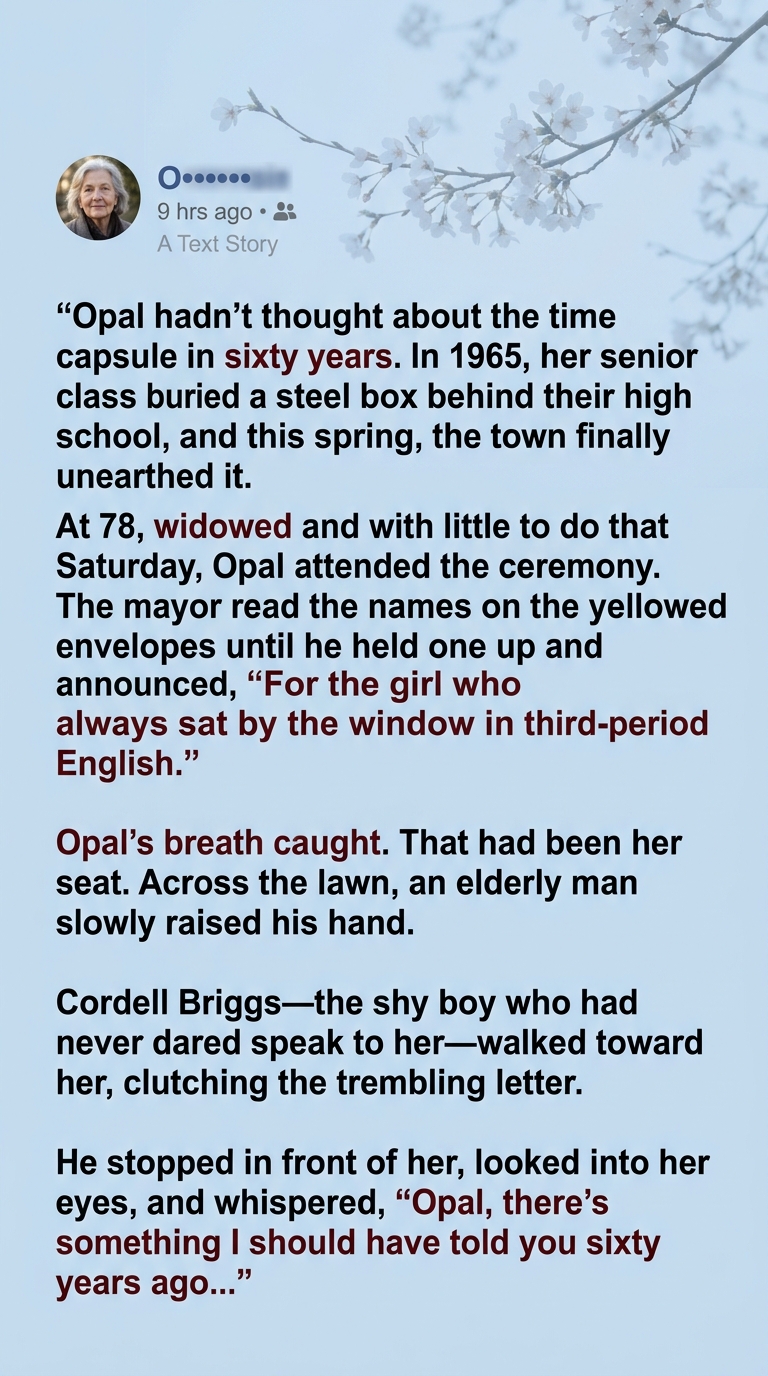
“Opal, there’s something I should have told you sixty years ago.”
Cordell Briggs stood in front of me, holding a yellowed envelope with both hands.
His fingers trembled.
His hair was almost completely white, and his shoulders had grown thinner with age, but his eyes were unmistakable.
They were the same gentle eyes I remembered from high school.
For a moment, I couldn’t speak.
Then I managed to whisper, “Cordell?”
He nodded.
“I never thought I’d get the chance to give this to you.”
Behind us, the mayor continued speaking to the crowd gathered on the school lawn. People were taking photographs, laughing, and examining the old objects recovered from the time capsule.
But I could hear none of it.
All I could see was the envelope.
My name was written across the front.
Opal.
In handwriting I hadn’t seen since 1965.
I was seventy-eight years old, a widow, and I had come to the ceremony expecting nothing more than a pleasant afternoon remembering my school years.
I hadn’t expected a letter from a boy who had once been too shy to say hello.
“What’s in it?” I asked.
Cordell looked down.
“Everything I couldn’t tell you back then.”
I reached for the envelope.
And suddenly, I was seventeen again.
It was 1965.
Our high school was preparing for graduation, and the senior class had decided to bury a steel time capsule behind the old gymnasium.
Everyone was asked to contribute something.
Some students included photographs.
Others placed newspaper clippings, coins, school programs, and letters to their future selves.
I contributed a small photograph of my parents and a handwritten note about the kind of life I hoped to have.
I wanted to become a teacher.
I wanted a little house with a garden.
And I wanted to travel somewhere far away.
I had no idea how much my life would eventually change.
Cordell Briggs was in my English class.
He was quiet, polite, and almost painfully shy.
He sat near the back of the room, usually beside the windows.
I sat two rows ahead of him.
Sometimes, when the teacher asked a question, I would turn around and notice him looking in my direction.
The moment our eyes met, he would look down at his notebook.
I thought he was simply a quiet boy.
I never imagined he had feelings for me.
One afternoon, I dropped my books outside the library.
Papers scattered across the floor.
Cordell was walking past.
He immediately stopped and helped me gather everything.
“Thank you,” I said.
He nodded.
“You’re welcome.”
I smiled.
“See you in English.”
He looked at me as if I had just given him the greatest gift in the world.
But he never said anything more.
A few weeks later, our teacher announced that the time capsule would be sealed on Friday.
I remember writing my letter that evening.
I addressed it to myself at age seventy.
I wrote about my dreams, my fears, and the boy I thought I might someday marry.
I didn’t mention Cordell.
I didn’t even know his first name was something I would remember sixty years later.
At graduation, everyone went their separate ways.
I went to college.
Cordell stayed in town for a while before eventually moving away.
I married a wonderful man named Thomas, raised two children, and built a life I was grateful for.
Thomas died twelve years ago.
Our children lived in different states, and although they called regularly, my days had become quieter.
I had never thought much about Cordell.
Until that Saturday.
The town had announced that the time capsule would finally be opened after six decades.
The original school building had been renovated, and the ceremony was being held on the same lawn where we had buried the box.
I almost didn’t attend.
But I thought it might be nice to see some old classmates.
I wore a blue cardigan, comfortable shoes, and a small silver necklace Thomas had given me on our fortieth anniversary.
I arrived shortly before noon.
The mayor welcomed everyone and explained that the steel box had been recovered from behind the old gymnasium.
It was rusty, but most of its contents had survived.
Several yellowed envelopes were removed.
The mayor began reading the names.
Then he held up one envelope.
“Here’s an interesting one,” he announced.
“For the girl who always sat by the window in third-period English.”
My breath caught.
That had been my seat.
I looked toward the table.
The mayor examined the envelope.
“There’s no full name written here. Just a description.”
Then an elderly man near the back raised his hand.
It was Cordell.
He slowly walked toward me.
And now he was standing in front of me with the letter.
“Opal,” he said.
I swallowed.
“What does it say?”
He looked at me.
“May I sit with you?”
We moved to a bench beneath the old oak tree.
He carefully opened the envelope.
Inside was a letter, folded into thirds.
He handed it to me.
“Read it,” he whispered.
I unfolded the paper.
The first line made my eyes fill immediately.
Dear Opal,
I don’t know if you’ll ever read this.
I’ve watched you sit by the window in English class for almost a year. I know you probably haven’t noticed me, but I’ve noticed you every day.
You always arrive carrying too many books. You always tuck your hair behind your ear when you’re thinking. And whenever you laugh, I forget whatever I was trying to say.
I stopped reading.
Cordell looked away.
“Keep going.”
I continued.
I wanted to ask you to the spring dance, but I was afraid you would laugh.
I wanted to walk you home, but I was afraid you would say no.
I wanted to tell you that I thought you were the most wonderful girl in our entire school.
But I never did.
My father has accepted a job in another state, and we’re leaving after graduation.
I don’t know what will happen to me. I only know that if I leave without telling you, I’ll regret it for the rest of my life.
So I’m putting this letter in the time capsule.
Maybe when we’re old, you’ll read it and know that someone loved you quietly when you were seventeen.
I hope you have a beautiful life.
And I hope someone tells you every day how special you are.
Cordell.
I pressed the letter against my chest.
For several seconds, neither of us spoke.
Then I looked at him.
“Why didn’t you give it to me?”
He gave a sad little smile.
“Because I was seventeen and terrified.”
I laughed through my tears.
“You could have just said hello.”
“I know.”
He looked toward the old school building.
“My father was very strict. He had already decided we’d be leaving. I thought there was no point starting something I couldn’t continue.”
I folded the letter carefully.
“Did you ever think about me after you left?”
He nodded.
“More than I should admit.”
He told me that his family had moved to Oregon shortly after graduation.
He had gone to college, worked as an engineer, and eventually married a woman named Helen.
They had two children.
He spoke about her with warmth.
“She was a wonderful woman,” he said. “She passed away six years ago.”
I told him about Thomas.
We talked about our marriages, our children, our grandchildren, and the lives we had built.
It was surprisingly easy.
We weren’t two teenagers anymore.
We were simply two elderly people sitting beneath a tree, remembering the people we used to be.
Then Cordell reached into his jacket pocket.
“There is one more thing.”
He handed me a small photograph.
It was a picture of our high school classroom.
I was sitting by the window, looking down at a book.
Cordell was visible in the background.
He was looking directly at me.
I laughed.
“You kept this?”
He nodded.
“I found it in my mother’s things after she died. I recognized you immediately.”
I studied the photograph.
“Why did you come today?”
He looked at me.
“Because I saw the announcement about the time capsule. I knew my letter was inside. I thought this might be my only chance to give it to you.”
I looked down at the envelope.
“Did you know the mayor would read it?”
“No. I had asked him to keep it aside if he found it. But when he announced the description, I realized I couldn’t wait any longer.”
I smiled.
“You were still shy after sixty years.”
He laughed.
“Some things never change.”
We spent the rest of the afternoon together.
At one point, the mayor invited us to stand for a photograph.
He explained that our reunion was one of the most touching moments of the ceremony.
Cordell looked embarrassed.
I squeezed his arm.
“Don’t worry. We have already survived high school. We can survive a photograph.”
He laughed again.
Before we parted, he asked whether I would like to have coffee sometime.
I looked at him.
“Are you asking me on a date, Cordell Briggs?”
His cheeks turned pink.
“I suppose I am.”
I smiled.
“Then you should know I’m seventy-eight years old.”
He nodded solemnly.
“I’m eighty.”
“Well, that’s two very old people having coffee.”
He grinned.
“I’ve been waiting sixty years. I think I can manage.”
We exchanged phone numbers.
I drove home that evening with the letter on the passenger seat.
For the first time in years, I felt something I hadn’t expected to feel again.
Not young.
Not foolish.
Just curious.
Curious about the man Cordell had become.
Curious about what we might have to talk about.
Curious about whether a friendship could begin after so much time.
Three days later, he called.
We met at a little café near the town library.
He brought a small bouquet of yellow tulips.
I laughed when I saw them.
“Why yellow?”
He shrugged.
“You always wore yellow in the spring.”
I stared at him.
“You remember that?”
“I remember more than you think.”
We began meeting regularly.
Sometimes for coffee.
Sometimes for lunch.
Sometimes just to walk through the park and talk.
We never pretended we could recover the years we had missed.
We had both loved other people.
We had both raised families.
We had both experienced loss.
But we discovered that we still enjoyed each other’s company.
A few months later, Cordell invited me to visit the old school library.
The building had been renovated, but the third-period English classroom was still there.
We stood outside the window.
“That’s where you sat,” he said.
I smiled.
“And that’s where you sat.”
He pointed to the back row.
I looked at him.
“You know, if you’d spoken to me, I might have gone to the spring dance with you.”
He laughed.
“That’s the sentence I’ve been hoping to hear for sixty years.”
I slipped my hand into his.
“Then I’m glad you finally gave me the letter.”
That evening, I placed the envelope in a wooden box beside my husband’s old photographs.
I didn’t put it away because I wanted to forget it.
I kept it because it reminded me of something important.
Life doesn’t always follow the plans we make at seventeen.
Sometimes the people we love become memories.
Sometimes opportunities pass without us noticing.
And sometimes, when we think our story is nearly finished, life surprises us with another chapter.
I never became the girl who married the boy from English class.
But I became a woman who got to know him sixty years later.
And that was something I never could have imagined.
The time capsule was buried in 1965 to preserve memories of the past.
But for Cordell and me, it gave us something neither of us expected.
A chance to finally say what we had left unsaid.
And when he called me the following Sunday, he didn’t ask whether I remembered the letter.
He simply said:
“Good morning, Opal. Would you like to sit by the window with me again?”
I smiled.
“Only if you promise to talk this time.”