MY FAMILY DISOWNED ME OVER A $64,000 BIRTHDAY PARTY—SO I STOPPED PAYING THEIR BILLS
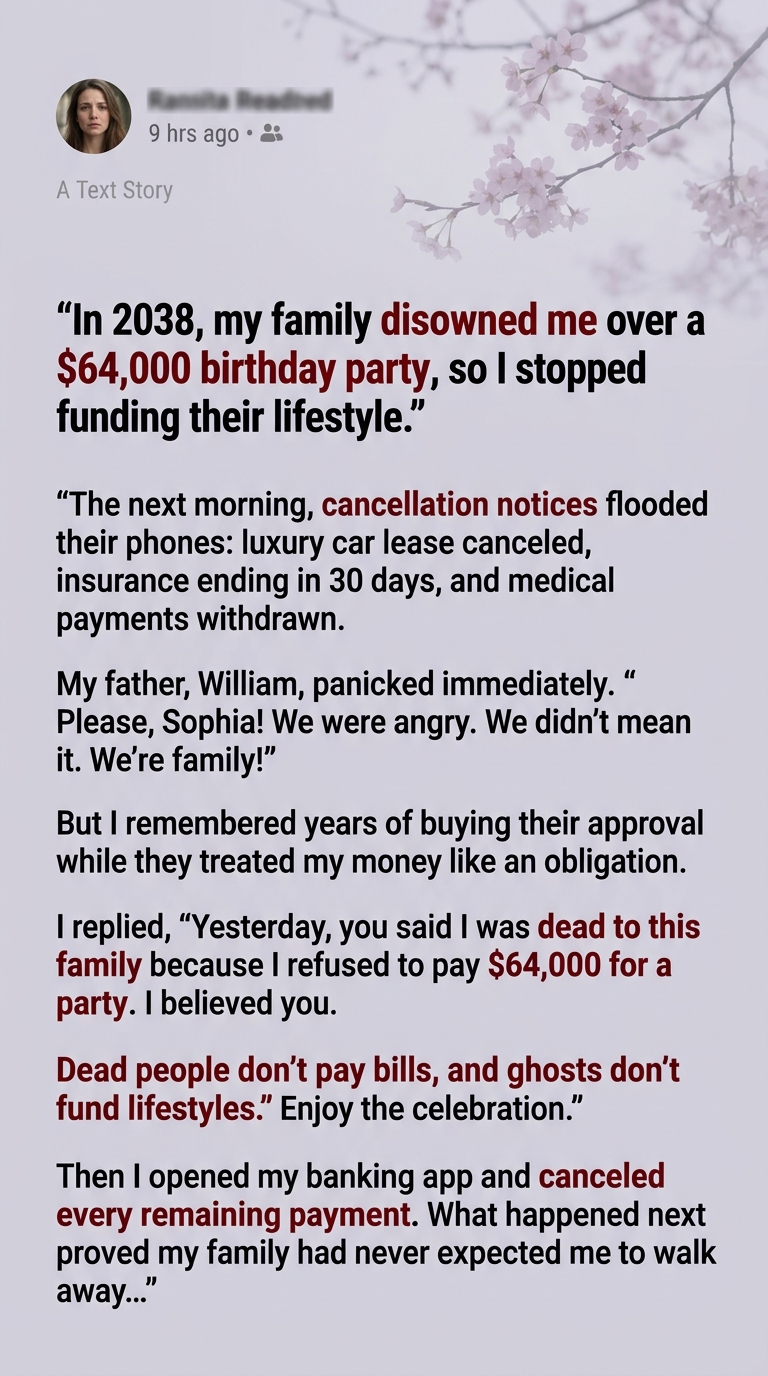
In 2038, my family disowned me over a $64,000 birthday party.
By the following morning, they were begging me to come back.
But by then, I had already discovered something I should have understood years earlier: my family didn’t love the life we shared. They loved the lifestyle I paid for.
My name is Sophia Bennett. I was thirty-four, successful, and financially comfortable. I had built my career from nothing, working long nights, missing vacations, and saving money while my friends enjoyed their twenties.
My family always told me how proud they were.
At least, that’s what I believed.
My father, William, had retired early. My mother, Patricia, loved expensive shopping trips. My younger brother, Ethan, drove a luxury SUV he couldn’t afford, and his wife, Madison, enjoyed posting pictures of their vacations online.
Somehow, all their financial problems became my responsibility.
I paid my parents’ mortgage. I covered their health insurance and medical expenses. I paid for Ethan’s car lease, his insurance, and even some of his credit card bills.
I never complained.
Whenever someone asked why I did so much, I gave the same answer.
“They’re my family.”
But there was one thing my family never understood.
Being able to afford something didn’t mean I owed it to them.
The breaking point came when my father announced his sixty-fifth birthday celebration.
He wanted a luxury hotel ballroom, celebrity entertainment, a private dining experience, expensive decorations, and a guest list of nearly two hundred people.
My mother called it a once-in-a-lifetime celebration.
My brother called it the party Dad deserved.
Then they handed me the estimated cost.
$64,000.
I stared at the number.
“That’s more than some people earn in a year,” I said.
My father frowned.
“It’s my sixty-fifth birthday, Sophia. It only happens once.”
“I understand, Dad. But I can’t justify spending sixty-four thousand dollars on one night. I can contribute toward a smaller celebration.”
My mother immediately shook her head.
“A smaller celebration? Your father has worked his entire life. He deserves something special.”
“I never said he didn’t.”
Ethan leaned back in his chair.
“You’re acting like we’re asking you to buy a spaceship. You have plenty of money.”
I looked at him.
“Then why don’t you pay for it?”
His expression changed.
“Because you’re the successful one.”
That sentence stayed with me.
Not because it was insulting, but because it explained everything.
My success had become their excuse to avoid responsibility.
I stood up and said I wasn’t paying for the party.
My father slammed his hand against the table.
“After everything we’ve done for you, this is how you repay us?”
I almost laughed.
Everything they had done for me?
I had paid their mortgage for six years. I had covered their medical expenses. I had helped Ethan avoid losing his car twice.
Yet somehow, I was the ungrateful one.
My mother started crying.
“You’ve changed, Sophia. Money has made you selfish.”
Then my father said something I would never forget.
“If you can’t support this family when we need you, then you are no daughter of mine.”
Ethan nodded.
“Maybe we should just stop pretending she’s part of this family.”
I looked around the room.
Nobody defended me.
Nobody reminded them how much I had sacrificed.
My father pointed toward the door.
“You’re dead to this family until you learn what loyalty means.”
I left without another word.
That night, I sat alone in my apartment, staring at my phone.
For years, I had believed that if I gave enough, helped enough, and sacrificed enough, my family would finally see me as someone worth appreciating.
Instead, the moment I said no, they erased me.
So I decided to take their words seriously.
If I was no longer their daughter, I would stop acting like their financial provider.
I opened my banking app.
First, I reviewed the monthly payments.
My parents’ mortgage assistance.
Their insurance premiums.
Their medical bills.
Ethan’s luxury car lease.
His auto insurance.
The household subscriptions and other expenses I had quietly covered.
I canceled every payment that I was legally authorized to stop.
For payments tied to contracts, I contacted the providers and followed the required cancellation or transfer procedures.
I also contacted my financial adviser to make sure I wasn’t leaving myself responsible for anything I had overlooked.
I didn’t touch anyone else’s accounts.
I simply stopped using mine to support their lives.
The next morning, my phone began vibrating before seven.
The first message came from my mother.
“Your father’s insurance payment didn’t go through. Can you check it?”
Then Ethan called.
“Sophia, what’s going on? My car company says the lease payment is missing.”
I didn’t answer.
A few minutes later, my father called.
I finally picked up.
“What did you do?” he demanded.
“I canceled my payments.”
There was silence.
Then he shouted.
“You can’t do that! Your mother and I depend on that money!”
I took a breath.
“Yesterday, you told me I was dead to this family.”
“Don’t twist my words. I was angry!”
“You said I was no daughter of yours.”
“Sophia, please. We didn’t mean it.”
I looked at the message thread from the previous night.
“Yesterday, you said I was dead to this family because I refused to pay $64,000 for a party. I believed you. Dead people don’t pay bills, and ghosts don’t fund lifestyles. Enjoy the celebration.”
He started crying.
Not because he missed me, I realized, but because he was beginning to understand what my absence would cost.
Then he said something that revealed even more.
“Your brother’s car is going to be repossessed if we don’t fix this!”
I almost dropped the phone.
“Why is Ethan’s car my responsibility?”
“Because you always help him!”
“That doesn’t make it my obligation.”
He lowered his voice.
“Please, Sophia. We’re family.”
I ended the call.
But the calls didn’t stop.
By lunchtime, Ethan had sent seventeen messages.
First, he was angry.
Then he was confused.
Finally, he was desperate.
“You know Madison and I have a baby coming. You can’t do this to us.”
I replied:
“Your child deserves parents who can support their household. I hope you start planning for that.”
He called immediately.
“You’re punishing an unborn child!”
“No. I’m refusing to keep paying for your decisions.”
Then he said the one thing that made me realize how deeply he had misunderstood our relationship.
“You’re supposed to be the one who fixes everything.”
I stared at the screen.
That was it.
To him, I wasn’t his sister.
I was a solution.
Over the next few days, the consequences became impossible for my family to ignore.
My parents discovered they couldn’t maintain their lifestyle without my monthly contributions. They had to review their expenses, speak with their mortgage provider, and reconsider their insurance arrangements.
Ethan had to contact his leasing company and negotiate his own payments. Madison began looking for a cheaper vehicle and returned several expensive purchases.
The birthday party was still scheduled, but the deposits and remaining costs were no longer covered by me.
Three days before the celebration, my mother sent a photograph of the ballroom.
The decorations were beautiful. The tables were covered in white flowers, and a huge golden sign displayed my father’s name.
Underneath the picture, she wrote:
“Your father still wants you there. Please don’t let one disagreement destroy this family.”
I didn’t respond.
The following evening, my father called again.
This time, he wasn’t shouting.
He sounded exhausted.
“Sophia, I want to apologize.”
I remained quiet.
He continued.
“We didn’t realize how much you were doing for us.”
I finally answered.
“That’s the problem, Dad. You never realized it. You just expected it.”
He sighed.
“We made a mistake.”
“You didn’t make one mistake. You made a habit of treating my generosity like an obligation.”
He asked if I could at least help with the party.
I couldn’t believe what I was hearing.
Even after everything, he was still thinking about the celebration.
“Dad, I don’t want to pay for the party. I want you to understand why I stopped.”
He went silent.
Then he asked whether I would come if they apologized publicly.
I told him I wasn’t interested in public apologies.
I wanted honest ones.
And I wanted a relationship where saying no didn’t mean losing my family.
The birthday celebration went ahead, but it was much smaller than originally planned. Several guests learned that the extravagant arrangements had been canceled. My father spent much of the evening explaining why the party wasn’t what everyone expected.
I wasn’t there.
Instead, I spent that weekend with friends who had never asked me to pay for their affection.
A week later, Ethan came to my apartment.
He looked different. The expensive watch was gone, and he wore an ordinary jacket.
For the first time in years, he didn’t begin by asking me for money.
He sat across from me and said, “I think I’ve been taking advantage of you.”
I waited.
He looked down.
“I knew you were paying for everything. I just convinced myself it was normal because you never complained.”
“Why didn’t you ever offer to help?”
He swallowed.
“Because I didn’t want to give up the things I liked.”
It was the first honest answer I’d heard from him.
I told him I wasn’t going to restart the payments.
But I also told him I wasn’t closing the door forever.
“If you want to be my brother, be my brother. Don’t come here because you need your bills paid.”
He nodded.
Before leaving, he apologized.
It wasn’t perfect, but it was real.
My mother eventually called too. She admitted she had spent years comparing my financial success with what she believed I should provide for everyone else.
My father took longer.
Months passed before he finally sent me a handwritten letter.
He wrote that he had mistaken my financial help for proof that he was still in control of the family. When I refused to pay for his birthday, he felt embarrassed and powerless, so he attacked the person who had helped him most.
He didn’t ask for money.
He didn’t mention the party.
He simply wrote:
“I should have been proud of the daughter you became instead of treating your success like something I owned.”
I read that sentence several times.
Then I cried.
Not because everything was suddenly fixed, but because I had waited so many years to hear something like it.
I eventually agreed to meet my parents for lunch.
We talked about ordinary things. We talked about work, health, and the coming holidays.
For once, nobody asked me to pay for anything.
Our relationship didn’t return to what it had been.
It became something different.
I still loved my family, but I no longer confused love with unlimited financial support.
I helped when I genuinely wanted to and when I could afford to. I stopped rescuing adults from choices they refused to take responsibility for.
And the $64,000 birthday party?
It became the most expensive lesson my family never actually had to pay for.
Because the morning after they disowned me, they thought they had lost a daughter who refused to celebrate her father.
What they had really lost was the person who had quietly kept their entire lifestyle running.
And when I finally stopped paying for everything, I discovered something wonderful.
My life didn’t fall apart.
It finally became my own.