MY HUSBAND SPENT YEARS HELPING HIS EX-WIFE… BUT WHEN MY EX TEXTED ME FOR ONE SMALL FAVOR, HE LOST HIS MIND.
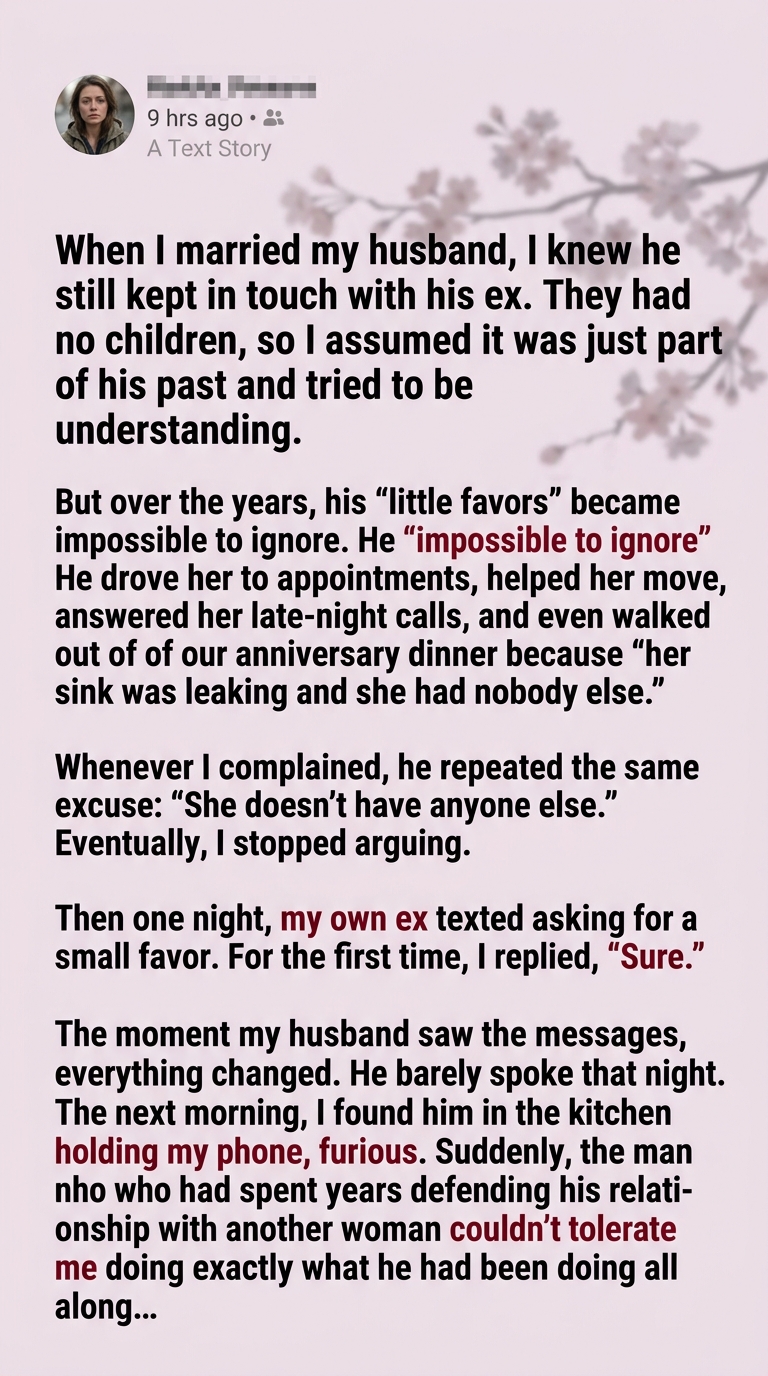
When I married Daniel, I knew he was still in contact with his ex-girlfriend, Rebecca.
They had been together for six years, but they never had children, never married, and had been separated for almost three years before Daniel and I met.
At first, I didn’t see a reason to worry.
I believed that two adults could end a relationship without becoming enemies. I even respected Daniel for wanting to remain on friendly terms with someone who had once been important to him.
But I never imagined that I would spend the next several years feeling like I was competing with a woman who wasn’t even his wife.
It started with little things.
Rebecca needed a ride to a doctor’s appointment.
Daniel volunteered.
Her car wouldn’t start, so he went over to jump-start it.
She needed help carrying furniture into her new apartment, so he spent an entire Saturday moving her belongings.
Then came the late-night phone calls.
Sometimes he would leave our bedroom and talk to her in the living room for almost an hour.
Whenever I asked what was wrong, he would shrug.
“She’s having a difficult time. She doesn’t have anyone else.”
That sentence became his favorite excuse.
I tried to be patient.
I tried to understand.
I told myself that being a good husband didn’t mean he had to erase everyone from his past.
But slowly, Rebecca began taking up space in our marriage.
One evening, Daniel and I were celebrating our third wedding anniversary at a nice restaurant.
I had booked the table weeks in advance. I bought a new dress, made a reservation, and looked forward to spending one special evening together.
Halfway through dinner, his phone rang.
Rebecca.
He answered immediately.
I watched his expression change.
“What’s wrong?” he asked.
He listened for a few seconds before standing up.
“Her kitchen sink is leaking. I need to go.”
I stared at him.
“Daniel, we’re celebrating our anniversary.”
“I know. I’ll be back as soon as I can. She doesn’t have anyone else.”
He kissed my forehead, grabbed his keys, and walked out.
He never came back that night.
I sat alone at the table, staring at the two plates and the untouched dessert.
That was the first time I truly wondered whether I had married a man who was emotionally unavailable to me.
When he came home, I confronted him.
He became defensive.
“You’re making this into something it isn’t. Rebecca is my friend. You knew we were still in contact when you married me.”
“I knew you were friends. I didn’t know she would come before our marriage.”
He shook his head.
“You’re jealous over nothing.”
After that, I stopped arguing.
Not because I was suddenly comfortable with the situation.
I simply became tired of explaining why I deserved to feel like a priority in my own marriage.
I stopped asking where he was going.
I stopped questioning the late-night calls.
I stopped reminding him about special occasions.
And Daniel seemed relieved.
He thought the problem had disappeared.
He had no idea I had simply stopped expecting him to understand.
Then, one Thursday evening, something unexpected happened.
My phone lit up while Daniel was sitting beside me on the couch.
It was a message from my ex-boyfriend, Michael.
We had dated years before I met Daniel. Our relationship had ended peacefully, and we hadn’t spoken in a long time.
His message was simple.
“Hey, I hope you’re doing well. I’m having trouble moving a few things into my new apartment this weekend. Would you be able to help me find someone with a truck? I don’t really know who else to ask.”
I read it twice.
Then I looked at Daniel.
He was scrolling through his phone.
For the first time in years, I decided not to overthink something.
I replied:
“Sure. I can come by Saturday and help you figure it out.”
Michael responded with a thank-you.
That was all.
No flirting.
No secret meeting.
No romantic conversation.
Just a small favor.
But Daniel had seen the name on my screen.
He didn’t say anything immediately.
He simply put his phone down and went to bed.
The next morning, I walked into the kitchen and found him standing beside the counter.
He was holding my phone.
His face was red with anger.
“Who is Michael?”
I looked at him calmly.
“My ex.”
“Why is he texting you?”
“He needs help moving. I told him I’d help.”
Daniel stared at me.
“You’re going to help your ex-boyfriend move?”
I nodded.
“Yes. Why?”
“Are you serious? You’re married!”
I almost laughed, but there was nothing funny about the situation.
“Daniel, you’re married too.”
His expression tightened.
“That’s completely different.”
“How?”
“Rebecca is my friend. There’s nothing between us.”
“And Michael is my friend. There’s nothing between us.”
He slammed my phone onto the counter.
“Don’t play games with me. You know how inappropriate this is.”
I looked directly at him.
“Do you remember our anniversary? The night you left me alone in a restaurant because Rebecca’s sink was leaking?”
He said nothing.
“Do you remember the Saturdays you spent moving her furniture? The appointments you drove her to? The nights you left our bedroom to answer her calls?”
“She needed help,” he muttered.
“And now Michael needs help.”
“That’s not the same thing!”
“Then explain the difference.”
He opened his mouth but couldn’t answer.
I took my phone from the counter and continued.
“Daniel, I never asked you to stop being kind to people. I asked you to understand that marriage comes with boundaries. Every time I brought up Rebecca, you told me I was jealous. You told me I was insecure. You told me she had nobody else.”
I paused.
“But what about me? Who was looking after my feelings while you were looking after hers?”
For the first time, he looked uncomfortable.
I continued.
“I spent years accepting things I wasn’t comfortable with because I trusted you. But you never once considered how your actions looked from my side.”
Daniel rubbed his forehead.
“So what? You’re trying to get revenge?”
“No. I’m showing you what it feels like when the person you love gives someone else unlimited access to their time and attention.”
He looked away.
Then he said something I never expected.
“Rebecca and I used to talk about getting back together.”
My stomach tightened.
“What?”
He sat down.
“It was before I met you. We were together for a long time. After we separated, she had a hard time. I felt responsible for her.”
“Responsible for her?”
He nodded.
“She didn’t have much family. I promised I wouldn’t abandon her.”
I stared at him.
“Daniel, you made a promise to her before you ever met me. But you made marriage vows to me.”
He lowered his head.
Then he admitted that Rebecca had recently started telling him she missed their old relationship.
She had even suggested that they should take a trip together someday, just like they used to.
He claimed he had never agreed to anything romantic.
But he also admitted he hadn’t told me because he knew I would be upset.
That hurt more than the favors.
For years, he had insisted that their relationship was completely harmless while hiding conversations that suggested otherwise.
I didn’t scream.
I didn’t throw anything.
I simply asked him one question.
“Do you still want to be with her?”
He looked at me for a long time.
Then he whispered, “No. I want to be with you.”
“Then start acting like it.”
That weekend, I didn’t go to Michael’s apartment.
I called him and explained that I had reconsidered. He understood and arranged professional movers instead.
I wasn’t interested in creating a situation that could be used to distract from the real problem in my marriage.
But I also refused to let Daniel turn my simple message into proof that I was doing something wrong.
We had a long conversation that Sunday.
I told him I needed clear boundaries.
No leaving our plans for emergencies that weren’t genuine emergencies.
No hiding conversations.
No treating Rebecca like a second partner.
And no using the phrase “she doesn’t have anyone else” to excuse behavior that repeatedly hurt our marriage.
Daniel wasn’t happy about the boundaries at first.
He said I was asking him to abandon someone who had been part of his life for years.
I told him that he could remain respectful and kind without making himself available every time she called.
Eventually, he agreed to speak with Rebecca.
He told her that he was married and that their relationship needed to change.
She didn’t take it well.
She accused me of controlling him and said I had changed the man she used to know.
Daniel told her that the decision was his.
For the first time, he didn’t use me as an excuse.
He took responsibility.
It wasn’t an instant fix.
Trust doesn’t return because someone says the right words one Sunday afternoon.
Over the following months, Daniel had to prove that our marriage was his priority through consistent actions.
He stopped answering unnecessary late-night calls.
He no longer canceled our plans to run to Rebecca’s apartment.
And when she contacted him asking for favors that could easily be handled by someone else, he politely declined.
More importantly, he began listening when I told him something hurt.
One evening, almost six months later, we were having dinner at home.
Daniel reached across the table and took my hand.
“I owe you an apology,” he said.
I waited.
“I kept telling myself that I was just being a good person. But I was ignoring the fact that I was making my wife feel second in her own marriage.”
I nodded.
“That’s exactly what happened.”
He looked down.
“I should have understood before it took something like that message from Michael to make me see it.”
I squeezed his hand, but I didn’t tell him everything was forgotten.
Because forgiveness and trust are not the same thing.
I was willing to work on our marriage.
But I would never again accept a relationship where I had to beg my husband for the same consideration he freely gave another woman.
And I learned something important.
Sometimes, people don’t understand the pain they’re causing until they imagine experiencing it themselves.
Daniel had spent years defending his right to be there for his ex.
But the moment I showed him that the same freedom applied to me, he finally understood why boundaries mattered.
I didn’t need to make him jealous. I needed him to recognize that marriage is not about giving one person freedom while demanding loyalty from the other.
A healthy marriage doesn’t require either partner to erase their past.
It requires both partners to respect the life they’re building together.
And that respect should never be one-sided.