My Mother Told Me My Brother Died in 1958—Then I Found a Birthday Card Mailed to Him in 1965
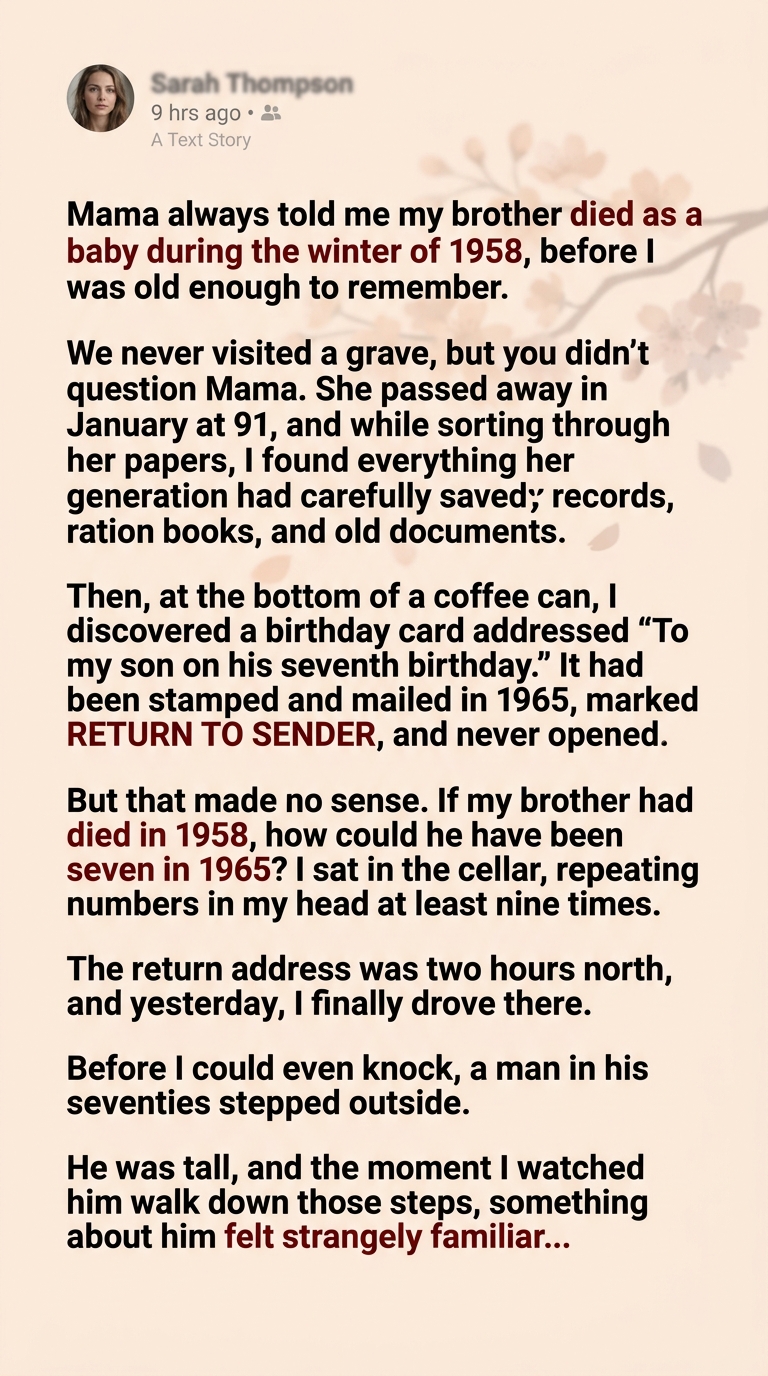
My mother always told me I had a brother who died as a baby during the winter of 1958.
His name was Thomas.
She said he had been sick, that the doctors couldn’t save him, and that he was buried in a little cemetery outside town.
But we never visited his grave.
Whenever I asked about him, Mama would become quiet.
“Some things are too painful to revisit,” she’d say.
And that was the end of the conversation.
I grew up believing her.
I was born in 1956, so if Thomas had died in 1958, I would have been too young to remember him anyway. I had no photographs of us together, no toys that had belonged to him, and no stories beyond the few sentences Mama occasionally shared.
My father died when I was in my forties. Mama lived much longer, reaching the age of ninety-one.
She passed away in January.
After the funeral, I returned to her little farmhouse to sort through her belongings. It was the same house where I had grown up, with its narrow staircase, creaking kitchen floor, and cellar that always smelled faintly of damp earth and old wood.
Mama had saved everything.
There were egg money records from the 1940s, ration books from the war years, handwritten recipes, old bank statements, and envelopes filled with photographs.
She even kept receipts from grocery stores that had closed decades ago.
I spent several weekends sorting through everything.
Most of it was ordinary family history.
Then I found the coffee can.
It was tucked behind an old wooden cabinet in the cellar.
Inside were buttons, loose coins, two faded photographs, and a collection of envelopes tied together with string.
At the bottom was a birthday card.
It was addressed in Mama’s handwriting:
To my son on his seventh birthday.
I turned it over.
There was a postmark from 1965.
The card had been mailed, but someone had written across the front in red ink:
RETURN TO SENDER.
It had never been opened.
I stared at the date.
Then I read the words again.
My brother had supposedly died in 1958.
If he had been seven in 1965, he would have been alive at least until that year.
I sat on the cellar steps.
I checked the numbers again.
1958.
1965.
Seven years.
I repeated them at least nine times, hoping I had misunderstood something.
Maybe the card had been intended for someone else.
Maybe Mama had written the wrong date.
Maybe there was another explanation.
But the name on the envelope was unmistakable.
Thomas.
And the return address was from a town approximately two hours north of where Mama had lived.
I searched the coffee can again.
Beneath the card, I found a folded piece of paper with a telephone number written in pencil.
There was no name.
Just a number and the words:
If he ever asks, tell him I tried.
I didn’t sleep much that night.
For the next few days, I researched the address, checked old directories, and tried to determine whether the house still existed.
It did.
A small property on a quiet residential street.
Yesterday, I finally drove there.
I had no idea what I would say.
I wasn’t even sure anyone would still live there.
When I arrived, I sat in my car for nearly ten minutes.
Then I noticed movement behind the front window.
A moment later, the door opened.
An elderly man stepped outside.
He was tall, with silver hair and slightly stooped shoulders.
He walked down the steps slowly, one hand resting on the railing.
And something about the way he moved made my heart skip.
I had seen that walk before.
In old photographs of my father.
The man stopped when he noticed me.
“Can I help you?”
I opened my car door.
“Are you Thomas?”
His expression changed.
“Who wants to know?”
I held up the birthday card.
“My name is Margaret. I believe my mother may have known you. Her name was Eleanor.”
He stared at the envelope.
Then he looked at my face.
For several seconds, neither of us spoke.
Finally, he whispered:
“Eleanor?”
I nodded.
He stepped closer.
“You’re Margaret?”
My throat tightened.
“Yes.”
He closed his eyes.
Then he said something that made my knees feel weak.
“I’ve wondered whether you were still alive.”
I couldn’t answer.
He looked at the card again.
“She finally sent it?”
I shook my head.
“It was returned. I found it in her cellar.”
His face crumpled.
“Then she never got it.”
He stepped aside and opened the door.
“Please come inside.”
I followed him into a small living room.
There were family photographs on the walls, shelves filled with books, and a large wooden clock ticking beside the fireplace.
On the mantel was a photograph of a young woman holding a little boy.
I recognized my mother immediately.
She looked much younger, perhaps in her early thirties.
The boy beside her was around seven years old.
I walked closer.
“That’s Thomas?”
The man nodded.
“That’s me.”
I stared at the photograph.
Then I looked at him.
“You really are my brother?”
He swallowed.
“Yes, Margaret. I’m your brother.”
I sat down.
I couldn’t stop shaking.
He brought me a glass of water and sat opposite me.
For a long time, neither of us knew where to begin.
Finally, I asked the question that had followed me all the way there.
“Why did Mama tell me you died?”
Thomas looked down at his hands.
Then he began telling me a story I had never heard.
When he was seven, our mother had been struggling.
My father had been working long hours, money was tight, and their marriage had become increasingly unhappy.
Thomas said he remembered arguments, although he hadn’t understood them at the time.
One afternoon, Mama told him he would be staying with another family for a little while.
She said they would take good care of him.
He remembered crying because he didn’t want to leave his little sister.
He remembered Mama holding him tightly.
And he remembered her saying:
“You’re going to be all right, sweetheart.”
He was taken to live with a couple named Walter and Ruth Bennett, who lived in the northern town where I had just arrived.
They had been unable to have children and had offered to care for him temporarily.
But the arrangement changed.
According to Thomas, the Bennetts eventually began discussing adoption.
Mama had signed papers allowing him to remain with them, but the details were never fully explained to him.
He grew up believing that Eleanor was a distant relative who had been unable to raise him.
He knew he had a younger sister somewhere.
But he was told that contacting his birth family would cause problems.
“Did you ever try to find her?” I asked.
He nodded.
“Several times.”
He explained that when he was a teenager, he had written letters to Mama.
Some were returned.
Others received no answer.
When he turned eighteen, he tried contacting the local authorities for information about his birth records.
But the adoption paperwork had made it difficult.
He eventually married, had children, and built a life of his own.
Still, he never stopped wondering about his mother and sister.
I looked at him.
“Did you ever know that I existed?”
He smiled sadly.
“I knew I had a little sister. Mama told me your name was Margaret. She used to say you had dark hair and liked drawing pictures.”
I began crying.
I had spent my entire life believing I had no brother.
But he had spent his life knowing I existed.
Then I asked about the birthday card.
Thomas reached into a cabinet and pulled out a small wooden box.
Inside were several old letters.
He placed one on the table.
It was addressed to Eleanor.
The postmark was from 1965.
“I sent this when I was seven,” he said. “I remember writing it with Ruth’s help. I told Mama I missed her and wanted to see my sister.”
I read the letter.
It was written in a child’s handwriting.
Dear Mama,
I hope you are well. I am seven now. I wish you could come to my birthday. I miss you and I miss Margaret. Please tell her I have a bicycle.
At the bottom was a little drawing of two children holding hands.
I couldn’t breathe.
“She never received this?”
Thomas shook his head.
“I don’t know. I sent it to the address I had. It came back.”
I looked at the return address.
It was the same one on the birthday card I had found.
Then I understood something.
Mama had tried to contact him too.
She had mailed him a birthday card.
But it had been returned.
Neither had received the other’s message.
I looked at Thomas.
“Did you ever know she sent you anything?”
“No.”
He rubbed his eyes.
“I thought she had forgotten me.”
I felt tears running down my face.
“She told me you died.”
He looked at me.
“Maybe she thought it would be easier.”
I shook my head.
“I don’t know.”
For a while, we sat quietly.
Then Thomas asked:
“Did she ever talk about me?”
I thought about all those years.
The conversations that ended whenever I asked about my brother.
The photographs she never displayed.
The way she became unusually quiet every winter.
“Not much,” I admitted. “But she kept everything. I found your birthday card in a coffee can with old photographs and documents.”
Thomas looked toward the fireplace.
“She kept it all this time?”
“Yes.”
He lowered his head.
Then he started crying.
“I used to think she didn’t care.”
I reached across the table and held his hand.
“She kept your card for sixty-one years.”
He squeezed my fingers.
That afternoon, we talked for hours.
I learned that Thomas had married a woman named Helen, who had died several years earlier. They had two children and four grandchildren.
He showed me photographs of them.
One of his granddaughters had my mother’s eyes.
I laughed through my tears.
“She really does look like Mama.”
Thomas smiled.
“Everyone says that.”
Before I left, he walked me to my car.
I turned toward him.
“Can I ask you something?”
“Of course.”
“Would you like to meet again?”
He looked surprised.
Then he smiled.
“I’ve been waiting seventy years to meet my sister.”
I hugged him.
It was the first time in my life I had ever hugged my brother.
And I didn’t want to let go.
Over the following weeks, we began piecing together the family history.
Thomas showed me his adoption papers. I showed him Mama’s old documents.
We eventually learned that our parents had been under considerable financial and emotional strain in 1958.
Mama had arranged for Thomas to stay with the Bennetts, believing it would be temporary.
But the arrangement became permanent after the adoption process was completed.
My father had apparently agreed to the decision, although neither Thomas nor I knew exactly what he had been told.
We also discovered that Mama had attempted to contact Thomas more than once.
There were old letters and returned envelopes tucked into different places around the house.
Some had never been mailed.
Others had been returned because the addresses were outdated.
I don’t know whether Mama ever found the courage to tell me the truth.
Perhaps she believed she was protecting me.
Perhaps she was protecting herself.
Perhaps she simply couldn’t bear to revisit the decision she had made as a young mother.
I’ll never know for certain.
She died before I could ask her.
But I no longer believe that my brother was forgotten.
He was hidden.
And there is a difference.
Last Sunday, Thomas came to visit me.
He brought a photograph of himself at seven years old, holding the bicycle he had mentioned in his letter.
I placed it beside an old photograph of myself at the same age.
We stood there looking at the pictures.
Two children who had grown up believing they were alone.
Then Thomas said:
“You know, Margaret, I used to imagine what my sister would look like.”
I smiled.
“What did you imagine?”
He laughed.
“Someone exactly like you.”
I hugged him again.
And for the first time in decades, I felt that a missing piece of our family had finally found its way home.
I still wish Mama had told us the truth.
I wish we had known each other when we were children.
I wish I could have heard his voice across the dinner table, shared birthdays, and watched our families grow together.
But I can’t change those years.
What I can do is make sure the years we have left are different.
The birthday card that spent sixty-one years hidden in a coffee can never reached my brother in 1965.
But yesterday, I finally delivered it.
I handed it to Thomas.
He read the front, turned it over, and held it against his chest.
Then he looked at me and said:
“Happy birthday, little sister.”
And I cried all over again.